Category Archives: Mexican Holidays

Las Posadas and Modern Day Marias

Las Posadas in Mexico is a 9-day nightly reenactment of Maria and Jose (Mary and Joseph) searching for lodging on their travels to Bethlehem.


In the song, it’s all very sweet when the housekeeper (he insists his home is not an inn) finally allows Maria to huddle in the stables to give birth and all, but have you ever wondered what type of woman Maria was to even make this trip? What kind of courage did it take for her to leave her friends and family to come with her husband, who wasn’t even sure about marrying her in the first place? (Matthew 1:19 ) Then when she finally arrived in Bethlehem after a long, tiresome trek, she didn’t even have a place to stay. Talk about poor planning on Jose’s part! Can you imagine how it must have pained her to be in active labor and still at the door negotiating for a room as depicted in Las Posadas? Did the housekeeper’s wife convince him to offer them refuge that night? Did she attend Maria as she gave birth? Was Maria surrounded by a community of women or was she alone? Was a midwife summoned? Was it a difficult birth? Were there complications? Did she cry with joy when she first lay eyes on her firstborn? How was her recovery? Did she have problems nursing? Did the baby feed well? Who let those shepherds into the stable? Were they just bringing in their flocks for the night or did they come to gawk? I’m sure she wasn’t really up for visitors right then. Must have been another one of her husband’s bright ideas. (Luke 2: 1-20)

Then, after the visit of the three astronomers (Los Tres Reyes) some months later (not a handful of days like the Three Kings’ Day tradition suggests), Jose dragged her and her young son to Egypt, where they lived as foreigners until King Herod’s death (Matthew 2:1-23). In a land of strangers, who did she turn to when her son was colicky? Who made the poultice to keep the baby’s fever down? Who laughed with Maria as they watched him take his first steps? Who made up her community of women so far from home? Was she able to negotiate a good deal at the market? Did the sellers take advantage of her foreignness or her inability to communicate well in the language? Did she have anyone to listen to her complaints when Jose had one too many at the local gathering house? Did her first Passover celebrated without her family cause her to weep with homesickness?

Well, we can only imagine what Maria’s life might have been like, how she managed, what joys and sorrows she saw, what challenges she overcame. From what little we know about her, she was a woman of faith, chosen among women but firm in her modesty. The Las Posadas song and Mexican culture give her the added title of being the Queen of Heaven among titles but she considered herself no more than a servant. (Luke 1:48) It’s too bad those inspired bible writers left out so much of her story. Men!

I thought that instead of rehashing the holiday traditions unique to Mexico (See Christmas in Mexico) this year, I’d share stories of women, who like Maria, left the land of their birth to live in a foreign land. Perhaps by reading their stories, we might imagine what Maria’s early married life may have been like. I hope you are as inspired by the stories of these modern day Marias as I have been.

**********************

disclosure

2 Comments

Filed under Mexican Holidays, Religion

Fogatas, tapetes and San Miguel Arcangel –Bonfires, sawdust and Michael the Archangel

Uriangato, the neighboring town that also believes itself to be a city, has an incredible community festival in September to honor their patron saint, Michael the Archangel. It begins on September 19 and is followed by 8 days of activities, finishing with an event called La Octava Noche on September 29.

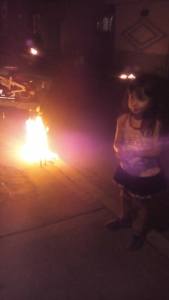
From September 19 to September 28, each household lights a small bonfire with ocote wood (a type of pine native to Mexico) in front of their homes each night. These fires are called candiles literally translated as lightings as they are said to light the path of San Miguel Arcangel during this novena (9 prayer days).

candiles

I have to say that the first time I witnessed this event, I was startled. It’s quite a sight, fire after fire, street after street. Of course, it’s origin is prehispanic.

From what I understand, this local tradition was associated with the god Curicaueri, whose name in Purepecha means great fire, and who was credited with the foundation of the state of Michoacan. (Uriangato is a mere hop, skip and jump from the present day border of Michoacan.) Curicaueri was considered the oldest of the gods and was honored by the lighting of bonfires with ocote wood.  Some of this long ago origin remains in the form of indigenous dancers that perform during the events.

There are peregrinaciones (pilgrimages) over several days usually in the form of parades made up of local civic groups.  The parade route takes the pilgrims to the Parroquia de San Miguel Arcángel, the main Catholic church in Uriangato.

The other major event associated with this festival is the creation of tapetes, floor mats. These are labourously created with colored sawdust, seeds, and flowers along the roads in Uriangato. They usually take the form of a variety of Catholic images and are tread upon by the passage of the image of Michael the Archangel on October 6, known as La Octava Noche (the 8th prayer day in the novena). The tapete tradition is said to have begun in 1966 and each year becomes more and more elaborate.

The custom to take out the image of San Miguel and walk through the town at night, in a similar fashion to El Senor de Esquipulas in Moroleon, began after the Spanish conquest. It seems that only the Independence War and the Cristero War kept the procession from well, proceeding. It starts and ends, naturally enough, at La Parroquia de San Miguel Arcángel and covers an area about 5 km long.

The image is carried by different groups of volunteers with rest and prayer stations found along the route. This year, the image has been covered in protective glass, which better protects the 50 ornate vestments from the elements.

Here are some of the outfits.

It really is a unique festival and should you happen this way during the holy celebration, it is definitely worth checking out.

************************

disclosure

4 Comments

Filed under Mexican Holidays, Religion, Tourist Sites in Mexico

Fruits and Vegetables

Did you know that in addition to corn and chocolate being native to Mexico, avocados, peanuts, squash, tomatoes, sweet potatoes, and papaya are all Prehispanic delights?

avocado pictograph
Aztec pictograph indicating “the place where avocados grow.”

Avocado is thought to have originated in the state of Puebla. The oldest evidence of avocado use dates to about 10,000 BC, found in a cave located in the town of Coxcatlan. The word avocado comes from the Spanish aguacate which comes from the Nahuatl word āhuacatl which goes back to the proto-Aztecan word *pa:wa. The Nahuatl word also can be translated as testicle.  Since this fruit was considered an aphrodisiac, perhaps because of its similarity to male reproductive organs, young girls were kept indoors during the annual avocado harvest.

Aguacate maduro, pedo seguro.  Ripe avocados–farts for sure!  

Without the avocado, there would be no Guacamole! The name Guacamole comes from the Nahuatl work āhuacamolli which translates as avocado sauce (see Mole).

The tomato also comes from Mexico. The name comes from the Nahuatl word tomatl which translates as “fat water.” The Aztecs cultivated the tomatl and came up with a new species they called xitomatl which translates as “plump thing with a navel.”

A la mejor cocinera se le va un tomate entero.   A whole tomato can escape the best cook. Meaning everyone makes mistakes.

And what would salsa be without the tomato?

The papaya was also a common domesticated fruit in Mexico before the arrival of the Spanish. It was called chichihualtzapotl in Nahuatl which meant zapote nodriza (mothering or nursing zapote.) The papaya had medicinal value to the indigenous peoples of Mexico. The Aztecs applied papaya fruit to their skin for relief from insects bites. Asthma was treated with boiled papaya leaves applied to the chest.

cacahuate
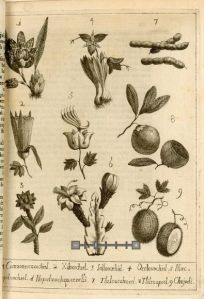
Nine flowers of Mexico

The modern day name for the zapote fruit, papaya, comes from the Mayan word páapay-ya which means zapote jaspeado (marbled or spotted zapote).

Peanuts may have been domesticated in Argentina or Bolivia. However, its cultivation in Mexico was well-established before the arrival of the Spanish. Peanuts were called tlalcacahuatl or tlalli auh cacahuatl in Nahuatl which gives us the Mexican Spanish word cacahuate that is used today.

peanut seller
One of our local peanut vendors in Moroleon, GTO

Me vale un reverendo cacahuate.  It’s as important to me as a holy peanut. Meaning it’s not important to me at all.

The oldest pumpkin seed found was in the Guila Naquitz Cave in Oaxaca and dates as far back as 7000 BC.  Squash has been cultivated in the Tehuacan and Oaxaca valleys and in Tamaulipas since 6000-5000 BC. Its cultivation predates the domestication of maize and beans by about 4,000 years. (See Las Tres Hermanas)

Squash was a ritual offering presented in honor of the dead during the month of Miccailhuitontli by the Aztecs and is still considered an appropriate addition to the altar during El Dia de los Muertos celebration in Mexico in the form of calabaza en tacha (candied pumpkin).

Sweet potatoes are native plants that are found from the Yucatan on down south to Venezuela. The Maya domesticated the plant at least 5,000 years ago.  In Mexico, sweet potatoes are known as camotes which comes from the Nahuatl word camotli. Camotes enmielados (honeyed sweet potatoes) are yet another specialty food traditionally made and served for El Dia de Los Muertos.

I hope you’ve enjoyed this little week-long foray into traditional eats in Mexico as much as I have!  And remember–La vida es un camote agárrese de donde pueda.  Life is a sweet potato.  Hold on to it where you can.

***********************************************************************


8 Comments

Filed under Carnival posts, Mexican Cultural Stories, Mexican Food and Drink, Mexican Holidays, Native fauna and flora, Natural Healing