Increasing Happiness–Scientifically

A few weeks ago, I finished an online course about global poverty.  While I enjoyed the experience, I thought I’d try something more upbeat this time around.  So I registered for The Science of Happiness sponsored by edX and the University of California–Berkeley and was not disappointed.  

Everyone wants to be happy.  Not only do you feel better emotionally, but it provides all sorts of benefits for your physical self as well. Happy people have more friends, live longer, have fewer health problems and generally enjoy life more.  But did you know that 50% of your happiness level is genetic and there’s not much you can do about that.  However, 10% is determined by life circumstances and there are some things you can do about that.  Whereas the remaining 40% is based on your actions, how you choose to live your life.  (See Happiness: it’s not just your genes, stupid!) Basically, you are in control of somewhere between 40 and 50% of your overall happiness.  Sounds good to me!

So how happy are you now?  Well, there are ways to find out!  Start with the Authentic Happiness Inventory sponsored by the University of Pennsylvania to measure your overall happiness. You have to register but it’s free.  While you are there go ahead and take the General Happiness Scale which assesses enduring happiness and the Fordyce Emotions Questionnaire which measures current happiness.  Now you have a baseline to work with.

Instead of going through why you should be happy, as the course did, I’ll just assume that you want to be happy and concentrate on that 40-50% that you have some control over. The course had a number of Happiness Practices that have been scientifically proven to increase your happiness.  Of course, the amount of happiness that you experience after applying these practices in your life varies from person to person as is to be expected. But it can’t hurt to give them a try!  Interspersed among the happiness practices are the movies that were included as part of the course syllabus.  You don’t want to miss those! I especially recommend Hector and the Search for Happiness.

Happiness practice #1: Three good things

Spend 10 minutes every night remembering three good things that happened during the day. For each thing, write a title, details about the event (including how you felt then and now), and what caused it. This activity teaches us to seek out and savor positive things, and it’s been shown to increase happiness up to six months later.  I already make a practice of doing this on a regular basis.  I think it really does make a difference.

Happiness Practice #2: Active listening

Take 15-30 minutes a week to have a conversation with someone you’re close to, and ask them to share what’s on their mind. As they’re talking, show attentive body language and don’t get distracted or interrupt them. Make sure you understand by paraphrasing what they’re saying and asking questions. Try to be empathetic and avoid pronouncing judgments. What’s your compassionate level?  Find out by taking the Compassionate Love Scale that measures your tendency to support, help, and understand other people.

Happiness Practice #3: Random Acts of Kindness

This was my favorite activity. Do five kind things – that you wouldn’t normally do – in a single day. To maximize the effects, make them all different and take time later to write down what you did and how you felt. The five kindnesses don’t have to be for the same person, and the person doesn’t even have to know about it.  If you need some inspiration try 101 Easy Ideas For Random Acts Of Kindness.

Happiness practice #4: Forgiving

Begin by making a list of people who hurt you who are worth forgiving. Then, start with the least painful offense and take some time to think about how you suffered and how that makes you feel. When you’ve decided to forgive, you can start to think about the circumstances that led to the offense, including the offender’s childhood, past hurts, and other pressures they were under. Pay attention to whether you feel kinder toward the offender and consider giving them a small gift. In the end, you can reframe the experience and try to find meaning and purpose in what happened. Not sure you need to forgive anyone? Take the Transgression Motivations Questionnaire to measures your forgiveness level.

Happiness practice #5: Mindfulness

This practice has three options.  Choose the one that works best for you.  The more you do each practice, the more happiness benefits you will reap.

Option #1 Mindful Breathing

Focus your attention on your breath, the inhale and exhale. You can do this while standing, but ideally, you’ll be sitting or even lying in a comfortable position. Your eyes may be open or closed. It can help to set aside a designated time for this exercise, but it can also help to practice it when you’re feeling particularly stressed or anxious. Practice mindful breathing 15 minutes daily. 

Option #2 Body Scan Meditation

Focus your attention on different parts of your body, from your feet to the muscles in your face. This activity is designed to help you develop a mindful awareness of your bodily sensations, and to relieve tension wherever it is found. Research suggests that this mindfulness practice can help reduce stress, improve well-being, and decrease aches and pains.  Practice 20-45 minutes, three to six days per week.


Option #3 Loving-Kindness Meditation

This one consists of receiving and sending loving thoughts. Practice 15-45 minutes, one to five times per week for eight weeks.


Happiness practice #6: Self-Compassionate Letter

Identify something about yourself that makes you feel ashamed, insecure, or not good enough. It could be something related to your personality, behavior, abilities, relationships, or any other part of your life. Once you identify something, write it down and describe how it makes you feel. The next step is to write a letter to yourself expressing compassion, understanding, and acceptance for the part of yourself that you dislike.

Happiness practice #7: Best Possible Self

Take a moment to imagine your life in the future. What is the best possible life you can imagine? Consider all of the relevant areas of your life, such as your career, academic work, relationships, hobbies, and/or health. What would happen in these areas of your life in your best possible future? For the next 15 minutes, write continuously about what you imagine this best possible future to be.  How optimistic are you about the future and the creation of your best possible self?  Take the Optimism Test.  Is your work an issue? Take the Work-Life Questionnaire and find out your work-life satisfaction.

Happiness practice #8: Gratitude letter

Call to mind someone who did something for you for which you are extremely grateful but to whom you never expressed your deep gratitude.  Write a letter to this person. Deliver your letter in person if possible.  Read the letter to this person.  I read my gratitude letter to my mother.  She said it made her year.  

Happiness practice #9: Gratitude Journal

Write down up to five things for which you feel grateful. The physical record is important—don’t just do this exercise in your head. Do this for at least 15 minutes per day, at least once per week for at least two weeks. Studies suggest that writing in a gratitude journal three times per week might actually have a greater impact on our happiness than journaling every day.  How grateful are you?  Take the Gratitude Survey that measures your appreciation about the past. Join Thnx and sign up for the 10-Day Intensive, or 21-Day Gratitude Challenge.

Happiness practice #10: Awe Walk

This one is so simple but so powerful.  Try to do this as much as possible. Go for a walk. Turn off your cell phone. During your walk, try to approach what you see with fresh eyes, imagining that you’re seeing it for the first time.  Appreciate your surroundings.

There you have it!  Ten scientifically proven ways to make yourself happier.  Should you wish to know the reasons why these practices will make you happier,  go ahead and take the course.  It’s free, so what have you got to lose?

*********************

4 Comments

Filed under Education, Health

How We Spend Thanksgiving Day in Mexico

How We Spend Thanksgiving Day in Mexico

By Neva Gurrusquieta

Ah, there’s a chill in the air! Everything is pumpkin spice flavored, and I do mean everything!  Time to break out the fuzzy sweaters, the boots, and scarves.  The holidays are coming!  Some people are starting to get Christmas fever. (I do admit to watching at least one Christmas movie already), but there’s one more stop on the holiday train first.  Thanksgiving!! 

Back home, the regular college football season is winding down, and next weekend, the diehard fans in my family will watch the final game of a disappointing season for the home team.

In recent years, because our family has grown so much, we often celebrated Thanksgiving on the weekend prior, then my mom would take off with her friends to go to Macy’s Thanksgiving Day Parade.  

My mother always kept a list on her fridge, a list of dishes she was preparing for our huge family, and who else was bringing what.  If I close my eyes, I can see her handwriting. She always made a turkey, a ham, at least three dishes of dressing, a big pot of gravy, and her famous potato salad. It was one of my brother’s favorites, so she always made it when he came home, and she continued the tradition even after he passed away.

Besides the non-negotiable dishes, she would make other favorites like corn pudding and collards. One sister would bring a broccoli casserole, another a green bean casserole, another deviled eggs.  I always brought Brussel sprouts for me and my brother in law, and some other dish which may or may not get sampled by the traditionalists at our table. Eventually, it became a challenge to see if someone would dare to try my dish each year. Chipotle butternut squash with asparagus and ginger, anyone?  Delish, but not traditionally southern, I know.

There was always a selection of homemade desserts which varied from year to year, chocolate cake, cheesecake, brownies, pecan pie, chocolate pie, coconut pie, and sweet potato pie. No pumpkin pie, sweet potato pie.  Just sayin’.

And to drink?  Sweet tea, of course!  But there was always a side pitcher of unsweetened tea for one of my sisters, and a couple of Coca-Colas for one of my brothers-in-law.

No Thanksgiving table would be complete without cranberry sauce of some kind, whether you serve jellied cranberry sauce or make your own from scratch with fresh, frozen, or dried whole berries. With eighty million cans sold every year and the nostalgia associated with this simple pleasure, I’m not alone when I opt for jellied for the Thanksgiving meal. 

Oh, wait…I’m in Mexico. Jellied cranberry sauce, if you can find it, isn’t cheap. The only pumpkin spice you’ll find around here is at Starbucks.  No fuzzy sweaters or boots or scarves. No college football. No Thanksgiving Day off. It’s a regular workday, a regular school day.

So what is an expat to do?  Lots of expats in small close communities do potluck dinners with friends since it’s not likely that all their extended families will make the journey for this most American of holidays. Some of those who are not closely connected with other expats are preparing the traditional meal for their new neighbors, or for close friends and family.

Some expats will order meals prepared by local caterers, others will simply eat out. We live in Queretaro, in central Mexico, and although there are expats here, I was unable to find a single restaurant offering an American style Thanksgiving dinner, and only one community event hosted by a private international school in their gymnasium for their students and families.  By contrast,  the large expat population in Yucatan creates a huge demand for holiday dishes, and a wide variety of options is available to those who live in that area, as we hope to do soon. 

There are only two options for us, prepare a huge, expensive meal for just the two of us, or not. We choose not.  The turkey alone would cost more than a day’s wages ($1.50/lb 15 lbs) so we would have to be in a much better position financially to throw that amount of money at one meal.

IMG_2573

We could purchase a turkey from a local farmer like we did a few years ago, but the effort takes an entire day and almost as much money. However, if anyone is so inclined, it is certainly an experience you won’t forget. I made a huge and quite expensive Thanksgiving meal that year with all the fixings to impress my in-laws and extended family.  I used Chef Anne Burrell’s brining recipe which I had used in prior years, so I knew it was going to be fantastic. The food was a huge hit with my husband’s family in southern Mexico, but they had to be convinced that I cooked it. Even with several eyewitnesses, I think some of them only pretended to believe so as not to be rude.

So, for us, there will be no big Thanksgiving meal this year. Instead, we will be celebrating the annual commemoration of the start of the Mexican Revolution on the Monday before Thanksgiving. My husband has a rare day off, and the typical celebratory activities for this holiday include little more than a beer and a nap.   There is even a “Black Friday” equivalent, “El Buen Fin”, or The Good Weekend” which we will also be skipping this year.

To all our fiercely loved family and friends back in the states, even though we are choosing to let Thursday pass as an ordinary food day this year, we will most certainly be expressing our thanks and gratitude for our many blessings, an especially poignant remembrance for us this year. No matter how you choose to spend Thanksgiving Day this year, I hope that our hearts as a nation will all begin to bend towards kindness and grace and that those heart attitudes will go with us throughout this entire holiday season. Happy Thanksgiving, everyone!

***************

https://www.facebook.com/NickAndNinaSpecialtyServices/

4 Comments

Filed under Guest Blogger Adventures, Mexican Holidays, Southern Comfort Food Mexican Style

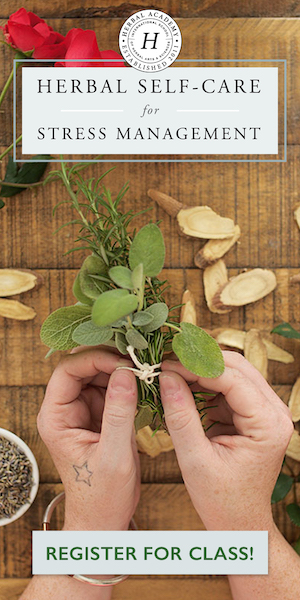
About the Herbal Self-Care for Stress Management Course

Enroll in the Herbal Self-Care for Stress Management Course

Herbal Academy just created yet another wonderful online course that I completed this month, earning me yet another little badge for my student dashboard. I’m so proud of me! This course was entitled Herbal Self-Care for Stress Management and had tons of useful information on the topic.  

stress badge

Stress is something we all experience at one time or another, for short periods of time (work deadlines) or longer periods of time (being a caretaker for a chronically ill loved one).  This course emphasized the importance of holistic care in treating the whole body and mind and, in this case, using herbs in order to become well after being subjected to periods of stress.  Can you see why I loved this class?

The course was divided into 3 units. Unit 1 presented information about how stress affects the body both physically and emotionally. Financial problems, time constraints, social interactions, cultural stressors (poverty, oppression, marginalization), natural disasters, traumatic events, excessive screen time, air, noise or light pollution, and infections are all stressors and activate that “flight or fight” survival mode. Being in a stressful “flight or fight” mode changes the rhythm of your heartbeat, inhibits proper digestion, alters breathing patterns, and raises blood sugar, none of which are conducive to a healthy body long term.  

stress badge

Unit 2 was full of suggestions on changing your diet in order to reduce the effects of stress on the body.  (See Food as Medicine) I was surprised to see how strong the gut-brain connection really is.  Adding prebiotic (whole grains such as wheat and rye, legumes, alliums like onions, garlic and leeks, bananas, asparagus, artichokes, Jerusalem artichokes, chicory, dandelion, burdock roots) and probiotic (yogurt and milk kefir, fermented vegetables like sauerkraut, kimchi, cultured pickles, miso and other fermented soy products like tempeh, and fermented drinks like kombucha and water kefir) foods to your diet will certainly help you reach a more balanced state of wellness. (See also Gut Health Super Bundle, Garlic Tea, and Herbal Fermentation) Making food from scratch, including bitters in your diet, ensuring proper hydration, taking the time to enjoy your meal without distractions, and avoiding caffeine, alcohol, refined sugar and artificial sweeteners are also great suggestions for improving gut health.  The course included several printouts highlighting trace nutrients the body needs to reduce or eliminate the physical and emotional effects of stress.

In addition to dietary recommendations, lifestyle alterations can really make a difference to your health.  Adding practices, like mindful breathing, yoga, and Tai Chi have been shown to reduce stress.  Here, try one now.

Other things you can do to improve your health generally involve spending more time in nature and bettering your social support system.  I don’t mean more friends on Facebook, but improving the quality of your relationships.  I’ll talk more about these in an upcoming post on the Happiness Course I finished recently.

Unit 2 also had a good introduction to aromatherapy and essential oils as they relate to stress and self-care including a list of herbs shown to be most effective for a variety of stress-induced ailments.  Lavender tops the list in several categories. The course provided recipes for several aromatherapy herbal blends to try out.

stress badge

After addressing safety issues and possible drug interactions, Unit 3 outlined three types of herbs most beneficial for stress-reduction application: nervines, adaptogens, and sedatives.  Nervines are herbs that influence the nervous system in some way. Chamomile and lemon balm are nervines. Adaptogens, also known as Qi tonics or Rasayana, are herbs that assist natural adaptive responses to stress.  Licorice is an adaptogen.  Sedatives are herbs that can sedate the central and peripheral nervous systems. Hops and valerian are sedatives. There was also a section on how to make infusions, decoctions, tinctures, and tea blends using the 17 herbs highlighted.

The more I delve into herbal lore, the more I realize how much I have yet to learn.  Once upon a time, herbal remedies, medicines, and tonics were carefully preserved generation after generation. These days, it’s so easy to rely on pharmaceuticals when illness strikes and the continuity of natural healing has been lost.  What I really appreciated most about this course was that using herbs for wellness wasn’t presented as a miracle cure-all, rather incorporating herbs is only one aspect of healthy living.  The lifestyle that many live is not conducive to optimal wellness. Perhaps it’s time to take a moment and find balance.

Partial Lesson Excerpt – Herbal Academy Course on Stress Management Course

*************************

Enroll in the Herbal Self-Care for Stress Management Course
disclosure

Leave a comment

Filed under Education, Health, Natural Healing