The other day we were going through our morning routine and discovered, to our horror, that we were out of coffee! Never one to be dismayed by such trivialities, my husband ducked out back and plucked a few leaves off our limón tree. Quite soon we had ourselves a nice cuppa of té de limón.Despite what google translator says, we don’t have a lemon tree in the backyard. It’s a LIME tree, specifically a Mexican lime tree (Citrus aurantifolia Swingle). The Mexican lime was actually introduced to Mexico by the Spaniards in the early 1500s. That didn’t stop the author of my little herb book Antiguo Recetario Medicinal Azteca from including it though. We use limes on about everything from tacos to cucumbers. Delicious! So let me tell you about the health benefits of regular lime consumption.
Lime juice prevents scurvy. Lest you think that this is irrelevant in this day and age, 6 to 8 percent of the general population in the United States are thought to have scurvy-level deficiencies. Scurvy is especially prevalent among the poor, homeless and college students. Adding lime juice to food prevents cholera. Not to alarm you, but in 2016, there were 132,121 cholera cases and 2420 deaths attributed to cholera reported worldwide. Cholera resistance seems to be a very positive benefit to lime consumption in my book. The peel and leaves have been shown to reduce the oxidative degeneration of cells in neurodegenerative diseases like Alzheimer’s.Lime prevents cancer. It slows cancer’s progress. It destroys cancer cells. It is toxic to pancreatic cancer cells. A high citrus diet combined with green tea consumption reduces your chance of getting any type of cancer incidences.Lime relieves muscle spasms.Lime is rich in fiber, vitamin C, folate and potassium, all good for general health.Limes are helpful in the treatment of diabetes. Combined with garlic, lime juice decreases blood glucose levels. (See Garlic Tea)It’s great for cardiovascular health! Lime juice and peel have been shown to be effective in treating atherogenesis, plaque formation in the arteries, lowering high blood pressure and reduces triglycerides, cholesterol, and LDL. Including limes and other citrus fruits in your daily diet reduces the chance of developing cardiovascular disease, especially cerebral infarctions.Lime leaves are a good source of natural antioxidants and antimicrobial compounds and are comparable in their antibiotic effect to standard antibiotics such as tobramycin, gentamicin sulphate, ofloxacin, and ciprofloxacin.Regular lime consumption has been proven to help protect the liver from toxins.Limes can help prevent and reduce the severity of osteoporosis.Limes are antifungal and antiparasitic. Lime juice is recommended for preventing and treating urinary tract infections.With all this medicinal good stuff in such a small thing, it’s worth reconsidering putting the lime in the coconut and drinking it all up. Not quite so adventurous? You can still enjoy the health benefits by adding a little lime leaf tea to your diet, here’s how.Pick and wash a handful of medium-sized leaves. Add to a liter of water. Bring to a boil. Reduce the heat and simmer for about 10 minutes. Allow to cool enough to drink. Add a drop of honey for sweetening if you like. Enjoy.
Even after Baby the Sheep’s untimely death, my husband carried on with his idea of switching from goats to sheep. He came home one day with Big Mama, an enormous black-faced furry sheep which cost a pretty penny. So now our herd was made up of 3 pregnant goats (Jirafe’s twin daughters and La Blanca), Baby’s mama, Big Mama, Caramela the sheep, and Skunk, the sheep macho.
Big Mama didn’t waste any time and within days gave birth to Fuzzy. Fuzzy is a huge baby and naturally enough, very fuzzy. I started to like the idea of sheep if it meant in May we could shear them and I’d have a bit of wool to make stuff with.
Not satisfied with Fuzzy and Big Mama, my husband traded Buttercup for an even bigger sheep, Cottonball, and a smaller sheep, Mary, both of the woolly species. Cottonball also didn’t waste any time and that very evening went into labor.
Things didn’t go as smoothly for Cottonball. After hours of labor, she was no closer to giving birth. The Borrega guy (one of our neighbors) suggested an injection to help speed things along. That helped, but the baby just couldn’t get out. It was presenting rump-first. So my husband became the midwife and inserted his hand to grab hold of the lamb. Its neck was bent around, which was causing the hold-up. After some more tugging, Peep came free, however, her neck was bent at an odd angle. My husband thought maybe her neck was broken. She was also very weak.
But the proceedings weren’t finished yet. A hand went in again and there was another baby presenting rump-first. This one was smaller than Peep and seemed to have less of an issue with the neck. Thus arrived Bo. Bo and Peep were both girls.
Only things weren’t done yet. Another rump-first lamb was having difficulty getting out. So some more mid-wife intervention on the part of my husband and the Borrega guy and FINALLY Wuzzy was born. Wuzzy was a boy and of the three the first one to stand and make his presence known.
By that time Cottonball was exhausted. We weren’t sure Bo and Peep would make it through the night and there was still the risk of infection because of the assisted birth. The next day we bought some penicillin for Cottonball and some dried milk for the babies. Cottonball wasn’t interested in nursing any of the babies. We considered trying to have Big Mama adopt at least Wuzzy, but he was a third of Fuzzy even though they were only 6 days apart in age.
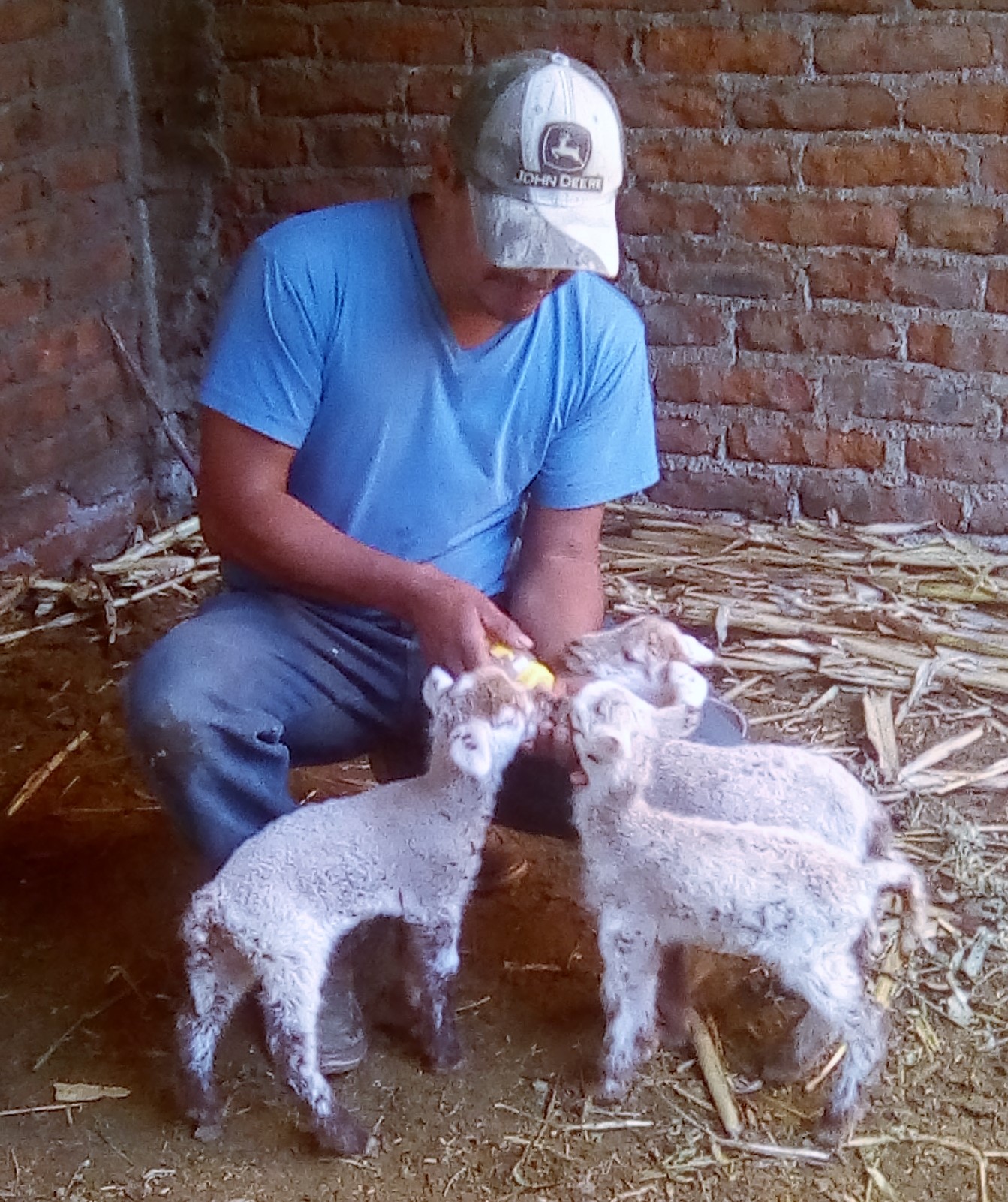
So bottle-feeding began while we waited to see if Cottonball would come around. Wuzzy was the first in line at feeding time and would not be set aside until he was satisfied. Peep was the loudest baa-er when hungry. Her neck was still twisted but she could walk and carry on so, which made us think maybe her neck muscles were sprained and not broken and hope for recovery. She looked like the Hunchback of Notre Dame. Bo wasn’t able to walk until the second day. She didn’t carry on like Peep. She didn’t insert herself for feedings like Wuzzy, but she was able to eat and walk. We were hopeful.
We also bought some selenium vitamins to give the lambs once they were 15 days old. Since we weren’t sure that Cottonball would feed them regularly, we wanted to give them at least a fighting chance. Cottonball did improve the third day after birth, but she was very lax when responding to Peep’s hunger cries. She seemed to allow Wuzzy to feed occasionally, but then he just wouldn’t take no for an answer.
The third night, there was a gathering of coyotes outside our front door. We think that there might have been a dead cow in the area that they had been feasting on. Their howling woke my husband. He sprung up and ran to the window to scare off the coyotes because “they were going to wake the babies.” Papa Chivo in full form!
Cottonball made a slow recovery but never did get into the swing of motherhood when it came to the triplets. My son took one look at them and said we needed to rename them Troll 1, Troll 2, and Troll 3. They are not cute little sheep. They are not glorious like Wuzzy. They remind me of what zombie sheep might look like, gray and mottled. Well, maybe they will spruce up after a while? What do you think?
The “Me Too” campaign recently making the rounds on social media sites called to mind another demand for justice launched last year called Ya No Nos Callamos Mas (We won’t Shut Up). While both campaigns were begun to highlight sexual abuse of women, Ya No Nos Callamos Mas has a forum for NAMING the assailant publicly. After all, there is some accountability due for sexual assault. Someone is the aggressor. Someone is the victim. Why should only the victim be named?
Worldwide, 13.7% of females raped are under 10 years old. 65% are between the ages of 10 and 20 years old. (Ipas Salud) 70% of the rapists are family members. In 7.2% of the cases, the rapist is the father while 8.2% of the rapists are stepfathers. 55.1% rapes are perpetrated by another male family member (uncles or cousins) or close friend of the family. 3.4% of the rapists are boyfriends of the victim. (Sexual Violence Research Initiative)
Fleeing the violence of their home countries also puts women in a vulnerable position. Six out of every 10 female migrants are sexually assaulted during the course of their travels. Being picked up by border patrol does not guarantee freedom from sexual assault. In one survey in 2006, 23 out of 90 women already detained reported being raped while in custody, more than half indicating the aggressor was a US state official. (Sexual assault of migrants from Latin America to the United States)(Why So Much Violence against Migrant Women?)
Mexico has laws to protect women. Although abortion is illegal in this Catholic country, the Official Mexican Standard 046, in effect since 2005, stipulates that in case of violation, “the institutions providing health care services must offer immediately and up to a maximum of 120 hours after the event occurred, emergency contraception “and are obliged to” provide medical abortion services ” Yet victims are often denied this right. (Teenage rape victim denied abortion in Mexico after judge rules attack was ‘consensual’ ) What can you expect from officials who claim the high rate of teenage pregnancies are due to “irresponsibility among females and inattention on the part of the heads of families” negating any responsibility of the male half of the equation? (In OECD Mexico no. 1 for teen pregnancies)
With statistics like those above, is it any wonder that empowerment movements like Ya No Nos Callamos Mas and Me Too are growing? Perhaps if enough women scream, perhaps if enough women protest, perhaps if enough women insist on their rights to their own body…..but that’s only half the battle. Rapists, abusers, and child molesters must be held accountable for their actions. And that’s not likely to happen soon, at least not here in Mexico.

 Despite what google translator says, we don’t have a lemon tree in the backyard. It’s a LIME tree, specifically a Mexican lime tree (Citrus aurantifolia Swingle). The Mexican lime was actually introduced to Mexico by the Spaniards in the early 1500s. That didn’t stop the author of my little herb book Antiguo Recetario Medicinal Azteca from including it though.
We use limes on about everything from tacos to cucumbers. Delicious! So let me tell you about the health benefits of regular lime consumption.
Lime juice prevents scurvy. Lest you think that this is irrelevant in this day and age, 6 to 8 percent of the general population in the United States are thought to have scurvy-level deficiencies. Scurvy is especially prevalent among the poor, homeless and college students.
Adding lime juice to food prevents cholera. Not to alarm you, but in 2016, there were 132,121 cholera cases and 2420 deaths attributed to cholera reported worldwide. Cholera resistance seems to be a very positive benefit to lime consumption in my book.
The peel and leaves have been shown to reduce the oxidative degeneration of cells in neurodegenerative diseases like Alzheimer’s.
Lime prevents cancer. It slows cancer’s progress. It destroys cancer cells. It is toxic to pancreatic cancer cells. A high citrus diet combined with green tea consumption reduces your chance of getting any type of cancer incidences.
Lime relieves muscle spasms.
Lime is rich in fiber, vitamin C, folate and potassium, all good for general health.
Limes are helpful in the treatment of diabetes. Combined with garlic, lime juice decreases blood glucose levels. (See Garlic Tea)
It’s great for cardiovascular health! Lime juice and peel have been shown to be effective in treating atherogenesis, plaque formation in the arteries, lowering high blood pressure and reduces triglycerides, cholesterol, and LDL. Including limes and other citrus fruits in your daily diet reduces the chance of developing cardiovascular disease, especially cerebral infarctions.
Lime leaves are a good source of natural antioxidants and antimicrobial compounds and are comparable in their antibiotic effect to standard antibiotics such as tobramycin, gentamicin sulphate, ofloxacin, and ciprofloxacin.
Regular lime consumption has been proven to help protect the liver from toxins.
Limes can help prevent and reduce the severity of osteoporosis.
Limes are antifungal and antiparasitic.
Lime juice is recommended for preventing and treating urinary tract infections.
With all this medicinal good stuff in such a small thing, it’s worth reconsidering putting the lime in the coconut and drinking it all up.
Not quite so adventurous? You can still enjoy the health benefits by adding a little lime leaf tea to your diet, here’s how.
 Pick and wash a handful of medium-sized leaves. Add to a liter of water. Bring to a boil. Reduce the heat and simmer for about 10 minutes. Allow to cool enough to drink. Add a drop of honey for sweetening if you like. Enjoy.