Cat Walk

With my new and improved schedule (See Transition Year), I am able to take a morning walk and sometimes an afternoon and evening walk.  Puppy absolutely adores our walks.  He’s able to sniff every corner, expand his marked territory and run off bigger and badder dogs emboldened by my presence.

Sometimes my husband or son go with me.  After all, it’s just not fitting that women walk alone in Mexico.  I shrug.  I’m only going around the block and there isn’t any real danger that Puppy can’t handle.  But if they want to come, that’s ok too.

I take my camera just in case there’s something worthy of posting on Instagram later.  Sometimes I find some pretties.  Sometimes I don’t.  One day I found 7 tomatoes that fell off the produce truck.  Salsa!  Another day I found a bag of grouting the exact color we are using to finish the second floor.  Score!

We recently brought Kitty from the little house in Sunflower Valley to La Yacata.  She’d gotten too big to be content in the enclosed space.  She SO wanted to go outside and lay in the grass.  When we didn’t allow that, she would literally throw a fit on the floor, meowing and rolling about.  So, we moved her to the backyard in La Yacata and she was happy for awhile.

She noticed that while Puppy is inside at night, at first light, he got to go outside.  Inch by inch she gathered her courage and moved toward the door.  After a few days of watching Puppy and I go for our walk, she ventured beyond the gate.  She decided she’d come with us.  

She complained the entire time!  Having been an inside cat since kittenhood, this was a LONG walk for her.  She was a bit out of shape.  But she stuck with us and made it around the block.

Puppy didn’t much like the new walk companion.  I mean really, she carried on so.  Then she’d get lost in the tall grass and get hysterical so he’d have to go and find her.  So he tried to discourage her from going on the walk with us.  

Eventually, she stopped accompanying us.  Instead, she comes out when we head off and waits by the door.  She knows that eventually we’ll come back and feed her.  Puppy’s satisfied with this arrangement as well.  Glad we could work that out.

*********************

Goods Shop by Herbal Academy – botanically inspired products

disclosure

7 Comments

Filed under Animal Husbandry

Baby the Sheep

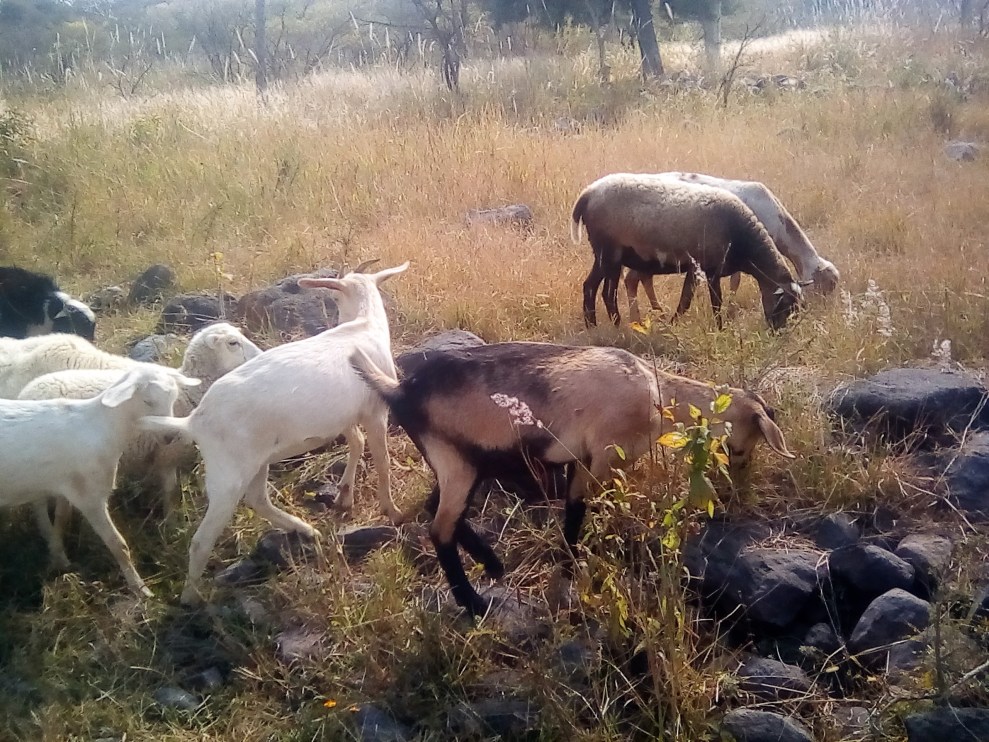
So my husband got it in his head that borregos (sheep) are more profitable than goats.  It is true that borregos sold by the kilo are more expensive BUT they are a smaller animal, so overall there are fewer kilos to be had.  Disregarding my logic, he went ahead and traded our macho goat for a young borrega and her borregita.

I continued my naysaying despite the now physical presence of more borregos.  Borregos carry on something awful whether or not they are hungry. (See Separating the Sheep from the Goats They are more delicate healthwise.  (See Birth and Death)  They need more care than goats.  They don’t eat as varied a diet as goats so food during the dry season will be harder to find.  All to no avail.

The young borrega managed to come down with a BAD case of chorro (diarrhea) probably from the change of diet from her previous home to ours.  This affected little borregita because the mama’s milk all but dried up during her illness.  So three days after purchase, it was looking like borregita wasn’t going to make it.  She was listless.  She became weaker and weaker until she could no longer stand.  It was pitiful.  My husband debated whether it would be kinder to just kill her.

I objected.  Surely there was another option.  We’ve had orphaned babies before on our mini-rancho.  I convinced him to try and nurse her back to health.  We bought a bottle and some milk, mixed with suero (electrolytes) to feed her.

The difference was marked almost immediately.  The second day of bottle feeding she could lift her head and bleated to let my husband (now named Papa Chivo–yes she’s a borrego but Papa Borrego doesn’t roll off the tongue as well) she was ready for more milk.

IMG_20171017_120054

My husband and son alternated bottle feedings and the borreguita was christened Baby so that when she hollered in the middle of the night I could shake my husband awake and say “Go feed Baby.”  After about a week of milk, she started to show an interest in the paca (alfalfa bales).  So feedings were supplemented with a bit of alfalfa and some ground maiz sorgo mixed with milk like a cereal.

It took about a week for her to try and stand but as soon as she could wobble about she demanded to be taken out with the rest of the herd.  She couldn’t keep up, so my husband had to carry her.  She was content as could be munching on the grass she could reach while resting and watching the gang graze.  Mama borrega was happy as well.  She was a nervous Nelly when she had to leave Baby behind.  Maybe that’s what we’ll call her–Nelly.

We had every hope that Baby would make a full recovery.  However, one morning she was again laying on the ground bleating piteously.  She didn’t suffer long.  She died just a few hours later.

IMG_20171026_184359_371.jpg

***********

 Herbal Academy Courses

disclosure

2 Comments

Filed under Animal Husbandry

Natural Remedies — Cherimoya

It’s that time again.  Walking in our backyard has become a hazard.  When you least expect it, heavy green fruit balls just might fall on your head.  So beware!

Our cherimoya, AKA chirimoya, chirmuya or custard apple, tree is loaded this year.   This strange name comes from the Quechua language and means “cold seeds” so called because the tree grows at altitudes of 1,300 to 2,600 m (4, 200 to 8,500 ft) and must have cooler weather periodically or will eventually go dormant.  There are several varieties of cherimoya.  The one in our backyard is the Annona cherimola.

You know a cherimoya is ripe when it has the consistency of a ripe avocado when squeezed, a bit mushy but is not yet brown and rotty. The peel and seeds are not edible.  In fact, the seeds are poisonous when crushed.  They contain small amounts of neurotoxic acetogenins like annonacin.  Dried seeds that have been ground into powder can be used to make a paste that can help get rid of hair lice.

Cherimoya tree bark extract is also dangerous.  If injected it can induce paralysis. I don’t know how anyone would have discovered that by accident, but it’s a useful fact to know. The leaves have long been used to treat hypercholesterolemia in Mexico and scientific study has confirmed that there is a basis for their use in treating high cholesterol. Cherimoya leaves have also been used traditionally in the treatment of diarrhea and dysentery and again, scientific studies confirm its use for those illnesses.

“We had an abundance of mangoes, papaias and bananas here, but the pride of the islands, the most delicious fruit known to men, cherimoya, was not in season. It has a soft pulp, like a

And oh, the taste!  Once you break open a cherimoya, the inside is creamy white. The riper it is, the sweeter and softer the texture.  While I’ve seen descriptions of the flavor ranging from banana to bubble gum, to me, it has a sweet, citrus flavor.  In fact, they are so sweet that I can’t eat more than one.

IMG_20171017_120519

There’s more to these huge ugly roundish fruits than meets the eye. Cherimoya is an excellent source of Vitamin B6, Vitamin C, fiber, and riboflavin.  It’s been proven to help with depression and to be suitable for the treatment of oxidative stress related disorders including Alzheimer’s disease, Parkinson’s disease, Asperger syndrome, cancer, atherosclerosis, heart failure, myocardial infarction, Sickle Cell disease, autism, chronic fatigue syndrome, and even tempers the wear and tear of normal aging like wrinkles, osteoporosis and gray hair. Cherimoya has also been shown to be successful in the treatment of diabetes and gastrointestinal disorders.

The fruit is only in season a short time, in our area mid-September to November, so it’s best to eat what you can while the cherimoya is available.

*****************

Interested in natural remedies? Uncover herbal remedies from traditional Mexican sources for healing and wellness in the Exploring Traditional Herbal Remedies in Mexico series.

4 Comments

Filed under Health, Mexican Food and Drink, Native fauna and flora, Natural Healing