Music Lessons

cam04288.jpg

My son got a bee in his bonnet in December about wanting a guitar. Finances have been less than stellar these days, but I promised we’d look into it. We found some mass produced guitars, but I didn’t think he’d be happy with that. I knew there were a few music shops around town and the odds are, we’d find one there, however, we ended up finding one where we least expected it, in a pawn shop. There were actually several to choose from. I had my son handle each one and strum the cords a bit to see if one felt right, kinda like Harry Potter choosing a wand.

The instrument that sounded the best to my ear was this handmade armadillo shell guitar. Well, I don’t know if it actually could be called a guitar. It was a stringed instrument to be sure. It had an honest to goodness armadillo shell and copper wires. It’s called a charango and believe it or not, quite a popular mariachi instrument even though it is most known in music from further south, Bolivia, Peru, and Argentina.My son refused it. He couldn’t see girls flocking around an armadillo player, you see. It gave us a good chuckle, though.

He did find one that he liked and that was that. Now comes the hard part, learning to play. We have a Learn How to Play the Guitar video Learn How To Play Guitar so that was the logical place to start. It was a complete failure. Maybe some can learn an instrument through video instruction, but it just wasn’t happening for my son.

The next logical action was to find a qualified teacher. The music teacher that teaches with me at the elementary school has his own music school, so I approached him first. He said he would be happy to teach my son, however, we ran into a scheduling problem. He taught evenings and weekends during the same hours that I have my private English classes. There wasn’t any way I could run my son to his school and get to my classes on time. Darn it!

guitar book.jpg

I wasn’t giving up so easily. I did find an old guitar book (The New Guitar Course, Bk 1: Here Is a Modern Guitar Course That Is Easy to Learn and Fun to Play!) among my piano books that showed him the basic finger positions, but he really needed a teacher. I could teach him how to read the music, but not how to play the guitar. Piano is my instrument.

“If possible, let the children learn from the first under artists, lovers of their work: it is a serious mistake to let the child lay the foundation of whatever he may do in the future under ill-qualified mechanical teachers, who kindle in him none of the enthusiasm which is the life of art” (Vol. 1, p. 314).–Charlotte Mason

Every day on the way to work, I pass this cute little shop with a piano keyboard painted on the sidewalk in front. That’s where I tried next. The teacher was an elderly chap, a retired (or not so retired) musician.  Anyone with that sort of imagination for just the outside decoration was bound to be a true musical artist!

The registration was high–$400 pesos. Class prices were high–$100 pesos per hour. The book price was high –another $100 pesos. But I went ahead and confirmed my son’s attendance the following Saturday at 10 am.  It was close enough that he could walk from the school I work at so I wouldn’t miss any of my own classes.

Of course, then we had to get a carrying case and pick. I bought a soft carrying case at the mass produced guitar store for $200 pesos. It’d be just the thing to sling over his back on our moto trip to town. I didn’t find any picks though. The teacher also asked that he come with his pencil case, including scissors and glue, a lined notebook and a music notebook. That was no problem gathering together.

tuner.png

My son came back from his first music class over the moon. He said the teacher told him he was a visual learner (no surprise there) and that he had learned more in one class than most students learn in 2 weeks of classes. He said the teacher shook his hand and was impressed with the quality and design of the guitar that my son had picked, saying that it was the perfect size for the length of his fingers.  (My son has incredibly long fingers.) The teacher had him download n-Track Tuner Pro to his phone so he could tune his guitar.

There was no chiding him to practice either. He went over what he had learned and tuned his guitar every day. He started playing around and picked out a few simple tunes. Money worth spent I think in this case. The second class was just as good, about musical theory and the like. The teacher said that he would be ready to start the book the following week, something that usually took a month of lessons.

I told my son that he could go as long as he liked with the music lessons and quit any time after the 3 month period that I estimated would compensate for the $400 pesos inscription fee.  I don’t think it will be a problem after all!  He loves his classes, comes right in and shows me what he learned as soon as he gets back.

My husband has visions of putting my son on the street corner with a hat to earn a little income on the side. In a pinch, I think he’d be able to earn some tortilla money at least. He would probably earn more with the armadillo guitar, but hey, who can say!

*****************************************


disclosure

***************************************************

Have a Charlotte Mason themed blog post?  Link up here!

cm blog

5 Comments

Filed under Education, Teaching

Chim Chimney

Do you ever think that maybe some skills should not be lost through the generations? I’m all for forward progress and all, but really, what if we find out that (for example) eating GMO food causes cancer and we want to go back to organic farming. Nowadays, even the farmers seem to have forgotten how to go that route.

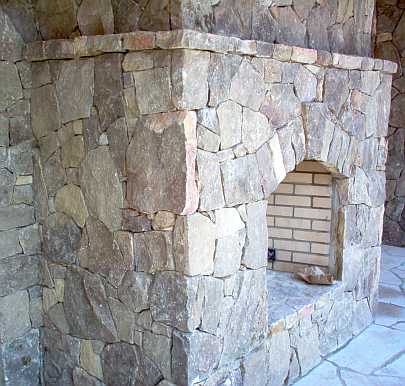
Another useful skill that has been lost is how to build a fireplace and chimney. Not so long ago, people would build their own houses around a central hearth, so somebody in the village knew how to make chimneys, probably a good many somebodies. Why hasn’t that skill been preserved?

fireplace

An outdoor fireplace my husband built in the States back when we had a different life.

As you probably know, we have a fireplace and chimney. My husband built it himself. Nobody else in La Yacata has one. The few people in nearby Moroleon that have one don’t use them because the smoke comes back in. My husband seems to be the lone chimney maker hereabouts, but nobody seems interested in having one installed. Why? Electric heaters. Gas heaters. Hot air electric heaters. Space heaters. All of which were totally inefficient and impractical for us so the fireplace was the way to go.

Is it difficult to build a chimney? No more than any other type of building I suspect, although every site that gives directions on how to build one tells you it just might burn your house down. What a bunch of pessimists! Our house is made of brick, stone and cement so it would take quite a fire to completely destroy it.

We didn’t have a fireplace in mind when we build our house, but after the first winter, we decided it would be a great addition. It does get cold here in Mexico, not so cold as say, Canada, but cold enough for a roaring fire to be just the thing some days.

IM000119.JPG

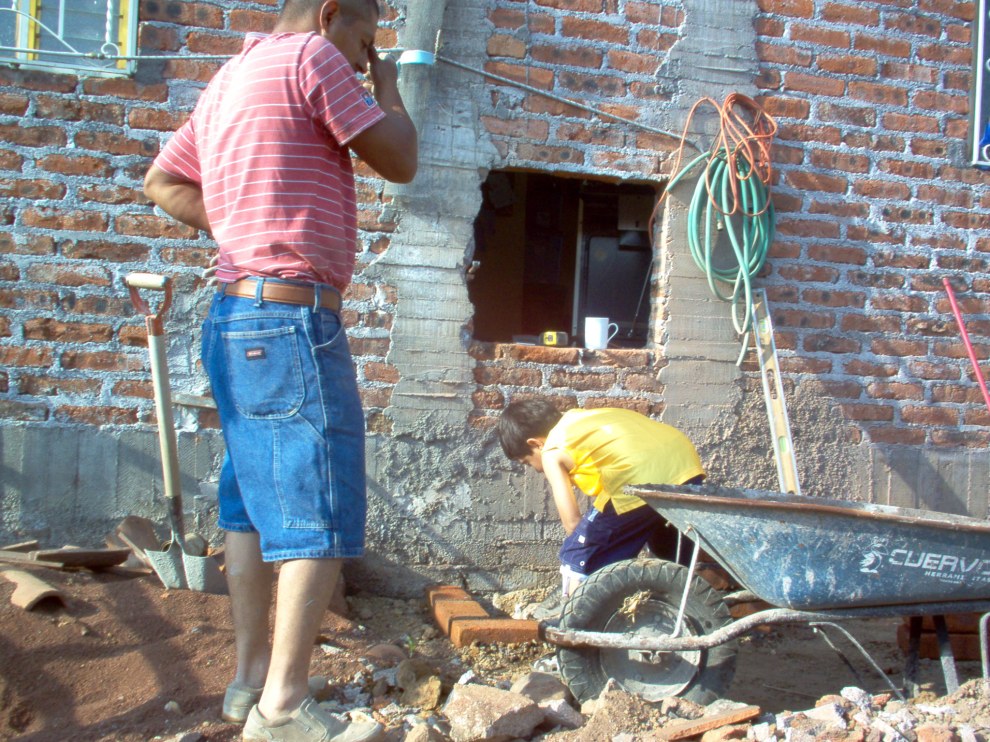
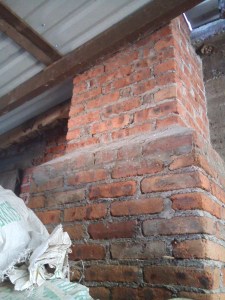
So since the chimney wasn’t in our design, the first step was to make a hole in the kitchen wall. My husband started from the ground and made the first section. About halfway up the first section is where the actual fireplace is on the inside of the house. He used cement sewer pipes that are readily available here in Mexico for the inside tube of the chimney, cementing it in place with a round of bricks.

cam04247.jpgcam04250.jpg

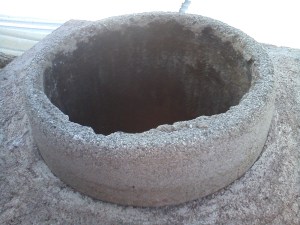
The second section up has a smaller cement sewer pipe so the outer wall is not as big. He is planning on going up another floor because our second floor now has a roof and may be inhabited one day. Therefore, the third section will have another yet smaller cement sewer pipe and smaller surrounding brickwork, to be topped off with some sort of little roof so that the rain doesn’t get in and drown out our fire.

cam04245.jpg

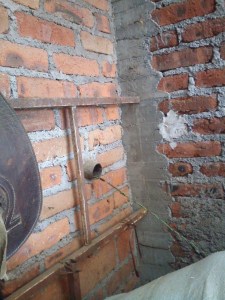
Ignore the wire, it’s not part of the chimney.  We run a wire from our DVD player to the car battery out the hole when we want to watch movies.  Obviously not when we are using the fireplace!

The hearth has an air hole that he made from a car tailpipe. It’s about 8-10 inches from the floor of the hearth and the purpose is to allow the air to circulate and go UP the chimney rather than back into the room. Seems those chimney builders in Moroleon neglected this little step giving fireplaces such a bad rep around here.

fireplace

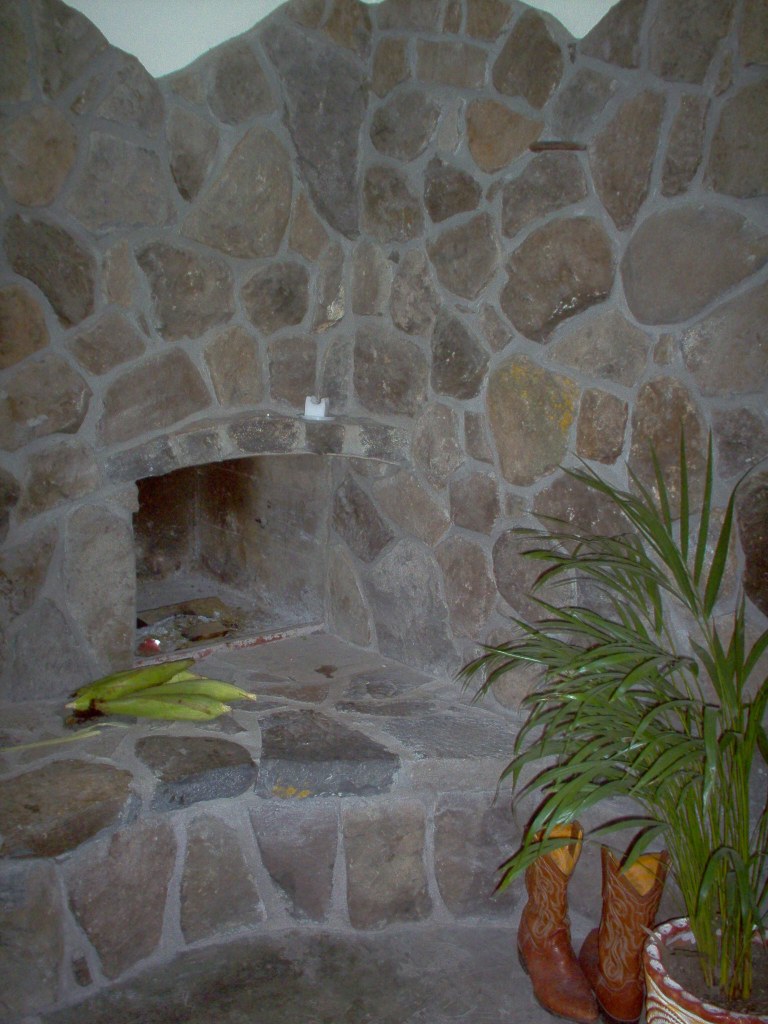
Our toasty fireplace

My husband finished it off with a seating area made from stones we plucked from our backyard. It’s lovely!

For fuel, we use dead mesquite branches we collect from around La Yacata. We can also use corn cobs (with the corn already removed of course). The fire burns faster with the corn cobs but most years we have plenty to keep it going. We could also use poop. Yep, dried cow patties or horse poop burns a long, long time. We don’t light our fire often enough to use up the mesquite branches or the corn cobs, so we haven’t had to go out and collect dung to burn yet, but hey, just in case, it is certainly good to know.

I’m sure that I’ve made it seem simpler than it actually was. There are measurements and bricklaying and figuring involved after all. It took about a week of work too. But it isn’t such an impossible task as one might think.

*************************************************

disclosure

9 Comments

Filed under Construction, Homesteading

Growing old


cam04098.jpg

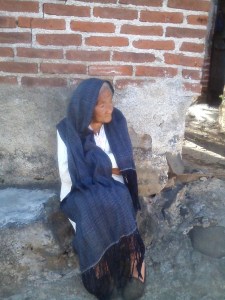
Mama Sofia in front of her home.

Over the holidays, we were able to visit with Mama Sofia, my husband’s grandmother, and her husband, Tio Felipe. Mama Sofia holds a special place in my husband’s heart. When he was homeless at the age of 12, she took him in. The two times he was deported with nowhere else to go, she opened her home to him. How could he not love her? How could we not love her?

We try to get to Cerano every month or so, but sometimes daily life gets in the way and we aren’t able to visit as much as we would like.

cam04088-1.jpg

Mama Sofia with 2 of her 4 children, Pepe and Caro.

We were delighted to see that Mama Sofia’s daughter, Caro, was also visiting from Zamora. She’s quite a lively lady, gets it from her mother I expect. The first time I met Mama Sofia, she was just arriving home with a 10 pound sack of planting soil slung over her shoulder. When my husband tried to take it from her, she got angry.

This time, we were sad to see the decline in Mama Sofia as old age takes its due. She is 97 (or 95 or 92 no one is quite sure least of all Mama Sofia herself) or so and life is hard after all.

Mama Sofia is not able to get around to do her shopping, attend mass, or visit with friends, most of who have long since died anyway. Her balance is precarious and she often falls and injures herself in her own home. Her great-grandniece looks in on her daily and brings her the tortillas that Mama Sofia can no longer make. Vendors know to stop by with geletina, gorditas or tacos de canasta. There is a little bitty market right across the street and the owner brings over cooking oil, rice, tuna and pasta. The priest walks over from the church after Sunday mass to give Mama Sofia communion. All these activities keep her mind from stagnating, but there are hours and hours of daylight left to occupy.

Mama Sofia is still able to straighten her rooms, make the beds, sweep the floors and heat some soup.  Her plants are lovely.  The fruit trees provide guayabas, granadas, limones and nisperos.  She doesn’t haul planting dirt anymore, nor does Tio Felipe plant corn.

Both Tio Felipe and Mama Sofia receive a dispensa (government welfare) box every few months for the tercer edad (senior citizen). It has cooking oil, rice, beans, pasta and soap. Picking it up, however, requires a trip to Yuriria, which is nearly too much for Mama Sofia these days. Doctor visits are also pretty much out of the question. The walk to the newly built clinic is long and full of uneven ground. The wait to see a doctor is interminable. When Mama Sofia is ill, the ladies of the family in Cerano take turns caring for her until it passes. Sometimes Caro is able to come and stay awhile. Sometimes she can’t. Life is hard in Zamora too.

cam04095-1.jpg

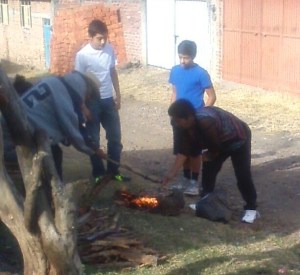
Toasting peanuts on the comal.

The day of our visit was mild and we sat outside with Mama Sofia on the cemented step. She didn’t say much, just enjoyed the pleasure of having company. Tio Felipe made himself useful and toasted peanuts on the comal. My husband went and bought some chicken and we had a veritable feast.

Too soon, we had to say our goodbyes. The animals need attending to. The roads aren’t safe to drive after dark. There are things that need to be done before we retire for the night. We left, knowing that the days we will be able to visit with Mama Sofia are numbered and promise ourselves that next week, or the week after, we’ll make the time to visit again.

**********************************

disclosure

7 Comments

Filed under Cultural Challenges, Parenting Challenges and Cultural Norms