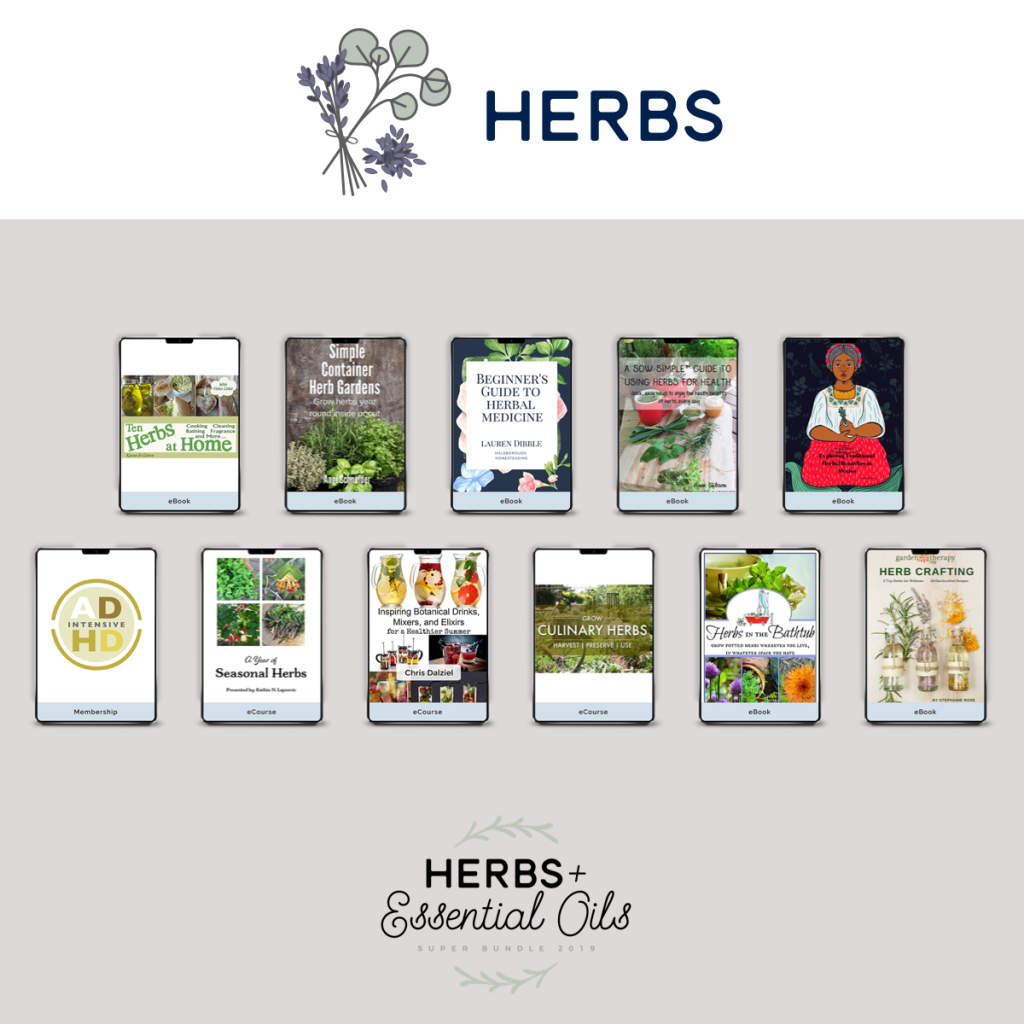
For two days only, the bundle, which includes 29 ebooks, 4 printables, and 7 ecourses, is on sale for $37. If you want the cheat sheets, the price goes up $10. You’ll also have the option to add the Self-Care bundle, which is another incredible set of resources.
The Herbs and Essential Oils bundle contains 40 products worth over $700 if purchased separately. It will continue to be available until June 2020, but at the price of $49.97. Additionally, the flash sale comes with three bonuses that the regular sale doesn’t include:
Puro co – $15 Gift card!
The Oil Collection – Pair of leather diffusing earrings (worth $19.99)
So let me just share some of my favorite ecourses. Herbal Academy’s Herbs for ADHD, Cognition, and Focus was naturally one of my favorites. Several of the herbs suggested for improved focus and reduced anxiety are even commonly available in Mexico. Score!
The Healing Powers of Tea was a fun short course. You know how I love herbal teas! More Than Weeds: 5 Common Plants to Forage for Food and Home Remedies highlighted herbs that often grow right in your backyard. I’m still making my way through the 29 eBooks! I never get tired of eBooks about herbs!
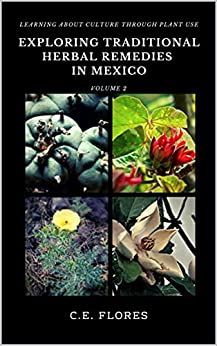
If you aren’t interested in these fascinating ecourses, printables and eBooks and only want to get my book, well, then I’m also happy to announce that the eBook version of Exploring Traditional Herbal Remedies in Mexico is now available for pre-order.
The Aztec marigold (Tagetes erecta) is known as cempasúchil in Mexico. The name comes from the Nahuatl cempohualxochitl which translates as “20 flowers”, possibly referring to the fact that each blossom has the potential to create 20 or more flowers, although some sources reference the ritualistic significance of the number 20, so there maybe be other reasons for this name.
This aromatic flower is native to Mexico and has a long history of medicinal and ritualistic use. Even today, this flower dominates the festival Dia de Los Muertos (Day of the Dead). It is believed that the strong scent will call to the spirits that are roaming free and guide them home to visit loved ones. This use has given the cempasúchil another name, Flor de Muertos (Flower of the Dead).
The Mayan had similar beliefs. The priests would wash their hands and face with an infusion of leaves and flowers before calling the spirits.
There is a legend that describes the love of Xóchitl and Huitzilin. Their feelings were so strong that when Huitzlin died in battle, the sun god Tonatiuh heard the pleas of Xóchitl to reunite them. He transformed Xóchitl into the cempohualxochitl flower. Huitzlin, who had been reincarnated in the form of the hummingbird, forever after found nourishment among her “20 flowers.”
Francisco Hernández described the common use of the cempasúchil in the Historia Natural de la Nueva España like this:
“Tienen todas hojas como de tanaceto, flores amarillas, o amarillas con algo de bermejo, de temperamento caliente y seco en tercer grado, sabor acre, partes sutiles y olor un tanto fuerte. Tiene virtud resolutiva y aperitiva; el jugo de las hojas tomado o las mismas hojas machacadas y tomadas con agua o con vino atemperan el estómago frío, provocan las reglas, la orina y el sudor, alejan los fríos de las intermitentes untadas un poco antes del acceso, quitan la flatulencia, excitan el apetito venéreo, curan la debilidad que proviene de destemplaza fría del hígado, abren las vías obstruidas, aflojan los miembros contraídos, alivian la hidropesía, provocan vómito tomadas con agua tibia, y curan los fríos de las fiebres y aun las fiebres mismas evacuando la causa por la orina y el sudor.”
Historia Natural de la Nueva España, Volume II. Book IV, CLXXIX
Loosely translated, it reads:
“They all have leaves like tansy, yellow flowers, or yellow with some red, hot-tempered and dry in the third degree, pungent taste, subtle parts, and somewhat strong smell. It has a decisive and aperitive virtue; the juice of the leaves drunk or the same leaves crushed and drunk with water or wine temper the stomach, provoke menstruation, urine and sweat, remove intermittent shivers by smearing a little near body cavities, rid the body of flatulence, they excite the venereal appetite, they cure the weakness that comes from the dislocation of the liver, they open the clogged passageways, they loosen contracted limbs, they relieve dropsy, they provoke vomit when drunk with lukewarm water, and they cure shivering of the fevers and even the fevers themselves evacuating the cause of urine and sweat.”
Strange 15th-century disorders aside, like the floating liver, the cempasúchil has been shown to be effective in the majority of the ailments Hernández listed and continues to be an important ingredient in many natural remedies in Mexico today.
Traditionally, the cempasúchil has been used to treat intestinal parasites. Drink 3 cups of a tea made from a pinch of flower petals and 1 / 4 liter of water. The flowers also have anti-inflammatory properties.
A diluted, lukewarm tea is given to babies with colic commonly called empache. The flowers have spasmolytic properties which help soothe the bellyache and reduces fussiness.
An infusion or tincture of the flowers is also used to treat susto or espanto which are nervous conditions. The compounds in the flowers have a sedative effect.
Both antioxidant and antibacterial, the cempasúchil has traditionally been used for wound care. The flowers are crushed into a poultice and can be applied directly to the injury or sore. The crushed leaves are used to treat boils and burns which aids in healing.
In the Yucatan, Tabasco, Oaxaca, and Veracruz, the cempasúchil is used to treat fever. Extracts from the plant are applied in a tincture to the bottom of the feet to provoke perspiration and sweating. In Guerrero and Tabasco, the plant is used to treat colds.
The petals are edible and have anti-aging properties, so go ahead and sprinkle some on your salad. Or you could this chicken in marigold sauce recipe or one of the dishes in the video below.
This versatile plant is also a boon to the gardener, being a natural insect repellent. Crushed petals rubbed on your skin will repel mosquitos.
The petals make a non-toxic dye. In Mexico, dried and powdered petals are fed to chickens so that their skin and eggs are yellower. There is also a cempasúchil pulque (moonshine) made in some areas.
All in all, there is more than one reason to have cempasúchil in your herbal repertoire.
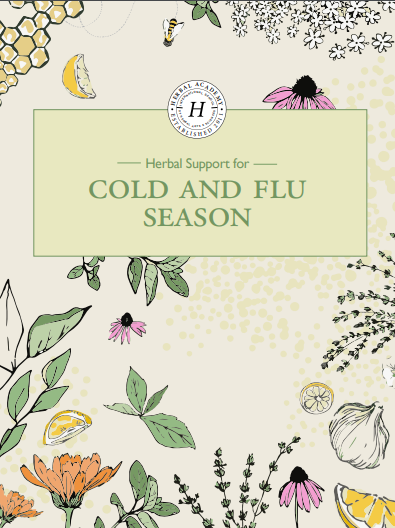
I have a few information tidbits from Herbal Academy that I wanted to pass along. First, they are giving away a free Cold and Flu Ebook that I’m sure you’ll enjoy whether you use these herbal remedies to keep healthy or to treat the bug that has you down. I know I’ve been loving my copy! Garlic honey, natural cough drops, and fever tea are just some of the recipes you’ll find in this little gem.
Many of these recipes were taken from The Herbarium monograph database. The Herbarium has a collection of articles, plant monographs, podcasts, videos, charts and tutorials and Short Course Intensives that are only available to members. And right now, Until October 31st, you can use the code COLDANDFLU for a one time discount of $10 off a membership to The Herbarium and get access to all that herb knowledge.
The newest intensive is Herbs for Animals. Those of you that have been following my blog for a while, know that we often use herbal treatments with our animals when they are ill or injured. And while you might not have the same animal variety that we do on our homestead, there may be a fur-baby in your life that would benefit from herbs.
The Herbs for Animals Intensive covers common ailments, dietary considerations, and appropriate herbs to help you support your pet’s well-being naturally. Is your dog terrified during thunderstorms? Is your cat skittish or moody? Wouldn’t you like to know more about flower essences used for emotional support to treat these problems? Then the short intensive course Herbs for Animals is for you!
So don’t wait, and get your membership for The Herbarium and access to Herbs to Animals along with the Herbs for ADHD, Cognition, and Focus Intensive I talked about a few months ago. Use the code COLDANDFLU for $10 off and start increasing your herbal know-how today!










 Surviving Mexico