Category Archives: Homesteading

Making Herbal Preparations 101 Mini-Course from Herbal Academy

Enroll now in the Making Herbal Preparations 101 Mini Course

Every time I treat myself to an herbal course at Herbal Academy I find myself rubbing my hands in glee. My latest experience, Making Herbal Preparations 101 Mini-Course, was no exception. I signed up during the free enrollment period in July. This course is scheduled to be re-released next year, so don’t despair if the link above takes you to another page.

I have to admit that herbalism in Mexico is challenging. I can’t just order herbs willy nilly from organic herb stores and have it delivered to my doorstop to brew, decoct or tincture in endless delight. Oh, no. That would be too easy. Instead, I have to painstakingly gather information and positively identify plants, flowers, and trees that I didn’t learn about growing up in the Eastern United States.

So, this drawn-out process in my adopted land has undermined some of my herbal concoction confidence. This is where I appreciated the Herbal Academy’s most recent course.

The course was divided into seven lessons. Each lesson had informative readings, printouts and easy to follow videos making this an excellent course for beginners.
Making-Herbal-Preparations-101-Mini-Course-badge-01

LESSON 1: EVERYDAY HERBAL PREPARATIONS

This lesson differentiated the different types of herbal preparations. There are water-based, sweet-based, oil-based and alcohol-based preparations. The type of solvent you use depends on the application and plant property needed to treat whatever it is you are going to treat with herbs.

LESSON 2: EVERYDAY HERBS

Lesson two stressed the importance of treating herbs as medicine. This means knowing how to prepare the herbs, potential side effects, and the duration an herb can be safely administered. You should also know the health issues and life stage of the person taking the herb and any possible herb-drug interactions. Of course, you should also be cognizant of plants that could become toxic with extended use or those that resemble beneficial herbs.

I was delighted to learn that Western herbalism has a similar categorization process to the Mexican culture which sometimes confounds me. Energetics in herbs is based on temperature (cool or hot), moisture (wet or dry) and tension (relaxed or constricted) which in many ways is identical to the indigenous belief system found where I live. So a person with a dry cough would be given a moistening herb to aid the body in achieving balance.

LESSON 3: WATER-BASED HERBAL PREPARATIONS

Water-based herbal preparation is one that combines herbs and water. It could be tea, a wash, an enema, an infusion or a decoction. A cup of chamomile tea prescribed as a sleep aid is an example of a water-based herbal preparation.

LESSON 4: SWEET-BASED HERBAL PREPARATIONS

Using honey as a base for creating an herbal preparation was the topic of lesson four. After all, a spoonful of sugar (in this case organic honey) helps the medicine go down.

LESSON 5: ALCOHOL-BASED HERBAL PREPARATIONS

Lesson 5 demonstrated the use of alcohol such as vodka, brandy, and gin to create herbal rubs, washes, and tinctures.

LESSON 6: OIL-BASED HERBAL PREPARATIONS

Oils can be used to create herbal infusions meant to be used externally or in cooking. Doesn’t rosemary-infused virgin olive oil sound simply delicious?

LESSON 7: EVERYDAY RECIPES

Lesson 7 provided basic preparation instructions for each of the methods presented in the course plus some delightful recipes including how to make a chickweed poultice, violet honey lemonade, fire cider and more. What a fabulous way to end the class.

Having gone through Herbal Academy’s Making Herbal Preparations 101 Mini-Course, I’ve gathered enough confidence to start decocting my own herbal medicine cabinet from locally harvested herbs.

***

disclosure

3 Comments

Filed under Health, Homesteading, Natural Healing

Not Taking The Blame

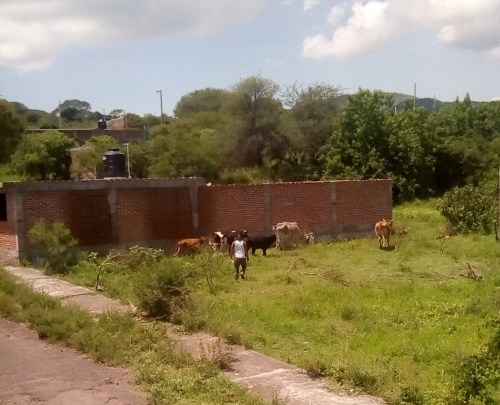
An actual picture of the elusive chicken feather guy rounding up his animals in the morning.

The other night, the horse guy, as opposed to the chicken feather guy, let his animals out to graze. Up and down the road they went, eating whatever tickled their fancy.

The next morning, the guy whose wife and kid planted some corn on their lot down the road came charging up to the house, beer in hand at 9 am to yell at me. He didn’t get too close. All three dogs got riled up and wouldn’t let him within 100 feet of me. Mr. Aggressive wanted to know if we had goats. We do. I didn’t deny it. He said that the goats ate all his corn. I said they didn’t. He should check with the guy who has sheep right next to his lot. 

So Mr. Aggressive went down to that house and banged on the door. The Borrega guy only comes before and after work so I shouted down that he needed to try at 5 pm or 8 am. You could see the steam rolling out of Mr. Aggressive’s ears. 

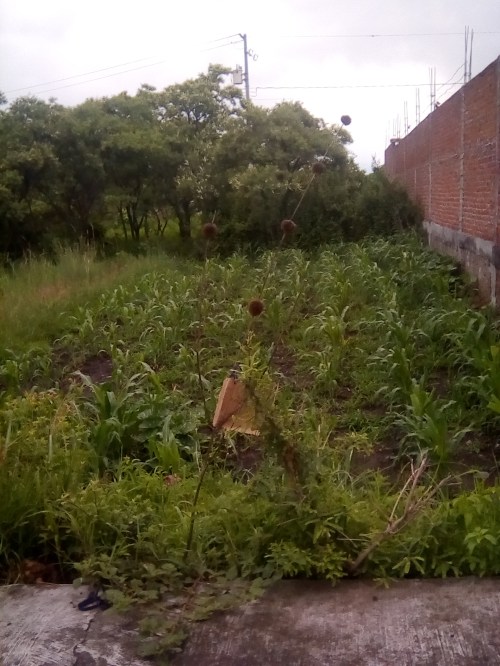
The corn field in question.

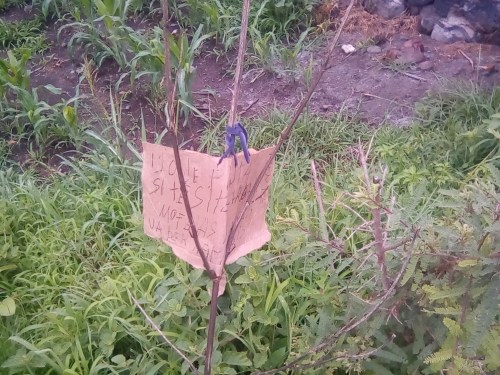
Mr. Aggressive went to town for some barbed wire and another beer and went at it. He hammered and drank and drank and hammered for 20 minutes or so. Curious, I decided to mosey on down after he’d left. Sure enough, he put up some sort of wire thing–not exactly a fence. He also nailed up a sign which I couldn’t figure out. Something about putas. If I couldn’t figure out the sign, what makes him think the livestock will stop and read it before helping themselves to young, tender corn shoots?

So the next morning, Mr. Aggressive lay in wait for Borrega guy who denied any and all knowledge of any corn eating. Borrega guy also pointed out that the poop right there in front of the lot wasn’t sheep or goat poop, which resemble little rabbit pellets. 

Not sheep, not goat, not even horse.

I’m not sure that the cow patty convinced Mr. Aggressive of anything. Neither the Borrega guy or we have cows. Of course, we could have brought one from another location to divert suspicion I suppose. Last night, the chicken feather guy let his animals out to graze again.

I have to quit rolling my eyes so hard. I’ve nearly given myself eye strain.

eye roll

***

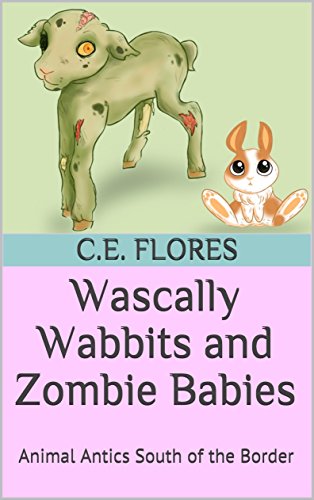
Have you read all of our previous animal adventures?

wwzzcover


Leave a comment

Filed under Animal Husbandry, Cultural Challenges, Homesteading

Natural Healing — Yerba Buena

yerbabuena.jpg

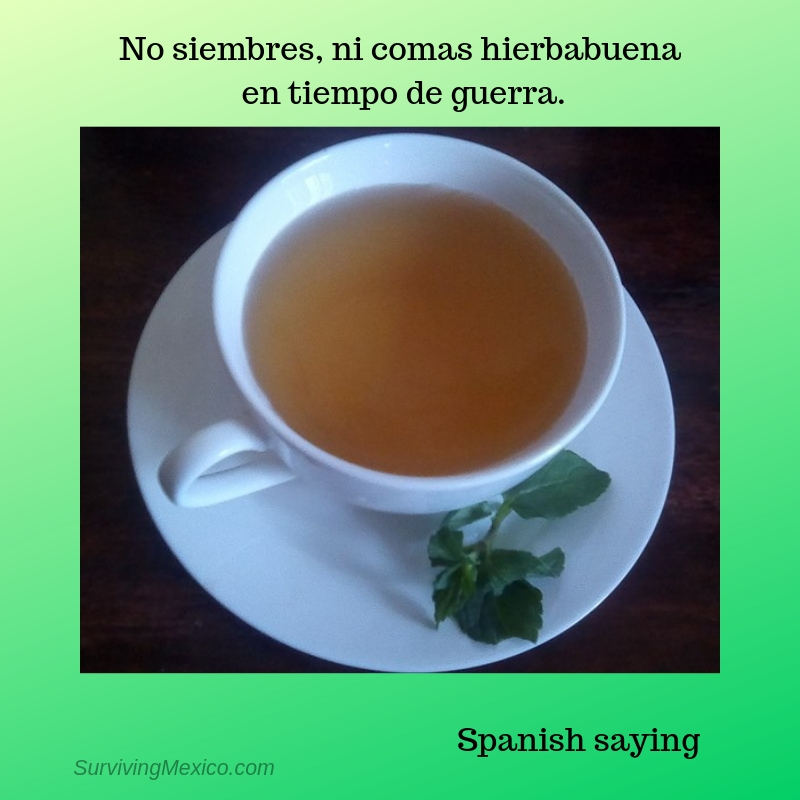
Yerba buena, (also spelled hierba buena) otherwise known as Spearmint, is yet another herb that came with the Spanish friars and was gleefully added to the indigenous medicinal herb garden. 

Curanderas (healers) add spearmint to make a concoction more palatable but it also has its own medicinal value.

To treat acid indigestion, gastritis, heartburn, and nausea steep dried or fresh yerba buena for 15 minutes. Allow the tea to cool to room temperature. Add limón and baking soda and drink as needed. Nausea caused by pregnancy tea is made from yerba buena flavored with canela (cinnamon). Nausea caused by a hangover calls for a tea made from a spoonful of yerba buena flavored with cinnamon, nutmeg, and cloves. Intestinal inflammations are traditionally treated with an infusion of powdered root. Spearmint has a proven antispasmodic effect.

For the most part, yerba buena (good herb) is still used primarily to treat stomach ailments in Mexico, although the herb has other medicinal properties worth noting.

Spearmint (Mentha spicata) has been shown to reduce pain for people who have osteoarthritis. The antioxidant properties protect the liver. Regular ingestion improves memory. Spearmint is effective in reducing anxiety and is antimicrobial. Infusions of spearmint have been traditionally used topically as a mild wound wash to reduce the chance of bacterial infections. A poultice of spearmint leaves and a little olive oil is sometimes used to treat burns.

It is both antiproliferative and antidiabetic. It has been effective in the treatment of Polycystic ovary syndrome and hirsutism. Yerba buena has often been used medicinally particularly digestive issues. It has been shown to have anti-obesity properties.

Yerba buena is often used to reduce flem. To make a tea for colds and flu, boil 10 grams of the leaves for each 1 / 2 liter of water. Tea for a headache is made with a sprig of fresh hierbabuena and a few romero leaves (rosemary).

Babies are given teaspoons weak tea made from yerba buena then they have hiccups and are teething. If a baby is colicky, basil, cempasuchil, eneldo (dill), fennel, senna, yerba buena, brook mint, rosa de castilla (rose) are combined in equal parts. Three fingers full (a good pinch) of the mix is steeped in a liter of water.

Yerba buena is a natural food preservative and can be used as an organic insecticide. It also prohibits the growth of certain fungi on plants.

Overall, yerba buena is a good herb to have on hand.

hierbabuena.jpg


***

Interested in natural remedies? Uncover herbal remedies from traditional Mexican sources for healing and wellness in the Exploring Traditional Herbal Remedies in Mexico series.

2 Comments

Filed under Homesteading, Mexican Food and Drink, Natural Healing