Escrituras! Escrituras! Wherefore art thou, Escrituras?

In June, Super Prez was called unexpectedly to the presidencia and informed that if we were interested in proceeding with escrituras (individual deeds) for the community, we could do so,  under certain conditions. Typically, escrituras are granted when at least 80% of the infrastructure for an area is complete, including sewer, water, electricity, and roads. If you’ve been following our story, you’ll know that we aren’t anywhere near 80%. However, not to look a gift horse in the mouth, we presented the opportunity to the colonos at the next junta.

The first question was how much it would cost. Because of our rural classification, most colonos were thinking about $5000 per lot. As that didn’t seem to be the amount that the presidencia was hinting at, we’d need to investigate further. 

Unbeknownst to us, the presidencia went ahead and called a meeting in the cabildo municipal via Facebook. I heard about it the day before and told Super Prez he should be in attendance. I couldn’t go because I had classes. He was busy with electricity estimates and said he wasn’t going to be able to make it. Another colono attended and sent him a message shortly after the meeting started, saying his presence was urgently needed. Super Prez wasn’t too far away, swooped in to an illegal parking spot in front of the presidencia, and party crashed what had become a Yacata bashing session. 

The colono who sent out the SOS said that upon Super Prez’s arrival, the tone of the meeting changed. No one DARED to badmouth La Yacata or the mesa directiva to Super Prez’s face. The meeting broke up shortly after that. Super Prez requested another meeting in the cabildo, with advance notice this time, so that we could get some details on the escrituracion process. 

La mesa directiva, including myself, and a handful of colonos were present at the second meeting. We had specific questions that I divided among the colonos, including who would be the notario that would be in charge of the process, how much would it cost, and were there other restrictions that we needed to be aware of. The notario would be from another city, the cost would be $24,000, and the conditions of the escrituras meant that we would remain a colonia and could not petition the municipio for any basic services (water, electricity, sewer) that normally would be provided as part of the predial (yearly taxes) collected each year. 

These conditions were not exactly favorable, but in our current condition, this would be the only opportunity we would have for escrituras until all the services were completed, which could take another 5 years. Feeling like we had received our answers that we could take back to the asamblea, Super Prez excused himself to attend to other matters. 

The second he left the room, the criticism of La Yacata started up again, and it was fierce. Certain colonos in the room started in how the mesa directiva was corrupt and untrustworthy, that there was no progress, that we were dipping into community funds for our own benefit. I saw RED. After all the time and effort we had devoted to making La Yacata a more dignified place to live? This was the thanks we got?

The presidencia representative said that based on the complaints, he could take over community direction for the “good of the community”. I was livid. I literally stood up at that point and directly refuted some of the blatant lies spoken by the agitators in attendance. Of course, my righteous indignation did not help the fluidity of my Spanish, so I stumbled a few times. I also had to leave because I had classes, and this meeting had already gone on for 3 hours. So, in parting, I addressed the remaining colonos and told them I was leaving the defense of our community and mesa directiva in their hands and marched out dramatically, although probably not elegantly as flustered as I was.

Later, a colona who remained at the meeting said the first thing the representative of the presidencia said when I left was that all members of the mesa directiva should be able to express themselves well in Spanish or be replaced, a direct jab at my second-language abilities. 

After that fiasco, we invited the enlace (representative) for the notario to the next community meeting so he could explain the process to the colonos. He sent a message right before the Sunday meeting saying that he would not be able to attend. We had the meeting anyway. 

On Tuesday, we took a group of colonos to the presidencia to meet with the powers that be to see why the enlace was “unable” to attend. We got the run around, nobody was able to meet with us, blah blah blah, until we made it clear that we would remain there, in the lobby, until we were attended to. Not 30 minutes later, we were ushered into the cabildo. The enlace was called in to explain himself. He gave the excuse that he was afraid to come to La Yacata, which puzzled us greatly until we pieced together that he thought we were “Las Yacatas”, another community in the next municipality, near where 6 men were executed the previous Friday, all known to the enlace. 

We confirmed the cost and that colonos would be able to pay for the escrituras in two installments, and the meeting ended.

Naturally, the colonos were flabbergasted at the cost, and it took some doing to explain that the escrituras were completely optional. Those who wanted to go through the process now could, and those who did not, were not obligated to do so. Either way, escrituras or not, all property owners would remain part of the colonia and have obligations towards community advancement and upkeep. 

A mad rush of those who had not paid any aportaciones indicated their interest in escrituracion. People with certificates issued by the previous encargado (person in charge) appeared out of nowhere. Some of the lots they had certificates for were owned by others, so it was quite a time making sense of the ownership trail. Others were certain they could get their escrituras from another notario for cheaper and, therefore, bypass the process completely.

Ownership needed to be proven by an official document. At the last minute, parents wanted to gift their lot to their children, and married colonos wanted to add their current significant other. The property certificate then had to be reissued since the escrituras and the certificate needed to match exactly. 

Then there was a subgroup of individuals who were no longer in possession of their property certificate for whatever reason. They believed that they could recover possession of said property via escrituras. Unfortunately for them, the original property certificate (not a copy) had to be turned over for the orden de escrituracion (deed order). Their applications for escrituras remained dead in the water at that point.

Then there were the names. Ma., Maria, M., Ma. de, and Jose, J., J. Gpe. Abbreviations or full names needed to match the INE (voter registration cards). Documents had to be reprinted and refiled. 

It was absolute chaos for a time.

Anyway, the first step was the application for the permiso de division (subdivision permit). It’s a technical form, and not just anyone would be able to fill it out. Super Prez offered his services as an engineer for a mere $200 compared to the going rate of $1800 or more. There were complaints about that.

The permit itself was $382. Originally, this was to be paid in the presidencia, but they didn’t want to bother with the individual payments and wanted a lump sum, so when we had a group ready, Super Prez took the cash himself, only to be told that the official number registration fee would also need to be paid at the same time. This meant calling everyone back to bring the cash for that transaction.

There was so much paperwork. So many messages to colonos asking for documents, or information, or payments. So much hassle. I was in charge of trying to keep the paperwork in order, while Super Prez was in charge of the more technical aspects and meetings with the enlace and presidencia. 

The first subdivision permits came back from the presidencia with errors and had to be resubmitted. The official numbers were issued using fractions of the colonia rather than the road and number. Fractions are not accepted by any agency (CFE, water, etc), so those were set aside to be given later, even though they needed to be paid for first, according to the presidencia. 

The fiscal year ends on December 15. Although the process of escrituracion can be done next year (or even the year after that), the price goes up every fiscal year. So we have been working overtime to try and get these packets of papers turned over to the enlace (representative) before the deadline for those who wish to get their escrituras right now. And this is a negative cost-benefit for the community. The 50 or so colonos, most of whom owe aportaciones (community fees), will have their escrituras, but we still won’t have enough money to pay the electricity contractor.

***

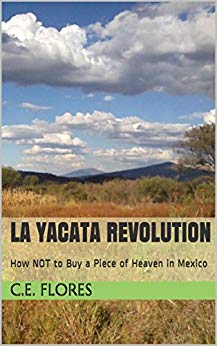
Curious how it all started? La Yacata Revolution: How NOT to Buy a Piece of Heaven in Mexico
7 Comments

Filed under La Yacata Revolution

Flipping the Switch on Community Power in La Yacata

In October, we started a new community electricity project. It’s really a continuation of the area that was covered by the federal grant we got last year that provided the colonia with electricity. Unfortunately, that little grant didn’t run lines to all the houses that are inhabited in La Yacata, and it took nearly a year to get this project rolling, what with estimates from different contracting companies, applications to CFE for another little grant, and trips to Guanajuato, Salvatierra, and Celaya for approval and paperwork. After some false promises, CFE Guanajuato dashed our hopes for any additional assistance from that quarter. Looked like we’d have to foot the bill ourselves.

Then the estimates from those contracting companies had to be brought before the colonos for approval, and there’s always hemming and hawing when that happens. Hence the delay. 

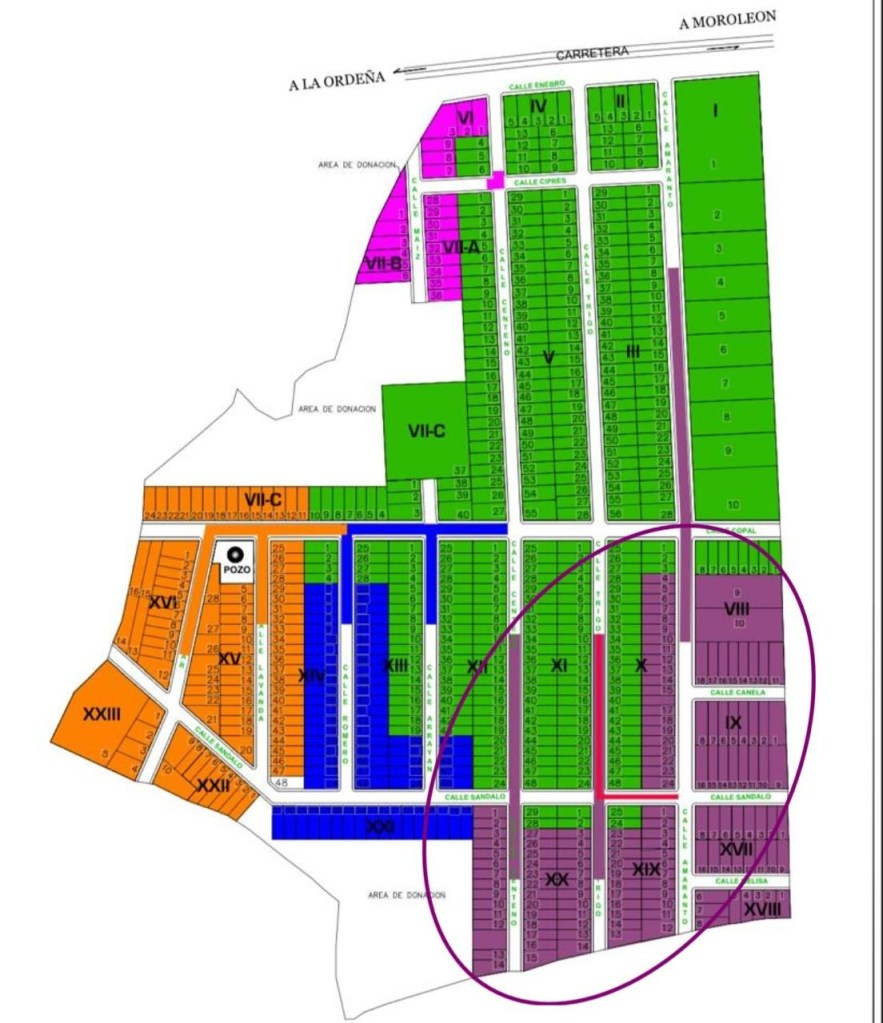
The three main roads will have the lines finished, and 3 private roads will have posts installed. There’s a total of 11 posts and public lighting in those areas. All the lots in the dark purple area will then have access to electricity. The green areas are those that were covered by the grant last year. 

When we set the second-semester aportación (community fees) last year, this project was included in the total amount requested. So those who have paid their aportaciones for 2024 had nothing more to contribute. Unfortunately, a good portion of colonos are in arrears, and without their money, we won’t be able to pay the contractor. 

We sent an update letter in February to all the colonos and followed up with a personal messenger appointment notification in September for those that were not up to date with their aportaciones. Super Prez wanted to make home visits, but I objected. I didn’t have time for that. So the personal messenger was the compromise we made. We then set aside every Tuesday in October to receive these delinquent property owners. It was a colossal waste of time. The money received from this batch of foot-draggers didn’t even pay for the cost of having the notices delivered. 

The next step is some sort of legal action. As we are a colonia, property owners are expected to abide by the regulations set forth by the community, one of which is payment of the aportaciones for community projects. In June, we had several lengthy community meetings to share those regulations with community members. These estatutos hadn’t been updated since 1995. Some of the bylaws were eliminated, including one that prohibited unmarried individuals from owning property in La Yacata. Others were clarified, such as the procedure for unbecoming community behavior, which includes non-payment of aportaciones. And some were added, like the formation of the Consejo de Honor y Justicia (more on that fiasco in another post). 

During October’s community meeting, we brought up the idea of multas (fines) for those who have not paid. The asemblea determined 20% would be acceptable and that these deadbeat colonos would be referred to the CEJA (Centro Estatal de Justicia Alternativa) office in the next town over. 

There was a small rush on payment of aportaciones the Tuesday following the junta, but not enough to make a dent in the amount we would need to pay for the current electricity project. Super Prez then asked for the phone numbers of colonos who have not paid, and he spent some time calling them to encourage them to pay up. Again, there was a small trickle of funds, but not enough to justify the time invested. 

Super Prez again brought up the idea of home visits, and I shook my head emphatically. What we need to do is go to the CEJA office and find out what they need to start calling colonos in for mediation. 

Unfortunately, there was a new wrench in the works. In June, the presidencia authorized escrituras (individual deeds), and the paperwork involved for that has been taking up every waking minute right now, but more on that in the next post.

***

Need to see how it all began?

Check out La Yacata Revolution: How NOT to Buy a Piece of Heaven in Mexico available on Amazon.

Leave a comment

Filed under La Yacata Revolution

Natural Healing — Guaco

Guaco is the common name for plants in the Aristolochia genus, not to be confused with Cleome serrulata or Mikanie guaco, which are also known as guaco. There are at least 500 species of Aristolochia, mostly found in the tropics. Approximately 65 are native to Mexico. At least three have been very recently discovered and named; Aristolochia purhepecha found in Michoacán; Aristolochia chiapensis native to Chiapas; Aristolochia emiliae in Jalisco. 

Guaco flowers have a strong odor to attract insects, which then become caught in the perianth tube. Once an insect has been captured, the hairs wither, and the insect is released, now covered with pollen. 

Most often, guaco is prescribed for stomach ailments or pain relief from poisonous bites and stings. Although guaco is the most common name in Mexico, some species of the plant have other regional names. 

Aristolochia plants have been shown to be anticancer, antibacterial, antiparasitic, and antiviral. They also have antiplatelet, antioxidant, anti-inflammatory, and neuroprotective activity. Additionally, the plants have demonstrated antifibrotic activity and anti-diabetic potential. Many varieties cause changes in the estrous cycle, and no remedy containing guaco should ever be taken by pregnant women as the plant is toxic. 

A few studies have been done on specific plants in the Aristolochia genus. Aristolochia taliscana exhibits antimycobacterial, anti-inflammatory, trypanocidal, and neuroprotective activity. A plant decoction is made to treat malaria.

Aristolochia trilobata (bejuco guaco) demonstrates antinociceptive and anti-inflammatory effects. A vaginal douche to treat infection is made by boiling a leaf in ½ cup of water and the root is heated and placed directly on a throbbing tooth infection. 

Photo credit: Zazil Dellamary 

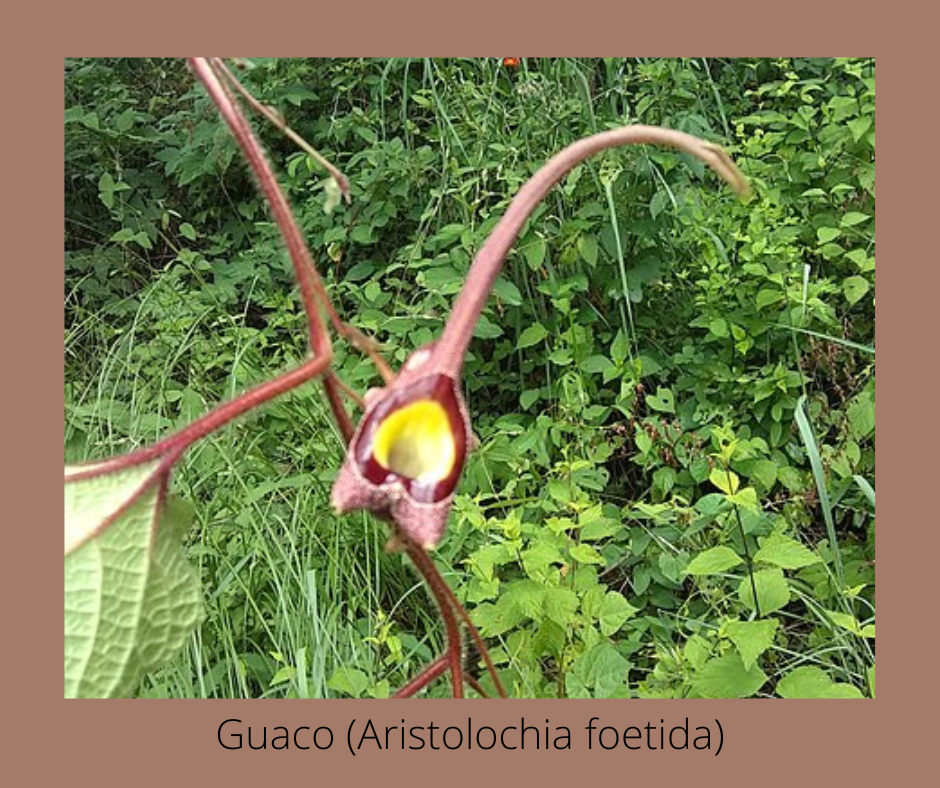
Aristolochia foetida shows cytotoxic potential against breast cancer cells. 

Aristolochia Mexicana is tlacopatli in Nahuatl and was used to treat urinary tract infections and speed labor during a difficult birth. Francisco Hernández reported its use in the treatment of abscesses, dysentery, and deafness. He described two varieties, coayxtelolotli (Aristolochia odoratissima) and Tomahuactlacopatli (Aristolochia pringlei), utilized in the treatment of venomous bites and stings. 

Photo credit: David J. Stang

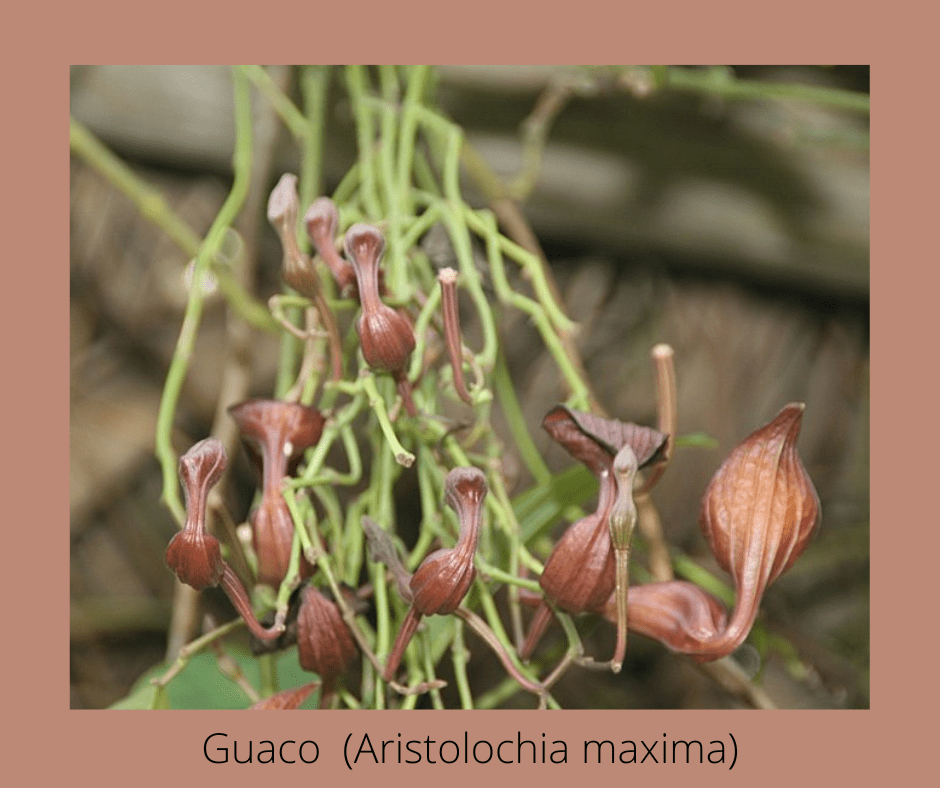
Aristolochia maxima has the botanical synonyms Aristolochia geminiflora and Aristolochia constricta. It’s native to South and Central America. In Guatemala, it is known as canastilla and in parts of Mexico, it is known as tecolotillo and wako aak’ in Maya. It’s often prescribed as a root decoction for stomach pain. Studies have shown that it reduces the severity of opiate withdrawal symptoms. 

Photo credit: Hesner Coto Fuentes

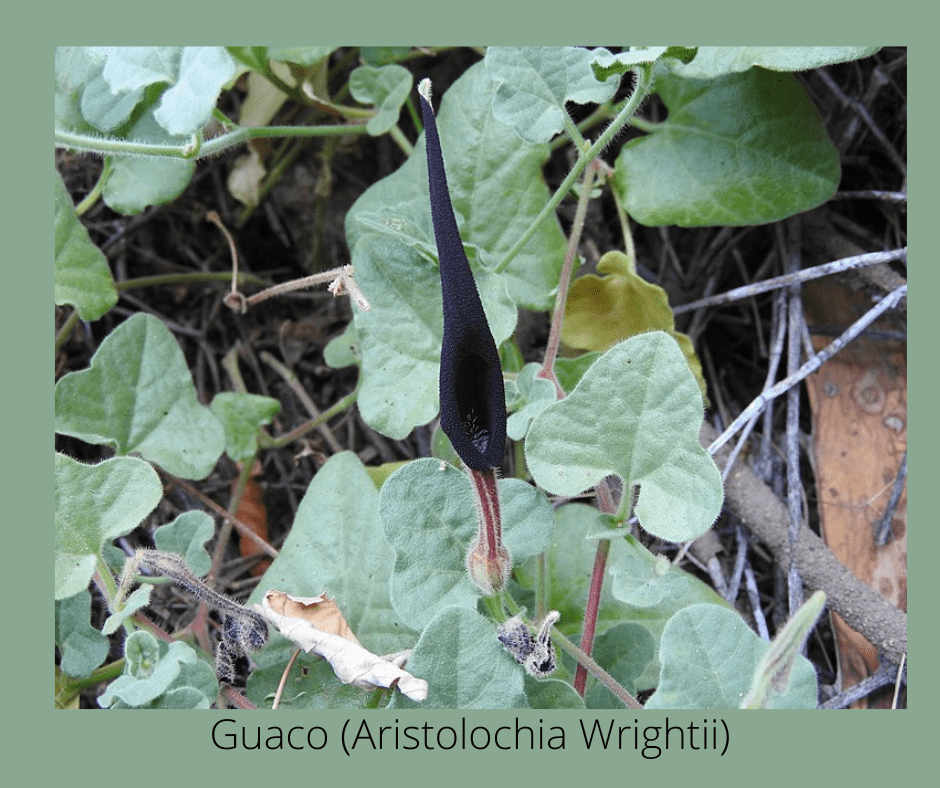
Aristolochia brevipes, with its botanical synonym Aristolochia Wrightii, is often referred to as hierba del indio. It has anti-cancer properties, as well as antimycobacterial and anti-tuberculous activities. Boil five guaco leaves in a liter of water and drink a room-temperature glass every day as a cancer preventative. Gallbladder pain can be treated with the same infusion three times a day cada tercer día (every other day). 

Aristolochia monticola, another variety known as hierbo del indio, is used in Baja California Sur for bilis (excessive rage), digestive issues, and intestinal parasites. It is also used in diabetes treatment and eye infections (lagañosos). For intestinal parasites, one root Aristolochia monticola section is boiled along with the estafiate root (Artemisia ludoviciana subsp. mexicana) and taken daily before breakfast. 

Aristolochia Watsonii, with its botanical synonym Aristolochia porphyrophylla, has stinky flowers that resemble a rat’s ear. The entire plant is toxic. However, it has been used as a treatment for snakebite, in a leaf decoction to reduce fever, and as a substance to expel the placenta after birth. 

Photo credit: John Tann

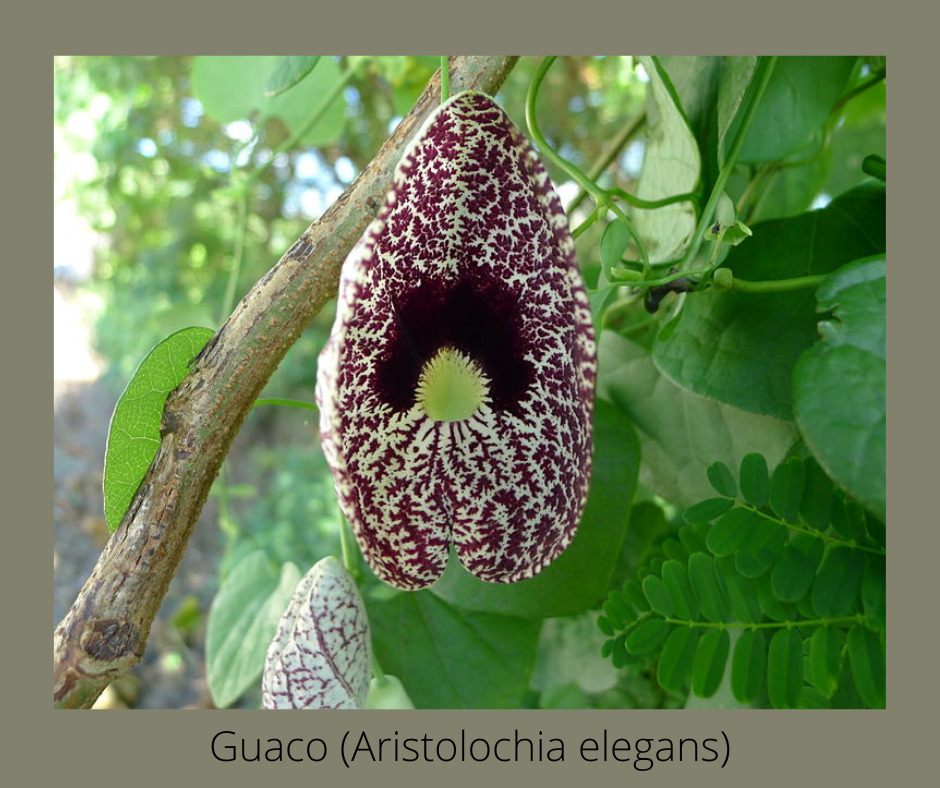
Aristolochia elegans, known as Flor de Cálico or flor de patito, is often used as an anti-venom. Studies have shown that the roots are an effective treatment for scorpion sting symptoms. The plant also demonstrates antiparasite and antimycobacterial activity.

A poultice for scorpion stings is made by dampening the crushed plant with warm water and placing it on the stung area. In addition, a hot infusion is made with one leaf in a cup of boiling water drunk at three-hour intervals until the pain subsides. 

Photo credit: Charlie Jackson

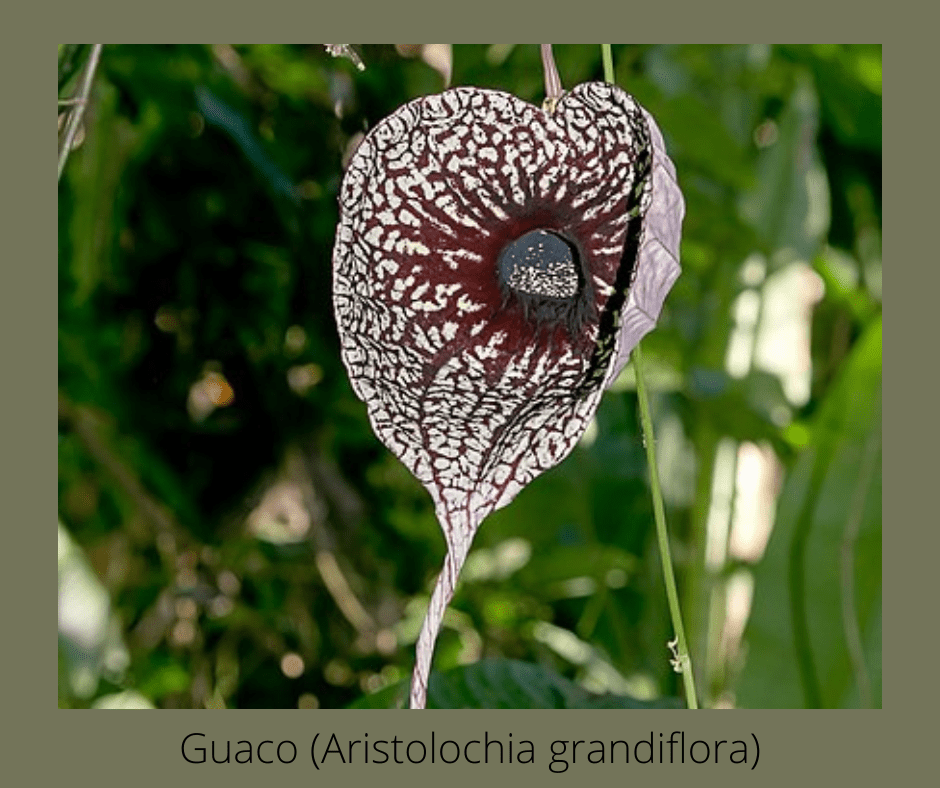
The entire Aristolochia grandiflora plant is used as an anti-venom in the event of snakebite. The leaves are made into a poultice for rheumatism pain. Aristolochia asclepiadifolia Brandegee, native to Veracruz, is prescribed for dysentery and poisonous stings and bites. 

One cup of a tincture, about ten milliliters, made from five guaco stem pieces about six cm long, soaked in five liters of aguardiente (liquor), is a recommended diarrhea treatment. Because of the toxicity of the plant, it should only be administered once per illness period. If diarrhea continues after this treatment, another remedy should be given that does not include guaco. 

Aristolochia odoratissima, also known as cuaco, sombrerito, hediondilla is prescribed as a stimulate, diuretic, and antipyretic. The leaves are used as a poultice for swollen lymph nodes, venomous bites or stings, and sciatic or arthritis pain. A tea infusion made from the roots or flowers is prescribed for arthritis pain.  Studies show that the plant does provide an analgesic effect. 

Photo credit: Kurt Stüber

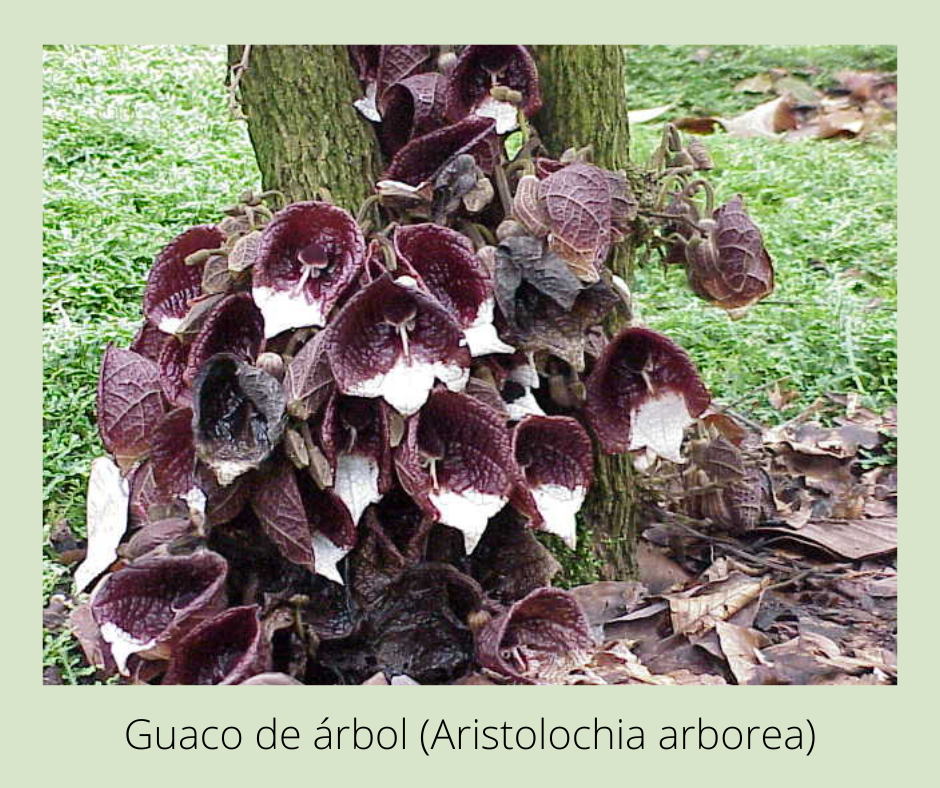
Aristolochia ovalifolia and Aristolochia arborea (guaco de árbol)  are used as snake bite treatments in Veracruz. Aristolochia pentandra is the species used in Tabasco and Yucatán. Additionally, Aristolochia pentandra is given for stomach pain (empacho) and used in wound care. An antiseptic wash is made from the flowers. Aristolochia impudica (guaco de palo) is prescribed for snake bites, cough, heart pain, and diarrhea. 

One snake bite treatment calls for five 2.5 cm guaco stem sections harvested from a mature plant, a dry seed from the crucetillo (Randia monantha Benth), and a piece 3 to 5 cm of  contrayerba (Dorstenia contrajerva L.) These are added to a liter of aguardiente (alcohol) to make a tincture. After being bitten, the person should drink a “trago” (shot) of the tincture and head to the nearest clinic or hospital for further treatment. 

As a treatment for cansancio (fatigue), the guaco tincture does not include crucetillo or contrayerba. One tablespoon is recommended each week. As a treatment for skin diseases, small amounts of shade-dried root powder are taken orally for 48 days.

*** 

Interested in natural remedies? Uncover herbal remedies from traditional Mexican sources for healing and wellness in the Exploring Traditional Herbal Remedies in Mexico series.

Leave a comment

Filed under Health, Native fauna and flora, Natural Healing