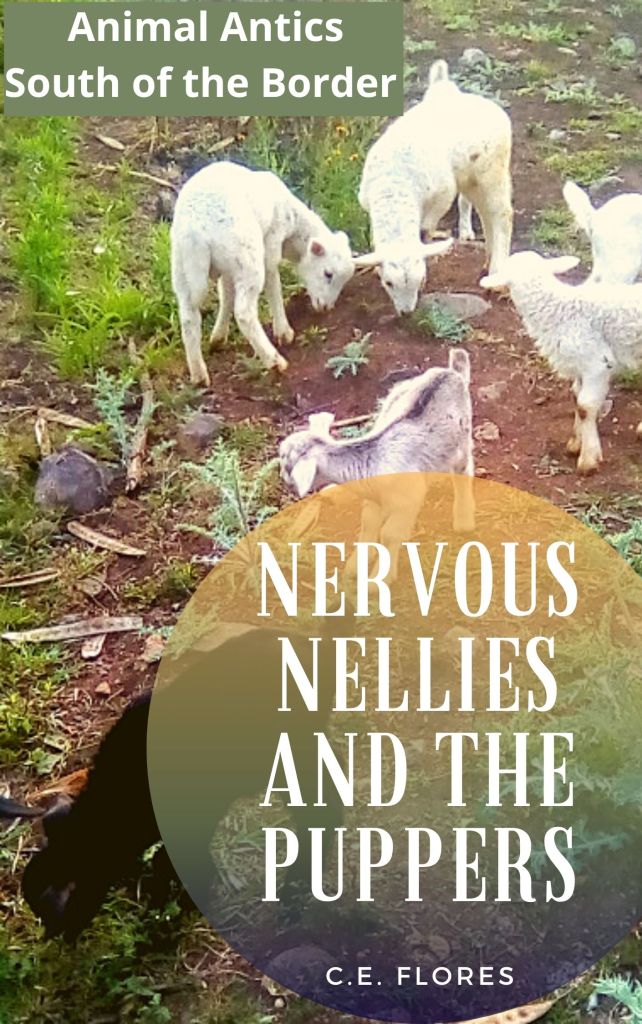
I didn’t sound the trumpets when the second volume of Animal Antics South of the Border was published in December because I was busy working on other things. So I’d like to remedy that and make a bit of hoopla as I formally introduce Nervous Nellies and the Puppers: Animal Antics South of the Border to the general public.
The animal hijinks continue in Animal Antics South of the Border book two. Ride along with the Flores family as they wrangle goats, sheep, horses, chickens, cats, dogs, and rabbits during the 2020 pandemic lockdown in central Mexico. From keeping the Grim at bay to raising Elvis’ love children, what could possibly go wrong on the ol’ homestead?
These fascinating animal exploits begin when an ordinary family of three moves from the suburban U.S. to rural Mexico and buys a donkey. Over the course of a decade, their animal kingdom experienced oodles of triumphs and adversities. Who knew bananas, red rags, and phases of the moon have so much to do with livestock success?
So if you’ve got a hankering for animal madness, then these are the books for you!
My artistic friend and personal illustrator, Claudia Guzes, gave me a 2022 planner when we met up for our children’s book series pow-wow in December. I didn’t notice until later that her artwork was on the cover. When I asked her about it, she said the company has contacted her about creating a design. And what a design it was. She illustrated Tonantzin, the mother of all and diety whose holy place became the place the La Virgen de Guadalupe first appeared.
I didn’t notice that Claudia had included this blog as part of her work description until later as well. She mentioned the book we’ve worked on together about Moroleon too. Cool beans! Anyway, the planner is awesome! I’ve already begun filling out my 2022 projects list.
If you are interested in a uniquely designed 2022 agenda yourself, check out chacharitas.kraft on Instagram or Facebook and see what they have to offer!
Photo credit: Allen Gathman Equisetum hyemale subsp. affine
The other day in the market, I noticed several bound herb packets including te de limon and manzanilla. The third mound was unfamiliar to me, so I asked about it. The woman selling them said it was cola de caballo and was for kidney disease. All righty then, time for another plant study!
Cola de caballo (Equisetum spp) is also known as equiseto, limpiaplata, cien nudillos, cola de rata, caña carricillo, and candalillo in Mexico. This plant is believed to have been part of the staple diet of herbivorous dinosaurs. There are about 30 species and subspecies in the Equisetaceae family, which reproduce by spores rather than seeds. At least three varieties, Equisetum hyemale subsp. affine, Equisetum laevigatum and Equisetum myriochaetum, are native to Mexico.
Traditionally in Mexico, it’s used as a diuretic, for kidney stones, and bladder or urinary tract infections. It’s also used in treatments for gout, wounds, hair loss, conjunctivitis, cough, diabetes type 2, and to increase energy. The young shoots are eaten as a vegetable. It has a grassy flavor, as to be expected.
A tea made from romerillo (Viguiera linearis) and cola de caballo (Equisetum laevigatum) is prescribed in Chiapas, Durango, and Sonora to treat urinary disorders. In Oaxaca, a tea prepared with 4 teaspoons dried or 8 teaspoons fresh of leaves, flowers, stems, and roots (Equisetum hyemale subsp. affine) in 1 cup of boiling water is given for kidney stones. Allow the infusion to steep from 5-20 minutes. Strain and drink daily before meals. In Chiapas, Guerrero, and Oaxaca, cola de caballo (Equisetum myriochaetum) is combined with barba de maíz (Zea mays), corn silk, for treatment of kidney ailments. Seven to 12 grams of each ingredient is added to ½ liter of water and boiled for 15 minutes. Two cups are prescribed daily. Yet another kidney stone treatment calls for a decoction made from cola de caballo (Equisetum myriochaetum), nopal paddle (Opuntia ficus-indica), and gobernadora leaves (Larrea tridentata) prepared every morning and cooled by the morning dew for 40 days.
A wash for wounds consists of 200 grams (Equisetum myriochaetum) boiled for 30 minutes in 2 liters of water. Because cola de caballo has a high silicone content, it is believed that drinking a daily infusion will promote shiny hair and strong nails.




 Surviving Mexico