Adorning the Chim-chiminy

If you remember, one of my goals for 2020 was to finish the front of the house. There are several small projects that need to be done for that to happen, one of which was the adornment of the chimney face. 

My husband had a bee in his bonnet that he wanted to use what he called “pasta” to make a design. So we spent nearly three fruitless weeks looking for a place that sold pasta. Every place that we were referred to had gone out of business it seemed. Finally, we found a ferretería that sold this pasta–which is actually called PegaDuro Piedra en Polvo. 

Examples of molds. We wanted the top one.

In order to make the design, you need a mold of some sort. The PegaDuro spreads on with a play-dough like consistency, then the mold is pressed into it while it’s still wet to make the pattern. We looked through the catalog and picked a color and molding design. 

Of course, when the supplies were delivered, the ferretería had sent some sort of texturing device instead of a mold. Back to the store we went. It turns out, the piece we had paid for was the texturing thingy, not the mold. The mold would cost $1,500 pesos and they didn’t even have the design we wanted. My husband was having none of that.

He decided that he’d make his own mold and he wanted to use my bath. I objected. Then he said he’d use the car mat. I was still making faces at the idea. Finally, he said we could get a tile piece and use that as a mold.
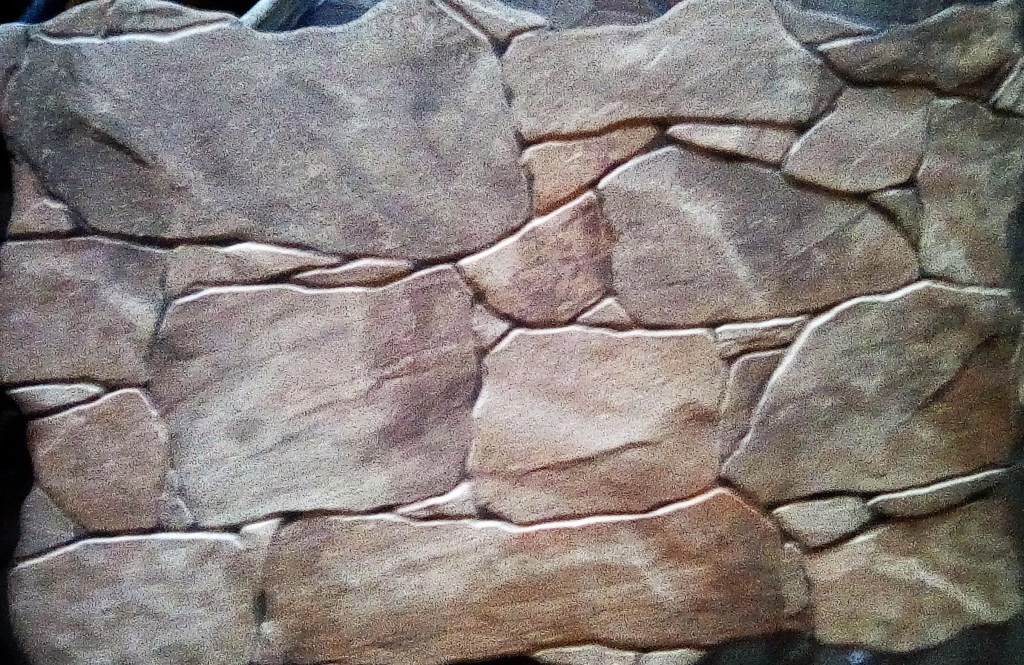
This is the design I wanted.

We went to the tile shop and bought one tile for $83 pesos. I wanted to tile the section to begin with, but my husband said it would cost over $2,000 pesos just for the tile plus we’d have to get the grouting and adhesive and stuff. My second suggestion was that he use rocks from around La Yacata. There are plenty of those, it would be free, and I already know he can do a fabulous job based on our two fireplaces. Nope, pasta it would be.

Well, the tile didn’t work as a mold. As I mentioned, the consistency is like play-dough, so it just stuck to the tile. While my husband was hemming and hawing, my son decided to try and draw a pattern with a stick. I have to say, it didn’t turn out too bad. It’s not exactly what I had in mind, but I suppose it will do. I also noticed that the very top of the chimney seems a bit lopsided, but I think I won’t mention that at all.

Currently, the three of us are in a heated debate about what color to paint the house, so the next step might take awhile. 

2 Comments

Filed under Construction

Natural Healing–La Miel Sagrada

As if you needed another reason to consume honey regularly, here’s a little bit of information about the sacred Melipona honey. 

gailhampshire from Cradley, Malvern, U.K [CC BY (https://creativecommons.org/licenses/by/2.0)]

The Maya used the honey from the native stingless bee Melipona beecheii extensively in their traditional remedies. They believed that illnesses that could be cured with this honey had supernatural origins. It was used to treat both “hot” and “cold” infirmities including respiratory and digestive ailments, cataracts, pterygium eye and conjunctivitis, as well as wounds, burns, fevers and poisonous stings and bites.

The reason supernatural illnesses could be treated with this honey was because they believed it was a sacred gift from the gods, specifically the bee god Ah Muzen Cab. The Maya communities continue to use this sacred honey to treat cancer, sinusitis, typhoid, laryngitis, bronchitis, cough, bacterial infections and postpartum issues. It has and continues to be used as a sweetener, an antibiotic and the main ingredient in the fermented drinks balché and Xtabentun.

When Francisco Hernandez de Cordoba first arrived in the Yucatan in 1517, he encountered enough bee yards producing honey that was traded throughout Mesoamerica. The importance of this activity is evidenced in the Madrid Codex, one of the four surviving Maya codices, which was devoted entirely to beekeeping.

Honey contains iron, calcium, potassium, magnesium and vitamins B1 to B8. It is antimicrobial, antiseptic and anti-inflammatory, making it ideal for pain alleviaion in the throat, and as a result of burns and ulcers. Applied topically, it will moisturize the skin and is beneficial in wound healing. Honey can help ameliorate thyroid disturbances and reduce the risk of developing diabetes as well as fight cancerous cells. 

Regular honey consumption lowers cholesterol and reduces the occurrence of cardiovascular disease. Honey can help alleviate dehydration and potassium loss caused by diarrhea. Furthermore, it aids in digestion and reduces issues caused by gastroesophageal reflux disease (GERD).

The amount of nutrients that honey contains varies according to the local plant source.To determine whether a particular batch of honey is pure, drop a spoonful into a glass of water. Adulterated honey dissolves, while pure honey remains in a ball. Honey can be stored at room temperature. If it crystallizes, setting it in a pan of hot water will liquidize it again.

Melipona honey is slightly different than honey made from other types of bees. It is more watery, less prone to crystallization and contains more fructose than glucose giving it a distinct taste. The honey from these stingless bees has more antioxidant and anti-inflammatory properties than honey produced by stinging bees. 

The Melipona bees are in danger of extinction. The ecosystem which they have co-existed for centuries is being destroyed. They are also facing increasing competition with the Apis mellifera bees since commercial beekeepers prefer their more abundant honey production to the native species. If you are in the Yucatan, be sure to take advantage of the local sacred Melipona honey available to you.

Precaution: Honey should never be given to children under one year of age because it may cause botulism. 

Have you tried Melipona honey?

***

Interested in natural remedies? Uncover herbal remedies from traditional Mexican sources for healing and wellness in the Exploring Traditional Herbal Remedies in Mexico series.

Leave a comment

Filed under Health, Native fauna and flora, Natural Healing

Paro Nacional de Mujeres

March 9, the day after International Women’s Day, has been declared a Paro Nacional de Mujeres (Women’s Strike) in Mexico in protest against the continued prevalence of femicide and violence against women throughout the country. 

As a permanent resident of Mexico, I am not permitted to join in the numerous protests #ParoNacional that happened yesterday. However, I am showing my support by refraining from working, shopping, or using social media today. (This post has been scheduled in advance.) #UnDiaSinNosotras

Current estimates state that at least 10 women are murdered in Mexico every day. It may be substantially more but men, women and children disappear in this country at an astounding rate. Many times their bodies are never found. And if they are, local Mexican authorities may not have the capability to analyze and identify remains or they aren’t interested in doing so. Impunity is sky high here as well. Fewer than 5% of all criminal activities have a perpetrator that is held accountable. 

I’m not naive enough to believe that one day of outrage is sufficient to change Mexican society overnight. However, perhaps it’s a start.

2 Comments

Filed under Safety and Security