It’s that time again! A new Herbs and Essential Oils offering from Ultimate Bundles is available. Honestly, it’s hard to get essential oils where I live in central Mexico, so I’m only lukewarm about those items. But the herb stuff! Now that’s what I’m talking about!
With COVID and now the flu season kicking into high gear, I’ll be spending just as much time at home as I have for the past few months in self-quarantine. My fingers are tingling to get started on some of the resources in the bundle. Who wouldn’t want to try some Healthy Herbal Sweets? There’s an ecourse for that! EEEK! Exciting!
Then for those of you homeschooling, there’s a Mom and Me Herb Bundle Lesson with printables to keep those little minds active! And the Quick and Easy Family Favorite Recipes: Use Essential Oils in the Kitchen to Make Your Food POP with Flavor! ebook will liven up your dinner table.
If you’re looking for gift giving ideas, then you can’t go wrong with the DIY Herbal Gifts for Men, Herbs and Essential Oils in Soap Making, Natural Facial Soaps, and Relaxing Home Spa: 24 Natural Recipes for Self-Care ebooks.
If you really want to dive into herbal lore, then Medicinal Herbs Materia Medica Starter Pack ebook, The Herb Study Notebook: A Printable Guide to Deepen Your Herbal Knowledge, One Herb at a Time printable, and Making Herbal Preparations 101 by Herbal Academy ecourse are sure to please. You know I’m a big fan of Herbal Academy courses!
If you are interested in what you can do to boost your immunity with herbs, then An Herbal Winter, Simple Remedies for Cold and Flu Season, and the Echinacea 101: How to Use Effectively During Cold and Flu Season ecourses will appeal. The Happy & Healthy Holidays: The Ultimate Guide to Using Essential Oils for Health, Home, & Hosting, Healing Kitchen Herbs: 12 Common Herbs With Powerful Medicinal Benefits, and Herbal Teas for Winter Health ebooks will certainly make interesting reading in that regard as well.
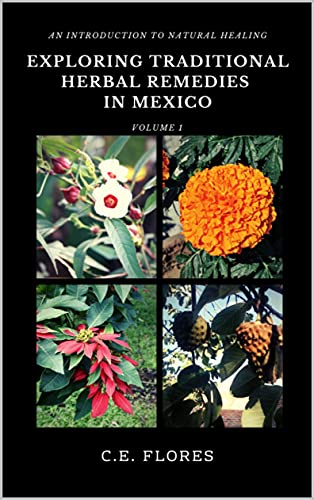
Now, it’s time to toot my own horn here. My latest herbal compilation Traditional Mexican Herbal Remedies is part of the bundle. It includes 20 herbs, or rather 19 and miel sagrado (sacred Melipona honey) and their medicinal use by Mexican healers as well as scientific research on their effectiveness in treating a variety of ailments. This little book is ONLY available through Ultimate Bundles which will ONLY be available November 16 – 20.
All in all, you’ll get 18 ebooks (including mine), 11 courses, 6 printables and workbooks, worth a total of worth $684.36 for $37. WHOO HEE! I’m all set to liven up my self-quarantine with a little herb action! How about you?
When basil was first used in Mexico, medicinally is a little unclear. The plant ocimum basilicum is most often referred to as albahaca or alhábega in Mexico. The origin of those words implies that basil was yet another herb that came with the Spaniards since herbs with the prefix al- were Moorish derivatives. So in Mexico, you’ll find albahaca blanca (white basil), albahaca corriente (wild basil), albahaca de castilla (Castile basil), albahaca de la tierra (ground-growing basil), albahaca morada (purple basil), and albahaca arribeño varieties among others.
However, some believe that at least one variety, Ocimum campechianum (Cinnamon basil), known as albahaca de monte (mountain basil), is native to Mexico. The fact that there are terms in Nahua (talachía) and Maya (Kha-kal-tun) for Ocimum basilicum seem to support that theory, as do some of the traditional medicinal uses.
Albahaca is used to treat bilis, a Mexican infirmity that is believed to be caused by sudden rage (coraje). Bilis is the Spanish word for bile. The Aztecs believed that the liver was one of the three centers of energy. Strong emotions were centered in the liver, which would then become enlarged when there was an excess of emotion. It was thought that after this extreme emotional outburst, the person would show symptoms of bilis, including intestinal inflammation, gas, constipation, vomiting.
One remedy for bilis included leaves from albahaca, tomato, estafiate (white sagebrush), yerba buena (spearmint), orégano de monte, and a piece of nopal root from the Opuntia cactus. The herbs and root are simmered for 10 minutes, then strained. One cup is drunk daily for 9 days before breakfast.
Albahaca is generally used for digestive issues, which may or may not be caused by bilis. Twenty grams of basil and 200 grams of water are drunk three times daily to stimulate digestion. Ocimum basilicum is an effective remedy for preventing colitis, gastric ulcers, and diarrhea.
If your upset stomach or attack of coraje is caused by parasites, albahaca has you covered there too. Intestinal parasites are treated with 10 grams of albahaca and 100 grams of water drunk on an empty stomach. Another remedy for expelling parasites calls for fresh basil simmered for 15 minutes and strained. One or two drops of anise oil are added to the tea and drunk as needed.
Caída de mollera (sunken fontanel) is another Mexican ailment that is often treated with albahaca. This condition occurs when the soft spot on a baby’s head seems to be concave. Newborn babies are not held upright in the belief that this will cause caída de mollera.
In addition to a sunken soft spot, other symptoms include vomiting or diarrhea. A sunken fontanel is often a sign of dehydration. Traditional treatment for caída de mollera includes giving the baby weak infusions of albahaca or manzanilla (chamomile), which soothe the digestive system and provide some of the needed liquids as the baby recovers.
Isihuayo is a term used to describe the displacement of a woman’s uterus after she has given birth. Talachía (AKA albahaca) is used to help settle her organs back into place. The woman squats over a steaming infusion of Ocimum basilicum as part of after-birth cleansing rituals. As albahaca has antiseptic, antibacterial, and antidepressant properties, this may be an excellent way to get a new mother back on her feet.
In many areas, it is believed that brujas (witches) can not tolerate the smell of basil. So you’ll sometimes find a basil plant along with an aloe vera plant (which witches reportedly fear) at the entrance of a business as a ward against evil. Although I can’t attest to the anti-bruja effectiveness of albahaca, it is a reasonably efficient insect repellant.
Albahaca is also used in Mexico to help with breathing issues. One remedy calls for boiling 6 leaves in ¼ liter of water for five minutes and then allowed to cool. This is drunk morning and night without added sugar for five days. Studies have shown that the anti-inflammatory properties found in basil are indeed useful in the treatment of asthma and lung inflammation.
If you have canker sores, try gargling with 40 grams of albahaca and 200 grams of water. Remember, basil is anti-bacterial, and it just might bring you some relief. If you have an earache or are experiencing ringing in the ears, ground leaves on a cotton ball placed in the ear might help.
For rheumatism, a rub can be made with one liter of alcohol and equal parts of albahaca, ruda (rue), and romero (rosemary). Use this linament on affected areas for 8 days. Basil has is an analgesic which would explain why this treatment is so effective. Migraines are also reduced in frequency and severity after basil essential oil is applied to the temples every eight hours.
Regulation of menstruation is another condition that albahaca is called upon to remedy. One method is to drink 4 cups of 100 grams of basil per liter of water. Another technique consists of a spoonful each of dried ruda (rue) albahaca, and yerba buena (spearmint) steeped in a cup of boiled water.
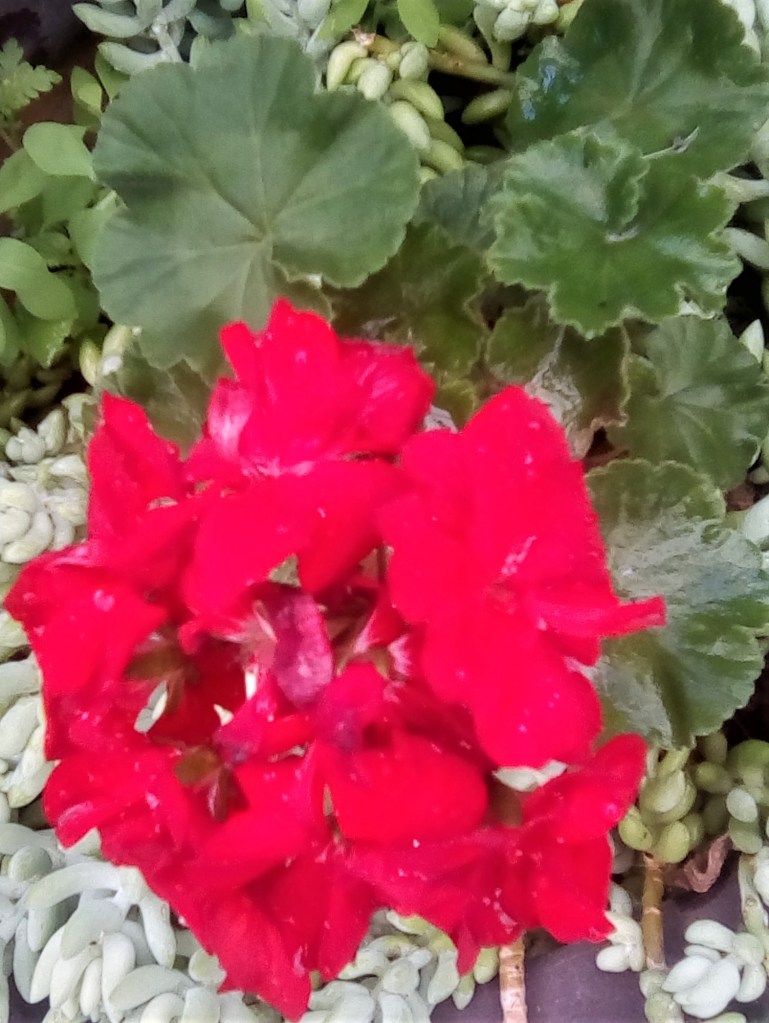
Every so often, my husband will head out to my garden and come back chewing something or other. Sometimes it’s an actual fruit or vegetable. Sometimes it is a leaf off my Wandering jew plant and sometimes he’s salted and eaten a leaf from my geranium plant. He swears that it was the remedy Mama Sofia (his grandmother) would prescribe when he had a bit of a stomach ache.
Not one to let unexamined herbal remedies slide by, I set about to find more on this plant. The genus for this plant is pelargonium spp and there are nearly 300 varieties. It is native to South Africa but was brought to Mexico in the seventeenth century.
Although a favorite of certain species of butterflies, the Japanese beetle becomes paralyzed after eating geranium flowers. It seems that they contain quisqualic acid which causes excitotoxicity (nerve cell death).
In Mexico, geranio leaves are mashed with vinegar and salt and applied to the forehead to alleviate headaches. A decoction made from red geranium flowers is used to treat diarrhea. Another diarrhea remedy calls for a rounded spoonful of ground geranio root boiled in ½ cup of water drunk every hour until the ailment ceases.
An upset stomach can be treated with a tea made from geranio, manzanilla (chamomile) and yerba buena (spearmint). Pelargonium sidoides and Pelargonium endlicherianum have been shown to have anti-inflammatory properties that will indeed calm your stomach. Pelargonium roseum Willd. is antiparasitic and thus another variety that can soothe your digestive system if you have intestinal parasites.
Scented geraniums have long been used in perfumes. Pelargonium quercifolium smells like incense. The Prince Rupert variety has a lemon scent. P. radula has a lemon-rose smell. P. odoratissimum has an apple scent. P. capitatum smells like attar of roses. The aroma of the Reunion Geranium (Pelargonium roseum Willd) has an antidepressant effect.
Pelargonium sidoides is an effective treatment for acute respiratory tract infections. Extracts from the root of this same plant can calm a cough. Rose geranium (Pelargonium graveolens) essential oil has anticancer components.
Not all varieties have been studied scientifically, but there is more than enough evidence to say that geranio belongs in a curandera’s garden after all.








 Surviving Mexico