Category Archives: Native fauna and flora

Animal Doctoring

Having as many animals as we do guarantees that some will fall sick on occasion, no matter how attentive we try to be.

For instance, there was that horrible week when the hens would get the hiccups then fall over dead, and we had no idea what to do.  It did eventually run its course, but we lost 5 chickens.

Then there was the sad event when our new puppy somehow managed to get on the other side of the wall and was accidentally stepped on by Beauty.  Sometimes the only thing to do is to sit by an animal’s side.

But in other instances, the illness or injury is completely treatable, if you know how.  My husband often calls me to “traer el libro” (bring the book) for me to do some on the spot research on a new symptom of one or more of our animals.

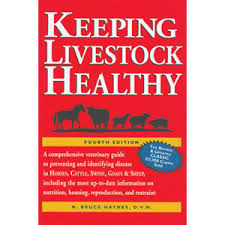
Our library is small and consists of Barnyard in your Backyard and Keeping Livestock Healthy, but for the most part, that’s enough.

barnyardlivestock

When our rabbits kept getting sore hocks, we changed the entire way we kept rabbits, from caged to free range, well, within our yard range anyway based on a section of the Barnyard book.  When the chickens looked droopy, my husband cut a hole in the wall so that they could forage in the goat and horse poop while those animals were grazing, and sure enough, the extra vitamins did a world of good, all based on the Healthy Livestock book.  When one of our nanny goats developed mastitis, we checked the books to see what we could do and did what we could to ease her agony until the infection cleared up.

In addition to our resource books, there are local folklore methods concerning the care of animals. Fortunately, my husband is not one of those men afraid to ask for directions, when it comes to the welfare of his animals that is.  Some of the information he gets seems to be a bit hokey at times, so we cross reference with our books.  If the treatment appears to have some sort of valid basis and not entirely dependent on the warts of a frog during the lunar eclipse, he often gives it a try.

My husband has treated swollen eyes with a spit of salt water.  The first patient was Duchess, the goat, who was accidentally hit by a slingshot stone. (Apparently, there was a passing squirrel my son was aiming at.)  A spit of water and the swelling was completely gone within the hour.  The second patient, Shadow the yeguita (female colt) also was struck by a misdirected stone thrown to scare her back from jumping a fence that was much too high for her young legs.  Again, the spit of salt water, my husband actually spits into the eye, and the swelling went down.

The most recent examples of this folklore animal medicine can be illustrated with the unfortunate injuries sustained by our horses, Beauty and Shadow.

beauty's leg

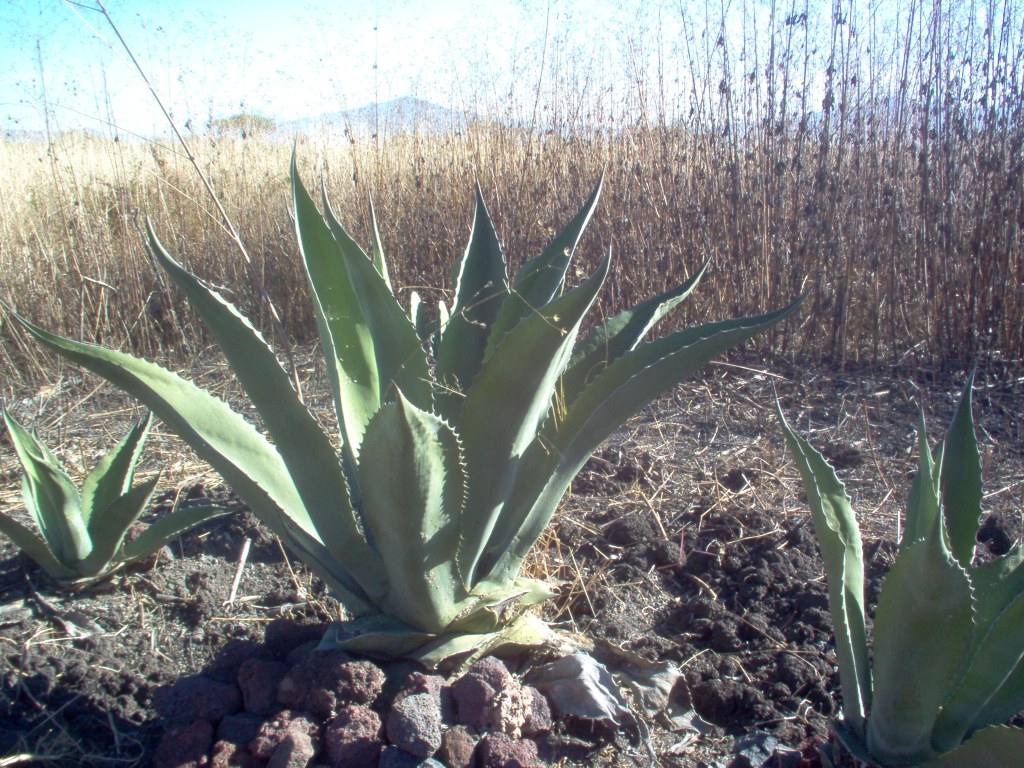
Beauty came up lame one day and what appeared to be a superficial cut above her front hoof became a gaping hole overnight.  My husband thinks that she opened it with her own hoof while dancing. Yes, she actually dances continuously in her stall at night.  As it was on the bend of her foot, it could not be sewn up. He was, at first, dismayed and unsure how to help in the healing since she opened it anew every time she went out to graze.  He asked around.  One person told him to echar aqua de la mata de toro (bull’s weed water).  Another told him to cover the wound with hoja de sábila (aloe leaves).

mata de toro

mata de toro

Now, I had never heard of mata de toro (bull’s weed), so I couldn’t be too sure of its effectiveness. However, aloe is a herb that I know to have soothing qualities for burns and endorsed its use.  Beauty’s treatment ended up being a periodic dash of Azul (Blue) for infection, a daily wash with boiled mata de toro (bull’s weed) and an overnight bandage of sábila (aloe).  The Azul we purchased at a local vet place, but the other two herbs grew wild in La Yacata, and it was just a matter of harvesting. Her wound is slowly healing, and we hope she will be back up to her regular dance routine soon.

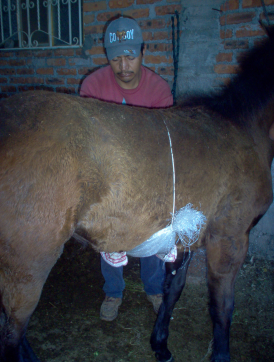
shadow

Little Shadow

Shadow also recently sustained an injury.  One day, she wandered a bit from where her mother was grazing and tried to leap a barbed wire fence.  She’s only 6 months old, so she really didn’t know any better.  A good section of her skin on her underbelly was ripped open, the fur hanging off in one big sheet.  Poor thing.  My husband called in a more experienced horse keeper for advice.  He brought a needle and thread to sew her up.  Of course, she wasn’t too keen on this procedure, so she had to be lightly sedated.  Even under anesthesia, she kicked out several times and had to be held down to get the stitches in.   This was quite a group project.  In attendance in the operating theater, a.k.a. Shadow’s stall, was the tailor, my husband and his father for front and back leg holding, my son, for head holding and nerve soothing, and my sister-in-law, the light holder.  I stood outside the stall and ran for things like clean water to wash with, alcohol to sterilize the needle, rags for blotting, etc.  Beauty, the anxious mother, was behind me looking on and expressed her emotions noisily every few minutes. It was over in about 30 minutes and took another 30 minutes or so for Shadow to recover from the sedative.

aloe

Warming aloe vera to make a poultice

In the morning, my husband made a dressing from hoja de sábila and fashioned a bandage out of a costal (feed bag).  He heated the aloe leaves on the comal (tortilla pan) so that the juices would run well.  Then he cut the sharp edges off the leaves and sliced them down the middle.  The inner sides he placed up so as to be the part that touches the wound and tied on the bandage.  We also have been using periodic treatment with the Azul, which is an animal antiseptic, although it is more purple than blue and a round of penicillin and tetanus shots just to be on the safe side.  We are all hoping for a quick recovery for our little lady.

bandage

Attaching the bandage with the aloe vera poultice

I won’t say that we know everything about healing animals and we may yet discover that what we do on these occasions is not the best way to treat injuries, but we do what we can with what we have and have found that the natural remedies offered in our area often outdistance any man-made chemical when it comes to effectiveness.

********************************************************

A complete Herbal Starter Kit by Herbal Academy

disclosure

4 Comments

Filed under Animal Husbandry, Health, Native fauna and flora

Picking Pitayas

top of cactus

June marks the beginning of the raining season. Most fruits and vegetables are not reading for picking yet, however, the flower of one type of cactus converts to fruit and is ready for harvest at the very beginning of the rainy season. On Sunday, we started off early to minimize heat exhaustion and went in search of pitayas.

presa

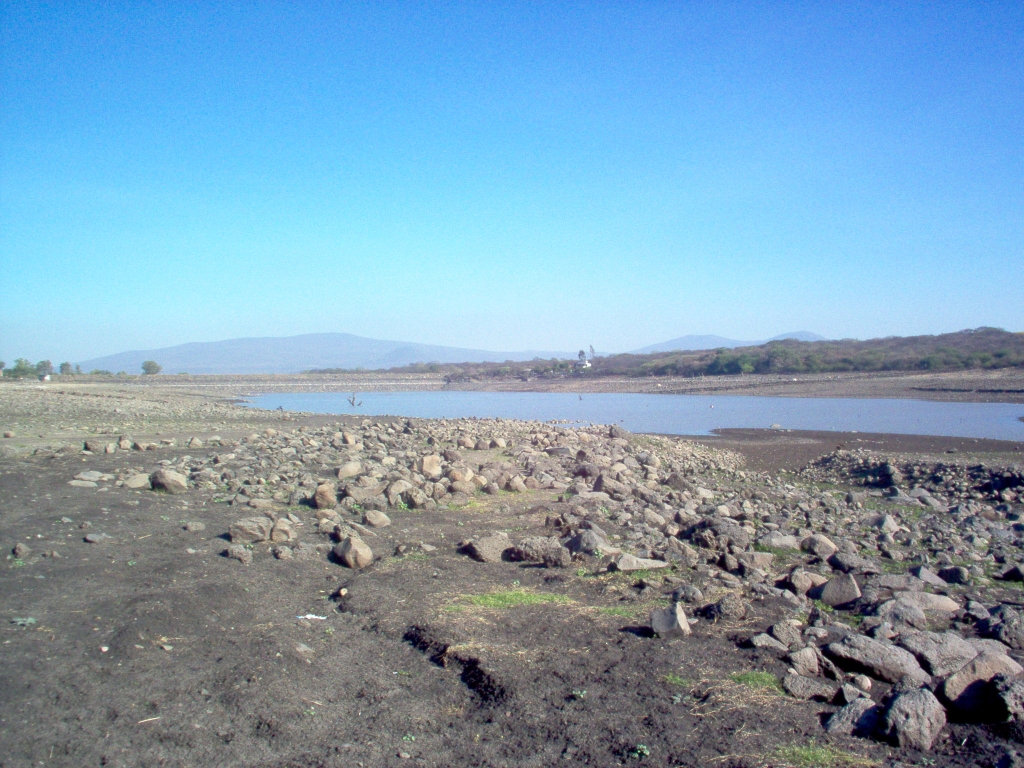
la presa de Quirahuyo during dry season

Quiahuyo

We went to the presa (lake) near Quiahuyo where we fetch our drinking water. (See Water Woes) It was especially low because last year’s rains were less than normal.

bones

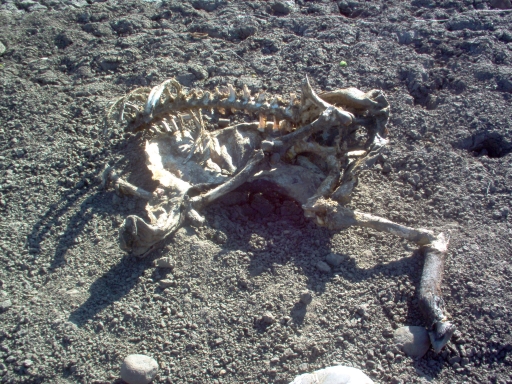
Cow bones found when this section of the lake dried

During the rainy season, this lake is almost 3 times as wide and has hidden deep areas that often become muddy traps for cattle and swimmers.

fishing with nets

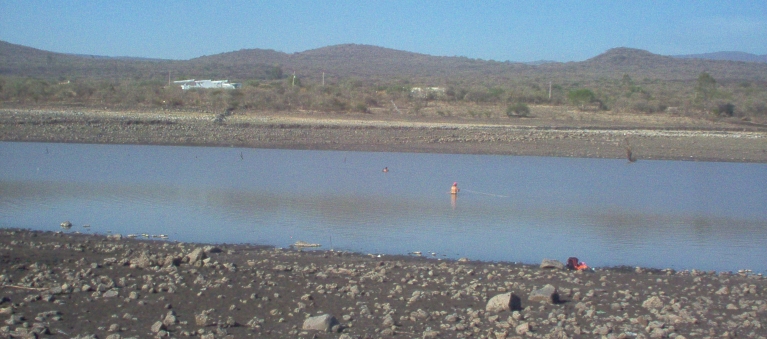
Locals illegally fishing

Even this shallow, the presa (lake) teems with fish.

sign

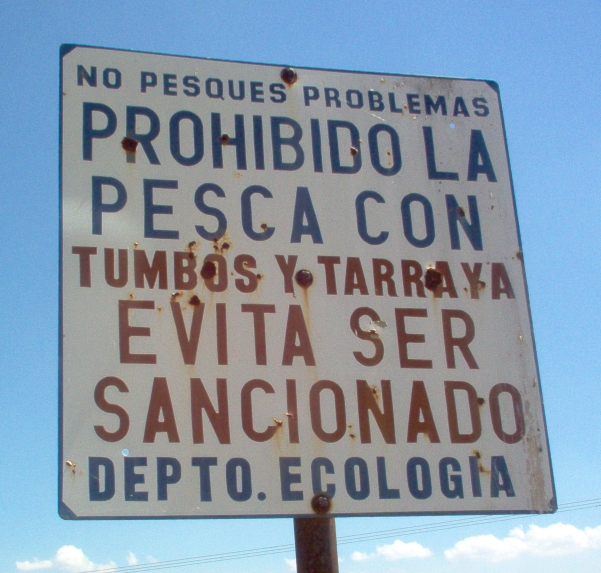
Prohibited to fish with nets in this area

Fishing with nets is prohibited so that the fish population isn’t eradicated, however, that doesn’t stop local fishermen.

Old spark plugs are used in fishing.

Old spark plugs are used in fishing.

All along the edges of the lake, we found rusty spark plugs. Since there was no way for a vehicle to get through the mud and rocks, this seemed odd to me until my husband explained that the spark plugs weigh down the plastic soda bottles that are tied to the fish traps. When the bottle bobs, fish have been caught.

In order to get to the pitayas, we had to cross an area where cows came down from above to drink. As the cattle didn’t seem too pleased to be disturbed, we moved quickly. My son even took off his red t-shirt so as not to attract the attention of the toros (bulls) guarding their herds.

cactus

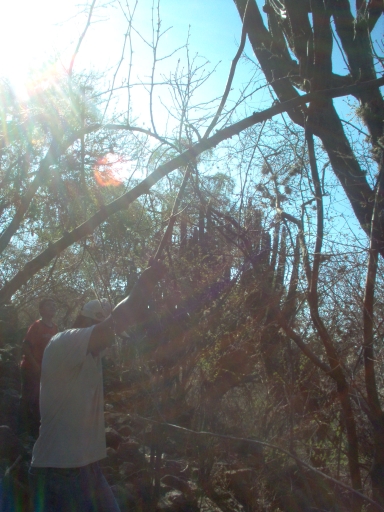
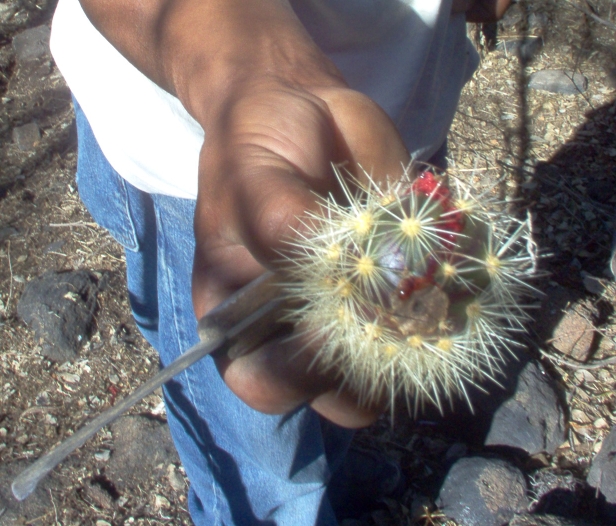
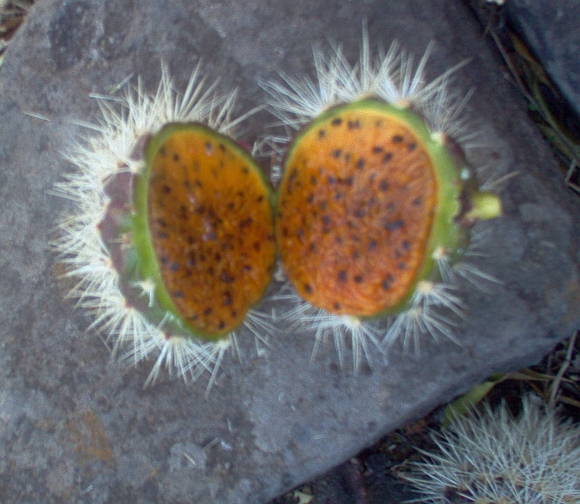
Just a bit further on, we found a good number of cactus. Pitayas are the spiny balls found at the top.

cutting

Cutting the pitayas

Unless you are a chuparosas (hummingbird) harvesting them requires a very long forked stick. Fortunately, my husband is an old pro and we had a bucketful in no time.

pitaya

fresh pitaya

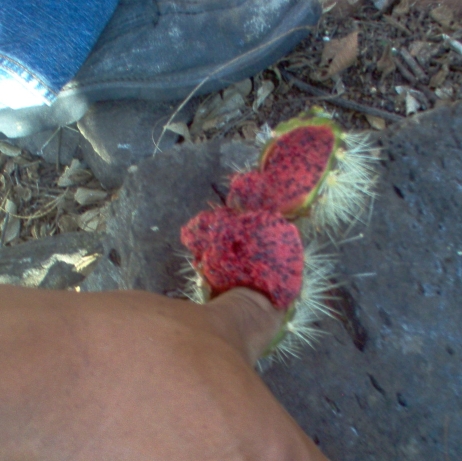
To eat pitayas, you must slice them open, being careful not to get espinas (thorns) in your hands as you hold them still.

pop it out

Pop the pitaya fruit out with your thumb

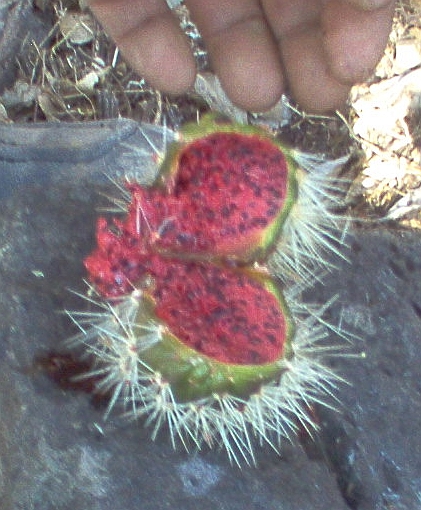
Then, once the fruit is exposed, use your thumb to pop half out and pop it in your mouth, again, checking for stray espinas (thorns). The fruit has the consistency of seedy brains and tastes a lot like strawberries.

red tuna

Red pitaya

Pitayas come in red and yellow, depending on the color of the flower on the cactus. We were in luck and found both and thoroughly enjoyed a sweet treat.

yellow

Yellow pitaya

We are so fortunate to live in an area where the earth provides an abundance for her people. It does take more effort than going to the corner store for chatarra (junk food) but what is life without a little effort?

********************

disclosure

7 Comments

Filed under Native fauna and flora

Separating the sheep from the goats

herd

Our goat herd posing for a picture at our mini-ranch

Mini-ranching on a lot that measures a mere 7 x 20 meters requires careful animal selection. Our animals must be sheltered from the torrential downpours of the rainy season and the staggering heat during the dry. So larger animals like cows were not in the plan. Instead, we opted for goats.

There’s a quite a bit of bad hype about goats but managed properly we have found them preferable in every way to sheep. Goats eat more of a variety of the native plants that grow in La Yacata, are hardier, healthier, give more milk and complain less. They stay bunched around the female boss goat and although sometimes like to dar la vuelta (take a walk) do not startle as easily as sheep.

rainy season foreging

Finding something to eat in the rainy season is no problem at all.

Yes, they like to jump. Duchess is a champion jumper. She managed to spring off the wall and hurtle over the 5-foot fence several times a day. My husband then added another 2 feet of wire, and now she stays put.

almanzo

Almanzo our rent-a-stud

Yes, the macho goats smell. And smell quite a lot during the breeding season. You see, apparently, male pee is like cologne to a female goat, and a macho goat will want to be at his best to entice the ladies, so pees on his own face in the hopes of a little romance. Male goats, if they still have their horns, also have odor areas behind the horns and in a mature male, it does reek! Most of the stud muffins we borrowed or rented for the breeding season (we don’t keep a male goat all year around) have been dehorned and deodorized, so the smell is not quite so bad. Macho goats are a bit territorial when it comes to their flock of beauties too. Once I thought I’d go in the pen to refill the water that had been accidentally spilled while Almanzo was in residence. Well, he didn’t take kindly to my intrusion into his harem, and when I turned to try and scramble out, he gave me a full head-butt on my backside and knocked me 5 feet or so to the wall. Fortunately, he was dehorned, and the only thing damaged was my pride. Nowadays, when there is a macho gigolo in residence, only my husband enters for feeding and watering.

sheep and goats

Goats have hooves that if not worn down by walking or regular filing, grow into enormous curved claws that cripple them. The terrain in La Yacata is well suited for hoof maintenance. Our goats go out several hours a day, jump around on rocks, play king of the mountain and munch vinas (bean-like crunchy seed pods that grow on mesquite trees).

vinas

Vinas (seed pods from a mesquite tree) a goat delicacy!

For the most part, my husband’s “uncha, uncha” keeps them together. My son and I apparently do not have the same authority in our voices, and when it has been up to us to care for the herd for the afternoon, it has been a delight for the goats and a frustration for us. Just like at school when a substitute teacher is in, chaos reigns!

Goats provide milk and meat for our family, although we learned early on not to name those destined for the butcher’s knife. It is awfully hard psychologically to eat the pets! Goat destinies are determined at birth. Girl goats will be breeders, and boy goats are either sold or cooked. After a girl goat’s first successful pregnancy and delivery, we can determine if she is a keeper or to be sold. Keeper goats are those that have good milk production, have twins or are excellent caretakers. Tweedledee, for example, adopted King and Queenie (twins that we purchased shortly after their birth) AND our two little twin sheep whose mother did not have any milk, Vaquita and Torito, in addition to her own kid Princess. Unfortunately, good mothering instincts is not a hereditary trait like twinning. Princess had her first kid this year, but continued nursing from her mother refused to nurse or care for her daughter Spring and managed to find a way to drink her own milk. We sold Princess, and Tweedledee adopted her grandkid Spring.

IM000182.JPG

Vaquita the sheep

My husband has tried twice now, unsuccessfully to keep sheep with our goats. Borregos (sheep) are finicky eaters, so aren’t as delighted with foraging as our goats and thus, require additional alfalfa purchases. They also prefer to eat from the ground rather than a trough but since they won’t eat food that has poop pellets in it, waste more food. Sheep startle easily and then run blindly around. One day, my husband and I left the herd with our son and went up the hill, no more than 5 minutes away, to tie the horses. When we got back, my crying son told us that the 2 new sheep had run off and now were at the bottom of a neighbor’s ajibe (dry well). Fortunately, the water was only up to their necks, but it took some doing to haul them out. And talk about bleating! Sheep carry on whether there is food in the trough or not. Once one sounds the alarm, the rest pick up the tune.

queenie

Queenie sounds the alarm when food supplies run low!

That’s not to say that goats don’t holler when dinner is late. Queenie is notorious for it! She decided it is her duty to let us know when food supplies are running low, even with a mouthful of food.

Then there is the problem of housing two machos–one goat and one sheep. Of course, each wants to be head macho and butt heads for the title. And according to my husband, a goat that has been serviced by a sheep, even though no offspring results, becomes sterile. I’m not sure if that is true but necessitates keeping the machos in a separate area and tied which then limits their completion of their husbandly duties for their own species.

the tweedles

Tweedledee and Tweedledum

All in all, we’ve decided that sheep are not for us. So far this year, Princess has given us Spring and Duchess (an excellent mother although without much extra milk) has provided us with Winter. And just yesterday, Queenie has presented us with Rey (King) and Royal. With grandmas TweedleDee and TweedleDum, we have a manageable herd, and once the kids are a bit older, we will have more milk that we know what to do with! For awhile, I was making homemade bread with the excess organic goat milk and organic eggs our little mini-ranch produced and had quite a little business going there. However, at this moment, our chickens are in the off-season (when they don’t lay very many eggs due to the number of hours the sun shines) and the goats all have hungry kids, which leaves us just enough milk for our morning coffee and that’s it.

**********************

Online Entrepreneur Herbal Course

disclosure

17 Comments

Filed under Animal Husbandry, Homesteading, Native fauna and flora