Category Archives: Health

Natural Remedies — Cherimoya

It’s that time again.  Walking in our backyard has become a hazard.  When you least expect it, heavy green fruit balls just might fall on your head.  So beware!

Our cherimoya, AKA chirimoya, chirmuya or custard apple, tree is loaded this year.   This strange name comes from the Quechua language and means “cold seeds” so called because the tree grows at altitudes of 1,300 to 2,600 m (4, 200 to 8,500 ft) and must have cooler weather periodically or will eventually go dormant.  There are several varieties of cherimoya.  The one in our backyard is the Annona cherimola.

You know a cherimoya is ripe when it has the consistency of a ripe avocado when squeezed, a bit mushy but is not yet brown and rotty. The peel and seeds are not edible.  In fact, the seeds are poisonous when crushed.  They contain small amounts of neurotoxic acetogenins like annonacin.  Dried seeds that have been ground into powder can be used to make a paste that can help get rid of hair lice.

Cherimoya tree bark extract is also dangerous.  If injected it can induce paralysis. I don’t know how anyone would have discovered that by accident, but it’s a useful fact to know. The leaves have long been used to treat hypercholesterolemia in Mexico and scientific study has confirmed that there is a basis for their use in treating high cholesterol. Cherimoya leaves have also been used traditionally in the treatment of diarrhea and dysentery and again, scientific studies confirm its use for those illnesses.
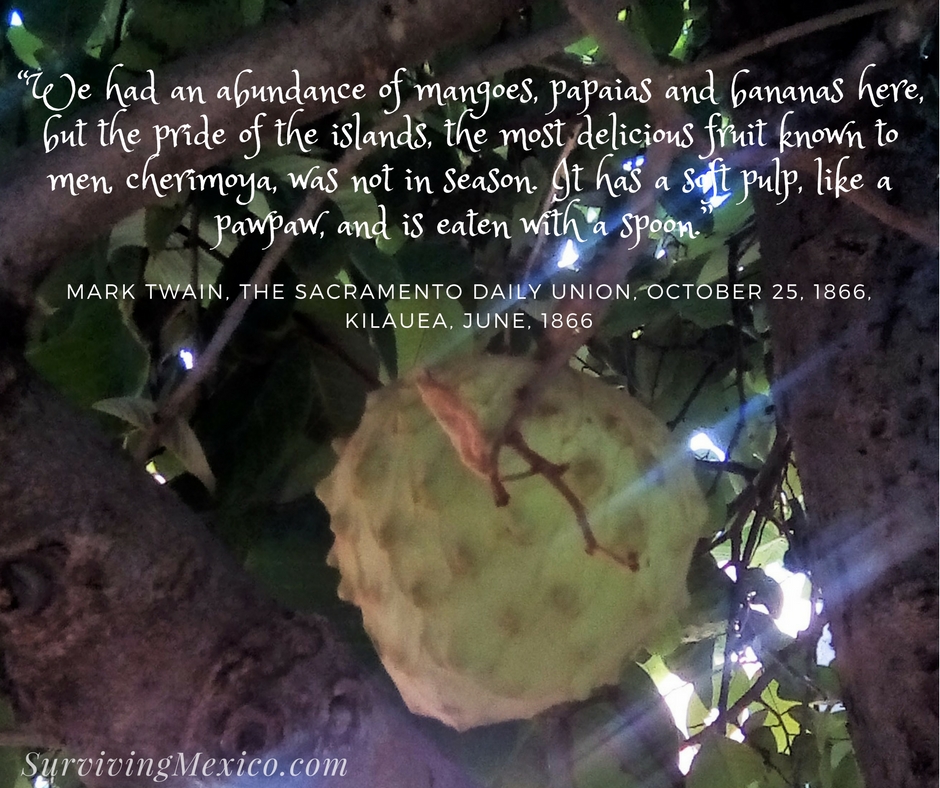
“We had an abundance of mangoes, papaias and bananas here, but the pride of the islands, the most delicious fruit known to men, cherimoya, was not in season. It has a soft pulp, like a

And oh, the taste!  Once you break open a cherimoya, the inside is creamy white. The riper it is, the sweeter and softer the texture.  While I’ve seen descriptions of the flavor ranging from banana to bubble gum, to me, it has a sweet, citrus flavor.  In fact, they are so sweet that I can’t eat more than one.

IMG_20171017_120519

There’s more to these huge ugly roundish fruits than meets the eye. Cherimoya is an excellent source of Vitamin B6, Vitamin C, fiber, and riboflavin.  It’s been proven to help with depression and to be suitable for the treatment of oxidative stress related disorders including Alzheimer’s disease, Parkinson’s disease, Asperger syndrome, cancer, atherosclerosis, heart failure, myocardial infarction, Sickle Cell disease, autism, chronic fatigue syndrome, and even tempers the wear and tear of normal aging like wrinkles, osteoporosis and gray hair. Cherimoya has also been shown to be successful in the treatment of diabetes and gastrointestinal disorders.

The fruit is only in season a short time, in our area mid-September to November, so it’s best to eat what you can while the cherimoya is available.

*****************

Interested in natural remedies? Uncover herbal remedies from traditional Mexican sources for healing and wellness in the Exploring Traditional Herbal Remedies in Mexico series.
4 Comments

Filed under Health, Mexican Food and Drink, Native fauna and flora, Natural Healing

Herbal Fermentation

One of the things that sold me on the Ultimate Healthy Living Bundle was the inclusion of Herbal Academy’s The Craft of Herbal Fermentation Course normally retailed at $129 USD.  Just like the previous course I enrolled in at Herbal Academy, the Herbal Materia Medica Course, it was jampacked with information.  I’ll share a few highlights so you can see for yourself.
The Craft of Herbal Fermentation Course by Herbal Academy

Unit 1 was all about brewing herbal beer. Not only is it good for you, but the act of making your own beer allows you to become a part of a centuries-old brewing tradition.  The course talked about the history of beer brewing as a medicinal tonic, provided a brewing video tutorial, and even expounded on the experience of herbal beer tasting.  Included were all sorts of downloadable handouts to simplify your beer brewing efforts.

Unit 2 dealt with herbal mead.  This time there were two video tutorials as well as an entire lesson dedicated to herbal mead brewing philosophy. Again, lots of handouts and fascinating tidbits.  Did you know that the Maya made a mead called balché from tree bark and another mead from the nectar of the Morning Glory plant called xtabentún?

Unit 3 focused on kombucha and water kefir. I’d heard these two beverages mentioned time and time again as probiotic drinks and was extremely curious about the material in this unit.  There was a video tutorial for each type of fermented drink along with a lesson about sugar, caffeine, and alcohol safety concerns.

Unit 4 was devoted to lacto-fermented vegetables like pickles and sauerkraut. Again there was a video tutorial and plenty of downloadable resources.  If you are interested in just getting these handouts without enrolling in the course, Herbal Academy has made them available here.

So there you have it–a brief overview of the course.  Sadly, for me, this course was for informational purposes only.  Just like with canning, the supplies I would need to successfully ferment herbally are not available locally.  I did get a nifty badge to display proudly.

beer badge

I am looking forward to my next class with Herbal Academy, the Herbal Self-Care for Stress Management Course, that begins October 30. There’s a discount if you register before then.  Here’s a link to a sneak preview of the course: 3 Nervine Herbs to Help Soothe Stress.

Enroll in the Herbal Self-Care for Stress Management Course

**************

disclosure

6 Comments

Filed under Health, Mexican Food and Drink, Natural Healing

Blackberry Leaf Tea

IMG_20170904_101605

The blackberry bush in the backyard is trying to take over!  Shoots are popping up left and right, and it continues to wrap its spiny clutches around the lemon tree despite being cut back several times.  Since I will not be one of those ill-prepared preppers that lament the loss of coffee and tea after TSHTF (See Into AutumnInto Autumn) if you’ve got it, use it right?

Blackberry tea leaf is easy to prepare.  Just pour boiling water over dried leaves and let steep. It’s a darker color than some of the other teas I’ve prepared.  It has a rich, deep taste, just right with a drop of honey as a sweetener.

IMG_20170824_080322

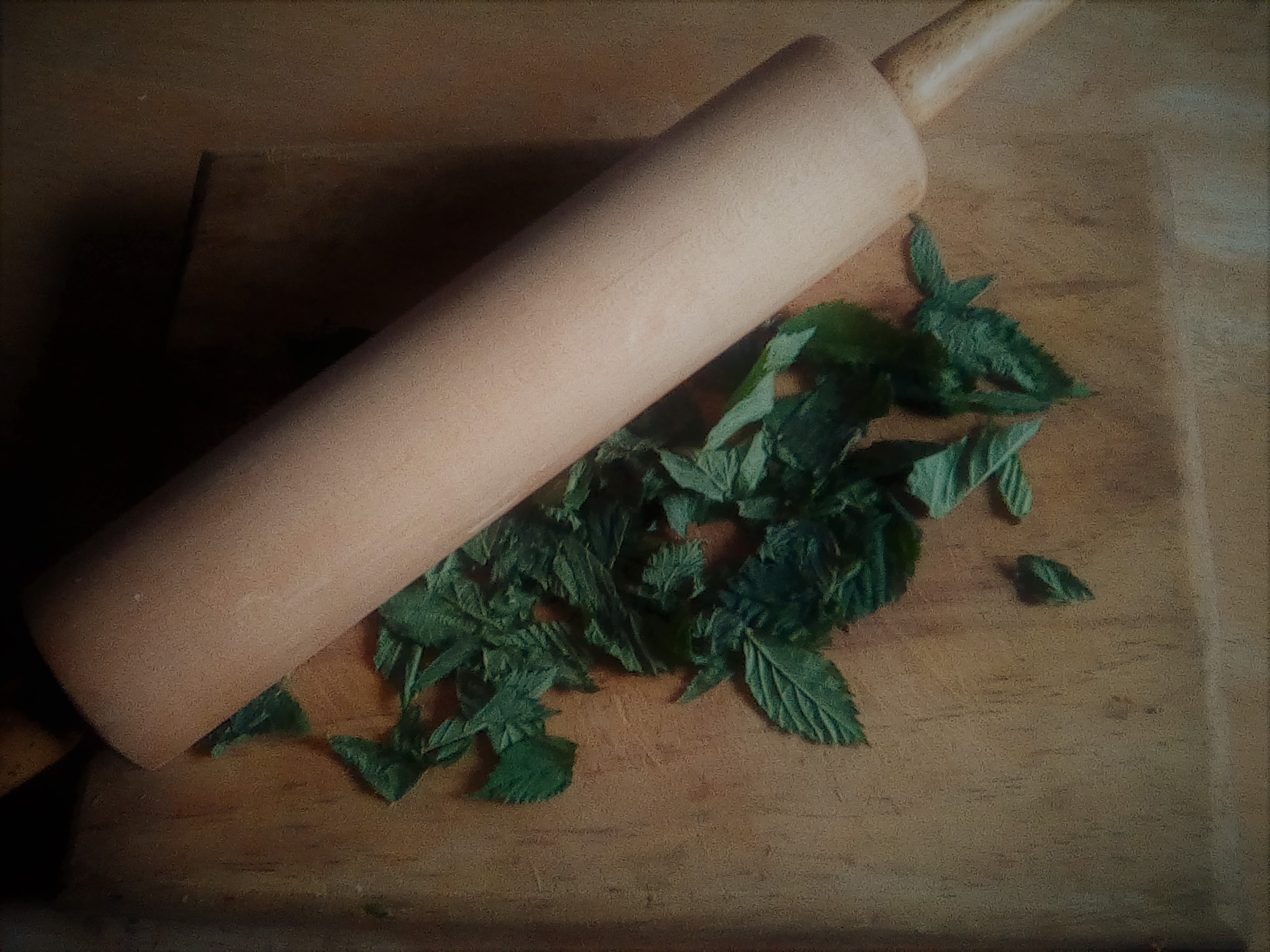
Fermenting the leaves increases the tea’s flavor.  To ferment, crush wilted blackberry leaves with a wooden rolling pin.  Wrap them in a damp cloth and hang in a dark, warm area.  In 2 or 3 days, the leaves will smell like roses which I thought odd until I realized that blackberries (Rubus allegheniensis) are part of the rose family after all.  Remove the leaves from the cloth and allow them to dry completely before storing.

Not only is blackberry leaf tea delicious but it’s good for you as well.  Used medicinally since the ice age, leaves were chewed to strengthen gums and made into plasters to treat shingles and hemorrhoids. During the Medieval and Renaissance periods, blackberry leaf infusions were used as a gargle for a sore mouth, throat cankers and wound washing. Now in more enlightened times, blackberry leaves have been shown to fight cancerous cells and are a good source of antioxidants.  Blackberry leaf has also been effective in diabetes treatment, as a wrinkle preventative, and as a protection against cardiovascular disease.

There’s been some evidence that the tannins found in blackberry leaves, bark and roots may cause nausea in some people.  However, adding milk to the tea neutralizes the tannins quite nicely.  Thus the German regulatory agency for herbs has approved blackberry leaf tea for relieving non-specific acute diarrhea.  In addition, just like our medieval ancestors, the Germans have determined that blackberry leaf tea, mouthwash or gargle is appropriate for mouth sores and gum inflammation.  

(after use, please put it backin its proper place)

With all these reasons to drink blackberry leaf tea, perhaps this spring you should harvest your own.  Pluck the tender light green new leaves before the plant flowers, being mindful of those tiny pickers.  Ferment as described above or hang to dry and you’ll be all set.

******************************

Exploring Traditional Herbal Remedies in Mexico https://amzn.to/2MI4EBZ

2 Comments

Filed under Alternative Farming, Health, Homesteading, Natural Healing