Category Archives: Health

Natural Healing — Tumba Vaqueros

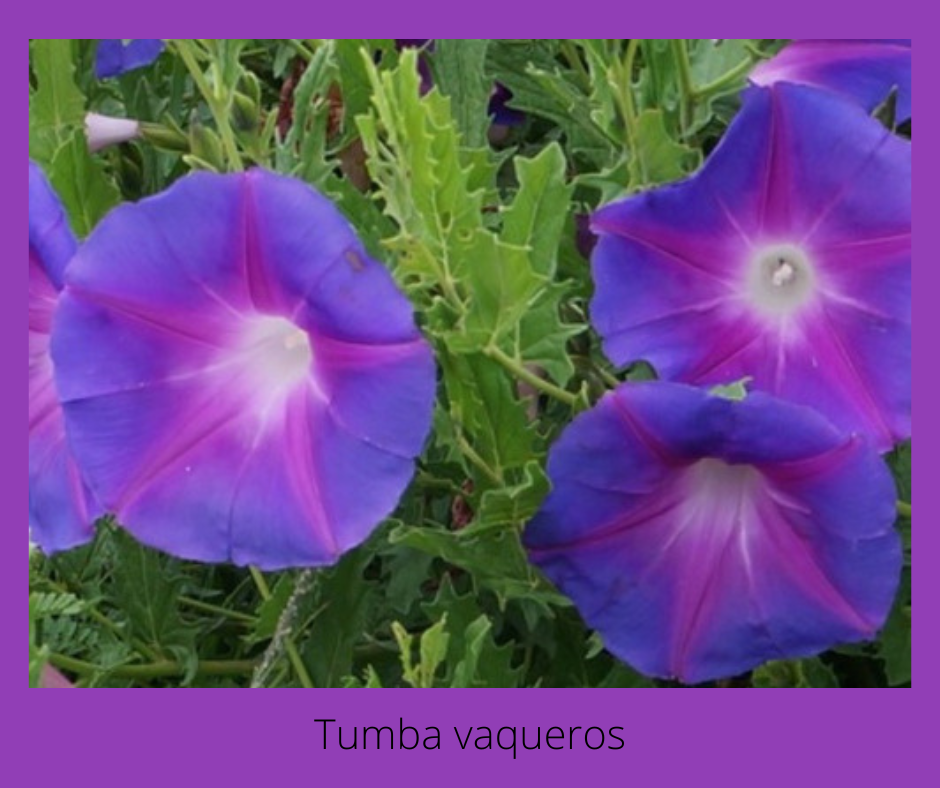
Ipomoea stans, another morning glory although more bushy than viney, is most often called tumba vaqueros (knocks down cowboys) in the area where I live. However, there are a plethora of other names including espanta lobos (frightens wolves), limpia tunas (cleans prickly pears), quebra platos (breaks plates), correhuela (run it smells), and campanita (little bell). In Náhuatl, this plant is known as cacamótic, cacastlapa (cacaxtlapa), flor de casclapa (caxtlapa) or castlapa canibata. Still other areas use the terms galuza, manto, maromero, tanibata, den-tzee’ or tlaxcapan (with spelling variant tlascapan). 

The rhizome is boiled in remedies for kidney ailments and bilis (excessive rage). It’s also used to treat el mal de San Vito (Huntington’s disease), chorea (involuntary movement disorders), and epilepsy. For movement disorders, the recommended dosage is 15 grams of rhizome boiled in one-half liter of water and drunk three times a day. Studies have shown Ipomoea stans does have anticonvulsant properties as well as neuroprotective activity.

As an anti-anxiety treatment, it is made into an infusion along with flor de azahar (Citrus sinensis), flor de manita (Chiranthodendron pentadactylon), salvia (Salvia mexicana), palo de Brasil (Haematoxylum brasiletto), and flor de tila (Ternstroemia lineata). Another nerve tonic used in the states of Guanajuato, Hidalgo, and Puebla is to make a tincture with the rhizome, allowing it to steep for eight days. When it is ready, the tincture is applied to the back of the neck. An infusion for nervous disorders is made with two grams of the rhizome boiled in a one-half liter of water. Half is drunk in the morning and the other half in the evening. Research has demonstrated that tumba vaqueros possess anxiolytic and sedative effects. 

The chopped rhizome is eaten to calm coughing. An infusion made from boiling chopped root and allowing it to steep for ten minutes before straining is drunk three or four times daily during menstruation as an anticontraceptive. A tincture made from the plant is rubbed on the abdomen to reduce cramping. 

In one form or another, tumba vaqueros is also used for headaches, nephritis, bone pain, dysentery, and dizziness in different areas of Mexico. As with jalapa (Ipomoea purga), the root also has purgative properties. It’s considered a “hot” remedy.

To treat dystenery, ten flowers are boiled in one liter of water and sweetened with honey. It’s drunk before breakfast and then three or four times additionally during the day. 

In addition to the aforementioned properties, tumba vaqueros is cytotoxic, antiproliferative, and antibiotic

***

Interested in natural remedies? Uncover herbal remedies from traditional Mexican sources for healing and wellness in the Exploring Traditional Herbal Remedies in Mexico series.

Leave a comment

Filed under Health, Native fauna and flora, Natural Healing

Natural Healing — Ololiúqui

Photo credit: DMTrott

Ipomoea corymbosa

Identifying this plant proved to be quite tricky. Finally, I found confirmation that Ipomoea corymbosa, Ipomoea sidaefolia, Turbina Corymbosa, and Rivea corymbosa all refer to the same native Mexican plant whose seeds are used in religious ceremonies as a hallucinogenic. The botanical name listed depends on the date and source origin.  

The Mexican name for the plant is also widely varied, although the uses are similar throughout the country. The most common name used in central Mexico is ololiúqui which in Náhuatl means “round thing,” referring to the seeds rather than the plant. In Náhuatl, this variety of morning glory is Coatlxoxouqui, Coaxihuitl, or Coaxoxouque (snake-plant); in Maya, Xtabentún or x-táabentun, badoh in Zapotec; in Mixtec, Yucu-yaha or Yugu-yaha. The Chinantec use the terms Huan-mei or Huan-men-ha-sey. In the Mazatec language, it is Mo-so-le-na. The Tlapanec refer to it as Yuguá. Spanish names include tripa de pollo (chicken intestines) and tumba caballo (knocks a horse down). In English, common names include Christmasvine and Christmaspops.

Ipomoea corymbosa is a viney plant with heart-shaped leaves and white bell-shaped flowers. The seeds contain the hallucinogens d-lysergic and d-isolysergic acids, comparable to LSD, and have long been a part of religious ceremonies in Mexico by the Chantec, Mixtec, Mazatec, and Zapotec for divination, finding lost objects and people, and diagnosing illnesses. One source also reported that the seed was given to those intended for sacrifice to induce euphoria and drowsiness. 

X-táabentun (which translates roughly as one that is tied to the stone or stone vine) root infusions are given to women by parteras (midwives) in especially difficult delivery situations in some areas in the Yucatán. The infusion is prepared with three fingers of x-táabentun root, and nine spikes of koke’ (Smilax spinosa Miller) sweetened with Melipona honey. In Oaxaca, the seeds are used instead of the root.

Lysergic acid (d-lysergic acid) found in both the Ipomoea corymbosa and Ipomoea tricolor causes uterine contractions within fifteen minutes of ingestion. This compound is also hemostatic and has been shown to reduce hemorrhaging after childbirth if given after the placenta has been delivered.

Among the Maya, this plant is representative of the departure of the rains and the rainy season, during which plants (and humans) are more at risk for death. Baalche’ is a ritual drink made from the seeds, fermented maíz (Zea mays), and melipona honey. It is drunk to induce visions and also rubbed on pregnant women’s abdomens. 

Ipomoea tricolor

Ipomoea tricolor (also known as Ipomoea violacea and Ipomoea rubrocaerulea) seeds have a hallucinogenic effect but not as intense as the seeds from the Ipomoea corymbosa plant. This plant shares the names ololiúqui and badoh negro as their stronger counterpart. Other names include bodongás, manto del cielo, hiedra, and Mich-doh. In English, these plants are known as grannyvines or heavenly-blue morning glories. Ipomoea tricolor typically has blue, purple, or white blossoms.

The hallucinogenic effect is dependent on the dosage. Anything over 200 seeds is a high dosage and can result in undesirable effects, including suicidal tendencies. Other side effects include panic attacks, incoherent speech, coldness in the hands and feet, nausea, uncontrollable laughter or weeping, and extreme body odor.

In some areas, the bright blue flowers of the Ipomoea tricolor (also known as Tlitliltzin in Náhuatl) are ground and mixed with corn flour to make colored ceremonial tortillas.

In addition to the aforementioned properties, Ipomoea tricolor also has significant cytotoxic activity against breast cancer cells and antibacterial properties.

***

Interested in natural remedies? Uncover herbal remedies from traditional Mexican sources for healing and wellness in the Exploring Traditional Herbal Remedies in Mexico series.

Leave a comment

Filed under Health, Native fauna and flora, Natural Healing

Natural Healing — Zoapatle

Photo credit: Pedro Tenorio Lezama

Zoapatle (Montanoa tomentosa), with spelling variants soapatle, zoapatli in Morelos, zihuatapli, zoapacle, zoapaxtle, zuhuapatli in Puebla, and zoapatl in Tlaxcala is also known as cihuapatli in Nahuatl which means “woman’s medicine.” Other names include roö and toó (Otomi) in Mexico state, Cacopacle in Hidalgo, and Cacachpa, Cacahpachtle, Chapus in Puebla. Other areas use the terms pirimo blanco or perimo (Purépecha), aclinán, yucuyahui, nocuana-titete-xini-ni or yaga-zeche (Zapotec), cuana-xana, ciguapactli, Homah-ak (Maya), and talacao (Guarijío).

This Mexican native bush has fragrant leaves and yellow or white flowers. Traditionally, it has been used to facilitate a difficult delivery and other “women’s issues.” The Florentine Codex records its use in delivery and for bloody diarrhea. Francisco Hernández documents that the plant is considered “hot” and useful in “cold” infirmities. He continued with the information that in addition to inducing labor, it was prescribed for post-partum infections and to bring on menstruation. Francisco Ximénez wrote that it was also useful in alleviating menstrual pain and anxiety. According to Martín de la Cruz, zoapatle root was added to stews and used as a flavoring in pulque. 

A zoapatle leaf and root decoction is prepared with canela (Cinnamomum zeylanicum) and chocolate (Theobroma cacao) and given to the laboring mother to speed up delivery. Since the uterine contractions it provokes are extremely strong, zoapatle infusions should only be administered in extreme instances and never when there is something irregular about the baby’s placement, such as a breech birth. Additionally, the infusion can cause fatigue, thirst, and cardio-respiratory depression in the newborn if not taken in proper dosages. Bernardino de Sahagún recorded that this concoction was given right before the baby crowns. A second cup could be given if needed.

Zoaptle leaves combined with maiz root (Zea mays) sweetened with piloncillo (brown sugar cone) taken on an empty stomach is a simple abortifacient. Uterine contractions triggering miscarriage can begin as fast as five to twenty minutes after ingestion. 

An after-birth tea is made with zoapatle leaves, bretónica (Lepechinia caulescens), and epazote (Dysphania ambrosioides), sweetened with chocolate (Theobroma cacao) or piloncillo (brown sugar cone) is served to help expel the placenta and reduce hemorrhaging. The plant and root are chopped and boiled to make a poultice to stop hemorrhaging after birth. 

In the event that contractions are not strong enough to bring on cervical dilation, or the contractions are strong, but the cervix has not dilated, the laboring woman may be given a steam bath in the temazcal with zoapatle leaves. Studies have proven that zoapatle infusions will indeed cause cervical dilation

To regulate menstruation, a decoction of zoapatle leaves is drunk in place of water while the woman fasts for three days. For menstrual cramps, the infusion is made with flower buds. Studies have shown that Montanoa tomentosa has an anti-anxiety effect during low-hormonal conditions, such as the premenstrual period. Thus, evidence supports its use as a mood stabilizer and natural antidepressant

Zoapatle leaves possess a unique antifertility activity in that it inhibits a fertilized egg’s implantation by affecting uterine motility during ovulation. It does not function as a spermicide

Post-delivery, women are encouraged to continue to bath with zoapatle infusion and drink it as an infusion to promote milk production. It may be that the anti-fertility and anti-depressive components of the plant are what most benefit the new mother at this point since there is no scientific evidence of zoapatle either being a galactagogue or an anti-inflammatory agent. If the woman doesn’t become pregnant right away, her milk production won’t drop off as the new fetus develops. Furthermore, the condition necaxantle, generally understood as “woman’s weakness” caused by the loss of menstrual blood, pregnancy, childbirth, and childcare through breastfeeding, evidenced by fatigue, mood swings, and depression, is regulated through the continued use of zoaptle infusions post-partum. 

***

Interested in natural remedies? Uncover herbal remedies from traditional Mexican sources for healing and wellness in the Exploring Traditional Herbal Remedies in Mexico series.

Leave a comment

Filed under Health, Native fauna and flora, Natural Healing