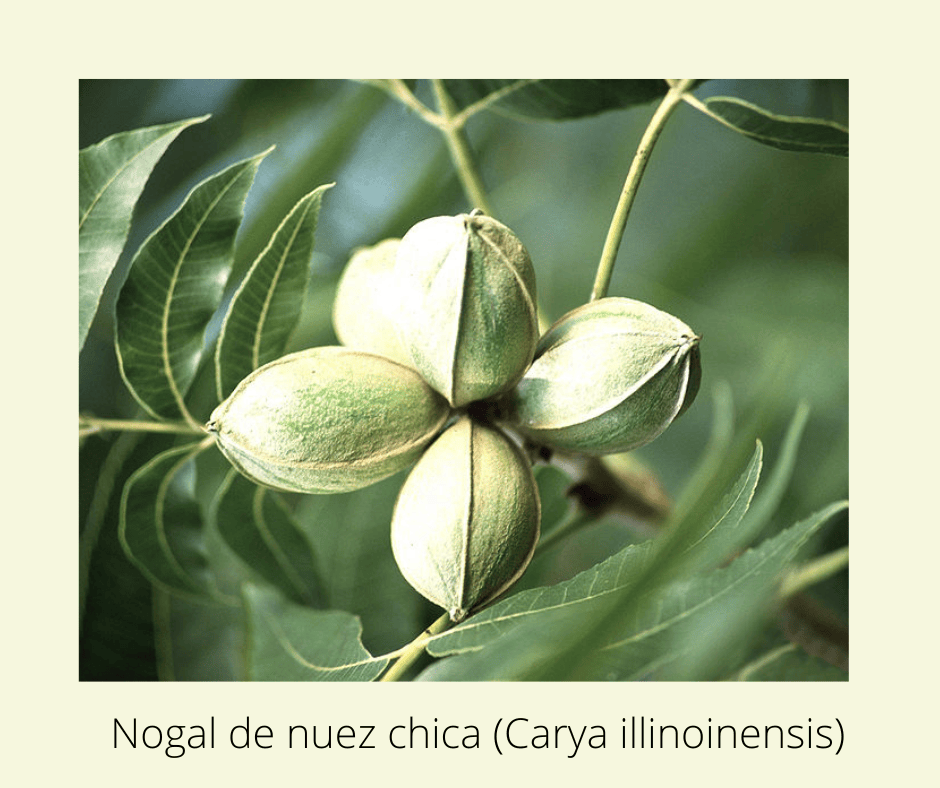
During my research, I’d come across a handful of remedies that used cáscaras de nuez chica (pecan shells) and skipped over them with the erroneous belief that pecans weren’t native to Mexico. Well, color me surprised when I dug a little more and discovered that nogal de nuez chica (Carya illinoinensis)–not to be confused with nogal (walnut)–is indeed native to Mexico, specifically to the states of Nuevo León, Coahuila, Tamaulipas, Chihuahua, Durango, San Luis Potosí, Querétaro and Hidalgo.
Other common names for the tree include nogal pacanero, nogal de nuez lisa, pacano, nogal de cuilpan, and pecán. The nut is known as pacana, pecana, nuez de pecán, nuez cáscara de papel, nuez de la isla and nuez encarcelada. The Otomí refer to this tree as damzá or demzá and in the Zapotec language it is known as Yaga-sola.
In Mexico, the leaves, shells, and bark have a number of medicinal applications, including antidiarrheal aid, treatment to stop bleeding, anti-inflammatories, and as an antiseptic.
Leaf and bark infusions are employed as astringents to treat mouth sores, inflamed gums, and eye irritation topically and as a tea to stop diarrhea, treat urinary infections, and dissolve kidney stones. Leaf poultices are placed on swollen joints to reduce inflammation. Mixed with milk and applied to the back and chest, leaf poultices are applied to relieve cough.
Pecan shells (Carya illinoinensis) are added to a floral infusion for a vaginal wash for irregular bleeding. To bring on menstruation, a decoction of crushed aguacate seed (Persea americana), crushed pecan shells (Carya illinoinensis), and the leaves of the purple wandering Jew (Tradescantia pallida) is given. For vaginal hemorrhaging, 12 pecan shells are boiled in ½ liter of water for 5 minutes and allowed to cool to room temperature. A cup is drunk every 15 minutes until the bleeding stops.
In some areas, las cáscaras de nuez chica and bark are used to treat tuberculosis. The bark is a proven antimycobacterial agent, supporting this traditional use. In other areas, a bark infusion is prescribed for intermittent fevers and empacho (indigestion).
The pecan nutshell has properties that have been found to be effective in the prevention and treatment of cancer, diabetes, and heart disease. The shells have antioxidant and antimicrobial activities.
A decoction made from equal portions of pecan leaves (Carya illinoinensis), agrimonia (Agrimonia eupatoria), salicaria (Lythrum salicaria L), and condurango (Marsdenia condurango) is prescribed for diarrhea caused by intoxication, poison, or overeating.
Pecan flowers are antioxidants, antimicrobials, antifungals, and antibacterials. Pecan oil is applied externally to wounds, eczema, and dermatitis and ingested to treat intestinal parasites. It is also prescribed for PMS.
Pecans contain vitamins A, B, and E and fatty acids. Regular nut consumption has been shown to reduce the risk of cardiovascular disease. Additionally, pecans are antihypertensives, antioxidants, immunomodulators, protease inhibitors, and inhibitors of cell cycle progression in cancer cells.
Who would have thought this little nut would pack such a big punch?
***
Are you interested in natural remedies for healing and wellness? The ‘Exploring Traditional Herbal Remedies in Mexico‘ series offers a treasure trove of traditional Mexican herbal remedies. Learn about these remedies’ rich history and cultural significance and how they can benefit your health. Get your copy today!