Tag Archives: Mexican plants

Natural Healing — Zoapatle

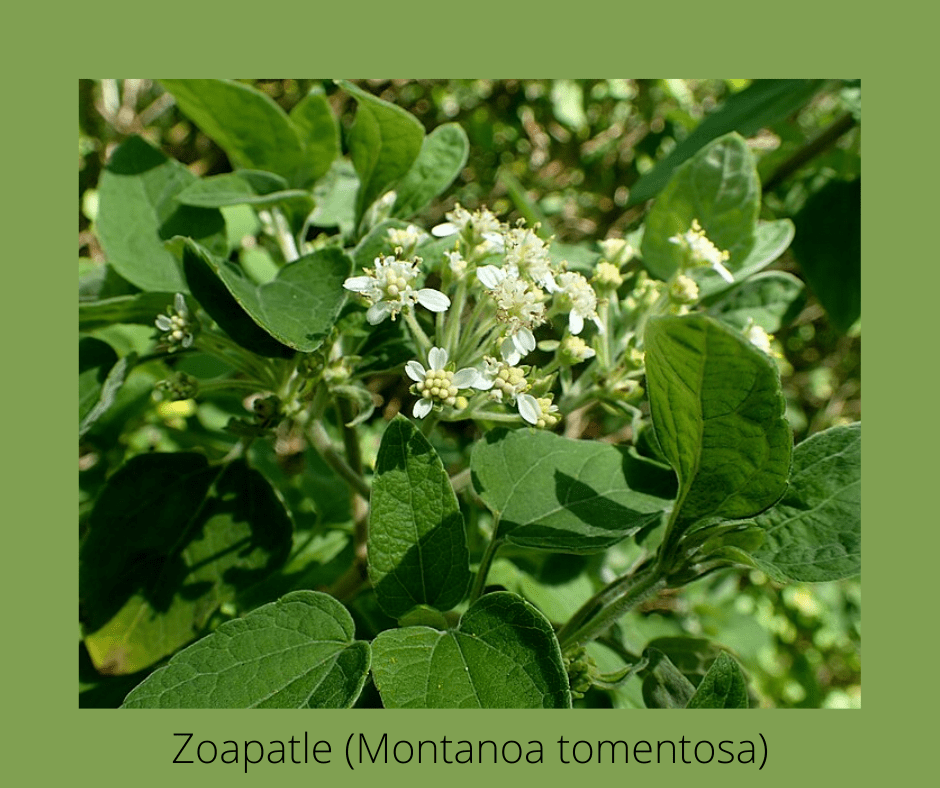
Photo credit: Pedro Tenorio Lezama

Zoapatle (Montanoa tomentosa), with spelling variants soapatle, zoapatli in Morelos, zihuatapli, zoapacle, zoapaxtle, zuhuapatli in Puebla, and zoapatl in Tlaxcala is also known as cihuapatli in Nahuatl which means “woman’s medicine.” Other names include roö and toó (Otomi) in Mexico state, Cacopacle in Hidalgo, and Cacachpa, Cacahpachtle, Chapus in Puebla. Other areas use the terms pirimo blanco or perimo (Purépecha), aclinán, yucuyahui, nocuana-titete-xini-ni or yaga-zeche (Zapotec), cuana-xana, ciguapactli, Homah-ak (Maya), and talacao (Guarijío).

This Mexican native bush has fragrant leaves and yellow or white flowers. Traditionally, it has been used to facilitate a difficult delivery and other “women’s issues.” The Florentine Codex records its use in delivery and for bloody diarrhea. Francisco Hernández documents that the plant is considered “hot” and useful in “cold” infirmities. He continued with the information that in addition to inducing labor, it was prescribed for post-partum infections and to bring on menstruation. Francisco Ximénez wrote that it was also useful in alleviating menstrual pain and anxiety. According to Martín de la Cruz, zoapatle root was added to stews and used as a flavoring in pulque. 

A zoapatle leaf and root decoction is prepared with canela (Cinnamomum zeylanicum) and chocolate (Theobroma cacao) and given to the laboring mother to speed up delivery. Since the uterine contractions it provokes are extremely strong, zoapatle infusions should only be administered in extreme instances and never when there is something irregular about the baby’s placement, such as a breech birth. Additionally, the infusion can cause fatigue, thirst, and cardio-respiratory depression in the newborn if not taken in proper dosages. Bernardino de Sahagún recorded that this concoction was given right before the baby crowns. A second cup could be given if needed.

Zoaptle leaves combined with maiz root (Zea mays) sweetened with piloncillo (brown sugar cone) taken on an empty stomach is a simple abortifacient. Uterine contractions triggering miscarriage can begin as fast as five to twenty minutes after ingestion. 

An after-birth tea is made with zoapatle leaves, bretónica (Lepechinia caulescens), and epazote (Dysphania ambrosioides), sweetened with chocolate (Theobroma cacao) or piloncillo (brown sugar cone) is served to help expel the placenta and reduce hemorrhaging. The plant and root are chopped and boiled to make a poultice to stop hemorrhaging after birth. 

In the event that contractions are not strong enough to bring on cervical dilation, or the contractions are strong, but the cervix has not dilated, the laboring woman may be given a steam bath in the temazcal with zoapatle leaves. Studies have proven that zoapatle infusions will indeed cause cervical dilation

To regulate menstruation, a decoction of zoapatle leaves is drunk in place of water while the woman fasts for three days. For menstrual cramps, the infusion is made with flower buds. Studies have shown that Montanoa tomentosa has an anti-anxiety effect during low-hormonal conditions, such as the premenstrual period. Thus, evidence supports its use as a mood stabilizer and natural antidepressant

Zoapatle leaves possess a unique antifertility activity in that it inhibits a fertilized egg’s implantation by affecting uterine motility during ovulation. It does not function as a spermicide

Post-delivery, women are encouraged to continue to bath with zoapatle infusion and drink it as an infusion to promote milk production. It may be that the anti-fertility and anti-depressive components of the plant are what most benefit the new mother at this point since there is no scientific evidence of zoapatle either being a galactagogue or an anti-inflammatory agent. If the woman doesn’t become pregnant right away, her milk production won’t drop off as the new fetus develops. Furthermore, the condition necaxantle, generally understood as “woman’s weakness” caused by the loss of menstrual blood, pregnancy, childbirth, and childcare through breastfeeding, evidenced by fatigue, mood swings, and depression, is regulated through the continued use of zoaptle infusions post-partum. 

***

Interested in natural remedies? Uncover herbal remedies from traditional Mexican sources for healing and wellness in the Exploring Traditional Herbal Remedies in Mexico series.

Leave a comment

Filed under Health, Native fauna and flora, Natural Healing

Natural Healing — Chayote

It’s Eat Your Vegetables Day! So let’s talk about my husband’s favorite vegetable, the chayote!

chayote pic.jpg

Chayote (Sechium edule) is also called the Mexican vegetable pear,  mirliton squash or choyotl. It comes from the Nahuatl word chayohtli and is thought to be one of the earliest cultivated plants in Mesoamerica.

Once the plant takes root, it needs very little care. It will continue to grow and produce fruit for years. Not only is the fruit edible, but the root, stem, seeds and leaves are edible as well. All edible parts are useful in the treatment of cardiovascular disease and hypertension.

The chayote has components that are effective in the fight against cancer. It is rich in amino acids, vitamin C and antioxidants.

The root, which is tuberous and cooked like a potato or yam, has been shown to be successful in treating kidney inflammations. The root, leaves and stem are high in fiber and have been shown to reduce cholesterol levels. The shoots reduce obesity and are good for the liver.

Traditionally, an infusion made from 3 to 5 leaves boiled in a liter of water is drunk daily to dissolve kidney stones and reduce arteriosclerosis. It is quite diuretic. The leaves also are antibacterial and can be used as a poultice to dress wounds.

I’ve seen people eat boiled chayote like you would an apple, however, I have to admit, chayote has a flavor so mild that it’s not my favorite squash by a long shot. It is, however, a staple in our bone broth and my husband makes this absolutely delicious dish with chayote, squash, tomato, onion and garlic served over rice that I adore.

***

1 Comment

Filed under Health, Mexican Food and Drink, Native fauna and flora, Natural Healing

Natural Healing with Sábila (aloe vera)

wpid-cam00180.jpg Even before moving to México, I had known that aloe vera could be used for burn treatments.  I now know that aloe vera (sábila) has more uses than that. Sábila has been used since the time of the Mayans as a miracle plant, treating everything from cavities and cancer to brujaría (witchcraft).  The most potent part of the plant is the clear gel found within its long spear-like leaves.  This gel works as an astringent, pain killer, and coagulator.   It contains beta carotene, Vitamin B, niacin, riboflavin, Vitamin B6, folic acid, Vitamin B12, Vitamin C, and Vitamin E as well as calcium, phosphoric acid, and iron.  Sounds like a breakfast of champions to me. Sábila can be used to boost the immune system, regenerate damaged skin cells, as an antibiotic, reduce arthritis inflammation and pain, and stop bleeding.  It can be used as a topical agent or ingested by being made into juices or teas, although having accidentally eaten a bit that was on my toast one day, I’m not sure how delicious a tea would be.  It has an acrid taste.
IM000826.JPG

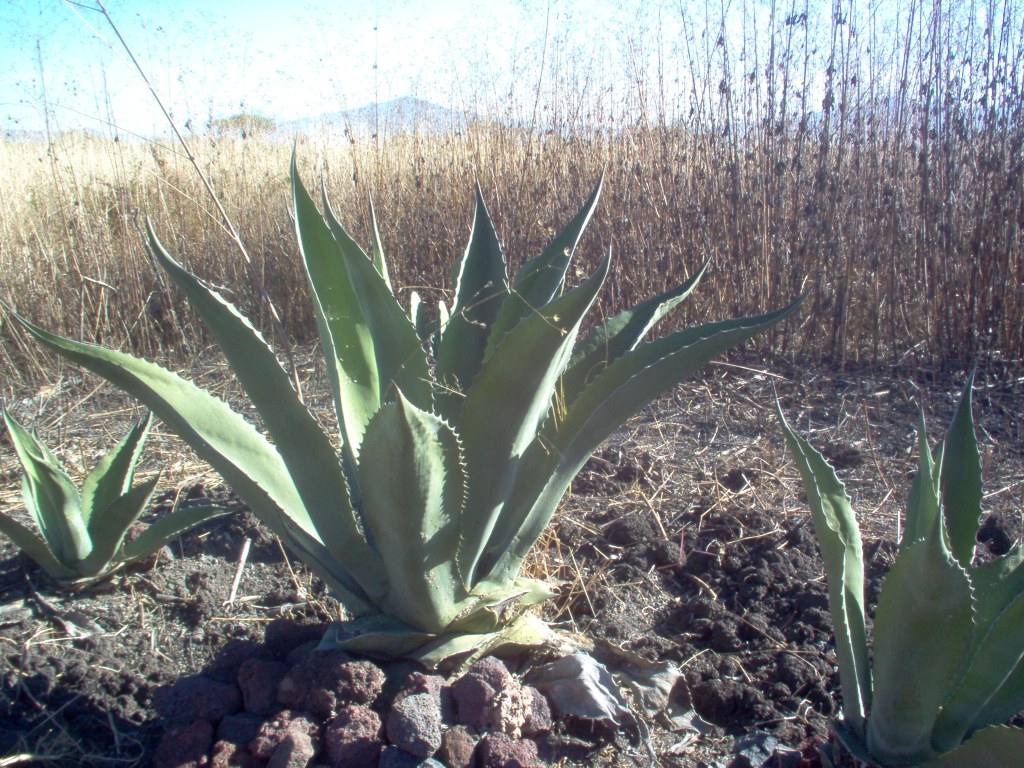
Maguey plant

So there is some basis in it being a miracle plant.  My husband had heard that it could be used in treatment for athlete’s foot, so one day he cut what he thought was sábila (aloe vera) and rubbed the gel on his feet.  Unfortunately for him, he had mistakenly cut a leaf from the maguey plant and the result was an extreme burning sensation rather than the itch soothing he was looking for. Since then, he has gotten savvier in his plant identification and has used sábila successfully in healing animal wounds. (See Animal Doctoring) When my sister-in-law was being plagued by brujería (witchcraft) being caused by envidia (envy) she bought a sábila (aloe vera) plant and placed it at the entrance of her tortillería (tortilla shop) to absorb any bad feelings being sent her way. (See Battle of the Brujas) Sábila used as a ward against evil should be placed at the left of the entrance and would be even better if there were two plants, one at either side of the entrance. I even found a little prayer that can be used in conjunction with incense made from sábila, balsam, ground coffee and sugar.  It goes like this: Cruz santa y divina, bujas y brujos: Enemigos que piensan llegar a mí, estoy con Dios por el poder de Cristo, que ha dado en el huerto de la fe.Oh! Dios. Pido que alejes de mí las tristezas y ruinas que vengan hacia mí.  Dios soberano, líbrame de las penas y las traiciones, que bendita sea María y la hostia de la consagración.  María Santísima, cúbreme con tu manto, que mi cuerpo sea parte de cielo, por los tres dulces nombres de Jesús, José y María.  Con Dios y esta mata, sea la prosperidad en mi vida y en mí y en mi casa, Jesús, Joaquín y Santa Ana, líbrame de todo mal. If the plant wilts or dies, it means that someone has had envy or bad intentions toward you and the plant absorbed the negative. There is also a belief that if you plant a sábila with a coin at the roots, the household will never lack money.  Since my husband recently transplanted two wild sábila to our backyard, it’s a perfect opportunity to test this out.  We sure could use that bit of financial wizardry. My little guidebook Antiguo Formulario Azteca de Yerbas Medicinales also has a section devoted to sábila.  For back pain, the halved heated penca (leaf) should be placed on the part that hurts or in inflamed to relieve pain.   For bronchitis or cough, a tea can be made with a little piece of sábila, 10 eucalyptus leaves and 10 flowers from the bugambilia morada plant (bougainvillea) and drunk an hour before going to sleep.

As with all customs and beliefs that we have discovered among our many adventures and disasters in México, we tend to err on the side of belief rather than skepticism.  As they say “When in Rome…

***************************************************

Interested in natural remedies? Uncover herbal remedies from traditional Mexican sources for healing and wellness in the Exploring Traditional Herbal Remedies in Mexico series.

10 Comments

Filed under Native fauna and flora, Natural Healing, Religion