Category Archives: Cultural Challenges

Internet Saga

i-dont-always-have-a-slow-internet-connection-23899039

If you remember, after quite a quest, we managed to get internet service at our house in La Yacata. The first month, it worked like a dream. Thus, my decision to move my office from The Little House in Sunflower Valley to La Yacata.

Then came the time to pay for the second month of service. We headed to OXXO, which seems like it just might make banks obsolete, to pay the bill. And the next day, our internet service tanked. Instead of getting upload/download speeds of between 8 to 10 Mbps, they hovered at .08 or less. Nothing would load.

We thought perhaps it was a one-day deal. Maybe there were some adjustments being made to the service. Maybe a glitch in the system. After all, the month before had gone without a hitch. Only, the bad stats continued and continued and continued. I canceled a week of classes.

We called the service support line. After all sorts of “troubleshooting” that we had already done, the service representative hung up on us. So the next day, we tried again. This time the service representative admitted that since we were officially outside the coverage area, there wasn’t really much he could do to help us.

So we went to the place where we had bought our modem and requested a service technician. We were told he’d be out around 4 pm to check things out. I canceled my classes again. At about 4:30, the service technician called and said he thought the problem was that our payment hadn’t been processed. I knew that was a bunch of hoo-ha since I had received an email confirmation of the payment. He said he’d look into it and call back. He didn’t bother to come out to La Yacata.

So if the service technician wasn’t interested in coming to us, we’d take the modem to them. The next day we boxed it up and went back to the office. Their solution was to wait for the service technician to come from Morelia and have him take the modem home with him. Moroleon is officially outside the coverage area. The fact that the internet works in certain areas is apparently a fluke that this office was capitalizing on. So in theory, connecting the modem in a coverage area would “reset” the internet and allow us again to have usable service.

It took two days for our modem to take its trip to Morelia and back. The result was that yes, for a while it did what it was supposed to do. And yet, there were sporadic outages and low service periods which unfortunately often coincided with my teaching hours.

Some research on the company shows that overall the internet service only rates 3 out of 5 stars and that even though they promise nation-wide coverage, that’s not necessarily the case. There had to be something better out there.

6 Comments

Filed under Cultural Challenges, Economics, Employment, Small Business in Mexico, Teaching

2019–International Year of Indigenous Languages

lenguages

Did you know that 2019 has been declared International Year of Indigenous Languages by the United Nations? The organization’s goals include increasing understanding, creating conditions for knowledge-sharing, and integration of indigenous languages with the dominant cultures of each country. UNESCO has even set up a site which lists events, ways to get involved, and teaching resources which you can find here.

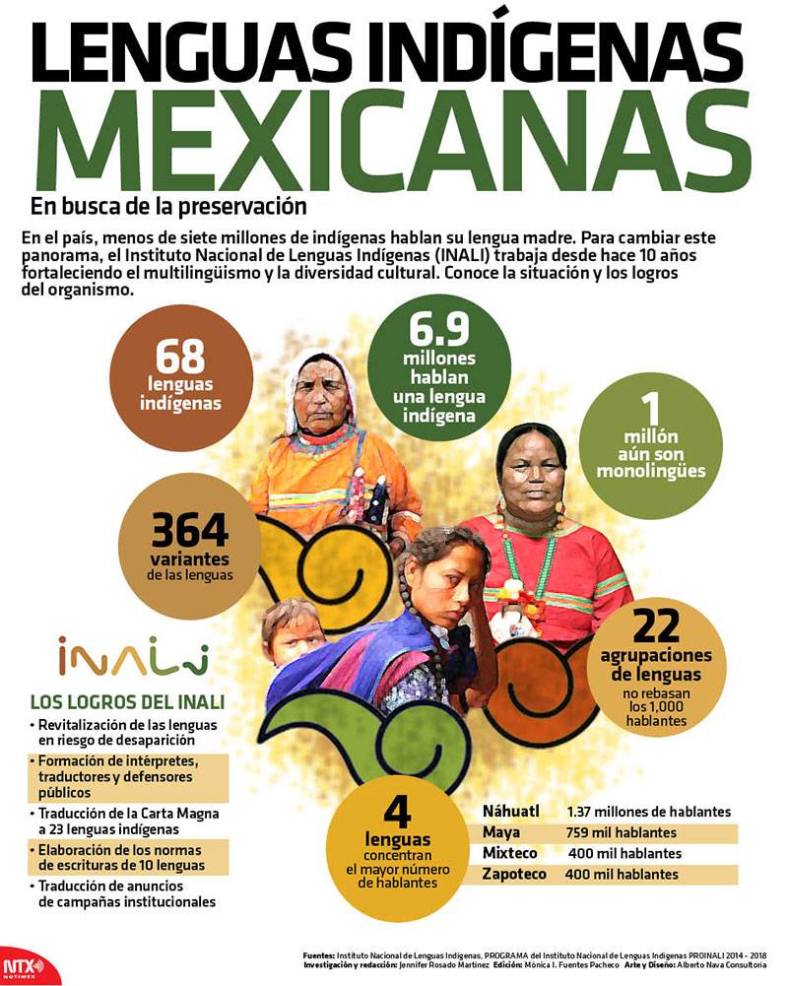
The Mexican government officially recognizes 68 indigenous languages which have approximately 350 different dialects. Most of these languages originated from 7 larger language families while some resulted from 4 language isolates, that is they developed independently of other languages. Purépecha, the indigenous language spoken in the area where I live on the border of Michoacan and Guanajuato, is one of those language isolates. (See Catalogo de las Lenguas Indígenas Nacionales: Variantes Lingüísticas de México con sus autodenominaciones y referencias geoestadísticas). Twenty-one indigenous languages are in danger of extinction as the last remaining speakers die off.

Since 2003, the Mexican law Ley General de Derechos Lingüísticos de los Pueblos Indígenas requires that its citizens receive services in their native tongues. Some strides in that direction have been made because of the efforts of the Instituto Nacional de Lenguas Indígenas but the results have been limited nationally.

Approximately 6 million Mexicans speak an indigenous language. Nahuatl, the language of the Aztecs, and Yucatec Maya are the two most spoken languages. Six million people is only about 7% of the entire population of Mexico which has allowed for increasing marginalization over the centuries.

However, under the new presidential regime of AMLO, indigenous culture has taken center stage once again. At his December 1 inauguration, the president-elect received the official blessing from the governor of Los Pueblos Indígenas (indigenous towns) complete with incense and cedar staff engraved with 68 indigenous language representations. He received yet another ruling staff on his trip to Oaxaca later in the month. This staff was the official Tatamandón, the staff that symbolizes the ruler of the majority of indigenous communities of the area.

Just days after taking office, AMLO announced the formation of the Programa Nacional de los Pueblos Indígenas stating “Daremos preferencia a los más humildes y a los olvidados, en especial a los Pueblos Indígenas de México.” Andrés Manuel López Obrador (We will give preference to the most humble and forgotten, especially the Indigenous Towns of Mexico)

It appears he is making efforts to listen to and incorporate the indigenous population in the new government.

On the other hand, AMLO also approved the construction of what is known as the Maya Train, even going as far as hosting a ceremony to ask Mother Earth bestow her blessings on the construction. Indigenous groups in the area are opposed to the route which will pass through some of Mexico’s most biodiverse and fragile ecosystems.

Furthermore, EZLN (the Zapatistas) have already made it clear that they do not support AMLO in any way, shape or form and will oppose his government with violence if necessary.

Whether the new government fulfills its promises toward the indigenous peoples or not remains to be seen.

What indigenous languages are spoken in your area?

2 Comments

Filed under Cultural Challenges, Mexican Cultural Stories, Politics

Surviving Voluntary Exile: Overcoming Common Obstacles to Making a Successful Life Transition Online Course

If you’ve followed my blog for a time, you’ll likely already know that I have made it my mission to provide practical information and support to those, especially women, who have moved to Mexico, particularly rural Mexico.

I love my life in rural Mexico. However, that has not always been true. When I first arrived, the lack of basic services like water, sewage and electricity caused my daily activities to be physically (not to mention mentally) exhausting. I was often depressed. It took me years to find my happy space. Looking back, I can pinpoint several life-changing moments that propelled me to create the life I have now. This process is what I want to share with others who are struggling with life in Mexico.

To that end, I’ve created an online course via CourseCraft that I hope will provide support and guidance for those that most need it. This course is entitled: Surviving Voluntary Exile: Overcoming Common Obstacles to Making a Successful Life Transition and is designed to not only identify common reasons why you might not be living to the fullest in your new country but also what you can do to reduce, if not eliminate these obstacles to happiness.

course cover square

Since I know that finances are a concern for many who have moved to Mexico, (the pesos is extremely low right now) I have priced this course at $9.99 USD during the month of January making it the perfect time for you to enroll. I know, I know! I’ll never make any money that way! That’s ok. It will all work out somehow!

So if you are having a hard time adjusting to life in Mexico, or know someone who is, check out  Surviving Voluntary Exile: Overcoming Common Obstacles to Making a Successful Life Transition.

Why not make 2019 your best year in Mexico yet?

enroll now


Here’s what participants are saying:

So much of the information out there on moving to another country is either focused on those moving for work or for retirement and only focuses on nitty-gritty details. What about if you are moving for another reason, or if you have the life details ironed out but want to prepare for the emotional rollercoaster that is sure to follow? This course is different; it is really about the internal changes we experience and how we help ourselves not be overwhelmed by our feelings. I found it very helpful in conceptualizing how we can change our reactions to events and therefore increase our happiness. Not only that, but many of the techniques or info can be applied to other areas of our lives!

— Florence P.

I really enjoyed the Surviving Voluntary Exile course. I really feel that it has excellent information for anyone overcoming obstacles in their life ( aren’t we all?!). The course designer has used her experience to make the path for other women to be easier and to have some idea of the challenges they will be facing. She approaches the lessons with positivity and humor. She really has an excellent perspective on this topic. It leaves you feeling like you can overcome the obstacles that lie ahead, and her positive attitude becomes contagious. There are assignments each week that are uplifting and not burdening. It’s information that you can come back to again and again to help you be successful.

— Erica D.

******

disclosure

1 Comment

Filed under Cultural Challenges, Education, Surviving Voluntary Exile