Category Archives: Carnival posts

Tamales

Did you know that the Maya didn’t make tortillas before 900 CE? The reason archeologists believe the tortilla is a more recent addition to their diet is that no comal has ever been recovered at any excavated sites of periods before 900 CE. So what did the Maya eat? TAMALES!

tamal hieroglyph

Tameles were foodstuff in the Aztec and Maya civilizations as far back as 7000 BC. The Maya even had a hieroglyph for tamales. Since a tamal is individually wrapped, it was the perfect portable food. They were often carried by warriors, hunters and travelers as a sort of meal on the go. Tamales could be reheated over the fire or eaten cold.

A tamal (notice there is not final “e” at the end of the word in singular) is made of masa (corn dough) steamed in a corn husk or banana leaf. The wrapping is not eaten, but we always save our wrappings for the goats. It can be filled with pretty much anything, meat, cheese, fruit, vegetables, chili etc.


Tamales-florentine-codex

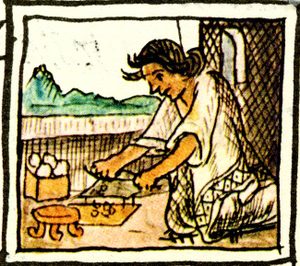
The Aztec had their favorite fillings. Tamales were often filled with turkey, flamingo, frog, axolotl (salamander), pocket gopher, rabbit, fish, turkey eggs, honey, fruit, squash or beans. Festival tamales were a cut above the rest. Tamales wrapped with amaranth leaves stuffed with greens and served with shrimp sauce were made for the Lord of Fire Xiuhtecuhtli. Tamales filled with beans and chilies were made in honor of the god “Smoking Mirror” Tezcatlipoca. The “Old God” Huehueteotl was honored with shrimp and chili tamales.

Tamales at festivals were passed around in baskets and always held in the left hand. Bad luck would come if you eat a tamal that had stuck to a cooking pot. Aztec women were forbidden to eat these tamales. A pregnant woman who ate a stuck tamal might have pregnancy complications, the child would cling to her womb just like the tamal clung to the side of the pot.

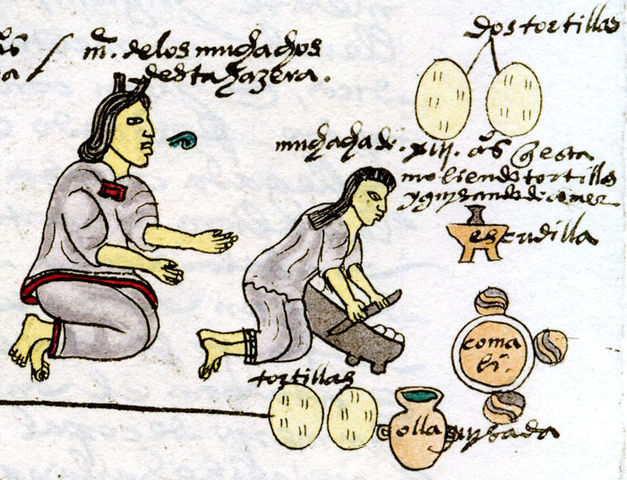
tamales codex

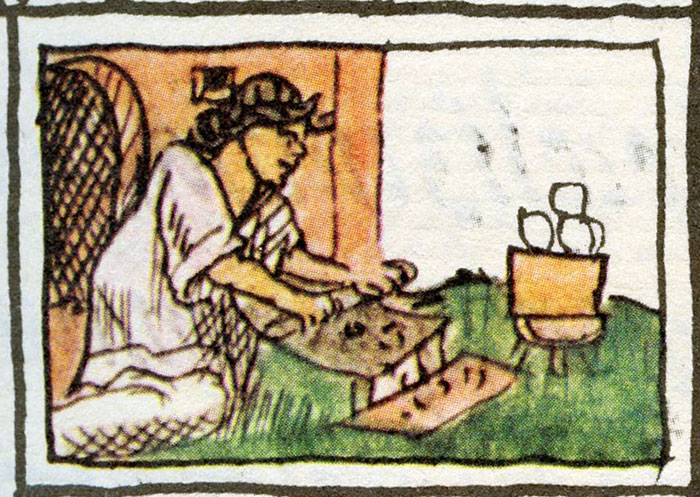
The Maya often had tamales filled with toasted squash seeds, squash flowers, beans, iguana, turkey, deer, and fish. The heart of the deer was used to make tamales for special festivals. They also had unique, elaborate tamales, rolled together and filled together like a jelly-roll, displaying spiral designs when cut. Often the tamales were wrapped in chaya instead of banana leaves or corn husks.

800px-Codex_Mendoza_folio_60r

Traditionally, food preparation was the domain of women. The ties began at birth when the umbilical cords of infant girls were buried under the grinding stone, symbolizing their future occupation. Girls learned at the knees of their mothers from a very young age so that by the age of 13, girls were responsible for grinding maize and food preparation. (See Codex Mendoza)

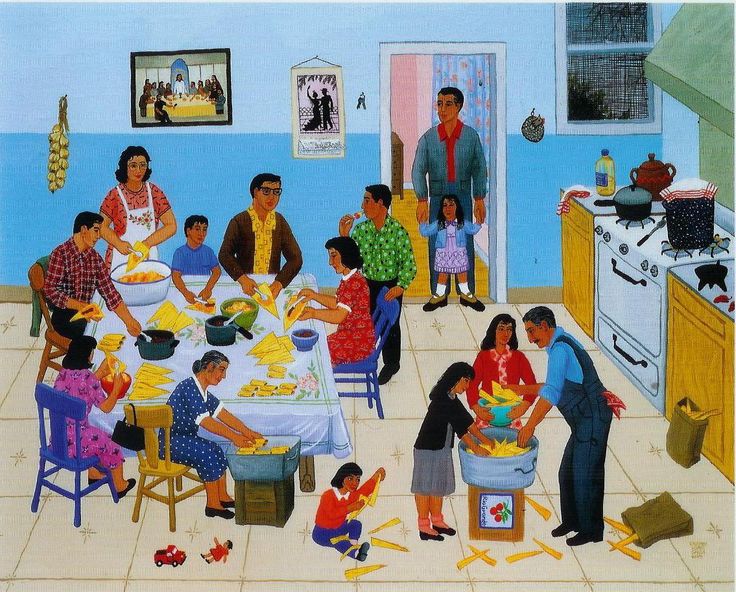
Women, young and old, participated in the extended tamal preparation in what was called a tamalada.
tamalada

La Tamalada by Carmen Lomas Garza

In Historia general de las cosas de la Nueva España, Bernardino de Sahagún described what he observed in a tamalada in preparation for a festivity.

“Among the ashes was the labor of the old women. They made tamales using dried grains of maize; …they made tamales of meat. Some cooked tamales in an olla. Some washed the maize grains which had been cooked in lime. Some carried and drew water, or poured it. Some broke up, ground, and pulverized cacao beans. Some mixed cooked maize with chocolate. Some cooked stews, or roasted chiles—different kinds of chiles. All night they remained there. Vigil was kept. They kept watch. There was constant awaiting of the light. They sat holding vigil and chattering.”

So how does one make tamales?

The beginning steps to preparing the masa are identical to making tortillas. (See Tortillas)

First, the dried corn is removed from the cob.

IM000773.JPG

Removing the corn from the cob.

The corn is then sifted to remove stones and dirt, then poured high so that the wind takes any chaff left over. Next corn is then boiled until soft with lime and the husks removed.

This is called nixtamalization.

The softened and peeled corn is then milled. Many tortillerias offer this service as hand grinding with a metate takes much longer. The resulting doughy mix is called masa.

Add melted manteca (lard) or vegetable oil to the masa and mix it until the dough is pasty.

IM000792.JPG

Corn husks can be bought already dried and flattened.

In addition to the masa (dough), the wrappings need to be prepared. If you are using dried corn husks, soak them in hot water until they are pliable. This could take up to 30 minutes. Drain and then pat dry.

Prepare your filling. For El Dia de Candalaria, we made pork tamales with chile.

In order to form the tamal, take a softened corn husk and spread the masa into a flat rectangle shape. Add the filling in the middle. Roll the husk and fold up it up at the end. Set the tamal upright in a steamer pot with 1 to 2 inches of water in the bottom. Cover and steam on medium-low heat until the dough pulls away from the corn husk. Enjoy!

Only one person should meter mano (put his/her hand in) to load the tamales into the pot, otherwise, the tamales will spoil, or so is the common belief.

The zacahuil tamal, a specialty still made by the Huastecan people, is 3 feet long, weighs about 150 pounds and uses most of the leaves of a banana tree to wrap. It is baked in an oven or in the ground rather than steamed.

As with any other integral part of life, there are several expressions using tamal/tamales found in Mexican Spanish.

The idea of infidelity comes into play again with the expression “Hacer de chivo los tamales” which literally means making tamales out of goat but means you are about to be betrayed by or betray your romantic partner.

Another is “El que obra mal, se le pudre el tamal“, literally, he that works poorly, causes the tamal to go bad. In other words, what comes around, goes around.

Or how about this one–“Para todo mal, un tamal. Para todo bien, tambien.” For everything bad, console yourself with a tamal. For everything good, celebrate with a tamal. With the variety of tamales available, there’s a flavor for every occasion. I’ve also heard this expression with mezcal replacing tamal. That will work too!

And one more–“El que nace pa’ tamal, del cielo le caen las hojas” He that was born to make tamales, the leaves fall from the sky. Once you’ve found your destiny, everything falls into place.

Bet you didn’t know the tamal was so profound, did you?

The Write Tribe Festival of Words #5

disclosure

13 Comments

Filed under Carnival posts, Homesteading, Mexican Cultural Stories, Mexican Food and Drink, Native fauna and flora

Tortillas

The creation story of the Maya recorded in the Popol Vuh explains how the gods created man in a sort of trial and error kind of creation. The first attempt consisted of mud men which resulted in mindless creatures with no strength that were easily dissolved in water. So then the gods tried wood men. This type of being was stronger but lacked that infinitesimal spark the gods were looking for. After much discussion, the gods crafted humans from a mixture of yellow and white corn. Finally, this was a being with strength, intelligence and agility. Thus the race of humans was born.

627px-Tortilleras_aztecas

Being people of the corn, maize has a sacred place in Mexican culture. Maize was domesticated about 10,000 years ago in the Balsas River Valley in south-central Mexico. Mexico is home to more than 2,000 identified varieties of native corn and has the oldest varieties found in any place in the world.

Is it any surprise that the corn tortilla remains an essential part of the Mexican diet?

florentine_codex_metate_3

The name tortilla comes from the word tlaxcalli in Náhuatl which comes from the longer word tlaxcalli tlán. The place nameTlaxcala means “the place of the tortilla” maybe giving some insight on where the tortilla was first developed. In Maya, tortillas are called waaj. In Totonaco, chaw. In Mixteco, ndíta. In Zapoteco, eta or gueta. In Otomi, hme. In Rarámuri, remeke.

Although there are now tortillerias (places that manufacture tortillas) where tortillas are machine pressed, it’s still possible to find delicious hand-pressed tortillas in a variety of colors wherever you are in Mexico. (See Tortilleria)

Making tortillas by hand is a very time-consuming process.

IM000773.JPG

Removing kernels

First, the dried corn is removed from the cob. It is possible to buy bags of corn and skip this step, though.

The corn is then sifted to remove stones and dirt, then poured high so that the wind takes any chaff left over.

Next corn is then boiled until soft with lime and the husks removed.

This is called nixtamalization. This process increases nutritional value, flavor and aroma of the while reducing mycotoxins when compared to unprocessed grain.

metate.jpg

The softened and peeled corn is then milled. Many tortillerias offer this service as hand grinding with a metate takes much longer .

The resulting doughy mix is called masa. Masa can be used for a variety of other delightful culinary treats which I’ll talk about in another post. (See Tamales)

tortillas

For tortillas, the dough is formed into small balls and then pressed flat. The now flattened result is transferred to the comal (heated flat pan) and toasted on one side, then flipped to be toasted briefly on the other. The finished product is removed and stacked.

There is a cara (face) to the tortilla which should be eaten that side up. I have yet to mastered being able to determine which side is the cara, but my son and husband have no problem, often flipping the tortilla before eating so that it is right side up. In the event that your taco is put together wrong, you might hear “le ponen los cuernos” (literally to put on the horns). This refers to the belief that in the event of an upside down taco, the preparer will be betrayed by his or her romantic partner. Hmm, maybe I’d better try a little harder to get that taco right side up.

cam04058.jpg

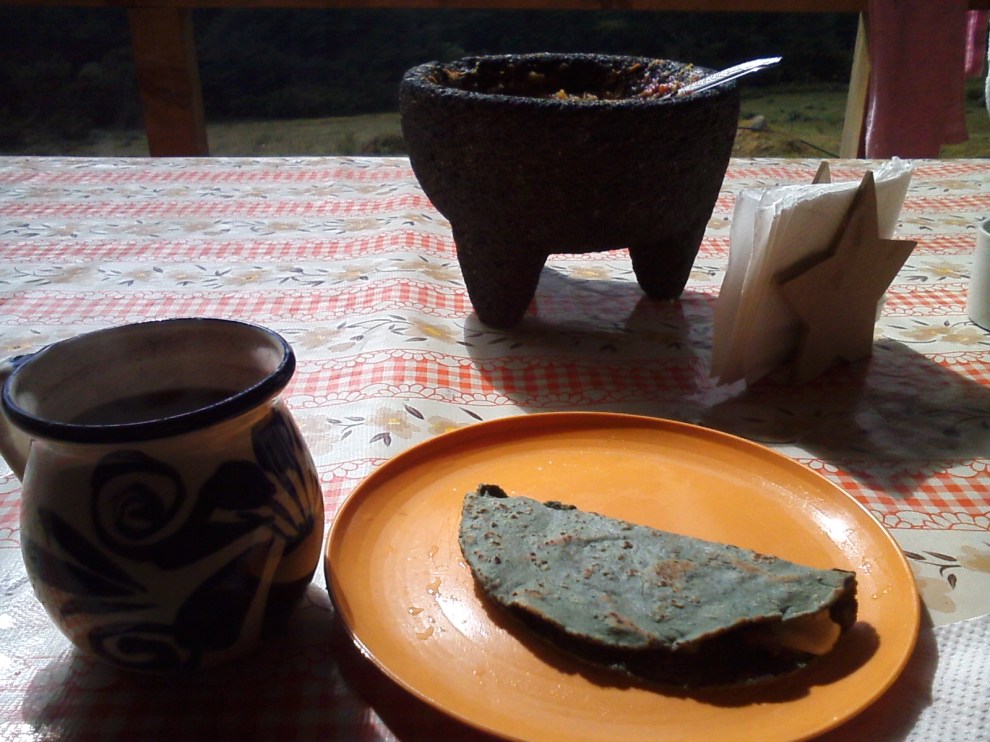
Tortillas come in a variety of colors mostly based on the type of corn used for the masa. When we went to the Monarch Butterfly Reserve, our delicious quesadillas were made from blue corn. I’ve also seen where tortillas can be made from cactus but haven’t had the pleasure of a taste of those yet.

The Write Tribe Festival of Words #5
disclosure

6 Comments

Filed under Carnival posts, Homesteading, Mexican Cultural Stories, Mexican Food and Drink, Native fauna and flora

Las Fiestas en Enero–Jaripeo

feria 2016.jpg

January has come around again, and it’s time for the annual festival in Moroleon. Although the events seldom vary, our own experience with the festival has.

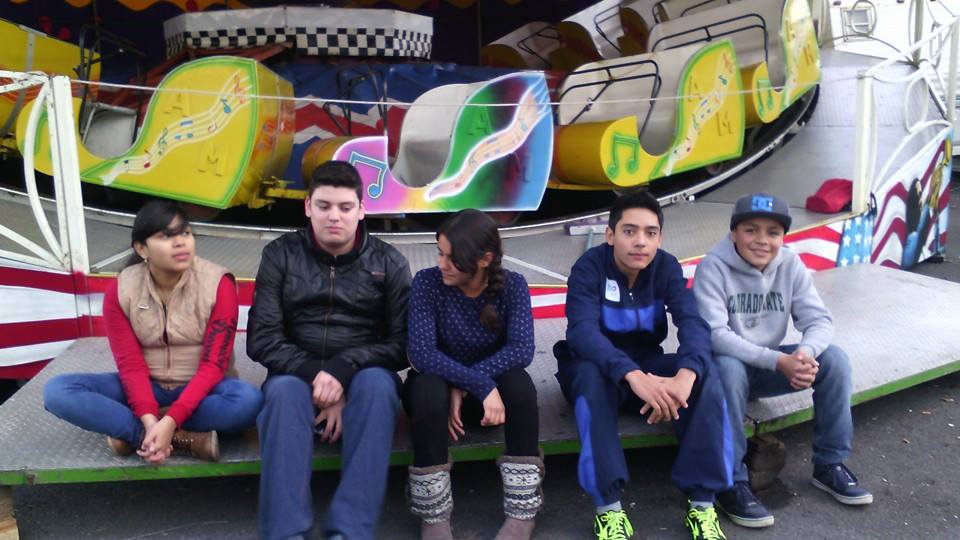
This year, our now 13-year old young man begged and pleaded to go to the fair with his friends rather than with us. Our schedule remains complicated, so he had to wear his school uniform, rather than ‘cool’ clothes, but he said he had fun. The first week was 2 x 1 admission which included unlimited rides and the circus, now with no wild animals performances. They did add the log flume to the ride repertoire, although getting drenched in frigid January temperatures isn’t ideal.

william at the fair

At the fair

I’ve decided that I’m too old for amusement park rides–my equilibrium isn’t what it used to be. My husband has an extremely weak stomach and never was a big fan of rides. So he and I decided we’d enjoy the festivities by going to a jaripeo (rodeo) instead.

When we found out that the jaripeo would be in the Lienzo Charro Nuevo, which was specifically dedicated to el Sr. de Escapulitas, and had free admission–there was nothing more to do but march our little fannies across the road from La Yacata and attend.

Our son decided that he wasn’t interested in attending, so just my husband and I set out.

Even though the rodeo was less than a five-minute walk from our house, my husband insisted we take the truck. Apparently, walking to such events is just not done. Sure enough, we saw several of our neighbors with their trucks there.

My husband clarified that this was not a jaripeo, even though that’s how it was announced, but a charreada–a skills presentation rather than real rodeo, but I didn’t care. The nearest I can figure is a true jaripeo is fairly dangerous to bull, horse, rider, and audience and may result in the death of any of the aforementioned participants. Whereas a charreada seldom results in death, although injuries, sometimes severe, do occur.

The charreada became popular when there were haciendas in Mexico, adapted from traditions brought from Spain in the 16th century. Originally, the charreada was a competition between the families of neighboring haciendas. The charreada is made up of 9 events for men and one event for women, all involving horses and cattle.

I had some mixed feelings watching the charreada. I enjoyed watching the horsemanship and rope tricks. However, I felt sorry for the undernourished yeguas (mares) that were roped and tripped and harassed. Most seemed to be about the same age as our Joey, but so thin and small, with large patches of hair missing from their hindquarters. I asked my husband what happens if one of the horses is injured in the fall. Sadly, they are fed to the lions. Yes, Moroleon has lions at the local zoo. Unmanageable, sick, unwanted, injured horses and donkeys are bought and served up fresh to the small lion pack at Los Areas Verdes.

Partying in honor of Las Fiestas de Enero continued on until the wee hours of the morning on Thursday, Friday, and Saturday nights. We opted to steer clear of that again this year. It’s cold, noisy, smelly and just not a whole lot of fun for us old fogies. The fair is here 2 full weeks and events such as the jaripeos are randomly interspersed in between. The “trastes”(dishes) stand also comes to town but no longer sets up with the circus. It rents an open area near Soriana for their tents now, probably cheaper. Dishes, glasses, pots, pans, cooking utensils, dish towels and the like can be found there. They aren’t less expensive than the regular stores, but there is more of a selection.

I have a special treat for those of you from Moroleon. My friend Claudia and I worked up a little book for children that highlights some of the more interesting historical tidbits about Moroleon.

portada 2The History of Moroleon for Kids (Kindle)

*************************************************

SOTBS Blog Hop Op1Sq

Have a Christmas or New Year in Mexico themed blog post?

Link it up here! An InLinkz Link-up

disclosure

4 Comments

Filed under Carnival posts, Cultural Challenges, Mexican Holidays