If you’ll remember, a few weeks ago, Fuzz was cat-napped. We know he was taken rather than just wandered off because my husband’s sister saw the people scoop him up. Well, I’m happy to report that Fuzz found his way home!
I heard the moment he entered La Yacata. The dogs at the corner started barking. There’s a new smallish dog that has adopted that corner. Yet another animal abandoned in La Yacata. The people that live there already have three dogs, so they feed it and let it live on the step, but haven’t adopted it completely. Anyway, that little guy takes his corner protecting job seriously, and set up a howl at about 8 pm one night.
Then our dogs took up the call, both the Puppers and Cocoa inside. The combined forces of the howling was answered by a pack of coyotes in the area. And then I heard it. Fuzz’s meows.
I hurried down and opened the front door. Fuzz streaked in. Well, it was more of an amble. Fuzz doesn’t go anywhere at speed. It took a few days for him to get settled back in. He also had to get used to Manchas, our newest arrival. But he’s back to his old snoozing routine and we are delighted!
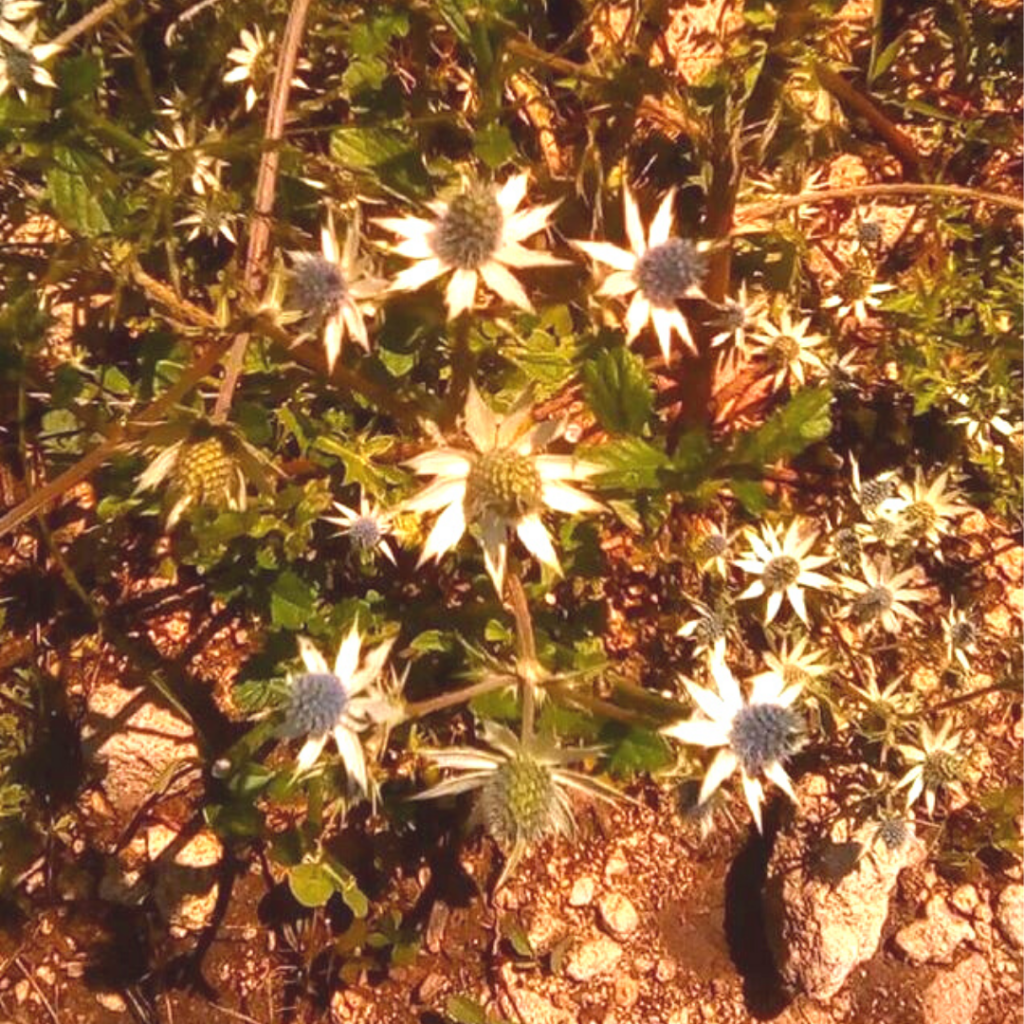
One day, I was out foraging for wildflowers and came across the unique blue-tinged beauty above. I took a picture of it, but for the longest time couldn’t find anyone who could identify it. Several weeks later, the indigenous herb seller at the local tianguis (flea market) had a basket of these flowers dried. Delighted, I asked what the name of it was and what it was used for. He gave me the name “yerba de sapo” and with that, I was off on my investigations.
Yerba de sapo translates as toad’s herb in English. The particular variety I encountered is Eryngium carlinae but there are more than 200 varieties in this species around the world. Some sources say this plant is blue thistle, others record it as button snakeroot or sea holly, and yet another source lists it name as Eryngo.
The name in Spanish isn’t any less confusing. Yerba de sapo can also be spelled hierba de sapo, however, this is also the term used for Eryngium heterophyllum, another variety of the Eryngium genus with similar health uses. Other names include cabezona and cardón.
It has been used since the time of the Aztecs as a restorative tonic, remedy for kidney problems, and weight loss aid. The mashed leaves were used to make a poultice for sore eyes. It was also used to regulate menstruation.
For kidney ailments, a handful of yerba de sapo is boiled in a quart of water. Then one small glass is taken before breakfast. The herb guy recommended a handful of the herb should be boiled along with a bit of palo de brasil (Haematoxylum brasiletto) and palo azul (Eysenhardtia texana) in a tea drunk daily, to lower cholesterol levels and reduce weight.
A tea made from just the leaves is used to treat cough and whooping cough. The roots are edible and sometimes eaten toasted for urinary tract infections. The juiced roots are prescribed as an aphrodisiac, to improve urinary function or induce contractions. Combined with other herbs, it is used in a gonorrhea treatment. It is also used to treat kidney stones and as a cancer remedy. Yerba de sapo is often prescribed to allieviate angina pain and reduce arteriosclerosis.
Few scientific studies have been done on eryngium carlinae. However, those that have been conducted show promising results for its medicinal use. It has been shown to be effective in the treatment of diabetes. It has a hypocholesterolemic effect, meaning that yes indeed, it will lower your cholesterol. It reduces lipid peroxidation in the brain, kidney, and liver while increasing the catalase activity having antioxidant properties. It is antibacterial and has been approved as a beverage with renoprotective effects, thus good for the kidneys.
Eryngium carlinae grows in chalky or limestone soil and higher elevations. In fact, the specimen I came across during my foraging trip was in the mountains near El Cerro de Los Amoles in what had been a limestone evacuation area. The plant does not like to be moved, but it can be propagated with root cuttings.
Precautions:
Because it can stimulate uterine contractions, yerba de sapo should never be taken during pregnancy. It should not be ingested for more than eight weeks so as not to cause kidney damage. Those that are allergic to fennel, dill, or celery may experience an allergic reaction.
The other day, we were walking the dogs and we heard a kitten meowing from inside my brother-in-law’s house. Since he has a large pit bull and isn’t known for his love of cats, we were surprised. So we stopped for just a second and peered under the door. An extremely irate and small, fluffy cat burst vocalizing its dissatisfaction with everything.
All three dogs are several times larger than this kitten. The dogs began jumping around in agitation but this little kitty wasn’t backing up. We decided we needed to get the dogs out of there before someone got hurt. But the little beast followed us. It was obviously terrified. Its tail was four times its normal size. And yet it kept coming. It chased us around the block. And when we tried to get everyone in the house, it marched its butt right in, still meowing horrendously.
I gave my son all three dog leashes and shut the door to the garage to round up the little kitty. However, as soon as I put it out, it dashed back in. It took three tries to get it out! It climbed the woodpile in front of the house and settled itself into my son’s window, still meowing. The pets lined up at the window to see the spectacle.
So thinking the cat was hungry, my son tried to give it food and water. Since we didn’t want it in the house, he snuck out the animal gate and left the supplies and dashed back in. It certainly was hungry and chowed down on the food like a ravenous monster, sound effects included.
The evening dog walk was suspended since we were now virtual prisoners in the house. The next morning, I tried again to make friends with the little thing. I let it in the garage and gave it food and water. Instead of eating, it dashed past our pets, up the stairs, and zeroed in on Cocoa’s food dish. How it knew where that was, I’ll never know. Cocoa was having none of that and repeatedly flattened the kitten with his paw to try and get it to stop.
I scooped it up and tried cuddles but it just would not be calmed. I tried more food, but it was still at a near-hysterical pitch. The way it was acting, I wouldn’t have been surprised if its head started spinning around. I finally had to put it back outside again.
We snuck out for the morning dog walk when the coast was clear. On our walk, we found a cardboard box on the road near my brother-in-law’s house. We think someone had brought it here to dump, it took shelter in the house, but didn’t count on the big dog. When it heard us, it thought it was rescued and followed us home. And that’s where we stood.
I sent messages to animal lovers and found someone that would take the kitten. I tried to bring it into the garage for safekeeping until they arrived, but it climbed the walls to where we have our solar panel batteries. Fearful that it would get injured, my son put it back outside again.
Finally, my artist friend Claudia came with a special cat backpack and we bundled the little guy up for his trip to his forever home. Whew! What a stressful couple of days. We are so relieved that the poor little mite found a home. We are well past animal capacity at the Flores ranchito, even if people keep leaving their beasties for us to find.