
Blogs About Mexico Worth Reading — Travel Documented

Samantha, from Travel Documented, is our featured blogger today. Read on to see what she has to say about her amazing life as an expat in Mexico.

Many things brought me to Mexico, including the culture, the people, warm weather, excellent food, cost of living, amazing cities, I could go on and on….close to the USA.

The blog I host is called Travel Documented. I live to travel and have been for some time. I think the name encompasses our passion for traveling to multiple places while documenting our journey. We write where we go. So far, these areas are Ajijic and Lake Chapala, Mazatlan, Puerto Vallarta, San Miguel de Allende, and Mexico City.

I love to write and share stories and adventures as I embrace new cultures and new languages. I make many mistakes, but I hope to learn from them and share what I have learned in the process. My blog is for a variety of audiences: Expats and Immigrants to Mexico from the USA and Canada, Solo Travelers and Solo Female Travelers, Those Looking to Exit Corporate America, The FIRE Community (Financial Independence, Retire Early), Remote Workers, and those wanting to leave the USA and are gathering information and experiences. As we continue to travel, our audience may expand to include minimalists and backpackers.

My favorite blog post is Mazatlan, Mexico: It’s Not Just Beautiful, It’s a Hidden Gem. I haven’t found anything to be extremely difficult to write about. I enjoy writing. However, just finding time to collect my thoughts and sit down to write can be challenging at times.

My recent visit to Mexico City (CDMX) has been the experience I’ve had in Mexico so far. I absolutely loved it, and I can’t wait to visit again. It was absolutely amazing. So many things to do. It blew me away. Unfortunately, it was also the worst experience. I was spat on in Mexico City. It was me and a store clerk at a restaurant at the same time as a man who demanded the restaurant give him food. I think I was in the wrong place at the wrong time. The store clerk didn’t react, nor did I. I just walked away and was fine.

For those planning to move or travel to Mexico, I recommend spending some time in a variety of places in different climates at different times of the year. Study Spanish and practice speaking it as much as possible. Learn about the Mexican culture, take an interest in the society, culture, the food, and have a humble spirit to integrate.

I plan to remain in Mexico as long as possible. I have no immediate plans to leave. I have residency here.

I would love to continue to collaborate with others, share information and build a community online and in person. As far as the future, who knows? I like to remain open to possibilities.

Connect with Samantha at: 

Facebook: https://www.facebook.com/travel.documented1234

Instagram: https://www.instagram.com/travel.documented/

Website: https://traveldocumented.com/

YouTube: https://www.youtube.com/@Travel.Documented

Leave a comment

Filed under Blogs about Mexico Worth Reading

Natural Healing — Huaútli

Photo credit: Kurt Stüber

Did you know that May is National Amaranth month? And did you know that amaranth is a native Mexican plant with oodles of health benefits?

Let’s dive into the history a bit. The Amaranthus species has three varieties cultivated as a grain. These are Amaranthus cruentus (Blood amaranth), Amaranthus hypochondriacus (Prince’s feather), and Amaranthus caudatus (Loves-lies-bleeding). The first two are native Mexican plants while Amaranthus caudatus was originally native to Peru.

Amaranthus cruentus is huauhtli in Nahuatl and known by that term’s variation huaútli throughout Mexico. In Maya, it is xtes or tez, alparie in Purépecha, guegui in the language of the Raramuri, xidha in Otomí and wa’ve in Huichol. Other names for varieties of this plant include quelite, bledo, and quintonil all of which are also used to identify plants in unrelated species, making them problematic for identification purposes. Amaranto is another moniker gaining popularity.

The importance this grain once held in the prehispanic is seen by the number of names in Nahuatl for specific varieties. Black amaranth was tlilhuauhtli. Xochihuauhtli was yellow amaranth. Wild amaranth was tezca huauhtli. Another type of amaranth was michihuauhtli. And texouauhtli was the word for blue amaranth. This language precision was natural considering approximately 80 percent of the prehispanic indigenous diet was made up of this grain. Huaútli was cooked, popped, or ground into flour. It was used for atole, tamales, and tortillas. The tender leaves were boiled as a vegetable.

Discoveries of this grain in the kitchens and places of worship at an excavation site in Tepetitlán, an area near Tula, further demonstrate its importance. Tula is not an area where maize thrives because of altitude, frost layer, and poor soil quality. Instead, huaútli was the main crop for the area, especially valued during drought periods as it could be stored in clay pots for long periods of time without rotting. 

According to the Mendoza Codex, newborn babies were bathed with leaf infusions. Amaranth paste was used to make symbolic objects presented to a new baby to help identify its place in society, such as a bow and arrow for a hunter, a scribe’s utensils for the priesthood, and so on. 

Amaranto seeds formed into a ball with agave honey called tzoalli was a common travel food. Mixed with blood it was an offering to the gods. Warriors ate it to increase their strength. Today, this recipe is known as alegrías (joys) and is found in traditional sweet selections throughout the country and during the Día de Muertos festivities molded into skulls. 

Tzoalli was vilified by Spanish priests after witnessing the festivities of the Aztec god Huitzilopochtli, the principal deity of war, sun and human sacrifice, and the patron of the city of Tenochtitlan, which was celebrated in what is now December. Among processions, dancing, singing, praying, and human sacrifice, a representation of the god was formed from tzoalli. At the conclusion of the holiday, this was cut into small pieces and celebrants partook of a piece in a communal ceremony known as “the eating of the gods.” The Catholic Church outlawed the cultivation of huaútli, punishing anyone who planted it by cutting off their hands and anyone who ate it with death. 

Amaranthus is an extremely adaptable crop, heat/drought-resistant, with no major disease issues, and easy to grow. It is full of iron, calcium, phosphorous, folic acid, manganese, selenium, magnesium, vitamin A, vitamin C. 

It has a higher protein concentration than most other cereal grains and is considered a preventative food source for cardiovascular disease, cancer, and diabetes. Infant formulas made with Amaranthus cruentus are nutritionally rich. Made into flour, it is a tasty alternative to wheat products

In addition to nutritional and spiritual elements, huaútli has medicinal value. A tea infusion made from the flowers is prescribed as a daily heart tonic. Studies have demonstrated its anti-hypertensive and antioxidant properties. It is also antifungal and anti-inflammatory

Traditionally, a tea infusion made from the leaves is prescribed for diarrhea and stomach pain. For chest and back pain, the infusion is made from the flowers. For menstrual pain, the flowers are boiled in chicken broth. Leaf poultices are applied for cold sores and skin infections.

Alegrías

  • ⅛ cup of water
  • 1 cone of piloncillo (brown sugar)
  • ¼ cup of honey 
  • ½  limón juice
  • 1 cup + 3 tablespoons of amaranth seeds
  • 1 cup of a variety of seeds, nuts, and dried fruit (optional)

In a skillet over medium heat, toast the amaranth seeds until they puff up and are evenly browned, about 10 minutes. If adding nuts or pumpkins seeds, add them to the amaranth and toast briefly.

In another pot, combine the water and piloncillo. Stir over low heat until the piloncillo dissolves. Add the honey and mix again. Then add the limón juice and simmer for 15 minutes. Remove from heat and allow to cool for about 10 minutes. If adding dried fruit, do so now. 

Pour the liquid mixture over the toasted seeds and mix thoroughly. Spread the combined ingredients in a pan lined with wax paper. Allow it to set for 2 hours. Cut into bars or use shaped cookie cutters.

***

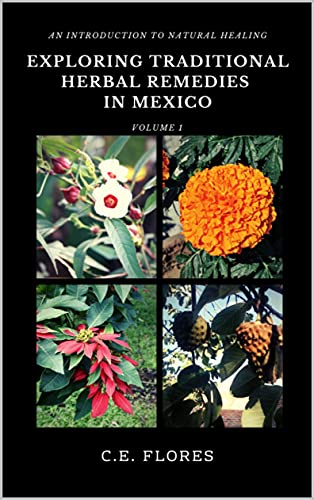
Interested in natural remedies? Uncover herbal remedies from traditional Mexican sources for healing and wellness in the Exploring Traditional Herbal Remedies in Mexico series.

Leave a comment

Filed under Health, Homesteading, Native fauna and flora, Natural Healing

Tooting My Own Book Horn

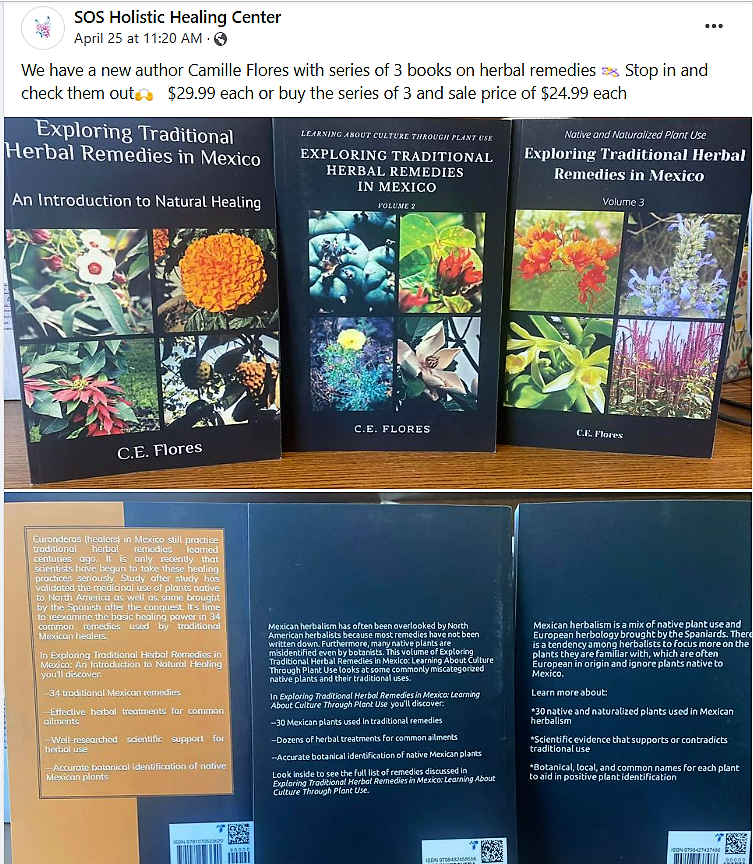
In addition to my interview with Toni Lontis and being featured in The Edge Magazine, I also fiddled around with getting some books in a physical (or rather a metaphysical) store in North Dakota. 

Here’s my highlight from SOS Holistic Healing Center.

That concludes my promotional activity for the month. Whew! I’m nearing completing Herb book #4, so look for a launch announcement towards the end of May. Herbs..herbs…herbs…

***

Order from Amazon!

2 Comments

Filed under Uncategorized