
Why did the chicken cross the road?
I expect to escape from being eaten.
My husband likes to reminisce sometimes about how when he was young, and there wasn’t enough for his ten brothers and sisters and him to eat. Being determined not to go hungry, he would do some chicken hunting. Most of the chickens he hunted were from his Tio Tomas (Uncle Tom) and boy did they sure taste good. He tells this story at least once a month, mostly to impress upon our son the sinfulness of wasting food, especially chicken. Of course, the story ends with him being caught by Tio Tomas and receiving the whipping of a lifetime.

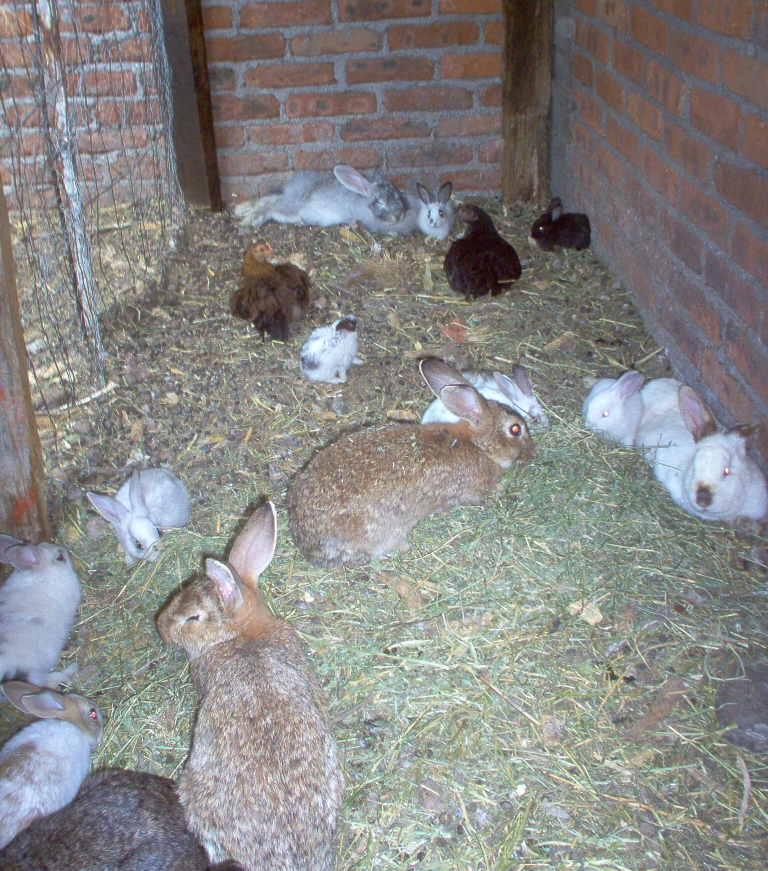
Our current enclosure for ducks, chickens, and quails
Chickens were one of the first animals we incorporated into our mini-farm. They don’t need fancy housing, they can forage for their own food, lay eggs, and can be eaten.
Most of the chickens were little red hens, just like the story. But one hen of our hens was brown and white speckled, and that made all the difference. We named her Penny, like in Henny Penny and the sky is falling down. Not one of the red hens liked her. They pecked her. They chased her away from the feed and water. They wouldn’t let her sleep on the roost. Just like a bunch of old biddies. So she became a bit of a loner, doing her own thing.

Penny is the light colored hen in the back.
This changed when Rocky the rooster came along. He was a spare rooster, as there was already Blackie the rooster to do the morning wake up call and ruffle the hens and make the egg announcements to the world. So Rocky and Penny were put together to keep each other company. Both being outcasts, they joined forces. Penny started laying eggs again. Rocky did his husbandly duties as any good rooster should.
But the day came when Rocky went into the soup pot. A spare rooster, after all, is redundant. Penny went into a deep depression. No kidding. She wouldn’t eat, she stopped laying eggs again, and she took shelter in a hollow pipe and wouldn’t come out. Within a week she was dead. She died of a broken heart. Chickens do have feelings. Love is not unique to humans.

Another one of our red hens named Jovencita is our pride and joy. She is the best broody hen we have. Last year she hatched groups of chicks four times, although the last bunch died of groopers, minuscule red bugs that swarmed their little lungs. Anyway, her first batch was doing well, when all of a sudden they developed itchy sores. Would you believe it, chicken pox? The feed was fine, the area and water were clean, so how could these poor little things get sick? After doing some research in my backyard farm animal guidebook, I discovered that this type of disease could be transmitted from turkeys. There weren’t any turkeys in our yard, but the neighbor down the road had some. I suppose a wild bird stopped at the turkey guy’s feed spot and had breakfast, then headed to our feed place for lunch, unwittingly carrying the disease. So 4 out of 5 chicks died within two days, awful painful itching deaths.

The color of the chicks seems to be dependent on the color of the rooster. These are Jovencita’s chicks to Blackie, the rooster.
One little rooster managed to survive but was horribly scarred. We named him Feo (Ugly), cuz he sure was ugly with bald patches and bumps. Being the only chick left, he had the run of the joint. Jovencita, having lost her brood, went broody again shortly after that, so Feo was left to his own devices.
Feo was fearless. He snatched food from right under the noses of the dogs. He swerved and ran to avoid pecking from the other chickens. He drank from the cat’s own water dish. We came to admire his pluck and courage. Nothing phased him. We could shoo him back into the wired enclosure, and 2 minutes later he was back out, happily strutting about. I guess having survived chicken pox he thought he was invincible.
At the time, all the chickens were kept in our walled backyard and mostly allowed to forage in the garden. But the grass is always greener they say and Feo got it into his head that there would be more succulent eats outside the fence. As he was undersized as well, he was able to slip between the gate bars into the wide blue yonder. One day, quick as a wink, as he was bravely venturing out to explore new worlds, a long, smooth, silver snake came out from under the sidewalk and gobbled him up. The race does not go to the brave, but to the swift.

Gringa, the hen
Our latest acquisition is a gringa hen, so named because this particular type of chicken does not have feathers on its scrawny neck. It is, therefore, a “redneck” chicken. Get it? Anyway, she isn’t accepted into the established chicken society, being different and all. She waits her turn at the food dish. First, the rooster and his ladies eat. Then the broody hens and her chicks eat. Then Mr. & Mrs. Muscovy eat with their ducklings. Then the codornices (quail) eat. Finally, la gringa gets her chance. Discrimination is not confined to humans.
*****************************************


0.000000
0.000000






 Surviving Mexico