Category Archives: Teaching

Learning and Teaching–Language

pig laying egg

My concept of teaching language has evolved over time from teaching vocabulary, structure and spelling, to teaching communication, which includes teaching these but goes beyond them by making sense of the language. That may sound elementary, but I assure you, communicating in a language other than your own, can be fraught with unimagined communication perils.

My experiences with language (in both teaching and learning) have mostly been with the American English language and with the Mexican Spanish language. These languages are full of strange usage and even stranger vocabulary that come from hybrid (as compared to standard) language development. Both languages owe much to varied and multiple indigenous roots and have evolved with exposure to other foreign languages. Because of this, translating between the two can be difficult.

Much of how I now teach English, comes as a result of how I have learned Spanish, with a communicative rather than grammatical approach. In my classes of beginning level English, we start with small lists of related vocabulary that can be easily illustrated by TPR or graphics and are particularly relevant to the student. The use of songs and stories help reduce the fear of using a language even for adults.

Charlotte Mason touches on language instruction when she writes “Young children find little difficulty in using French vocables, but at this stage the teacher should with the children’s help translate the little passage which is to be narrated, them re-read it in French and require the children to narrate it. This they do after a time surprisingly well, and the act of narrating gives them some command of French phrases as far as they go, much more so than if they learnt the little passage off by heart.”

It is important to clarify that this “translation” process is not a direct translation from one language to another, but more of a bridging activity, helping the students make sense of the ideas, not just the words and structure.

To illustrate this, take for example this common Mexican phrase “Fijate si puso la puerca.” Literally translated the phrase reads “Go and see if the pig put.” which doesn’t make sense. However, if it is explained that the verb poner can be used to refer to laying eggs, we can now translate the phrase as “Go and see if the sow laid eggs.” But there is obviously still some problem with this literal translation since pigs don’t lay eggs. It is not until it is explained that this phrase is used when someone is bothering you and in meaning is more along the lines of the American English phrase “Go fly a kite!” that the phrase is correctly translated.

The narration in the second language mentioned by Charlotte Mason is a gradual process, not just for young children, but for beginning learners of all ages. After having made sense of a passage, students can first retell it in their native language, then with teacher encouragement, use small phrases in the second language in the retelling, moving eventually to complete sentences in the second language in the retelling, truly making the language their own.

In one sense, I must disagree with Charlotte Mason when she writes“But a child cannot dream parts of speech, and any grown-up twaddle attempting to personify such abstractions offends a small person who with all his love of play and nonsense has a serious mind.” I have found it useful to personify some grammar points that are particularly difficult for Mexican speakers. For instance, with the auxiliary verbs “do, don’t, did, didn’t, does, doesn’t, can’t, can, etc.” in illustrating their grammatical use by saying that these are servants since they do the work of the main or master verb who then becomes so lazy it refuses to change (She goes home. She didn’t go home.) I have found that students make fewer errors in the use of the auxiliary verb and main verb and often hear them chanting under their breath, “servant does the work, so master doesn’t change.” It is much easier remember a story personified than a grammar rule and in fact, in American English with native speakers, we have all sorts of mnemonic devices to aid us with correct language usage. (i before e, except after c, or when two vowels go walking, the first one does the talking) There is no reason, therefore, to take the play out of language learning.

*************************************

disclosure

3 Comments

Filed under Carnival posts, Education, Teaching

Parenting Challenge–Education as a Discipline

Our vacation education project!

Our vacation education project!

Let the lessons be of the right sort and children will learn them with delight. –Charlotte Mason

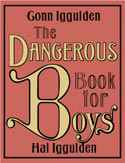
During the long 2 week vacation that comes with Semana Santa (Holy Week), I started my 10-year-old son on an educational path that involved the book “The Most Dangerous Book for Boys” by Con and Hal Iggulden. With a title like that, you would have thought that he would have dove right in, but it took a little prompting and finally a stern mandate that he was to read one section of the book and complete the activity (if it had one) each and every day of the vacation period. However, I moderated that he could choose whatever topic he wished. So reluctantly he took the book to his room and thumbed through the table of contents, only to return a few minutes later to ask if he really could choose whatever topic. I responded affirmatively, and his excitement was evident. He went back to reading and came back again asking if he could do more than one section a day. Of course, he could.

As we have already urged, there is but one right way, that is, children must do the work for themselves. They must read the given pages and tell what they have read, they must perform, that is, what we may call the act of knowing. –Charlotte Mason

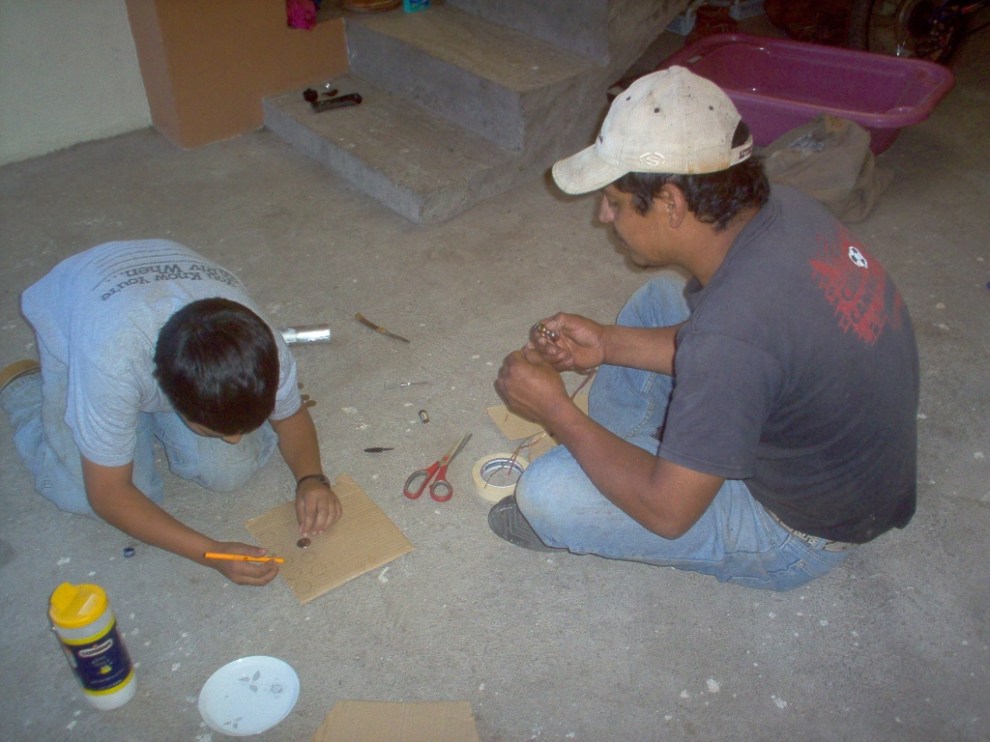
The first thing he read was about how to make paper airplanes. The house is now littered with the ones he learned from the book and several that he made his own adaptations to. Then he read about building a tree house, although I asked him what he thought he would do with that information since we do not have any trees large enough to support a tree house (cactus is not inherently stable enough to house a tree house.) But he wanted to read it, so he did. I came home from classes and found he had adapted the information to make a second dog house for Cocoa all on his own. (The first dog house, constructed with the help of his dad, has been taken over by 2 kittens and Hershey the new puppy.) Another day, he asked me to bring home vinegar and blotting paper for the newest experiment, a battery made with vinegar, quarters, copper wire, salt, and blotting paper. As blotting paper could not be found, he substituted thin cardboard and set to work. After a failed attempt (he had forgotten the salt) he tried again, his dad looking on. The second attempt also failed, (the light bulb was too large), so he tried again, doubling the number of quarters. He still wasn’t able to make the bulb light up, but he was able to create a spark, so the experiment was deemed a success.

making a battery

Working on making a battery from quarters and vinegar.

The bad habit of the easy life is always pleasant and persuasive and to be resisted with pain and effort, but with hope and certainty of success, because in our very structure is the preparation for forming such habits of muscle and mind as we deliberately propose to ourselves.–Charlotte Mason

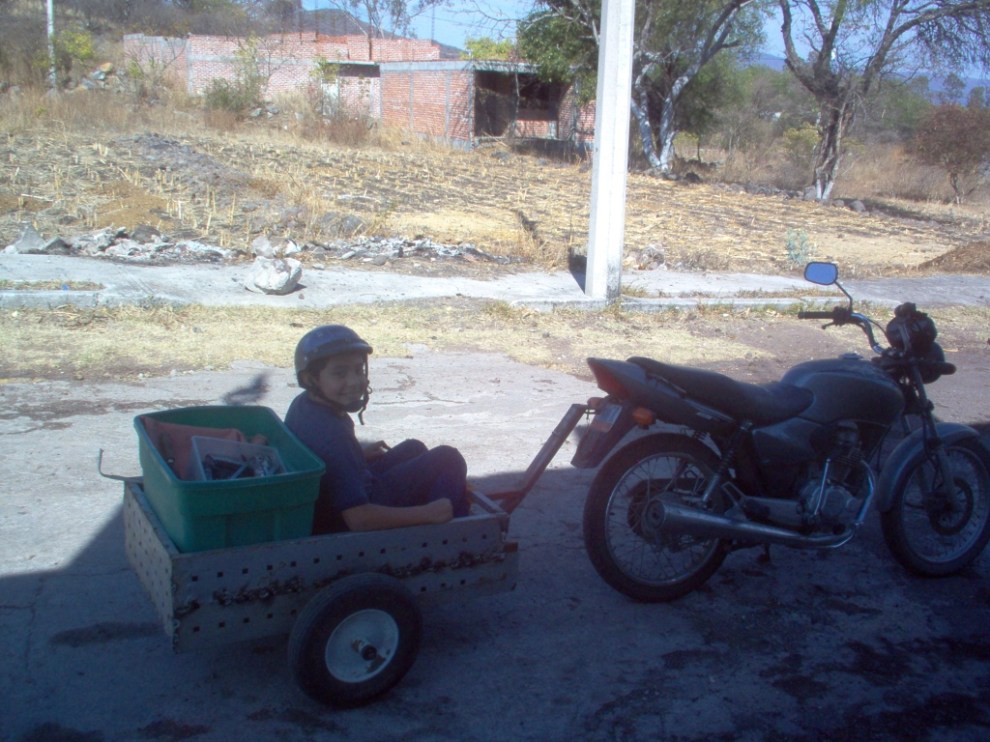
My son’s new found enthusiasm for experimentation has sparked my husband’s mind as well. My husband has retooled our moto (motorcycle) wagon and is now gathering materials for making an attempt at a windmill to provide us with electricity since it seems that the powers that be in this area are not interested in their civic duties. My husband has always been creative but slipped into complacency this past year. I hope that his new projects will reawaken what was once a sharp and agile mind.

side car

Moto-cart. Just the thing for transporting!

Physical fitness, morals and manners, are very largely the outcome of habit; and not only so, but the habits of the religious life also become fixed and delightful and give us due support in the effort to live a godly, righteous and sober life. We need not be deterred by the fear that religious habits in a child are mechanical, uninformed by the ideas which should give them value. –Charlotte Mason

Having myself been raised in a religiously strict household, I have taken a more indirect approach to religion with my son. Instead of attending regular religious services, we look for God in the everyday. Instead of forced bible readings, I present tidbits that prompt his own investigations. “The most Dangerous Book for Boys” contains sections on the greatest battles ever fought since the beginning of recorded history. Of course, this included biblical figures such as Nebuchadnezzar. He read the section covering the conflict in the book, then went off with a bible to gather more details about Nebuchadnezzar’s life and times.

It is as we have seen disastrous when child or man learns to think in a groove, and shivers like an unaccustomed bather on the steps of a new notion. This danger is perhaps averted by giving children as their daily diet the wise thoughts of great minds, and of many great minds; so that they may gradually and unconsciously get the courage of their opinions. –Charlotte Mason

There are sections on scientists, explorers, inventors, poets, excerpts from Shakespeare, The Declaration of Independence, and the King James Version of the Bible. There are readings on overcoming adversity, scientific discovery and reaching out towards self-awareness. I was delighted to find some of my own childhood favorites included. After all, my own life is based on what Frost tried to say “Two roads diverged in a wood, and I –I took the one less travelled by, and that has made all the difference” and it is my hope that my son will find his own path armed with all the knowledge and education that I lay before him.

**********************

disclosure

1 Comment

Filed under Book Reviews, Carnival posts, Education, Parenting Challenges and Cultural Norms, Teaching

Parenting Challenge–Creating an Atmosphere for Education

dinosaur track

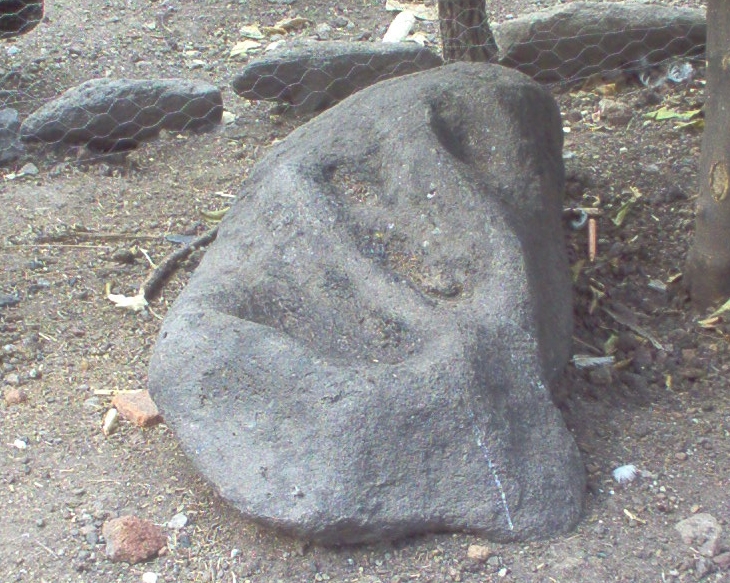
Often unexpected finds create the best environment for learning.

When we say that education is an atmosphere we do not mean that a child should be isolated in what may be called a ‘child environment’ specially adapted and prepared, but that we should take into account the educational value of his natural home atmosphere both as regards persons and things and should let him live freely among his proper conditions. –Charlotte Mason

I asked my 10-year-old son what he thought he has learned by residing in México. His immediate response of “that to get things, you have to suffer” was not what I was expecting. But he’s right. Everything is more difficult here, harder than you might imagine. So how can I, his mother, provide an atmosphere for education when just meeting the basic necessities of life takes so much time and effort?

How do I create an atmosphere for learning?

I provide options for investigation.

I am a teacher and as such have a natural tendency to provide my son with stimulating games and books at a variety of levels. When my son asked me what happened to the dinosaurs, I had a book already in my home library that offered a variety of theories. It was quite advanced scientifically so, I had him skim what was presented there, allowed him to ask me questions about things he didn’t understand and then asked him what he thought the answer to his question might be. When he said he still wasn’t sure, I was pleased to say that neither is anyone else. Did he learn something from his investigation? Most definitely. When we found a dinosaur print in La Yacata, he went back to the same book to try and identify the dinosaur that made the print. Again, he wasn’t sure that he had the correct answer, but finding the one right answer wasn’t the point in the educational experience.

I allow my son to be involved in economic decisions.

Each of our various business ventures has been family efforts. My son has a stake in what we decide to embark on and therefore, has a say in the matter. He also has obligations to make the venture as success as well. When we had the Crap Shoppe, he learned, mostly from his abuelita (grandma) about doing business and negotiation. I could trust him to make sales while I ran to the store or went to teach a class. This has served him well. He has just started his first outside-of-the-family job. He works from 9:30 to 12 Wednesdays in the mercado (market) selling plastic bags to the merchants. He takes a cart and goes store to store offering his wares. He works along with the nephew of the owner, but after the first day, he told the owner that since he did all the work, he should receive a percent of the sales rather than a fixed amount. The truth was in the pudding since when the nephew went alone on Saturday, he sold next to nothing. My son now gets 10% of the sales.

I set an example.

Adapting to this new life has not been easy for me. I make social blunders all the time. It requires every bit of my focused attention to pick up the cultural nuances and make sense of them. I have stumbled along paths that are not remotely what I had in mind when the journey began. And I have learned from it all. I have pointed out to him that even those people who make me uncomfortable, laugh at my errors or are downright mean, have taught me something. In fact, these people have been some of my best teachers. And that as long as I don’t give up, I haven’t failed. As he moves towards adolescence, with the desire to fit in and just be one of the crowd, I hope that my example will serve him well.

I learn from my son.

We work hard for every little bit we have, and no, things don’t come easy. There are hundreds of small disappointments that make a bit of success so sweet. When I am tempted to grumble and curse about a late night walk home because of a flat tire, my son says, “Mom, have you ever seen the stars look so beautiful?” and I can look at it as the grand adventure that it is.

Creating an atmosphere for education is not providing high-tech teaching material in a child-centered classroom. Rather it is providing an environment that fosters questions and inspires wonder. Nothing new has ever been discovered, invented or learned without it.

*****************


disclosure

7 Comments

Filed under Carnival posts, Education, Parenting Challenges and Cultural Norms, Teaching