Category Archives: Religion

La Curandera–The first reading

Curanderas cure with herbs and prayer in many parts of México.

Curanderas cure with herbs and prayer in many parts of México.

Thus, as we live in a place out of time, there are what are called curanderas here in México. The term loosely translated is “one that cures”, for the most part with herbs and prayers, that which ails you. All sorts of innocent looking items may be part of the cure. For instance, once I asked about this hairy looking thing in my mother-in-law’s house. It was a long brown stick with hair sort of like a horse tail whip that she said was a ward for evil and helped with the cure of her arthritic knee.

Now, I know that herbs are plenty helpful, in many cases more so than manufactured chemicals prescribed by doctors. There is nothing new in the idea of wise women in the history of the world. It was when I understood that a curandera is often a diviner, a fortune teller, or spell caster, that I was taken aback. After all, the bible warns against any association with witches and I had been raised a good Christian girl. But wait a minute, Chencha, the curandera was a devout Catholic.

So, before judging with biblical admonitions to “You must not preserve a sorceress alive” (Exodus 22:18) I needed to remember that the bible also speaks of prophets and prophetesses or seers in a positive light. For every witch of Endor (1 Samuel 28:7-25) there is a Deborah. (Judges 4:4-24)

Well, why not? When in Rome, the saying goes. . .So as things at the time were not going so well, off we trooped, my husband, my mother-in-law, my sister-in-law L and myself.

Chencha had a little waiting room/store. She sold amulets and lotions but the bulk of items for sale seemed to be ladies undergarments. So we sat in the waiting room and were eventually called to the secret room behind the store. And I was introduced Chencha, a tiny woman that radiated peacefulness and power, an efficient elf. She got right down to business and read the cards for each of us with a well worn and shuffled tarot deck.

L’s cards were full of woe and even the egg that was used to cleanse the body came out bloody. She would need more cleansing sessions before she could be “cruzado” crossed or blessed.

My husband’s cards were also portentous. Chencha made the comment that if she told everything she saw in the cards, he would surely weep. And when the egg was waved around his body and then cracked open, it contained oodles of salt. Apparently this means he is “salado” or had envious friends or acquaintances that were interfering with the flow of his life spirit.

Then it was my turn. She took my hand and placed it on the deck of cards and asked me to pray with her. I repeated what she said. It was something like I asked that the cards would show me answers for my well being and future happiness and that we would be wise in the interpretation of what was about to be presented.

So she said that I had a good heart, that I would live a long time, that my child would be fine, that my husband liked to drink but that didn’t mean he didn’t love me, that I had problems with the butterfly shaped organ that affected my mood, that I got angry easily and found forgiveness difficult and that my finances had been going down steadily for 2 years. As an afterthought, she said that any trip I might be planning would be fine.

So how close was she? My husband and I were having serious problems, so much so that I was planning on leaving México to go back to the US in a matter of weeks. However, I hadn’t told even him of that plan. I have hypothyroidism, the thyroid is the butterfly-shaped organ in the neck, and I had not been taking my medication for about a year. Three days after this consultation, we celebrated our second year in México, and our funds were at an all time low. And my in-laws chimed in and said that I was a “corajuda” or easily provoked. Who am I to gainsay them?
She seemed right on the money.

Chencha passed an egg over certain areas of my body, those I suspect that are in the centers of power and prayed. She cracked the egg into a clear glass already full of water and peered into it. I had some salt, literally, salt. As with my husband, it meant I was salada, that someone or some persons of my acquaintance were ‘echandome el sal’ or wishing me ill and that it was interfering with my sense of well-being. However, it wasn’t enough for her to suggest the full treatment. She was pretty sure it would take care of itself.

However, L and my husband needed the full dose, 9 sessions of cleansing and prayer and then the final blessing if the egg was clean. Nine seems to have special significance here. When a person dies there is a “novena” or prayers for 9 days after the death. When a prayer making petition is published in the newspaper, it is for 9 days. And it seems to me there are 9 stations of the cross in Catholicism as well.

My husband completed his treatments and we went about our daily lives.

*********************

disclosure

6 Comments

Filed under Natural Healing, Religion

El Velorio –Viewing and Wake

Today marks a year since my mother-in-law was killed by the police. (See On Life and Liberty) The horror, shock and grief have abated for her family some and as death is a part of life, it is necessary to understand some of  the customs surrounding it.
After my mother-in-law’s body was released from the hospital, she was taken to Yuriria for an autopsy since there were legal charges pending.  Her daughter L went in search of clothing to take to the funeral home, where they would clean and dress the body for viewing once the autopsy was finished.  I thought she would need to head out to La Yacata to pick up some clothing from my mother-in-law’s wardrobe, but I needn’t have worried.  L went to a special tailor to have a green and pink satin dress made and a crown of plastic flowers for her head.  Her body was dressed as the Virgin, possibly Santa Gertrudis, in what I thought was burlesque and even for this area was not common, although when I asked locals, they said they had heard of that being done.
Funeral homes come and set up a tent like this one to shade the mourners.

Funeral homes come and set up a tent like this one to shade the mourners.

The funeral home came to pitch a tent for the mourners outside the house before they brought the coffin.  There are funeral homes and salones de velación (places for the public display of the body) in Moroleón, however the poor still open their home for the viewing and wake, as inconvenient as it may be.
cofin 2
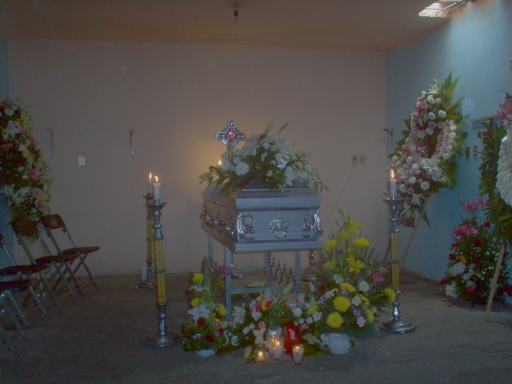
Her coffin arrived in the late afternoon and set up in the area adjoining the kitchen.  Large pillar candles were placed one at each corner and remained lit during the entire viewing. As the viewing was extended an extra day, we had to buy another set of candles.  Mourners brought more candles and flowers.
Squash was cut open and placed underneath the casket along with a dirt cross and rosary.  The squash was there to suck out the “cancer” from the deceased.  The nearest I was able to understand is that the squash removes the bad humors from the body in preparation for the spiritual awakening and that as the squash shrivels, the body is cleansed.
Every once in awhile, the women passed inside to rezar (pray with rosary beads) and I was included in this as a daughter-in-law of the deceased.   Being not only foreign but non-Catholic, I was not expected to lead the prayers and I just stood respectfully in silence.  However, the inclusion was a first and demonstrated an acceptance from the ladies of the family that was not extended to M’s American wife, who stayed outside with the men.
The casket was open but my mother-in-law was kept under glass, or rather plexiglass.  Her 88-year-old parents, Mama Vira and Papa Rique, came from Cerano, as did my father-in-law’s mother, Mama Sofia and her husband Tío Felipe.  Everyone was concerned that the viewing and wake might be too much for them at their advanced ages, but instead, it was her niece, daughter of her sister Lucia, that had difficulties.  Later that night, she was rushed to the hospital after having miscarried.  Doctors said that the fetus was malformed and the body took care of it on its own, however, the everyone nodded and said it was only natural that my mother-in-law’s spirit did not want to go alone and so took one of the family to accompany her.  Pregnant women are discouraged from attending for this reason.
In the evening, mourners arrived to accompany the family in their grief.  Some brought flowers, some tequila, some sugar and coffee or bread, as it is custom for the family to host the mourners, providing a beverage and light repast.
Mourners the first night included representatives of the various political parties, PAN, PRI/Verde, PRD, with their candidates very visibly and ostentatiously positioned.
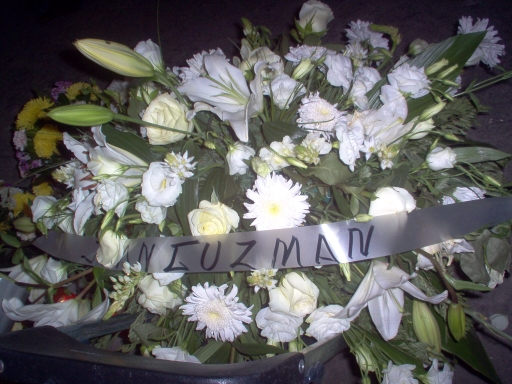
Flowers sent from the PRD candidate, later elected President of Moroleon

Flowers sent from the PRD candidate, later elected President of Moroleon

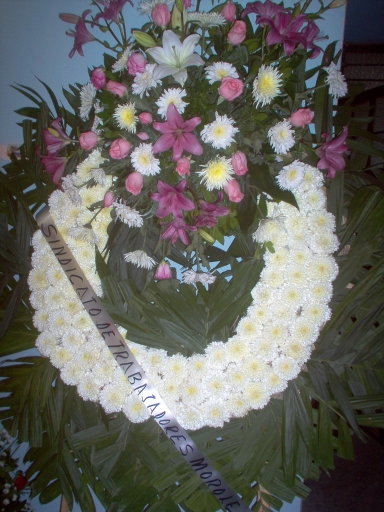
(See Politicking) My mother-in-law was PAN and although she wasn’t able to participate in this year’s elections, she was well known for past services and honored with a corona (wreath) from the party members.
flores de pan
Super Prez also came to the viewing with secretary R and his brother and the community’s lawyer R2.  Super Prez sent another corona (wreath) from the colonos de La Yacata.
flores de la yacata
My mother-in-law’s co-workers at the Presidency sent a third corona (wreath).
flores de sus companeros de trabajo
Not to be outdone, her son B bought a corona (wreath) twice as big as any of the others and at the crypt positioned it to eclipse the other wreaths, although as the heaviest it unbalanced and broke the stakes of the other wreaths.  I guess that proves that he loved her best.
flores de su familia
Mourners stayed until the early morning hours.  Family members took turns serving coffee and sweetbread to the women and tequila to the men.  Every two hours or so, there was another session of prayer.  In the early morning hours, there was singing.
****************************
disclosure

10 Comments

Filed under Death and all its trappings, Religion

Carnival, Lent, Holy Week and Pilgrimages

footprints soledad

Footprints of those that make the pilgrimage to La Soledad to see La Virgen.

Well, there is quite a bit to cover with a grand title like that, but I’m going to keep it local, rather than national. México is a Catholic nation, as I’ve mentioned before, but each area has its own spin on things. There are some areas where the activities and rituals surrounding this holy season are a reaffirmation of faith both for participants and observers. Moroleón is not one of those areas.

kinder parade

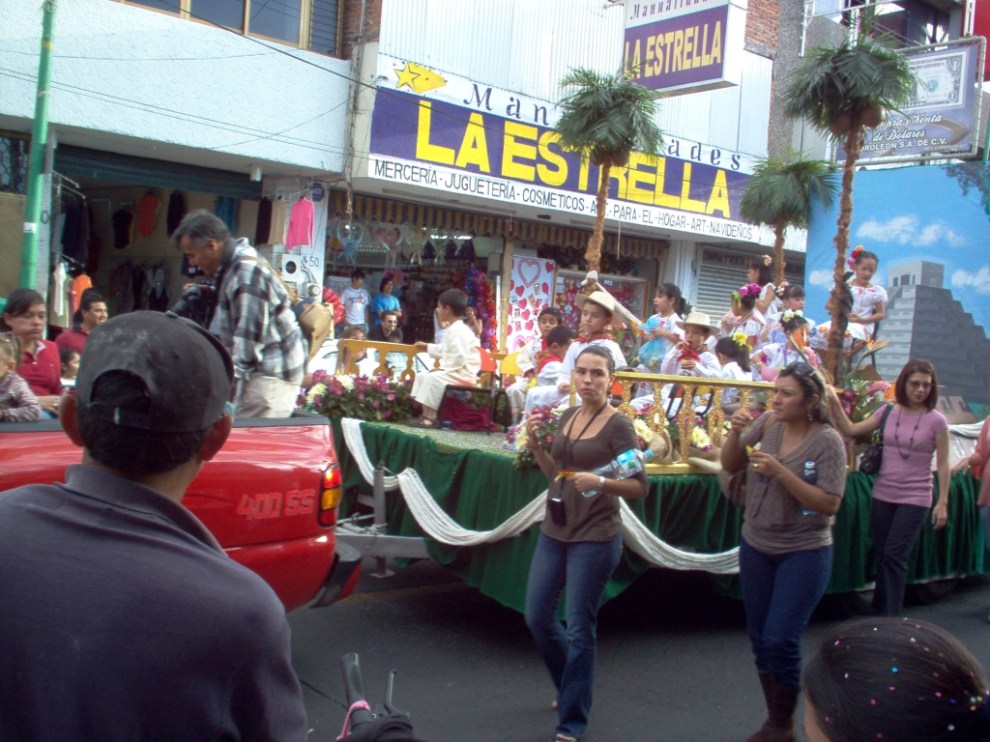
Moroleón Carnival parade with 4 and 5-year-olds dressed in traditional attire from Veracruz

In Moroleón, the beginning of the season of fasting and supplication begins with a parade. A kindergarten parade. In February, all the private kindergartens sponsor a float and dress their students in costumes representative to different regions or countries where Carnival is celebrated. Of course, having been a teacher in various kindergartens, I have had the dubious privilege of marching beside the float and keeping little guys from jumping out. It’s never fun for me, although the kids like throwing candies to the crowds. It’s a long walk around town, I get confetti in areas where confetti never should be found, and it’s often cold and blustery. After all, it is February.

Then there is the egg throwing. In Moroleón, after the kindergarten carnival parade, there is egg throwing. They are supposed to be blown eggs filled with confetti, but sure enough, there is a significant number of real eggs tossed. I have asked and asked, but no one can explain to me the significance of the egg throwing or its origin. Perhaps it is a symbol of waste, I don’t know. Regardless, we stay away from downtown as being pelted with either confetti-filled eggs, or real ones is low on the list of activities we’d like to do in the evening.

Then comes Ash Wednesday, the official beginning of Cuaresma (Lent). In the Catholic religion, the traditional purpose of Lent is the preparation of the believer for Holy Week through prayer, penance, repentance, almsgiving and self-denial.

This year, Ash Wednesday came right before Valentine’s Day, and I thought that the subsequent Valentine’s Day celebration would be muted. But no, apparently the gluttonous consumption of chocolate and the orgies of public displays of affection are allowed. So much for self-denial.

Ash Wednesday is marked by misa (mass) and the receiving of an ash and oil cross on the forehead in a reminder that “from dust we are and to dust we shall return.” As nearly everyone in México is Catholic, the church is overrun with devotees on holy days. They have become more efficient in their proceedings by using a rubber stamp (dipped in ink mixed with ash and holy oil) to mark the foreheads of the penitent.

The 40 days of Lent are to be a time of prayer and fasting in remembrance of the 40 days that Christ fasted in the wilderness. However, the fasting need not be extreme, at least here. Only meat is to be given up on Ash Wednesday and Fridays during Lent. All the carnicerias (butchers) are closed on these days. Fortunately, meat still may be bought at the Bodega Aurelia (a branch of Wal-mart) for those that are not Catholic or vegetarian. Fish, of course, is acceptable either day, as it is not considered particularly satisfying.

As one of the traditional practices in addition to prayer and fasting is the giving of alms, supposedly the meat that one would have customarily eaten on those days should be bought and given to someone in need, someone less well-off financially. However, I have yet to meet anyone in this area that does that. But that’s what I’m told.

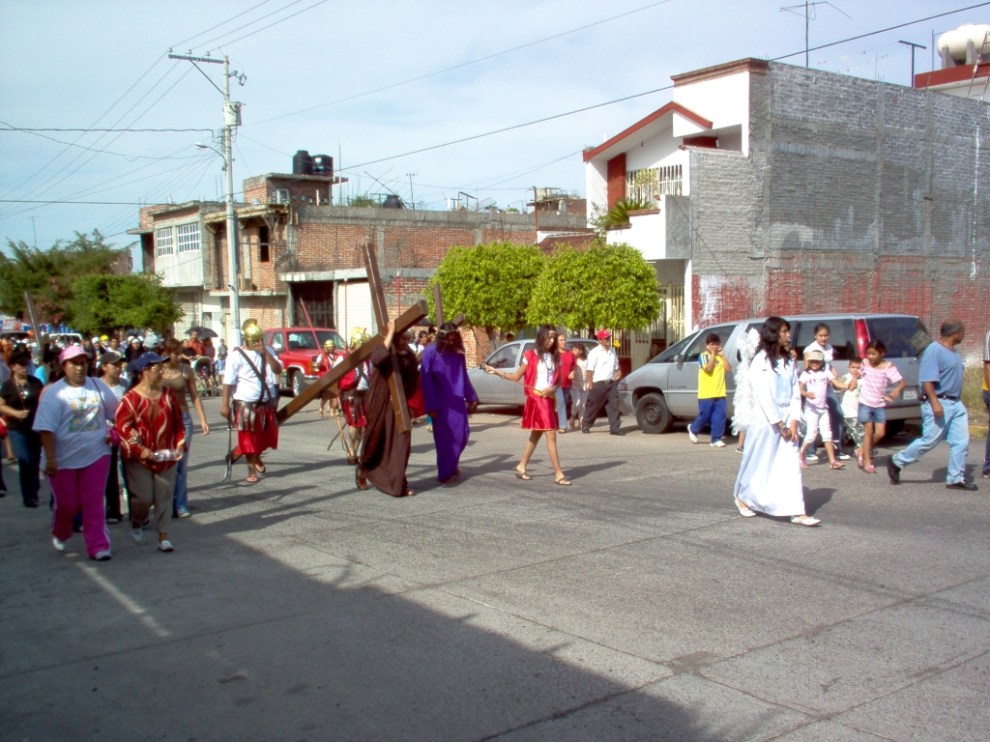
christ walk

Part of the drama, Christ carrying the cross.

The drama ends with the cruxification of Christ.

The drama ends with the crucifixion of Christ.

Semana Santa (Holy Week) is celebrated throughout México with reenactments of the betrayal, trial, and crucifixion of Jesus Christ. It’s really a good show. Barabas actually goes into shops that are open (as all stores are supposed to be closed anyway) and steals items. I even saw him take an ice cream cone from a little child watching the drama. The final crucifixion is done on a vacant lot on the edge of town. In Moroleón, Jesus and the 2 thieves are only tied up on the crosses, not nailed as they are in other parts of México. There is also no flagellation of any kind, Moroleón being a moderate sort of town.

During Cuaresma, suffering is the key, so traditionally one is to give up something dear for the 40 day period as a sacrifice in addition to meat. If your sacrifice holds the entire period, you may make a pilgrimage and ask a favor from the Virgin. The choice of pilgrimage place and the difficulty is dependent on the petition. For instance, when my mother-in-law was dying, her husband promised that if she survived, he would make a pilgrimage during Semana Santa (Holy Week) to La Soledad descalzo (barefoot). As she didn’t survive her injuries, the promise is not enforceable, and my father-in-law did not make his pilgrimage.

We, however, did. During Semana Santa (Holy Week), most specifically Maundy Thursday, Good Friday, and Sábado de Gloria (Holy Saturday), those in need of health-related favors make the pilgrimage to La Soledad, a little town outside Moroleón and there deliver their petitions to the Virgen de la Soledad, Madre de todos los enfermos. (Virgin of Comfort, Mother of the Ill)

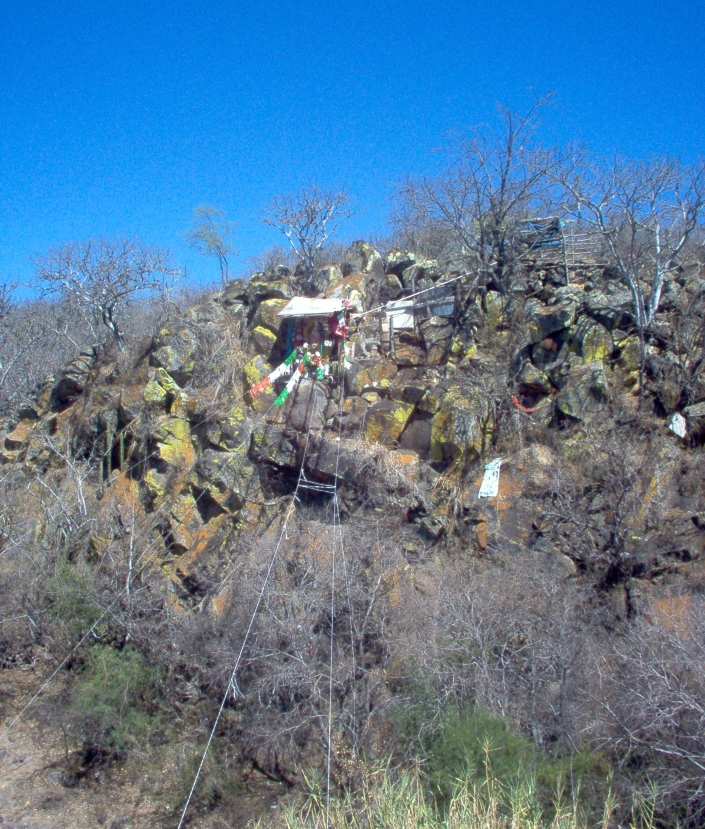
virgin

This shrine marks the entrance to the path that leads to La Soledad. As with all shrines of La Virgen, it supposedly appeared miraculously.

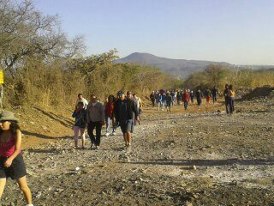
The transitos (traffic cops) stand on the major roads and slow traffic so that the hundreds of men, women, and children who make the pilgrimage from Moroleón and Uriangato and other communities can cross. From La Yacata, La Soledad is not terribly far. Through the dry creek bed and past the basurera (dump) the distance is about 3 miles as the crow flies. So Saturday morning, I donned my big floppy hat and long sleeve shirt (not taking any chances on yet another severe sunburn), and we were off.

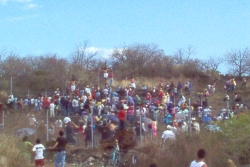
Hundreds make the pilgrimage to La Virgen de la Soledad during Semana Santa.

Hundreds make the pilgrimage to La Virgen de la Soledad during Semana Santa.

We were late getting started since we had to attend to the animals before we left and we met more returning from the pilgrimage than going in the same direction. But we arrived in good time, after maybe 2 hours of walking.

arriving in soledad

Refreshments for the weary walkers are available.

Enterprising vendors sell rosaries, holy prayer cards, candles and orange juice to the pilgrims arriving in La Soledad.

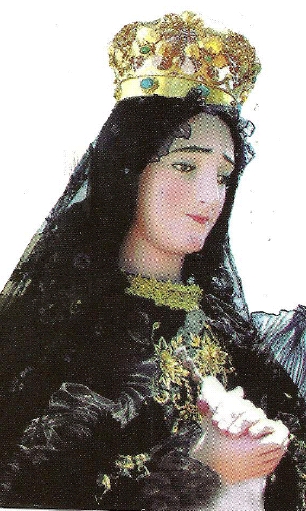
Virgen de la Soledad

La Virgen de la Soledad

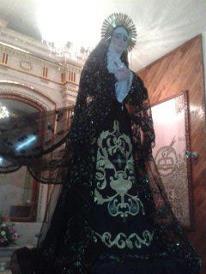
The shrine is not especially big, perhaps holding 20-30 people. Inside is a life-size statue of the Virgin Maria, dressed in mourning black and surrounded by flowers.

The prayer goes as follows:
Estás, Madre mía a la cabecera de todos los enfermos del mundo de todos los que, en este momento han perdido el conocimiento y van a morir, de los que han comenzado ahora su agonía, de los que han abandonado toda esperanza de curación, de los que gritan y lloran de dolor, de los que no pueden curarse por falta de dinero, de los que desearían andar mucho y tienen que estar inmóviles, de los que tendrían que acostarse, y la miseria les obliga a trabajar, de los que buscan vanamente en la cama una postura menos dolorosa, de los que pasan noches interminables sin poder dormir, de los que atormenta el pensamiento de una familia en la miseria, de los que tienen que renunciar a sus mas caros proyectos para el futuro, y sobre todo, de los que no creen en una vida mejor, de los que se revelan y maldicen a Dios, de los que ignoran que Cristo sufrío como ellos.

Loosely translated:
Mother of all those that are sick
You, my mother, foremost of those ill in the world that in this moment have lost consciousness and are about to die, those that have now begun their final agony, those that have abandoned hope of being cured, those that shout and cry out in pain, those that can not be cured due to lack of money, those that desire to walk and must remain immobile, those that wish to lay down but misery obligates to work, those that search in vain for a less painful position in their beds, those that spend countless nights unable to sleep, those that are a torment in the thoughts of their families because of their misery, those that have given up their most precious projects for the future, and above all, those that do not believe in a better life, those that revile and curse God and those that ignore that Christ suffered as they do.

La Virgen de la Soledad

La Virgen de la Soledad

Well, we took a quick look, didn’t stay the entire mass since we weren’t there to make any petitions, had some pan (bread) and horchata (rice milk), rested a bit in the shade, then started back. However, perhaps we should have made some sort of offering. We were under the weather the next three days.

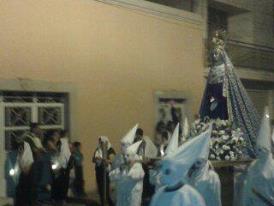
Procession of silence

Procession of Silence

There is also a procession of silence at night, but we didn’t stay for that.

Domingo de la Resureción, (Easter Sunday) is again observed with a mass and traditionally is a family day. However, this year, we noticed that several small towns used the opportunity to hold jaripeos (rodeos) later after misa (mass). Monday is typically a day off here, with the work week being Tuesday through 3/4 day on Saturday, so I’m sure the revelers had time to recover from the jaripeo (rodeo) overindulgence (the main attraction at the jaripeo is beer, beer, and more beer).

Schools are closed the week following Semana Santa, and many families use these days to go to the beach or other vacation areas. We took the week to recover from the virus that we caught and are now gearing up for back to school.

*********************
disclosure

12 Comments

Filed under Mexican Holidays, Religion, Tourist Sites in Mexico