March had me puttering about in my garden and doing a bit of herb research, interspersed with dips in the pool and working on the La Yacata issue. This month, I hope to do the same. Meanwhile, I thought I’d remind you of the books I’ve already published in case you are looking for something to read.
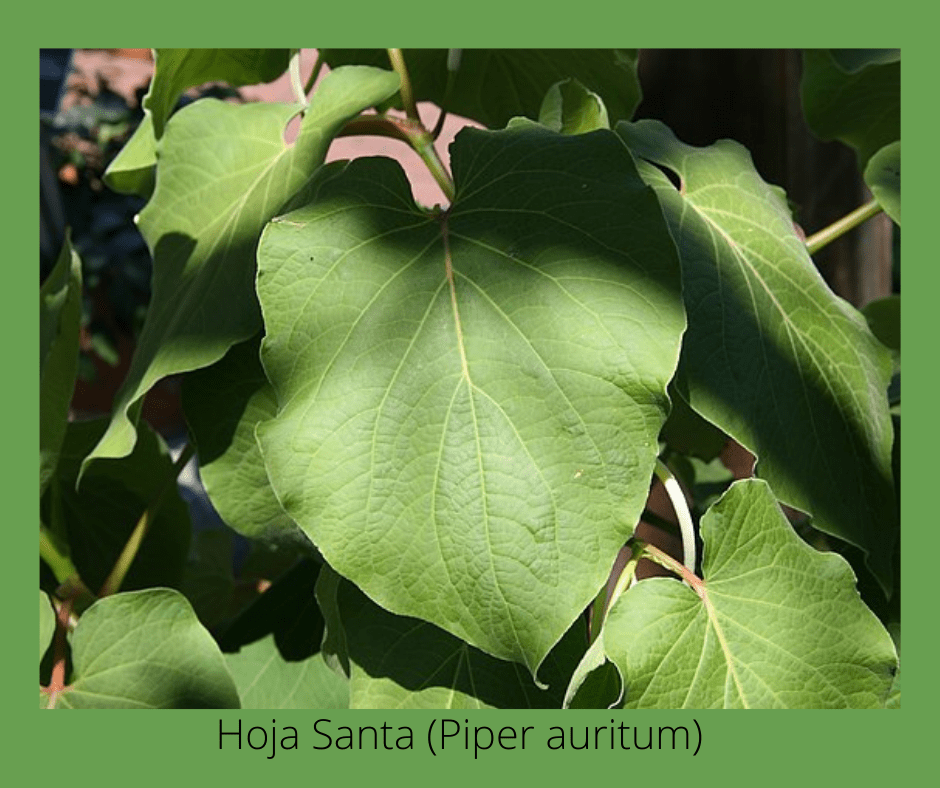
There are approximately 57 species of Piper indigenous to Mexico and 1457 worldwide, but less than 10 percent have been studied. Unfortunately, local names often apply Hoja Santa to several unrelated plants. Piper auritum and Piper sanctum are two species that share the names hoja santa or hierba santa. Although it is tempting to say the two are synonymous, as you can see from the picture below, the leaf structure is a little different. Then to make matters more complex, according to one study, Piper sanctum is an erroneous classification and more properly classified as Piper commutatum. Be that as it may, in many cases, Piper auritum and Piper sanctum are used interchangeably in Mexican herbalism.
Piper auritum is also known as acuyo, jaco, hoja de anís, momo, yuva ntoo, x-mak-ulam in the Mayan language. The santa or holy part of this plant comes from a story of how the Virgen María dried her holy son’s diapers draped over this plant. However, I couldn’t find much more than brief references to this legend.
Medicinally, a tincture made from the entire plant is used to treat asthma, laryngitis, bronchitis, and other types of inflammation such as rheumatism, venereal diseases, and toothaches. Other uses include treating diarrhea, coraje (anger issues), ear infections, snake bites, and stopping hemorrhaging. The leaves are made into a decoction for indigestion and abdominal cramps. Two cups of water are boiled with one leaf and drunk before meals.
The Chinantec people drink a decoction of leaves to aid in childbirth. The Maya apply the leaves for wound healing. The leaves are boiled and applied to the affected area to treat skin infections. For fever, a wash is made from boiled leaves. Warmed or toasted leaves are placed on the abdomen for cramps. In Yucatecan traditional medicine, a tea is prescribed to manage diabetes, hypertension, and obesity.
Piper auritum’s sassafras-like flavored leaves are used in Mexican cuisine as a flavoring and to wrap tamales. The fresh stems are eaten. This is the only Piper variety that is utilized as a food source.
Plants in the Piper species are antioxidant, antibacterial, and antifungal. They have antiproliferative, anti-inflammatory, anti-parasitic, anti-diabetic, and neuropharmacological activities, giving them a preventive potential for several chronic disorders. The compound piperlongumine or piplartine found in most Piper plants has anti-cancer and anti-neuroinflammatory properties.
pinch of orégano de monte leaves (Lippia graveolens)
Wash the hoja santa leaves. Bring ½ liter of water to a boil. Add the ingredients and boil for five minutes. Drink three times a day as symptoms persist.
Marrubio (Marrubium vulgare) is a plant brought to Mexico by Spanish friars after the conquest. Never one to look a gift herb in the mouth, it’s become a staple healing plant in Mexico. Other names that are also used to refer to this plant include manrubio, marrubillo, malvarrubia, malcubio, malva del sapo, marrubio de monte, and malvarrubina. In Michoacán, it is often referred to as uitsicua or uitzacua (sometimes spelled with a v instead of u) in the Tarascan language. The Popoloca people use the word kathuchjeekunia and in Mexico State, it is known as tzopiloshihuitl.
An infusion of flowers is used as an appetite stimulant and diuretic. In Veracruz, it is used for stomach issues, colds, cough, liver problems (bilis), diabetes, and to bring on menstruation. It is also used topically in after-birth cleansings, rheumatism, mange, wounds, hives, and rashes.
A digestive tea is prepared with one tablespoon of flowers in one liter of boiled water. Allow it to steep for 10 minutes before straining. Drink one cup, three times a day. As a wash, boil 20 grams of the leaves and flowers in one liter of water. For bilis (liver problems caused by rage), boil the stems in one cup of water and drink before breakfast or an infusion of leaves before bed. A decoction made from the stems, leaves, and flowers is prescribed for stomach issues. A tincture is made from the entire plant (root to flower) left to soak in alcohol overnight. For susto (sudden fear), fresh stems are used to “sweep” the person of the fear. Then at noon, the person’s shadow is swept in front of a lit candle while praying.
Marrubio and Laurel Infusion for Digestion
• 1 laurel silvestre leaf (Litsea glaucescens)
• 1 tablespoon of dried marrubio leaves (Marrubium vulgare)
Bring ½ liter of water to boil with the laurel leaf. Remove from heat. Add the marrubio and allow it to steep for five minutes. Strain and drink after meals.
***
Interested in natural remedies? Uncover herbal remedies from traditional Mexican sources for healing and wellness in the Exploring Traditional Herbal Remedies in Mexico series.









 Surviving Mexico


.jpg)