
Getting Legal–Trip 2

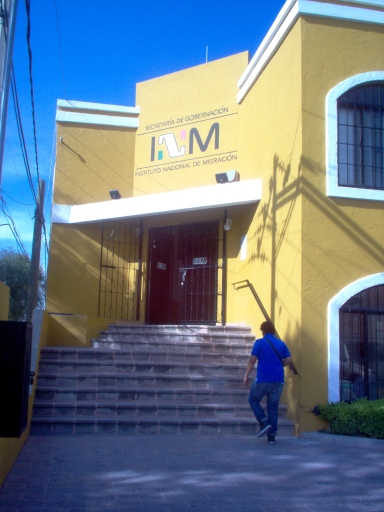
SEGOB the immigration office in San Miguel de Allende

SEGOB the immigration office in San Miguel de Allende

Having been told by the powers that be on my first trip (See Getting Legal–Trip 1) to San Miguel de Allende that I could not turn in my paperwork until the 2nd of the following month, the day that my Mexican identification expired, I had to make a second trip, a mere 7 days later. We filled up the tank and checked the truck for problems that might cause delays. Our battery in the truck was causing us some worry. There were times when it would start just fine and other times when we would have to give the truck a good push down a hill to get it going. Well, there wasn’t enough money in the budget for a new battery this trip, so it would have to behave or else.

We also bought the inspection sticker whose lack thereof was the reason we were stopped twice by transitos (traffic police) in Celaya on the previous trip. We didn’t get the truck inspected–no one does. We just paid the inspection center mechanic and he gave us the sticker and we put it on the truck window. It cost $250 pesos and has to be replaced in August, but it would do for this trip.

So we started out not quite as early in the morning since we would need to stop at the bank before we went to the immigration office. We were not stopped in Celaya either coming or going although we saw the same transitos that stopped us for the mordida the week before. I wanted to wave and blow kisses, but then we might have been stopped on some other pretext and we were really short of cash. So I restrained myself.

We stopped at Banamex and I jumped out, leaving the truck running in case the truck battery decided to go on strike. I went in with the paper I had been given by the office next to immigration and paid my $1000 pesos and got a receipt. Then we headed to immigration. We parked on the small incline near the office and hoped that no one would park in front of us, just in case we needed a running start.

I was number 8, so I was pretty sure we’d be out of there by 12:00, but you never can tell. While waiting, we watched the parade of men in the holding room being given their bathroom breaks. There were about 8 of them. My husband determined on the basis of their dark coloring and short statue that they were probably from Guatemala and had been picked up trying to cross México for the U.S. The immigration officer carried no weapons but a billy club and there seemed little risk of the detainees making a break for it.

While we waited, one elderly British lady marched up to the desk and even though the clerk told her she had to take a number, went ahead with her problem anyway. I suppose he figured it would take less time to answer her question than to try to get her to take a number, so he told her that since she had lost her CURP (an identification number given to residents and citizens of México) she could go to the web site and print a new one herself. She was content with that answer and breezed out.

Then it was my turn. I had neglected to make a copy of my receipt from the bank, but the clerk was feeling agreeable that morning and made a copy for me in the office. That was nice of her. Then I had to wait a bit because she didn’t know the password to the computer, but it wasn’t long. I was given a sheet that registered that I had a tramite (open case file) and could check via internet en 8 días (a week) to see if it had returned from D.F. (México City) with approval or not. If my application was missing some sort of documentation, I would have to return to SMA to present the missing documentation. If everything was hunky dory, then I would have to return to SMA to put my fingerprints on the application form.

Much to our relief, the truck started right up. We headed towards home with the hope that we would have enough cash left to eat in San Pedro, a small town with numerous buffet options, even a Chinese restaurant. We had just enough for some yummy beans, cactus, rice and taquitos and two bottles of water. We drank one and saved the second for after the grass cutting–it’s thirsty work that!

Disaster free, we arrived home just in time for my son to get changed and head to school for the afternoon. Qué alivio!

*********************

disclosure

2 Comments

Filed under Getting Legal

Declaring Solvency

thoreau-grasshopped

Oh, you say, but you live in México and everyone knows things are so much cheaper there. But the truth is, they aren’t. For example, a loaf of bread costs $24 pesos, a liter of milk $11 pesos, and a stick of butter up to $8 pesos, a bag of sugar $16, an ice cream cone costs $15 pesos etc and the average wage is less than $50 per hour.

Oh, but you don’t have very many expenses then, you might say. But that isn’t true either.

We have accumulated a little bit of debt. Last year, my moto fell to pieces and we had to buy a new one on credit, which wasn’t easy to obtain. However, making prompt and weekly payments of $315 pesos, my moto will be paid for in 14 weeks! Yippee!!

We have regular expenses such as tortillas (now $14 pesos per kilo), gas for the vehicles which every month is more expensive, clothing and shoes for a growing pre-teen and during the dry season, feed for the animals. Then there are the occasional expenses such as my current quest to become a Mexican resident (See Getting Legal–Trip 1 and Trip 2). And finally, there are emergency expenses like last week when my husband accidentally sliced open his arm with the machete while cutting grass for the horses and had to get stitches.

Since employment is iffy at best (See The Working Man) for my husband and I, becoming self-sufficient has been essential to our survival.

We have been able to eliminate some expenses entirely.

We have no running water, so we bring our water from nearby springs in water storage containers instead of supporting the Pepsi and Coke companies that sell water in garafones (water jugs) here. (See Water Woes) We do not have electricity, so we don’t have that bill to worry about. We use a power converter from our truck battery to run or charge the occasional electric appliances we use, like the blender for salsa, or the laptop and DVD player. Not having a refrigerator also means only buying what can be consumed in a day, so no prepared frozen foods for us.  (See Simple Living)

We have been able to reduce some of our daily expenses to next to nothing.

live simply corn.jpg

Our mini-orchard provides us with limones (limes), duraznos (peaches), guayabas, naranjas (oranges), chayotes, chillimoyas, and moras (blackberries) in season. La Yacata provides us with nopales (cactus), pitayas, (See Picking Pitayas) and tunas (See Picking Tunas) in season. Our goats provide us with meat and milk (See Separating the Sheep and the Goats) and our poultry (See Why did the chicken cross the road) with eggs and meat. We plant maiz, calabaza and frijol (corn, squash and beans)–the three sisters–for both us and our animals. We have also recently decided that our weekly loaf of Bimbo bread was a luxury item, so now we make our own, cutting our expenses from $24 pesos for one processed loaf to $15 pesos for 2 loaves of home-baked organic goodness.

donkey riders

It would be some advantage to live a primitive and frontier life, though in the midst of an outward civilization, if only to learn what are the gross necessaries of life and what methods have been taken to obtain them–Henry David Thoreau

Our wardrobes have been reduced to a few serviceable sets of clothing that are replaced when needed. Our cleaning supplies have been reduced to soap and water, a broom, a mop, a rag, and bucket. Our entertainment expenses consist of board games, horse or donkey rides (See Donkey Races in La Yacata), long walks, bike rides, visiting friends and relatives, reading, gardening and the occasional incidental adventure or two, all of which cost next to nothing.

When we moved to México, we decided to make a fresh start and live within our means. It has been an ongoing process and one that hasn’t been easy. It has required a rethinking of our lives, not just how we spent our money, and reclassifying many things that we thought were essentials as luxuries. (See Forcibly Green-Obligatory Organic) Our diet, our spending habits, and our family has changed dramatically in the 7 years we have been here. I can’t say that it’s been a bad thing becoming solvent.

***********************************************************************


disclosure

5 Comments

Filed under Alternative Farming, Carnival posts, Employment, Homesteading

Learning and Teaching–Language

pig laying egg

My concept of teaching language has evolved over time from teaching vocabulary, structure and spelling, to teaching communication, which includes teaching these but goes beyond them by making sense of the language. That may sound elementary, but I assure you, communicating in a language other than your own, can be fraught with unimagined communication perils.

My experiences with language (in both teaching and learning) have mostly been with the American English language and with the Mexican Spanish language. These languages are full of strange usage and even stranger vocabulary that come from hybrid (as compared to standard) language development. Both languages owe much to varied and multiple indigenous roots and have evolved with exposure to other foreign languages. Because of this, translating between the two can be difficult.

Much of how I now teach English, comes as a result of how I have learned Spanish, with a communicative rather than grammatical approach. In my classes of beginning level English, we start with small lists of related vocabulary that can be easily illustrated by TPR or graphics and are particularly relevant to the student. The use of songs and stories help reduce the fear of using a language even for adults.

Charlotte Mason touches on language instruction when she writes “Young children find little difficulty in using French vocables, but at this stage the teacher should with the children’s help translate the little passage which is to be narrated, them re-read it in French and require the children to narrate it. This they do after a time surprisingly well, and the act of narrating gives them some command of French phrases as far as they go, much more so than if they learnt the little passage off by heart.”

It is important to clarify that this “translation” process is not a direct translation from one language to another, but more of a bridging activity, helping the students make sense of the ideas, not just the words and structure.

To illustrate this, take for example this common Mexican phrase “Fijate si puso la puerca.” Literally translated the phrase reads “Go and see if the pig put.” which doesn’t make sense. However, if it is explained that the verb poner can be used to refer to laying eggs, we can now translate the phrase as “Go and see if the sow laid eggs.” But there is obviously still some problem with this literal translation since pigs don’t lay eggs. It is not until it is explained that this phrase is used when someone is bothering you and in meaning is more along the lines of the American English phrase “Go fly a kite!” that the phrase is correctly translated.

The narration in the second language mentioned by Charlotte Mason is a gradual process, not just for young children, but for beginning learners of all ages. After having made sense of a passage, students can first retell it in their native language, then with teacher encouragement, use small phrases in the second language in the retelling, moving eventually to complete sentences in the second language in the retelling, truly making the language their own.

In one sense, I must disagree with Charlotte Mason when she writes“But a child cannot dream parts of speech, and any grown-up twaddle attempting to personify such abstractions offends a small person who with all his love of play and nonsense has a serious mind.” I have found it useful to personify some grammar points that are particularly difficult for Mexican speakers. For instance, with the auxiliary verbs “do, don’t, did, didn’t, does, doesn’t, can’t, can, etc.” in illustrating their grammatical use by saying that these are servants since they do the work of the main or master verb who then becomes so lazy it refuses to change (She goes home. She didn’t go home.) I have found that students make fewer errors in the use of the auxiliary verb and main verb and often hear them chanting under their breath, “servant does the work, so master doesn’t change.” It is much easier remember a story personified than a grammar rule and in fact, in American English with native speakers, we have all sorts of mnemonic devices to aid us with correct language usage. (i before e, except after c, or when two vowels go walking, the first one does the talking) There is no reason, therefore, to take the play out of language learning.

*************************************

disclosure

3 Comments

Filed under Carnival posts, Education, Teaching