Failing at your own business–University courses

A University education is not all it's cracked up to be.

A University education is not all it’s cracked up to be.

I’m pretty famous around here. People recognize me all the time. Some people know me because my involvement with my making La Yacata a better place campaigns. (See The Beginning of the Revolution) But most people remember me from one of the 4 schools I’ve worked in over the years. (See Learning and Teaching) Those people that remember me often recommend me to other people, who then remember me on down the line when someone else they know would benefit from my skills.

That’s how I came to be involved in University courses. The parent of one of the students I taught, recommended me to his sister who was studying for her master’s degree in Queretaro. Now, I’m the go-to girl when it comes to English dilemmas.

Here’s what I offer for those higher learners in need of English assistance.

I offer a TOEFL preparation course. I charge 50 pesos per hour and another 50 pesos for a copy of the TOEFL book exercises. Students do better if they answer the questions on their own time and then we go over the correct answers together. I explain grammar points that they are having problems with and offer suggestions on how to best eliminate incorrect answers. I also offer a separate listening course for motivated students. Unfortunately, it seems quite a number of students are looking for TOEFL miracles three days before the exam. I do what I can, but stress that three weeks before the exam would make for a better preparation.

Other students need some help with their actual courses. A good number of the University level business courses have a textbook entirely in English. Most of the students are not up to that level of English reading, so they come to me to see what I can do to get them through the course.

I offer a summary service. I will read the chapter, unit, essay, study, or textbook and write a summary of the material, highlighting important facts. I charge 50 pesos per hour, not per page. My summary is in English. I have had students that want me to write it in Spanish, but I really don’t think my Spanish is up to scratch. I tell them to plug my summary into an on-line translator if they can’t manage it. I expect there are people out there who are busy translating these textbooks, etc, and making bootlegged copies to sell. I’ve lost a client or two after they found a Spanish version someplace. I’m ok with that. It’s a huge time commitment. I’d rather do about anything else than spend hours hunched over the computer. But the money is good.

Most recently, I’ve broadened my offerings to include on-line courses. A former student of mine recommended me to a co-worker. The co-worker called me in mid-March and asked if I could help prepare her for the TOEIC exam that she was going to take on Saturday. It was Thursday night. I told her that I did not have any time slots available for her. I don’t do emergency English classes. She went ahead and took the test, failing miserably. After Spring break, she called me again and wanted to meet. I told her that I was not familiar with the TOEIC test, but that I did have an available time on Saturday afternoon.

After blah-blahing for about 20 minutes about the aggravation of having to take the exam to qualify for her diploma, asked me if I would do the on-line English course for her. Here’s the low-down. She would get 700 points towards her TOEIC exam for completing the on-line course that cost 1,500 pesos per month. She had 3 months to complete the course before retaking the TOEIC exam. She would only need to score 200 points on the actual exam to pass and receive her Licenciatura in Business. The exam was the final requirement, otherwise, she would lose out the thousands of pesos she had already shelled out for the application and thesis requirements.

I said I would, with the understanding that I would charge 50 pesos per hour. She asked me to make a few errors so that it looked as if she were taking the course. She gave me the password and the go-ahead and I went ahead.

This was no measly ESL course. It was a bona fide Business English advanced level course with a few grammar activities thrown in for good measure. The course had 10 parts. Each part had 4 Units. Each Unit had 5 activities. Some of the activities were two-parters, essays or on-line research activities.

How many were going to St. Ives?

In addition, she wanted me to create a study guide so that she could be better prepared to earn those 200 points when the time came. When I sent the first week’s study guide, she was put-out that it wasn’t in Spanish. Nothing doing. I wouldn’t have time for that and told her so.

It took 10 weeks for me to complete the course. I worked every spare minute of internet access on it. I averaged 10-12 hours per week. Some weeks she would come and tell me to “echale ganas” and get it done as quickly as possible. Other weeks she would caress the money in her hand at pay up time and tell me it was “bien ganado” a little resentfully. One week I had class cancellations and logged 20 hours of course time, which amounted be 1000 pesos of hard-earned cash. I think she died a little death when I sent her that bill. She certainly delayed long enough, not stopping by with the cash until Thursday of the following week.

Saturday of week 9, she sent a frantic text message asking when I would have the course finished because she needed money to buy some textbook or other and it would cost $1300. I told her it would be done when it was done, by Wednesday at the latest. She wanted to know how many hours I would be working on the course. She also wanted a perfect score on the course now–no more intentional errors. She would get the full 700 points with a 100%, otherwise, she would get fewer points for the course and have to earn more with the actual exam.

I was feeling not only a little pressured but also a bit annoyed and suspicious. I redid the less than perfect activities and sent my hours when I finished the course, but not the final 3 essays. If she decided not to pay me for the work I’d done, I’d, at least, have the last laugh.

She didn’t appear until the following Thursday. She thanked me for my work, complained again about having to do the course in the first place, and told me if she ever needed another course done, she’d come to me. She also paid me! WHOOPEE! I sent the missing essays the next morning, officially ending our business relationship.

I was so relieved to be done with this project. I earned over 5000 pesos during this 10-week period, all of which I spent gleefully on various and sundry goods. Now, I have a baseline price to give prospective clients that want me to complete this course for them. I also cut and paste the exercises from the course and offer Business English and TOEIC preparation courses on Saturday afternoons. (See Failing at your own business–Saturday classes). I can’t wait to see what other opportunity presents itself!

*************************************

disclosure

6 Comments

Filed under Education, Employment, Teaching

Failing at your own business–Sharecropping

For the past few years, we have been sharecropping on a neighbor’s hectare (acre). It involves working 2-3 hours daily from the summer planting season in June until the fall harvest in November. (See Forcibly Green)

My husband waits to plant until the middle of June just to ensure the rains would remain steady because we have no way to irrigate the field. It’s a crucial decision in the life of a sharecropper. Plant too early and the corn sprouts wither. Plant too late and frost kills off the crop before harvest. We’ve had mixed results. Some years, there have been bumper crops. Others, the plants are puny and low producing.

barbechando

The first step is barbechando the area to be planted.

The first step is readying the field called barbechando. Fiona was an essential component there, pulling the plow up and over the old corn rows. She does 5-10 rows per day. When the soil is suitably mixed, she starts at the beginning again making rows. Nearly straight is just as good as totally straight. The plants don’t seem to know the difference and grow anyway.

plowing with fiona

Making the rows.

We plant in the tres hermanas (See Planting with the tres hermanas) style. Corn, beans, and squash are planted and tended together. Once the corn has sprouted about knee-high, Fiona takes another swing through the rows. Any maiz coyote (non-ear producing corn) is pulled out, and the regular corn plants in their rows are thinned out, although not aggressively.  Some sections need to be replanted.  Mice and birds really like organic seed corn.

thinning

Thinning out and replanting.

The rainy season ensures that the non-edible plants grow faster than the edible ones. To keep the edible plants from being choked to death, it’s necessary to arrancar (pull out from the roots) the invaders. As soon as the weeding is done through once, it’s time to start back at the beginning again.

working in the field

A nice morning for working in the field.

If the corn starts to yellow, we throw abono (fertilizer) around the roots. This is usually a one-day project, sometimes two if we get a late start on the first day.

As the crops ripen, we enjoy the steady stream of bounty. My husband makes a delicious squash, tomato and onion dish. Corn is boiled in its leaves or roasted over the open flame. Beans can be cooked fresh from the vine or spread out to dry for later.

corn

A day in the fields removing the dried corn ears from the stalks.

Let the planter beware! The drive-by harvesters flock to La Yacata about this time. Unlike crows, mice, and squirrels, the drive-by harvester is not put off by scarecrows or lines of plastic bottles swaying in the wind. We send out extra patrols, dando la vuelta to check the borders of our crops several times a day until all the fresh produce is in.

toros

These drying stacks are called toros.

Once the corn has dried, we cut and stack it in toros (stacks). This is when the sharecropper pays his dues. We had a la tercia (a third) contract For every 3 stacks the field produces, one stack goes to the owner of the hectare. The owner and the sharecropper walk through the stacks together while the owner indicates which stacks he will accept as payment.

bringing it home

Bringing it home.

Once the crop is divided, it’s in the best interest of the sharecropper to remove his stacks as soon as possible, either by having the molinero (shredder) come or just restacking them in another area for further drying. Remember, the concept of ownership is more open here in Mexico. We’ve had entire stacks of drying corn stolen in the night. We could file a police report I suppose, but when have the cops here ever looked out for anyone’s interests but their own?

fiona

Fiona saddled up for an afternoon ride.

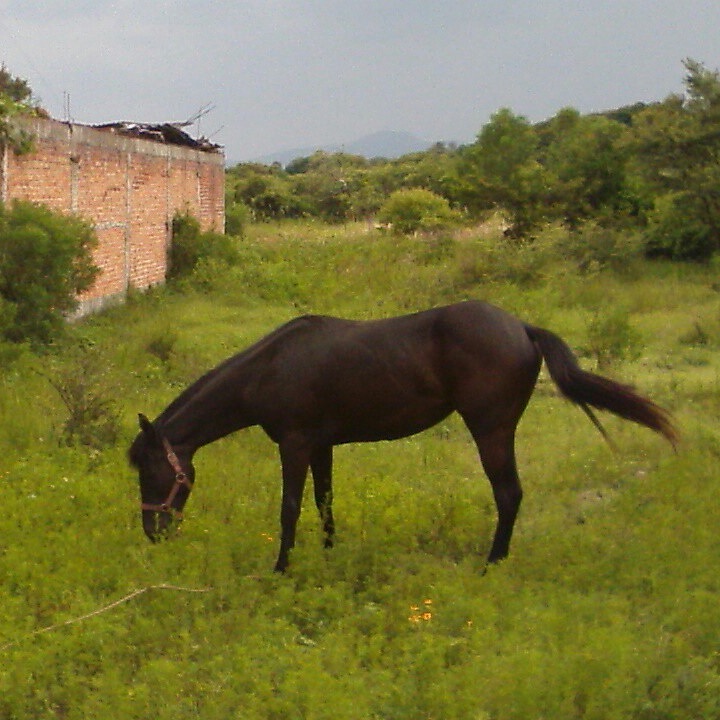
This year, my husband decided not to plant. He was so determined not to plant that he sold Fiona. I opposed the sale. Fiona is a good worker. She earns her keep. She is placid and gentle when not working, unlike Joey I also prefer her lady-like steps to Beauty‘s mountainous stride when riding. But he was not to be gainsaid. (See Reducing the herds) and away she went.

moliendo rastrojo

Moliendo rastrojo. Milling the corn stalks for animal fodder.

Even without planting ourselves, we should be able to get enough rastrojo (dry corn stalks without the corn) from neighbors. A 7 x 20 lot size sells for less than $100 pesos. Entire hectares can be purchased after the harvest. We’ve done this before. My husband makes the deal, and when the owner says it’s ready to be picked up, he goes with the truck and brings it back to stack next to our house. When we have enough, he calls in the molinero, and we bag it up for winter feed. Instead of a June-November work season, our gathering work takes about a week in late November.

I am not about to give up on fresh, organic goodness even though we aren’t sharecropping. So this year, I’ve been trying my hand at container gardening. (See Failing at Container Gardening).

**************************************

disclosure

14 Comments

Filed under Alternative Farming, Homesteading

Failing at Container Gardening

Just because my husband decided not to plant this year, didn’t mean we had to go without organic, home-grown goodies. Now that the roof was up, I thought I might fill it with potted plants, maybe hang a hammock and create my own tropical, and edible, paradise.

seed starters

I started seeds indoors in toilet paper tubes during Spring break. My husband came home with egg cartons he picked up somewhere, and I used them too. I used the plastic tops to cakes we bought over the past year to keep water from getting all over. Obviously, I’d been planning my planting smorgasbord for some time.

We have rich, black dirt in La Yacata, so I didn’t need to buy any potting soil or fertilizer. However, using natural, unprocessed dirt, left me open to surprises. While readying the dirt for yet another cake pan full of toilet paper tubes, I discovered a snake. No sir, it wasn’t a wriggly worm. It was a little black snake. After some hollering and hopping around, I managed to trap it in a cake pan and run it outside.

snake

Seeing my plant buffet inspired my husband to create a raised bed in the former pig pen. (See Miss Piggy didn’t bring home the bacon) I was delighted. I planted cucumbers, squash, beans, tomatoes, carrots, and jamaica (hibiscus). As the rainy season started in full force, my garden looked great.

cucumbersbeans

wpid-cam03280.jpg     wpid-cam03394.jpg

I bought more pots for container gardening and more plants to fill the containers. I hauled them upstairs to the porch area and put them into the sunniest location I could find. Unfortunately, I put several of them directly under the downspout and the first rain washed the pots clean, seeds, dirt and all.

lavender

eucalyptus

I bought some eucalyptus too, to go with my lavender plant. I’d like to have a full-fledged herb garden eventually. The lavender is still going strong, but the eucalyptus dried out. I gathered the dried leaves anyway and stored them alongside my feverfew from last year. (See Feverfew Tea)

chickens in the plants

Will you look at that? Mama hen and chicks caught in the vegetables!

One day, I went outside to check on the plants in the raised bed and found it nearly completely destroyed. At first, I thought it might have been the rain. Then, I thought maybe the destruction had been caused by the cats. Devil has been sighted lounging among the plants enjoying his afternoon cucumber rub. My husband insists that all three cats have been using the area as a litter box, but I haven’t seen that. I think the more likely culprits are Mama Hen and the Red Rooster. Mama Hen and her pollitos (chicks) are allowed free-range in the backyard. Being outside the animal compound reduces the chance of a little one being accidentally trampled by goats or horses and adds variety to their diets. Red Rooster is subordinate to Speckled Rooster in the pecking order and flees before him, right out of the compound and into the backyard. However, neither chicken had been given permission to forage in the area set aside for the garden. So much for cultivation.

wild tomato   wild bean

wpid-cam03532.jpg
squash

On the other hand, several plants sprouted without being cultivated. So far, the backyard has random tomato, squash, bean and tomatillo plants, along with the regular yearly explosion of feverfew. Neither the chickens nor the cats seem interested in any of these plants, so I hope they will be allowed to grow to fruit or flower-bearing stage.

garden

As for my container pots, the onion sprouts seem to be doing well, although nothing else has survived germination. I haven’t given up hope. I have a sprouted potato all ready to plant this week. I’ve also started some more jamaica (hibiscus) seeds. I’ve saved enough toilet paper tubes to fill another cake pan. Maybe I’ll try the cucumbers again, this time planting them upstairs. Although they are not necessarily safe there. Devil climbs the walls to his private bachelor sanctuary on the second floor. I think he likes the echo when he meows for food. He’s muy macho that way, despite his perchance for herbal rubs.

***************************************

disclosure

12 Comments

Filed under Alternative Farming, Homesteading