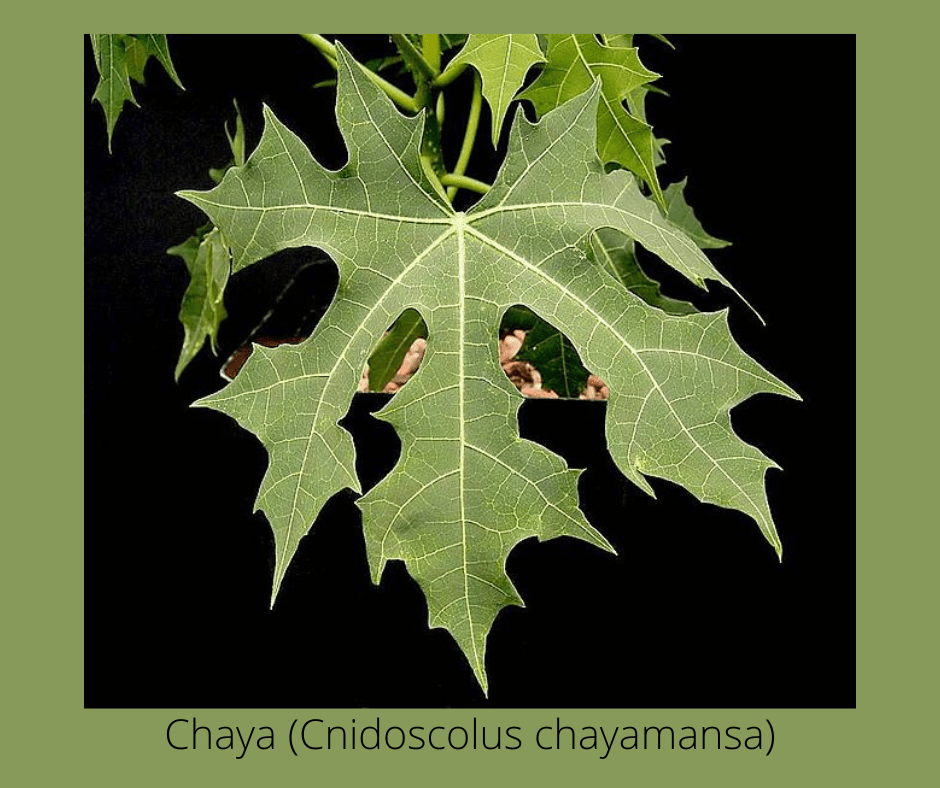
Chaya (Cnidoscolus chayamansa) is also called chaya col, chaya mansa, chaay, chin chin chayy, ts’iim, ts’iim, and tree spinach. Cnidoscolus aconitifolius, also known as chaya, is another edible variety less commonly consumed. The two are often used interchangeably in traditional remedies.
Chaya is a vitamin C-rich food source and is used traditionally to combat the common cold, parasites, bacterial infections, diabetes, rheumatism, insomnia, skin disorders, gout, alcoholism, respiratory, kidney, and gastrointestinal diseases, and as an anti-inflammatory agent. Leaf sap is sometimes prescribed for eye infections, while the sap from the stem is applied to insect bites, acne, skin eruptions, and scorpion stings. In Chiapas, boiled, shredded leaves are applied to fungal infections. As a part of a daily nutritional regime, the recommended dose is two to six leaves boiled and blended into juice or soup.
For a mild laxative, boil 10 grams of leaves and stems in a liter of water and blend. Drink one cup before every meal for fifteen days.
A decoction of dried or fresh leaves and stems is also drunk to augment milk production and applied topically for vaginal infections and as an after-birth wash. Be sure to boil the tea for at least five minutes since the leaves contain hydrocyanic glycosides. Boiling ensures that the leaves are safe to ingest.
We hadn’t had electricity for a month when we had our first outage. Fortunately, it was localized to just one house, but still, I couldn’t help thinking–this was why we didn’t have nice things in La Yacata.
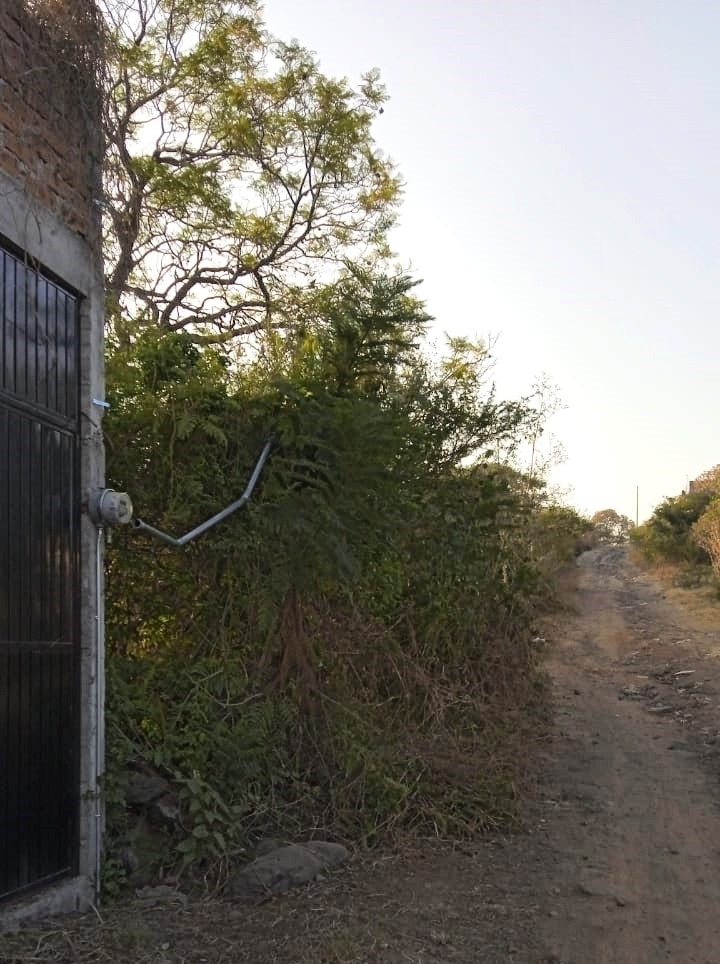
What happened, according to the neighbor was a large remolque (dump truck) was going up the hill and caught on the wire connecting to the main line to the house. The damage was bad. Fortunately, it didn’t tear down the main line, just the connecting wire, so there’s that, but still.
I moseyed up the road to take some pictures and sent them to Super Prez, who made a report to CFE. CFE assured him they would be out in 24 hours to fix it. Super Prez also called the owner of the house, who isn’t living there currently, to let them know about the issue.
24 hours, 48 hours, 72 hours….came and went—no sign of the CFE repair crew. Two weeks later, the owner called and asked me if I could get Super Prez to follow up. Every time she called CFE asked for a copy of the electricity receipt, which we hadn’t gotten yet. So I sent a message to Super Prez, and he called.
Not an hour later, a CFE truck zoomed by the house. Sadly, they disappeared into the horizon and did not stop to check the line. Later that evening, or the next, I forget which, a CFE truck was driving up and down the roads and finally stopped to ask for directions. Super Prez happened to be here with an update on other matters and got them orientated. However, since the entire pole had been mangled, it would need replaced and they didn’t have that on hand and it would have to be ordered.
While we waited for repairs, the owners of two of the five houses that weren’t included in the original CFE project because of their location approached us to ask about getting the electricity connected. Measurements were taken and considered. Technically, they both were just under the 50-meter maximum from the last installed post. The problem was that the line would need to cross a road and that might cause CFE to say no to their connections. But, nothing ventured, nothing gained.
So, both owners went to CFE to ask about it, but both were refused. They came to me with the new requirements, which I reviewed and sent to Super Prez.
Requirements for Contracting:
For Tenants:
Mandatory submission of:
Copy of the lease agreement.
Copy of the INE (official ID) of both the landlord and the tenant.
Power of Attorney:
If the owner cannot be present to sign the contract:
Submit a simple power of attorney signed by two witnesses.
Copies of the INEs of the witnesses.
Ownership Documentation:
Valid proof of ownership issued by the local delegate (applies to rural communities).
Copy of the current property tax receipt.
Valid proof of the official property number.
Official Identification:
Copy of a valid INE, passport, or professional license (both sides).
Tax Identification and Fiscal Status:
RFC with homoclave or current tax status certificate (issued within the month prior to contracting) when service invoicing is required.
Mandatory for businesses.
Contact Information:
Email address and phone number with national area code.
Technical Preparation:
Printed photographs of:
Electrical connection box (mufa).
Base.
Grounding rod.
Circuit breaker.
Visibility of Official Number and Meter:
Printed photo of the official property number visible on the facade and/or meter base.
Photo of the nearest neighbor’s meter number.
For Legal Entities:
Copy of the certificate of incorporation.
Copy of the INE of the legal representative.
Copy of the notarized power of attorney.
As we are neither an officially sanctioned independent community nor part of the municipio, the collection of documents was a bit hodgepodge. These included the new application, a copy of the property certificate, which served as the valid proof of ownership issued by the local delegate (Super Prez), a copy of the INE (official ID) of the owners, a copy of the articles of incorporation, a copy of the INE of the legal representative (Super Prez), a copy of the power of attorney, a copy of the current property tax receipt, and printed photographs of the electrical connection box, base, and the meter number of the nearest neighbor.
I organized this packet of paper into individual folders for the applying colonos and had them come and pick it up along with the photos of the various items requested in the list. One colono served as the guinea pig and took it to the CFE office where they were told that in addition to the paperwork turned in, he must present the número oficial vigente (official address number), which we didn’t have.
Our application for those numbers had already been given to the presidencia and they were sitting on the paperwork. So, Super Prez went to the CFE office in Salvatierra to find out if there was a workaround.
The downed line did eventually get fixed, but little did we realize that this was just the beginning of our issues with CFE.
****
Need to catch up on our first failed attempts at modernization in La Yacata? Then La Yacata Revolution is where you should start!
Ortiga is the general term for nettles in Mexico. The varieties tend to be used interchangeably in remedies. Nettles were used medicinally pre-conquest by Aztec healers to treat joint pain and rheumatism and continue to be a staple in traditional healing remedies throughout Mexico. The Nahuatl term ihtitzonhuītequi refers to the process of beating the stomach of a person with a branch of nettles as a treatment to break up stomach pain before a sobada (massage). While beating the stomach generally has gone out of favor in most treatments, rubbing stinging nettles on the body is still quite common.
Note: Ortiga may cause uterine contractions and has shown to be genotoxic (damaging to DNA resulting in birth defects); therefore, it should be avoided during pregnancy. Fresh leaves will cause itching, stinging, and rashes.
Ortiga mayor or verde (Urtica dioica L. var. angustifolia) is also known as dominguilla in Jalisco, solimán in Puebla, and in the Zapotec language, guiechi-bidoo with spelling variants guichi-bidu and ghuchibdu. This native Mexican nettle variety is the slender or tall nettle, also known as the California nettle.
Ortiga’s tender leaves, harvested before the plant flowers, are edible and are high in calcium. Wash, boil for ten to fifteen minutes, and they are ready to go. Enjoy in salads, soup, or pureed in juice. Although the boiling process reduces the potency of the nettle’s sting, be aware that eating undercooked leaves can result in tongue edema.
Ortiga is most often employed in the treatment of arthritis in Mexican traditional medicine. To make a poultice, crush the leaves and boil them. For a liniment, steep the leaves for two days in alcohol and rub on painful joints before bed. Urtica dioica is anti-inflammatory, supporting traditional use.
Ortiga is prescribed for diarrhea, bladder infections, rheumatism, bronchitis, bloody phlegm, and uterine hemorrhaging. The infusion is made with 15 to 30 grams of leaves and root for a half liter of water. Patients should drink three or four cups a day for twenty days. An infusion for edema is made from three branches in three-quarters liter of water.
Ortiga is a diuretic and is prescribed for PMS bloating. Pour a cup of boiling water over two teaspoons of dried herbs and steep for 10 minutes before straining. Drink up to three cups per day. One remedy for excessive menstrual flow, enfrío de señoras, calls for the purple variety of sin verguenza (Tradescantía Zebrina Purpusii), ortiga stems, the hairs of the outer shell of coco (Cocos nucifera) and crushed pecan shells.
Ortiga tea for prostrate issues is made with either fresh or dried leaves. Pour warm, but not boiling, water over two teaspoons and allow to steep for five to ten minutes. Drink two cups daily. Studies have shown that Urtica dioica suppresses malignant cell growth in individuals with prostate cancer. Urtica root also has been shown to be beneficial in the treatment of urinary tract infections and benign prostatic hyperplasia. Additionally, leaves and root extracts block sperm transport, making it a fairly effective male contraceptive aid.
Ortiga menor (small or dwarf nettle) is sometimes called ortiga negra (Urtica urens). Several studies have noted that several weeks of ortiga menor tea drunk by nursing mothers resulted in galactorrhea, which explains why nettles have traditionally been prescribed for increased milk flow.
Ortiga brava (Urera baccifera) is also known as, purichi, nigua, espanta diablo, pyno guasu, guaritoto, ortiga de caballo, pica-pica, pringamoz, laal tsiimim (Maya), chak lalil k’aax, and pringa leche. In English, this variety of nettle is called scratchbush.
Infusions are made with either the leaves or roots. The sap is applied to infected molars, boils, bruises, and skin infections. An infusion from the roots is given as a diuretic, to relieve urinary tract infections, and to bring on menstruation. A wash from the roots is applied to burns and ringworm infections. Ortiga brava has antioxidant, anti-inflammatory, and analgesic properties.
Ortiguilla (Urtica chamaedryoides) is also known as buba, chichicasate (with variant spellings chichicastle/chichicaztle), tsitsikaxtli, buba, and meloncillo. In English, this variety of nettle is the heartleaf nettle or slim stinging nettle. The leaves are used topically for muscle pain and cramps in the states of Morelos, Veracruz, and Mexico. Less frequently, ortiguilla is used as a wash for escarlatina (measles), hives, and sores. The root is boiled and the infusion drunk for a bloody nose.
A steam decoction is made from the leaves to treat asthma, tuberculosis, and bronchitis. An infusion is prescribed for digestive issues, including diarrhea, dysentery, and parasites. Other uses call for ortiguilla to combat mal de aire (evil winds), to bring on menstruation, and as a liver tonic.
Ortiguilla (Urtica chamaedryoides) and ortiga menor (Urtica urens) are very similar in appearance and often used interchangeably in traditional remedies. Ortiga menor has smaller and thinner leaves than ortiguilla with more triangular edges.
Ortiga blanca (white-dead nettle), also known as ortiga muerta, (Lamium album), arrived with the Spanish priests and is now easily found throughout Mexico. It is often mistaken for ortiga mayor (Urtica dioica). However, the flowers are different. Also the leaves of ortiga blanca are lacking in the “sting” that ortiga mayor has. Additionally, ortiga blanca leaves emit a strong, unpleasant smell when bruised.
It is used in traditional remedies for fever reduction, as a blood purifier, and for prostrate issues. An infusion is made using five grams of leaves for each half liter of water. Half is drunk in the morning, and the other half at night.
For flujo blanco (vaginitis), a wash is made from ortiga blanca and four leaves of manrubio (Marrubium vulgare). Studies have shown that Lamium album leaves provide relief in the event of vaginal and cervical inflammation.
Ortiga blanca is recommended as an infusion during menstruation to reduce heavy bleeding and combat anemia.
It is considered a fertility-enhancing plant in many areas of Mexico. Both partners should drink ortiga blanca as an infusion to improve fertility. However, there is no evidence supporting this traditional use.
Drunk during pregnancy, ortiga blanca is believed to help in fetal development and reduce bleeding after delivery. After birth, regular infusions are thought to help strengthen the mother’s body and increase milk production. Ortiga blanca demonstrates hemostatic activity, making it useful in wound healing.
During menopause, regular novena (9-day) doses of ortiga blanca tea are recommended to reduce bone loss and regulate hormones.
To make a tincture, add 100 grams of dry ortiga blanca leaves or 250 grams of fresh leaves to one liter of alcohol. Allow it to marinate in the sun for six weeks before filtering. Take no more than five ml three times a day. Lamium album has been shown to be beneficial in the treatment of arthritis pain. Lamium album is anti-inflammatory, anti-bacterial, anti-fungal, astringent, antiseptic, antibiotic, anti-viral, antispasmodic, antioxidant, and anti-proliferative. It has shown promise in treating respiratory ailments. It also decreases glucose levels.




 Surviving Mexico


