Tag Archives: Mexico

Picking Tunas

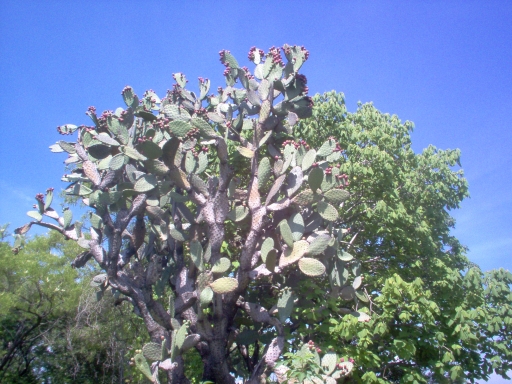
full of tunas

Tunas are not hard to find after the rainy season.


 La Yacata provides for us in many ways you might not expect. Not only do the cactus that grow here give us nopal and pitayas (See Picking Pitayas) but after the rainy season, there are the tunas. Tunas come in red and green and are what might be called prickly pears. As with all things the desert provides, they take some effort to harvest but are well worth it.

IM000163.JPG

Climbing on the top of the truck might get you close enough to harvest tunas–or it might not.

The first step in picking tunas is to find a cactus loaded with them. Once a likely target has been sighted, then the trick is to determine the best way to get at them. Tunas grow at the very tip top of the cactus and obviously you can’t just scurry up its branches like you would an apple tree. The cactus wouldn’t hold your weight and would give you espinas (thorns) in both your shoes and any other part of your body that might be exposed. You also don’t want to try and shake the cactus like you would a small nut tree or risk a rain of thorns.

stick with machete

Attaching a long stick to a machete may help you harvest.

Sometimes, parking below and clambering up on the top of the truck cabin will boost you enough to reach. Other times, if you are fortunate, the cactus will have grown next to some sort of tree you can climb. When all else fails, a long stick with a machete on top might do the trick.

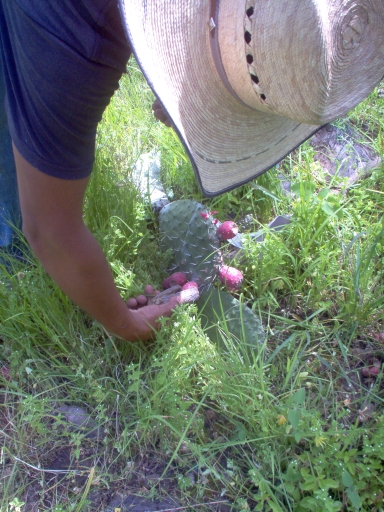
twist with pinchers

Cutting a small section of the penca (leaf) will allow you to get at the tunas.

With the machete, extended or normal, cut a section of the penca (cactus leaf) that has a good number of tunas. Don’t worry about damaging the plant. Wherever a penca (cactus leaf) falls, another cactus grows.

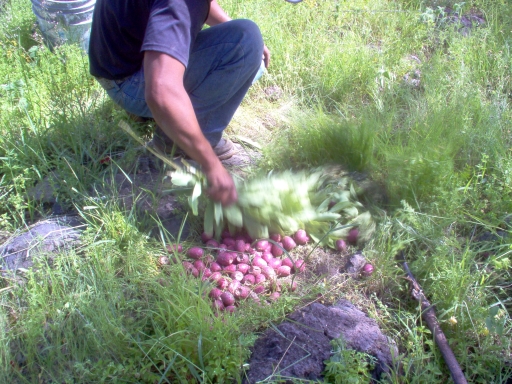
brush off

Brush the thorns off the tunas before cutting them open.

With improvised wooden pinchers made from whatever branches may be lying about, twist off the tuna. When you have a pile of them, use a group of leafy branches to knock off most of the espinas (thorns). Once brushed clean, slice the tuna lengthwise with your machete. Using your thumb, pop out the fruit and discard the outside. This process is best done out in the open. The tiny espinas (thorns) that protect the fruit are sharp and painful and get everywhere.

pop out

Slice open and pop out the fruit.


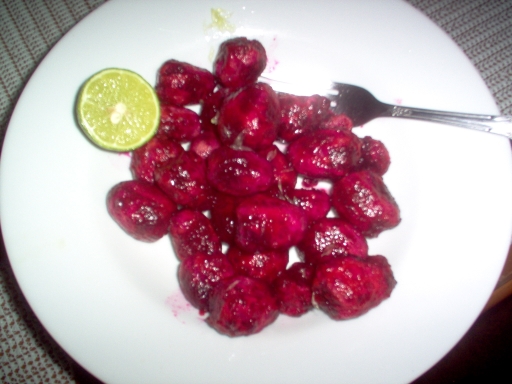
When you have a bunch of this juicy, seedy sweet fruit, add límon y sal (lime and salt) and enjoy.

with limon

Enjoy tunas with a little lime and salt!

Doesn’t this Prickly Pear Margarita look delicious?

PricklyPearMargarita

********************

disclosure

15 Comments

Filed under Native fauna and flora

Parenting Challenge–Religious Training

ghandi

This week is Semana Santa, Holy Week, in Mexico. (See Carnival, Lent, Holy Week and Pilgrimages) Allegedly it is the most sacred period for Catholics in the area.  All the pomp and ceremony involved makes it an ideal time to talk about religion with my son.   Therefore, with that in mind…

How Authority Works.––The supreme authority (and all deputed authority) works precisely as does a good and just national government, whose business it is to defend the liberties of the subject at all points, even by checking, repressing, and punishing the licence which interferes with the rights of others …–Charlotte Mason

In a just world, Charlotte Mason’s idea could be easily used to demonstrate God’s role as authority to my son. But we do not live in a just world, so it’s merely hypothetical. So how, as a Christian, do I provide a sense of religion for him?

Charlotte Mason goes on to say that “It is not authority which punishes: the penalties which follow us through life, of which those the family are a faint foretaste, are the inevitable consequences of broken law, whether moral or physical, and from which authority, strong and benign, exists to save us by prevention, and, if needs be, by lesser and corrective penalties” however, we see incident after incident when it is authority which punishes and no law, neither moral or physical, has been broken to merit the punishment. How do I explain that to my son in a religious context? (See On Safety and Security)

I do not make these statements because we live in Mexico, although I can say that injustice is perhaps more visible in our lives here as compared to our lives in the United States. This difference between the ideal and reality exists in all parts of the world, in all social-economic classes, the past, present and future. Where is the God’s mercy to show my son in all this?(See And Justice for All)

Charlotte Mason also talks about the importance of instilling reverent attitudes in our children through the use of “little ceremonies” and again I take issue. She writes “It is a mistake to suppose that the forms of reverence need be tiresome to them. They love little ceremonies, and to be taught to kneel nicely while saying their short prayers would help them to a feeling of reverence in after life.” I have seen my nephews and nieces learn their catechism, make the sign of the cross, beat their little breasts as sinners, kiss the horns of the devil away…and yet…and yet, it is all playacting. There is no reverence there. (See Parenting Challenges–When someone dies)

praying dc

My son has his own Bible, in fact, he has two, one in English and one in Spanish, but I admit it is daunting for him to just pick it up and read it as a book. It isn’t meant to be read like that. Instead, we focus on the stories and read the sections that have to do with that particular characters life. One of our favorite segments thus far in our studies has been the life of Elijah, from the poking fun of Baal, (“Call at the top of your voice, for he is a god, for he must be concerned with a matter, and he has excrement and has to go to the privy. Or maybe he is asleep and ought to wake up!”) and the abasement of the third army chief before Elijah that spared his life and the lives of his men from the lightening bolts of heaven, to the fiery war chariot and horses that brought an end to Elijah’s part of the story. (1 Kings 18:21- 2 Kings 2:25) Between us, we refer to Elijah as the original superhero and totally think there should be a movie made about him.

In this sense, I agree with Charlotte Mason when she encourages the habit of reading the Bible. The habit of hearing, and later, of reading the Bible, is one to establish at an early age. We are met with a difficulty––that the Bible is, in fact, a library containing passages and, indeed, whole books which are not for the edification of children; and many parents fall back upon little collections of texts for morning and evening use. But I doubt the wisdom of this plan. We may believe that the narrative teaching of the Scriptures is far more helpful to children, anyway, than the stimulating moral and spiritual texts picked out for them in little devotional books. None of my nieces and nephews who have taken their First Communion can retell Elijah’s story or any other fascinating Biblical story for that matter. I really don’t know what they learned during their 8-week required course before they become ‘one with God.’

Matthew 21:12-13 “And Jesus entered into the temple and threw out all those selling and buying in the temple, and overturned the tables of the money changers and the benches of those selling doves. And he said to them “It is written “My house will be called a house of prayer” but you are making it cave of robbers.

Matthew 21:12-13 “And Jesus entered into the temple and threw out all those selling and buying in the temple, and overturned the tables of the money changers and the benches of those selling doves. And he said to them “It is written “My house will be called a house of prayer” but you are making it a cave of robbers.

I recently posted the above on Facebook. My son saw it but didn’t notice that I was the one who had posted it to his page. It struck him as noteworthy enough to comment on it to me later that night. From this, I know that I have inspired what Charlotte Mason calls “The Kingship of Christ” in him. Christ as a historical, even political, figure is understandable to him in a way that being a son of God is not.

Next, perhaps, the idea of Christ their King is fitted to touch springs of conduct and to rouse the enthusiasm of loyalty in children, who have it in them, as we all know, to bestow heroic devotion on that which they find heroic. Perhaps we do not make enough of this principle of hero-worship in human nature in our teaching of religion. We are inclined to make our religious aims subjective rather than objective. We are tempted to look upon Christianity as a ‘scheme of salvation’ designed and carried out for our benefit; whereas the very essence of Christianity is passionate devotion to an altogether adorable Person.–Charlotte Mason

This idea of Christ as a hero brings us around full circle to the problems I mentioned at the onset in teaching religion. A hero, such as Christ exemplified, had the power to change an entire system of things through passive or at times aggressive resistance. A hero does not accept things just because they are but demands that things be as they should be. This I can teach my son.

Matthew 7:12 All things, therefore that you want men to do to you, you also must likewise do to them; this, in fact, is what the Law and the Prophets mean.

**************************************

disclosure

2 Comments

Filed under Carnival posts, Cultural Challenges, Parenting Challenges and Cultural Norms, Religion

Alternative Farming with las tres hermanas–Corn, squash and beans

ears-of-green-corn

I never really tasted corn until I moved to México. That seems odd to say since I grew up in a rural Pennsylvania community and had corn-on-the-cob freshly picked from our garden every summer, helped my mom freeze corn in August and had corn with most meals throughout the winter, but it’s true. I never tasted it before. I thought at first that it was how my husband cooked the corn. When he boiled the elotes (corn-on-the-cob) he left an outer layer of leaves on them. Then instead of butter, we ate them with lime and salt.

red corn

But it was more than that. México has more than 200 native varieties of corn. There is yellow sweet corn, yellow, not sweet corn, white corn, purple corn, red corn and blue corn all of which come in large, medium and small kernel size to name a few that I have sampled. And nothing compares to the taste! Each type of corn has its own specialty dish. Yellow corn for gorditas (fat small tortillas for stuffing), white corn for tortillas, reddish-purple corn for pozole, etc.

For awhile, I was concerned that Monsanto would make it big and destroy the natural diversity Mexico’s corn. However, GMO corn has been officially outlawed, although Peña Nieto’s new reforms that allow foreigners to own parts of México doesn’t rule out Monsanto continued and future interference entirely.  This ban does not include other crops, such as soy and cotton, so México is not GMO-free.  However, corn, or maize, is such a part of the fundamental culture here, that protesting campesino (farmer) groups were able to rally under the slogan  “Sin maize, no hay país” and in November 2013, force the Méxican government to listen.

simpler-life

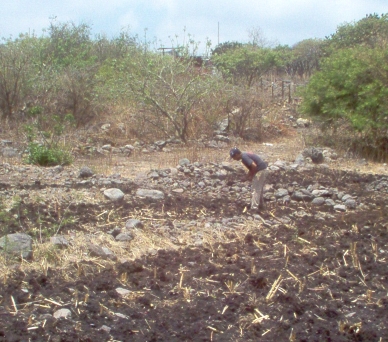
So since corn is a staple part of the diet, we had to plant some ourselves. As our property is a mere 14 x 20 meters and nearly fully occupied by our home and animal kingdom, we had to ask around to see if we could borrow a bit of land to plant on. We didn’t have too much problem making the sharecropping arrangements, and we were off. It meant clearing off the grasses and barbechando (taking the plow over it a few times), but with the help of Red, it was done in a matter of days.

planting

Next came the planting. We planted in the traditional way with las tres hermanas (the three sisters) corn, beans, and squash. The corn stalk supports the bean plant, and the squash grows along the ground. My husband dug the hole and my son, and I dropped in the seeds. Afterward, my husband tied a large branch to the back of Red and went over the mounds to smooth them out. Again, no more than a few days work.

tree back of horse

Then we waited for the rain. Planting is typically done in this area, central México, after the first day of summer, which marks the beginning of the rainy season. If you are feeling frisky, you can plant earlier, but you risk your newly sprouted corn drying out while waiting for the rains. We try to wait until there have been 2 or 3 days of rain before planting. Not only is the ground easier to work with, but there is less chance of crop failure. But you never can tell. A season that starts out well may not bring enough rain for your plants. This past year, we had to replant a section of our corn because it just didn’t grow well because of spotty rainfall.

The enormous varieties of corn available in México, ensure that there is a type of grain for each climate, soil, and elevation.  As these corn varieties have been developed over thousands of years, the introduction of homogenized genetically altered corn would upset the delicate balance that allows for the continued adaptation of the plant.
planting too

Throughout the rainy season, my husband spent an hour or two each day hoeing our rows of corn. When he had finished all of them, he started in at the beginning again. We hadn’t planted acres and acres, but a manageable piece of ground, about an 1 1/2 acres is all. My husband, of course, was all for planting more, but I pointed out that the years we had planted more, we had harvested less. It was just too hard to maintain properly. So we contented ourselves with what we could reasonably do.
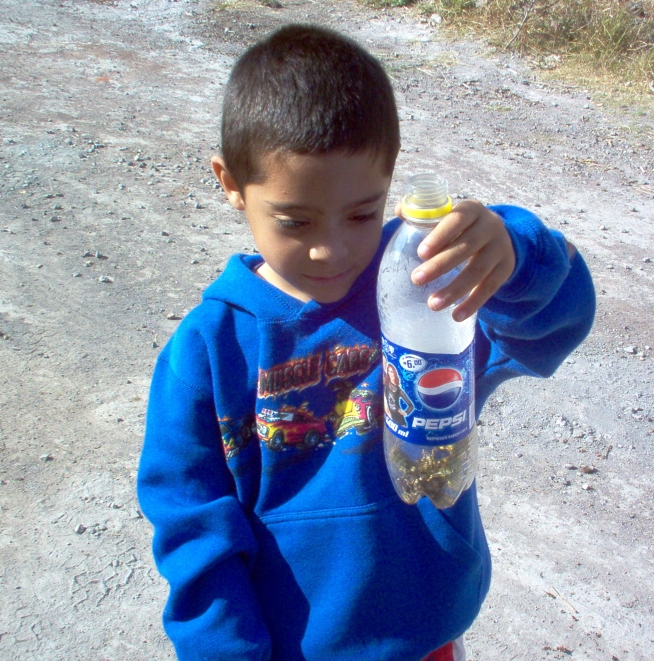
chocho bottle

We do not use any sort of pesticides on our crops. Of course, the chochos (grasshoppers) love that. But we don’t feel the need to exterminate the species to protect our plants. Every morning, when the chochos are still in a deep-freeze sleep, my son heads out and plucks them off the leaves and puts them in a plastic soda bottle. When the bottle is full, he empties it in the chicken area for them to enjoy a scrumptious protein-rich breakfast. Any that escape, are welcome to their lives. Any that return to feast on our corn leaves could be subject to being eaten tomorrow.

Before too long, we had small, tender calabacitas (squash) to enjoy. My husband makes this scrumptious dish of squash, tomato, and onion that we had an average of once a week while the squash held out.

chivada 2

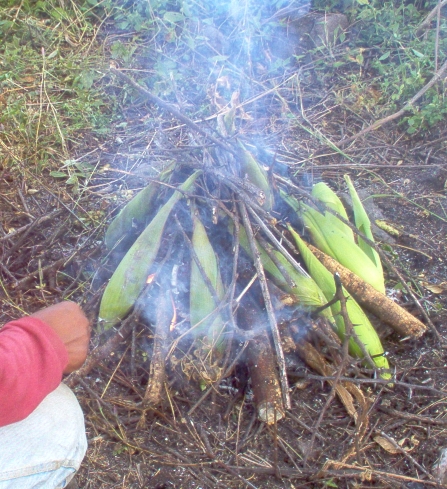
Then, the corn was ready. We had a chivada (corn toasted over an open flame) every second day or so. Incidentally, the word chivada was a new one for me. The first time I heard it I thought we would be having roast goat (chiva). But it’s only corn. I believe that the word began once upon a time as a poor man’s version of a goat roast, a play on words.

The beans were ready after the corn and yummy! The tender, fresh picked beans were absolutely delicious in taquitos dorados (fried tacos). Those that we didn’t eat right away, we set out to dry for future meals.
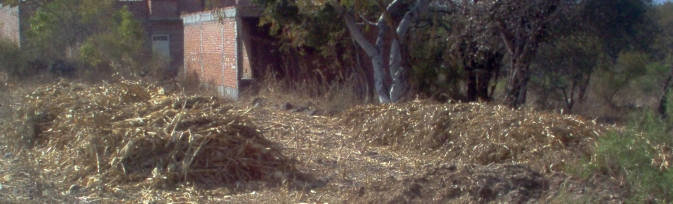
stacked corn

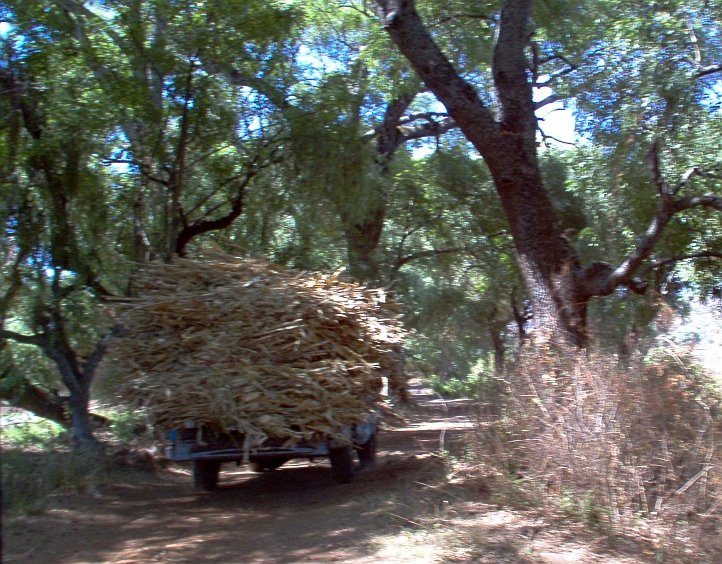
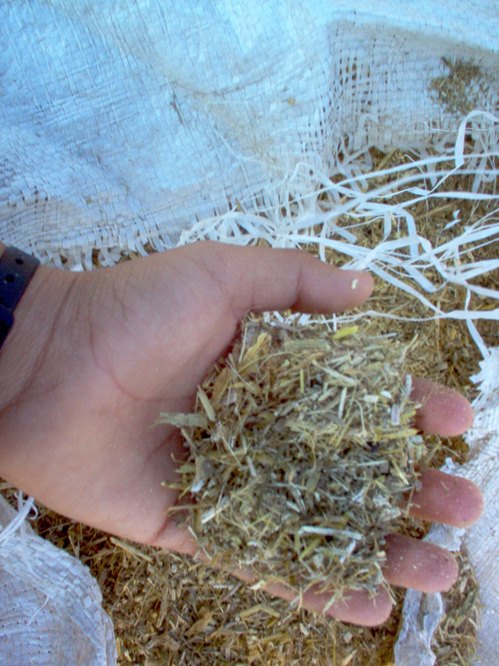
The corn plants eventually dried out in mid-October. When there were no more ears to be had, my husband chopped down the stalks and set them to dry. The chopping and stacking took the better part of a week. Once they were completely and utterly dry, he had a machine come and molir (grind) the rastrojo (corn stalks) into a coarse powder that we feed our animals mixed with other grains throughout the dry season. The machine is rented by the hour, so this chopping and stuffing into costales (sacks) is done by the end of the morning.
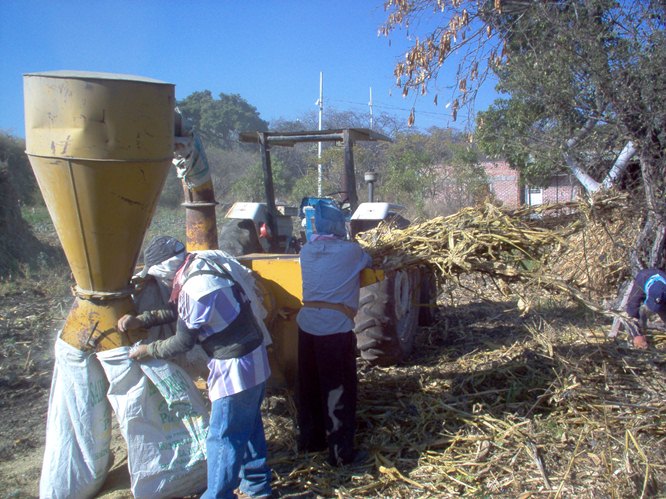
moliendo rastrojo

Moliendo rastrojo. Milling the corn stalks for animal fodder.

Once the corn plants were finished, my husband planted a few rows of garbanzo as a winter crop. Planting after the rains are officially over is risky if there is no irrigation. However, we have the attitude that if it grows, it grows and if it doesn’t we let the goats graze in it.
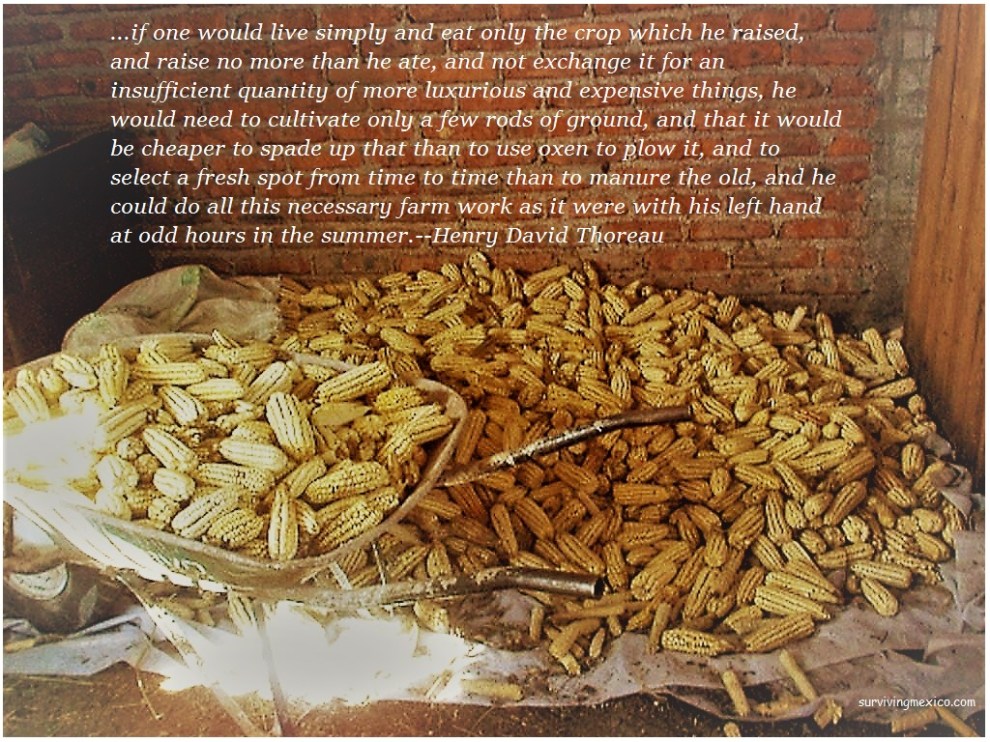
live-simply-corn

Our efforts at agriculture provide enough feed for our animals so that we need to buy very little to maintain them. If it becomes too hard to feed our animals with what we have harvested, we know that it is time to cull the herds and flocks.
rastrojo molido

What the milled fodder looks like.

Our human household is not year-round dependent on our cultivated crops either. We find nature’s abundance grows wild (See Picking Pitayas and Picking Tunas) and don’t try to store up in grain houses more than we need. We enjoy what there is to be had in season and agree completely with Thoreau when he writes “In short, I am convinced, both by faith and experience, that to maintain one’s self on this earth is not a hardship but a pastime, if we will live simply and wisely… It is not necessary that a man should earn his living by the sweat of his brow unless he sweats easier than I do.”

corn truck

***********************************************

GMOs: What You Need to Know

disclosure

15 Comments

Filed under Alternative Farming