
Tag Archives: mexican herbal remedies

Natural Healing — Bigotillo

Photo credit: Stan Shebs

I had a terrible time with the nomenclature for this plant. Every source I consulted listed at least 20 local names. However, most of them were problematic. For example, Poinciana is also Caesalpinia gilliesii, Flor de Nochebuena is Euphorbia Pulcherrima, Hoja Sen is another name for Senna alexandrina, Cabellos de Ángel is Calliandra grandiflora as well, Tabachín and Flamboya are local names for Delonix regia, and Ave del Paraíso is also Strelitzia Reginae. To top it off, Caesalpinia pulcherrima is considered a synonym for Poinciana pulcherrima. Thus, the question remained on what to call this plant.

After considerable research, I could verify that the names bigotillo, virundera del Perú, barbona, and ciringuanico or siringuanico in Purepecha did indeed refer to Caesalpinia pulcherrima and only Caesalpinia pulcherrima. Several sources also said that in Nahuatl, this plant was known as the “shrimp flower” but after searching the Nahuatl Dictionary archives, I could not verify that. In English, most gardeners seem to go with the Mexican bird of paradise or Dwarf poinciana. 

Caesalpinia pulcherrima is found in most areas in Mexico and is thought to be a native plant species, but botanists aren’t quite sure about that either. Then there is the apparent conundrum that Caesalpinia is toxic, but this species is used extensively as medicine. So more verification was in order. As it turns out, the ripe (but not unripe) seeds contain tannic acid. In most cases, pets and children will experience gastrointestinal discomfort, including vomiting and diarrhea if the seeds are eaten, but it is not fatal. 

In Mexico, the leaves are used for fever reduction, the flower is used for pain, and the unripe seeds are prescribed for respiratory illnesses and cough. Just four grams of the root will trigger a miscarriage in the first trimester, so this plant should never be used during pregnancy. It’s no surprise then that in Veracruz, a flower infusion is given to bring on menstruation. 

Mouth ulcerations and gum disease are treated with the root. Liver disease calls for a leaf infusion. In Michoacan, an infusion of flowers, leaves, and branches is made and drunk in place of water for bronchial ailments. The root, stem, or leaves are used for colds and flu with cough in other areas as well. For stomach ailments, including dysentery and ulcers, a cup of bigotillo leaf infusion is prescribed. To treat venereal diseases, insect bites, wounds, fever, and skin infections, a wash is made from the leaves. An anti-fungal wash is made by simmering the roots.

The Kiliwa in Northern Baja California consider the bigotillo highly toxic. A concoction that contains bigotillo meant to harm others can be obtained from brujos (witches) or hechiceros (sorcerers).

Caesalpinia pulcherrima flowers, leaves, and green fruit contain anti-inflammatory properties. Older adults in parts of Colombia use the flowers and leaves tincture to relieve rheumatoid arthritis pain. 
Bigotillo demonstrates α-glucosidase inhibitory activity and has been found to delay the process of diabetic retinopathy. It is anti-viral, anti-microbial, anti-bacterial, antifungal, and antioxidant. It exhibits gastroprotective effects and antiulcer activity, supporting its use as a digestive treatment. It has shown itself to be useful in treating tuberculous and is an immunostimulant compound.

Infusión de Bigotillo for Respiratory Illness and Cough

  • 2-3 bigotillo flowers (Caesalpinia pulcherrima)
  • 2-3 epazote leaves (Dysphania ambrosioides)
  • 5-10 gordolobo flowers and leaves (Verbascum thapsiforme)
  • 5 palo mulato flowers (Bursera simaruba)
  • 5 bugambilia morada bracts (Bougainvillea glabra)

Add the ingredients to 1 liter of boiling water. Reduce heat and simmer for 10 minutes. Strain and serve with miel (honey). 

NOTE: Not to be used during pregnancy.

***

Interested in natural remedies? Uncover herbal remedies from traditional Mexican sources for healing and wellness in the Exploring Traditional Herbal Remedies in Mexico series.
Leave a comment

Filed under Health, Native fauna and flora, Natural Healing

Natural Healing — Tejocote

Photo credit: Bernard Spragg. NZ

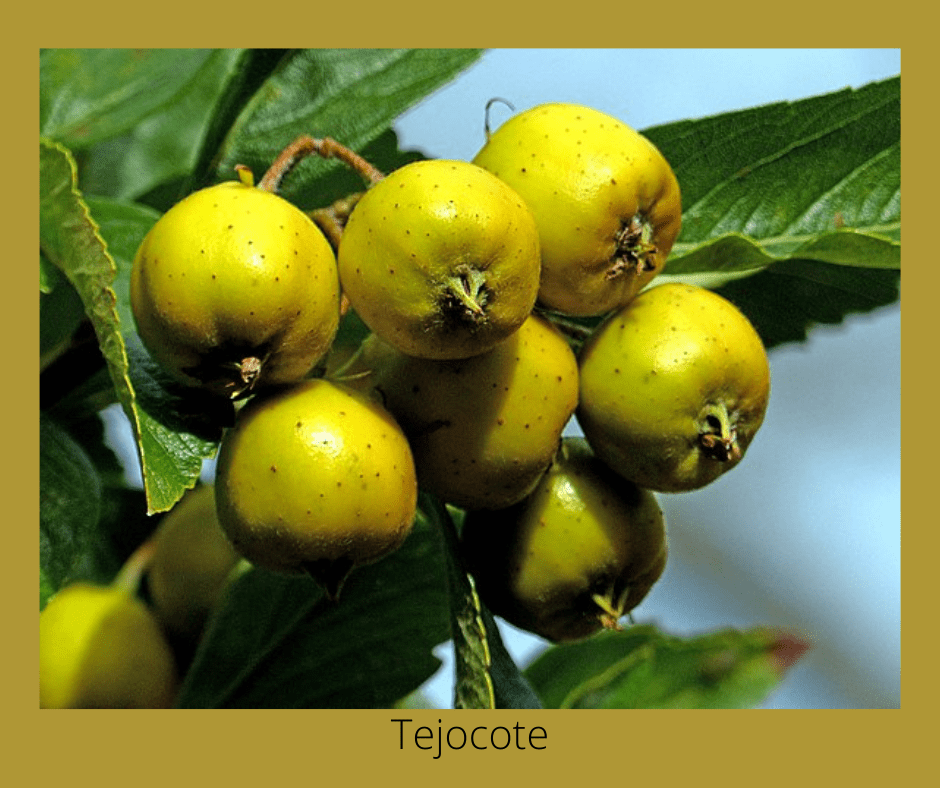
Tejocote (Crataegus mexicana) is Mexican hawthorn and is found in the mountainous regions of central Mexico. There are some herbal guides that list this tree as Crataegus pubescens Steud, but it is not considered a synonym according to botanists. However, Crataegus gracilior J.B.Phipps and Crataegus pubescens Steud are considered the same variety of hawthorn also native to Mexico. Crataegus oxyacantha is yet another hawthorn variety known as el espino blanco, espino albar, or majuelo. It is estimated that there are at least 13 native Mexican hawthorn species. 

In Mexico, these fruit-bearing species tend to be used interchangeably as medicine, although only Crataegus mexicana is known as tejocote. This name is the Spanishized version of the Nahuatl word texocotl, which means “sour stone fruit” and refers to the fact that the small apple-like fruit typically contains three or more pits and is sour when eaten raw. Other names include kanal chiste in Chiapas, npeni in otomí, and karhasi in Purhépecha.

In general, the leaves, seeds, flowers, fruit, bark, and roots of the Crataegus varieties found in Mexico are used to treat heart disease, hypertension, diabetes, and respiratory diseases. A root infusion is used as a diuretic and diarrhea remedy. An infusion made from the leaves and flowers to treat intestinal parasites

Interestingly, in the state of Michoacán, tejocote is given to children for “chipil.” This is a condition a child gets when his or her mother is pregnant. It is characterized by excessive crying, loss of appetite, and slight yellowing of the skin. A mild tea made from the leaves is made to help alleviate the condition which disappears on its own when the sibling is born. Also, in Michoacán, adult-onset diabetes is treated with a tea made from the leaves, roots, or bark.  

Tejocote is enjoyed raw, cooked, canned, in liquors, traditional sweets, jams, and preserves. It’s a main ingredient in ponche Navideño (Christmas punch). It is also prominent in Día de Muertos altar offerings. 

For respiratory issues, including bronchitis and cough, tejocote fruit is boiled and then eaten. An infusion made from the leaves and bark is prescribed for stomach issues. Another diabetes remedy calls for crushing the root, then boiling it, after which it is left to steep in aguardiente (alcohol) and drunk. Tea made from the roots or leaves is drunk three times a day for kidney problems. 

Alipotec is a diet supplement available in many Spanish-speaking countries (and Amazon) that reportedly contains tejocote root. Because of the side effects users were experiencing, several scientists decided to look into its composition. What they found was that there was no evidence of tejocote in the capsules. Instead, they found yellow oleander (Cascabela thevetia), which is poisonous. Tejocote root is also mildly toxic and can cause respiratory depression and irregular heartbeat. 

The Crataegus species studied have been found to contain quercetin which has antioxidant and anti-inflammatory effects, kills cancer cells, controls blood sugar, and helps prevent heart disease. Crataegus mexicana is antioxidant, toxic to liver flukes, and immunostimulatory. The leaves and stems from the Crataegus gracilior J. B. Phipps are anticancer, and the flowers, leaves, and fruit are potent vasorelaxants. It is also hyperglycemic, supporting its traditional use in the treatment of diabetes. Crataegus oxyacantha leaf and bark extracts have also been shown to be effective in treating cardiovascular diseases.

Dulce de Tejocote for Cough

  • 8 tejocotes (Crataegus mexicana)
  • 1 pinocillo cone (or 3/4 cup packed brown sugar)
  • 1 tablespoon vainilla extract (Vanilla planifolia)
  • 1 stick of canela (Cinnamomum zeylanicum)

Wash the tejocotes. Bring 1 liter of water to a boil. Add the tejocotes and boil for 3 minutes. Remove the tejocotes and place them in cold water. The skins will pucker so that you can peel them. Add the piloncillo cone, canela, vainilla, and peeled tejocotes back to the pot. Boil for 40 minutes, stirring continuously. Allow to cool for 2 hours before serving. 

***

Interested in natural remedies? Uncover herbal remedies from traditional Mexican sources for healing and wellness in the Exploring Traditional Herbal Remedies in Mexico series.

Leave a comment

Filed under Health, Mexican Food and Drink, Native fauna and flora, Natural Healing

Natural Healing — Orégano de Monte

Photo credit: Consultaplantas

Mexican oregano is not oregano (Origanum vulgare) at all. Rather it is part of the lippia genus. More specifically it is Lippia graveolens. It has a similar smell and taste to oregano though its medicinal properties are unique to this species. Orégano de monte is a plant native to Mexico. In Nahuatl, this spice is called ahuiyac-xihuitl which translates to “fragrant savory herb.” In Maya, the plant is xaak-il-ché or xak’il-ché. In the Huasteca language it’s known as ananté. It is also known as orégano cimarrón  or orégano del país.

There are some local names that also refer to other plants in different regions, so care should be taken when identifying the plant. For example, in Puebla, Lippia graveolens is known as salvia. In Coahuila, the same plant is epazote. In certain parts of Oaxaca, this herb is romerillo de monte. Hierba dulce is another common name for this plant which also refers to several other species. Additionally, there are more than 40 species of plants that are called orégano in Mexico. 

Traditionally, orégano de monte is used for indigestion caused by gastrointestinal infections, respiratory issues, intestinal parasites, toothache, diabetes management, and to bring on delayed menstruation. It should not be used during pregnancy. In high doses, it can provoke vomiting. It is also to season meat, pozole, salsa, fish, menudo, and other savory dishes

Lippia graveolens has antioxidant, anti-parasitic, anti-inflammatory, antimicrobial, antifungal, anti-viral, anti-bacterial, antibiotic, and anti-glycemic properties. It is useful in the treatment of dyspepsia. It also is effective in reducing anxiety. Orégano de monte has a high concentration of monoterpenes supporting its use in the treatment of respiratory issues. Several studies have shown it is an effective agent against ticks and diseases caused by protozoans such as malaria, trypanosomiasis, and giardiasis.

To eliminate intestinal parasites, add a spoonful of epazote leaves (Dysphania ambrosioides), and a sprig of orégano de monte (Lippia graveolens), tomillo (Thymus), and yerba buena (Mentha spicata) to a cup of boiling water. Drink 3 cups a day on an empty stomach. 

For toothache, moisten a cotton ball in the essential oil and place it on the problem tooth for relief. Make an infusion from the leaves to make a compress for bruises, soreness, and swelling. Simmer a sprig of orégano de monte (Lippia graveolens) and romero (Salvia rosmarinus) in a cup of water. Strain and drink for a gasy stomach. 

Treatment for bilis (liver buildup as a result of anger, hence an anxiety issue) boil one liter of water. Add equal parts albahaca (Ocimum basilicum ‘Cinnamon), estafiate (Artemisia ludoviciana), yerba buena (Mentha spicata), and orégano de monte (Lippia graveolens). Simmer the herbs for 10 minutes. Strain. Drink one cup a day on an empty stomach for nine days. 

***

Want to learn a new way to look at plants? Discover common traditional medicine practiced in Mexico today in the Exploring Traditional Herbal Remedies in Mexico series.
2 Comments

Filed under Health, Mexican Food and Drink, Native fauna and flora, Natural Healing