
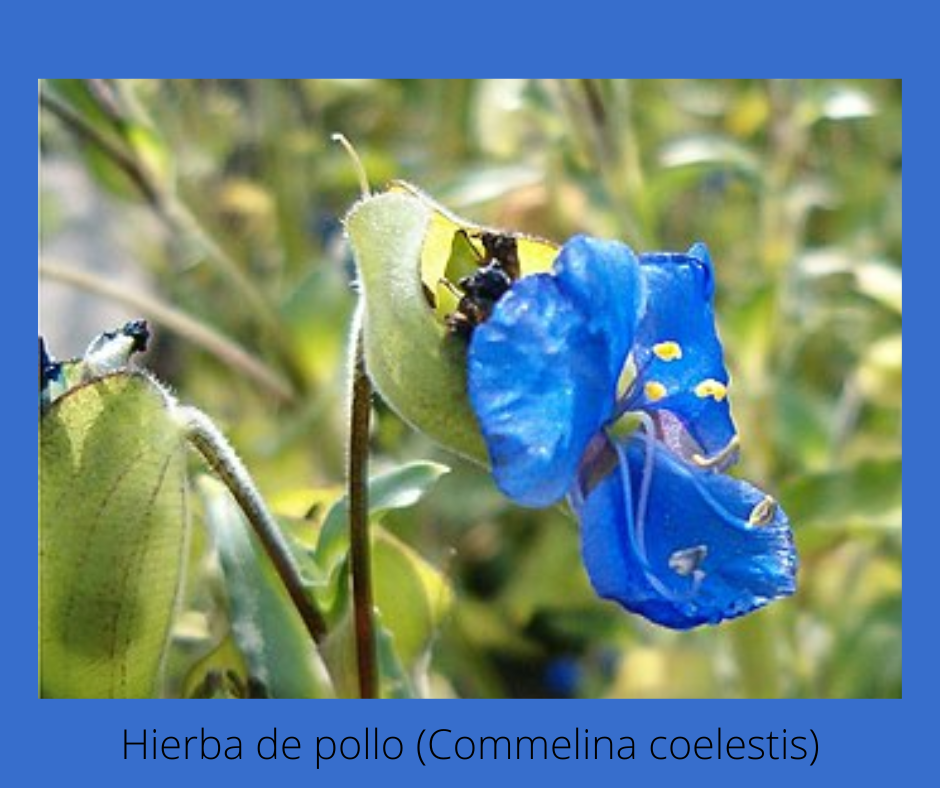
Hierba de pollo or Mexican dayflower, was a difficult plant to identify positively. One of the issues was that several herbal sources had photographs of Tradescantia plants rather than the bright blue flowers that are the hallmark of hierba de pollo. To complicate matters further, Tradescantia is one of the ten genera in the Family Commelinaceae. In fact, several varieties are very similar in appearance, albeit most, but not all of, the flowers are more purplish than blue.
Let’s make it even more tricky and list the botanical synonyms for hierba de pollo (Commelina coelestis): Commelina acuminata; Commelina coelestis; Commelina graminifolia; Commelina linearis; Commelina stricta; Commelina graminifolia var. stricta; Commelina dianthifolia var. longispatha; Commelina linearis var. longispatha; Commelina dianthifolia var. filiformis; Commelina tuberosa var. inflata; Commelina tuberosa var. nana; Commelina coelestis f. albipetala; Commelina dianthifolia f. alba.
Then we have the list of local names used to identify this plant as well as other Commelina varities. In addition to hierba (or yerba) de pollo, it is called, chipil de piedra, matlalina, ewe, carrodo, canutillo, pata de pollo, tripa de pollo, tripa de pollito. In Veracruz, it’s chic-ze, cañita, or cielo azul. Indigenous names include coapatli, zaca-matlalín, zoyalxóchitl, matlalitzic and matlalxóchitl.
In Quintana Roo, hierba de pollo is prescribed as an eye wash. In Hidalgo, a decoction from the entire plant is given for burning back pain (el ardor de espalda) and rickets. It’s also used as an anti-inflammatory aid and in post-partum baths. In Yucatán, a root infusion is given when there is pus in the urine. In Sonora, hierba de pollo is most often prescribed for wound healing and hemorrhaging, although it is also found in fever reduction remedies.
In other areas in Mexico, hierba de pollo leaves are used to stop hemorrhaging after childbirth as a vaginal wash and infusion. The wash and infusion are made with 100 grams of leaves in one liter of water. Powdered leaves are inhaled to treat nose bleeds, while fresh leaves are applied as a poultice to stop bleeding after tooth extraction and wound healing.
For bloody flux and intestinal discomfort five grams of hierba de pollo leaves are brewed as an infusion in one liter of water and drunk every six hours for 15 days. Honey and limón (Citrus aurantifolia) can be added to flavor the beverage and have their own medicinal properties. Commelina coelestis has been shown to have an antidiarrheal effect.
For a fever treatment, the stems are boiled and added to the bath water as well as drunk as an infusion.
***
Are you interested in natural remedies for healing and wellness? Discover a treasure trove of traditional Mexican herbal remedies in the ‘Exploring Traditional Herbal Remedies in Mexico‘ series. Learn about the rich history and cultural significance of these remedies and how they can benefit your health. Get your copy today!

 Surviving Mexico
