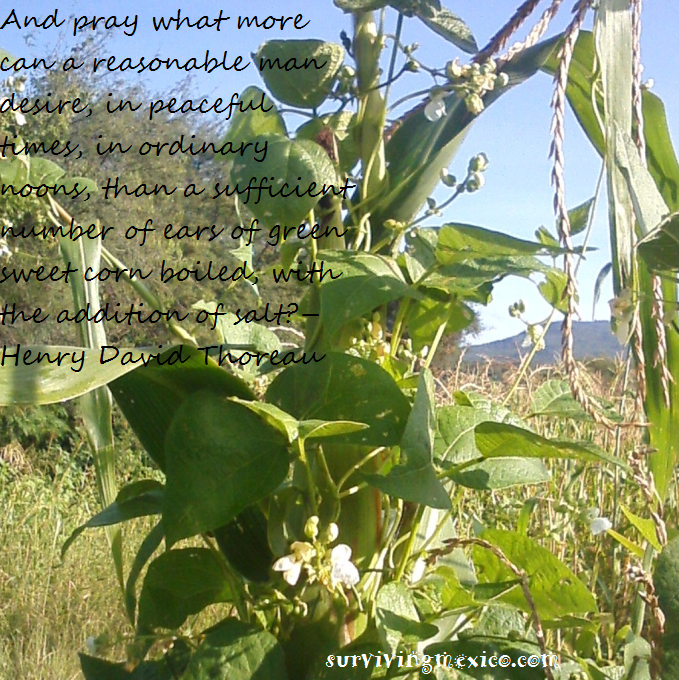
Tag Archives: homesteading

Alternative Farming with las tres hermanas–Corn, squash and beans

ears-of-green-corn

I never really tasted corn until I moved to México. That seems odd to say since I grew up in a rural Pennsylvania community and had corn-on-the-cob freshly picked from our garden every summer, helped my mom freeze corn in August and had corn with most meals throughout the winter, but it’s true. I never tasted it before. I thought at first that it was how my husband cooked the corn. When he boiled the elotes (corn-on-the-cob) he left an outer layer of leaves on them. Then instead of butter, we ate them with lime and salt.

red corn

But it was more than that. México has more than 200 native varieties of corn. There is yellow sweet corn, yellow, not sweet corn, white corn, purple corn, red corn and blue corn all of which come in large, medium and small kernel size to name a few that I have sampled. And nothing compares to the taste! Each type of corn has its own specialty dish. Yellow corn for gorditas (fat small tortillas for stuffing), white corn for tortillas, reddish-purple corn for pozole, etc.

For awhile, I was concerned that Monsanto would make it big and destroy the natural diversity Mexico’s corn. However, GMO corn has been officially outlawed, although Peña Nieto’s new reforms that allow foreigners to own parts of México doesn’t rule out Monsanto continued and future interference entirely.  This ban does not include other crops, such as soy and cotton, so México is not GMO-free.  However, corn, or maize, is such a part of the fundamental culture here, that protesting campesino (farmer) groups were able to rally under the slogan  “Sin maize, no hay país” and in November 2013, force the Méxican government to listen.

simpler-life

So since corn is a staple part of the diet, we had to plant some ourselves. As our property is a mere 14 x 20 meters and nearly fully occupied by our home and animal kingdom, we had to ask around to see if we could borrow a bit of land to plant on. We didn’t have too much problem making the sharecropping arrangements, and we were off. It meant clearing off the grasses and barbechando (taking the plow over it a few times), but with the help of Red, it was done in a matter of days.

planting

Next came the planting. We planted in the traditional way with las tres hermanas (the three sisters) corn, beans, and squash. The corn stalk supports the bean plant, and the squash grows along the ground. My husband dug the hole and my son, and I dropped in the seeds. Afterward, my husband tied a large branch to the back of Red and went over the mounds to smooth them out. Again, no more than a few days work.

tree back of horse

Then we waited for the rain. Planting is typically done in this area, central México, after the first day of summer, which marks the beginning of the rainy season. If you are feeling frisky, you can plant earlier, but you risk your newly sprouted corn drying out while waiting for the rains. We try to wait until there have been 2 or 3 days of rain before planting. Not only is the ground easier to work with, but there is less chance of crop failure. But you never can tell. A season that starts out well may not bring enough rain for your plants. This past year, we had to replant a section of our corn because it just didn’t grow well because of spotty rainfall.

The enormous varieties of corn available in México, ensure that there is a type of grain for each climate, soil, and elevation.  As these corn varieties have been developed over thousands of years, the introduction of homogenized genetically altered corn would upset the delicate balance that allows for the continued adaptation of the plant.
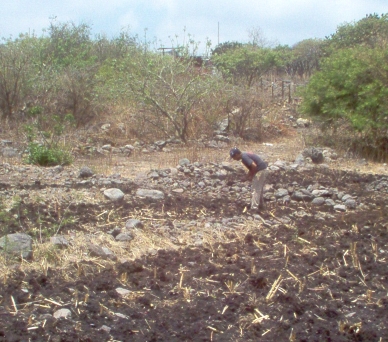
planting too

Throughout the rainy season, my husband spent an hour or two each day hoeing our rows of corn. When he had finished all of them, he started in at the beginning again. We hadn’t planted acres and acres, but a manageable piece of ground, about an 1 1/2 acres is all. My husband, of course, was all for planting more, but I pointed out that the years we had planted more, we had harvested less. It was just too hard to maintain properly. So we contented ourselves with what we could reasonably do.

chocho bottle

We do not use any sort of pesticides on our crops. Of course, the chochos (grasshoppers) love that. But we don’t feel the need to exterminate the species to protect our plants. Every morning, when the chochos are still in a deep-freeze sleep, my son heads out and plucks them off the leaves and puts them in a plastic soda bottle. When the bottle is full, he empties it in the chicken area for them to enjoy a scrumptious protein-rich breakfast. Any that escape, are welcome to their lives. Any that return to feast on our corn leaves could be subject to being eaten tomorrow.

Before too long, we had small, tender calabacitas (squash) to enjoy. My husband makes this scrumptious dish of squash, tomato, and onion that we had an average of once a week while the squash held out.
chivada 2

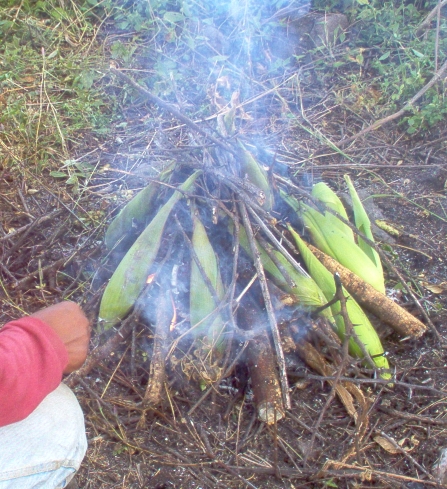
Then, the corn was ready. We had a chivada (corn toasted over an open flame) every second day or so. Incidentally, the word chivada was a new one for me. The first time I heard it I thought we would be having roast goat (chiva). But it’s only corn. I believe that the word began once upon a time as a poor man’s version of a goat roast, a play on words.

The beans were ready after the corn and yummy! The tender, fresh picked beans were absolutely delicious in taquitos dorados (fried tacos). Those that we didn’t eat right away, we set out to dry for future meals.

stacked corn

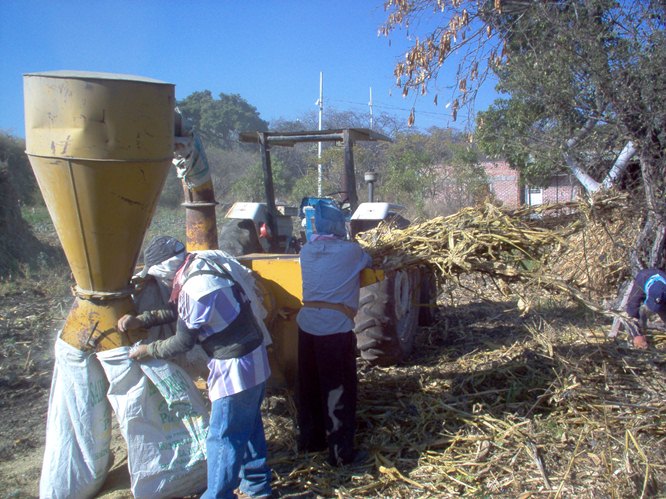
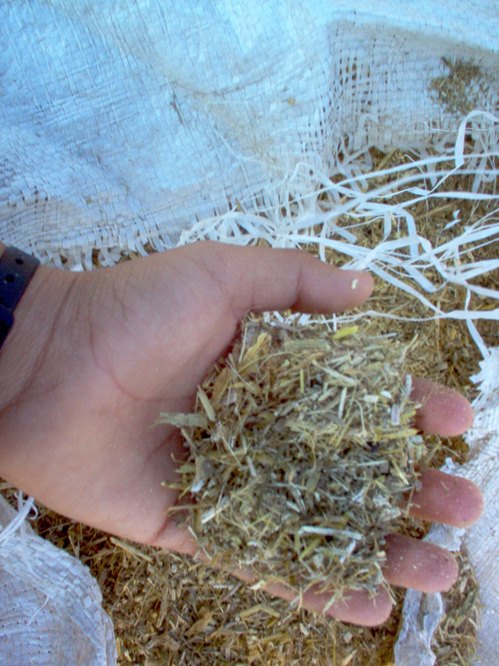
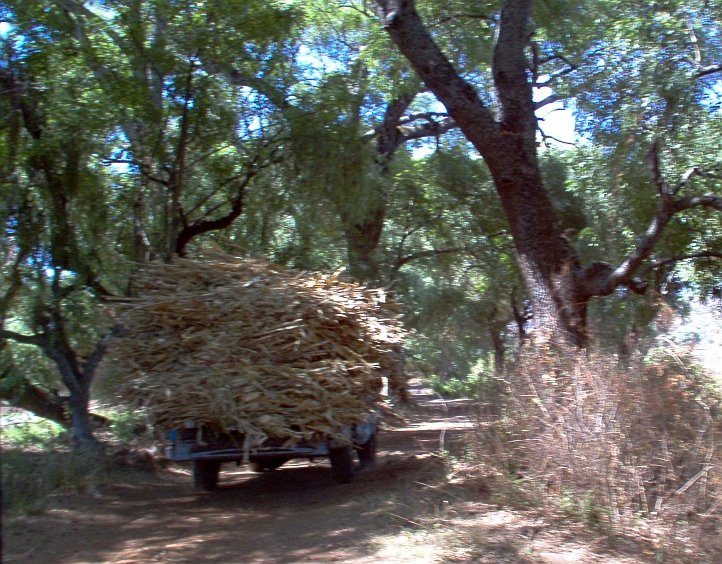
The corn plants eventually dried out in mid-October. When there were no more ears to be had, my husband chopped down the stalks and set them to dry. The chopping and stacking took the better part of a week. Once they were completely and utterly dry, he had a machine come and molir (grind) the rastrojo (corn stalks) into a coarse powder that we feed our animals mixed with other grains throughout the dry season. The machine is rented by the hour, so this chopping and stuffing into costales (sacks) is done by the end of the morning.
moliendo rastrojo

Moliendo rastrojo. Milling the corn stalks for animal fodder.

Once the corn plants were finished, my husband planted a few rows of garbanzo as a winter crop. Planting after the rains are officially over is risky if there is no irrigation. However, we have the attitude that if it grows, it grows and if it doesn’t we let the goats graze in it.
live-simply-corn

Our efforts at agriculture provide enough feed for our animals so that we need to buy very little to maintain them. If it becomes too hard to feed our animals with what we have harvested, we know that it is time to cull the herds and flocks.
rastrojo molido

What the milled fodder looks like.

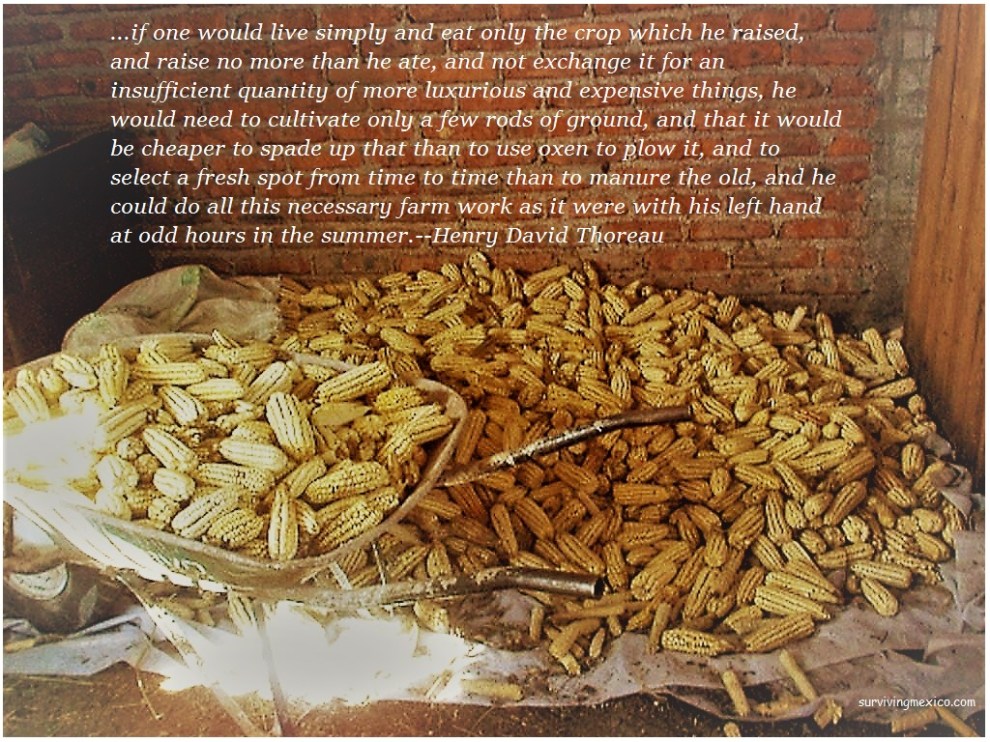
Our human household is not year-round dependent on our cultivated crops either. We find nature’s abundance grows wild (See Picking Pitayas and Picking Tunas) and don’t try to store up in grain houses more than we need. We enjoy what there is to be had in season and agree completely with Thoreau when he writes “In short, I am convinced, both by faith and experience, that to maintain one’s self on this earth is not a hardship but a pastime, if we will live simply and wisely… It is not necessary that a man should earn his living by the sweat of his brow unless he sweats easier than I do.”
corn truck

***********************************************

GMOs: What You Need to Know

disclosure

15 Comments

Filed under Alternative Farming

Beauty’s babies–A horse of a different color

beauty and spirit

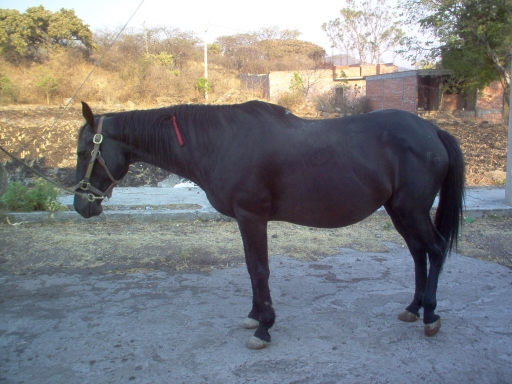
After Red disappeared, we were left with an increasingly pregnant Beauty. She couldn’t be ridden, her belly was so wide that it was nearly like doing a split to sit on top. She couldn’t be worked, the plow wouldn’t fit around her middle anymore. So she ate and ate.

I admit, we neglected our animals a bit during the hospitalization and subsequent funeral and novena of my mother-in-law (see on life and libertymass and burial Mexican style, El velorio viewing and wake and la novena). We barely had time to throw some food and water at them and then run up the hill to do the same for my father-in-law’s animals, before we headed back to town to attend to all that was involved. During one of these lapses, Beauty somehow got tangled up in her lead line and fell. We untangled her, and she seemed no worse for wear, but surprised us the next morning with a new potrilla (colt) which we are pretty sure came at least 2 weeks early. She was quite a handful, this little filly and we named her Spirit. She often reared up on her hind legs when approached and even knocked over both my husband and my moto with her frenzies.

holding back spirit

Spirit was quite a handful!

A few months later, my husband decided he couldn’t care for the horses anymore and sold both Beauty and Spirit. Beauty was pregnant again, so the new owner felt like he got quite a bargain. For a time, we were horseless. The new owner sold Spirit but kept Beauty, and as he housed her in La Yacata, we often saw her. She seemed sad and underfed. Then, some months later, hoping to receive his U.S. visa permit, the new owner sold his vehicles and livestock. My husband was all in a lather to get Beauty back.

Again, he made payments and scrimped and saved, and bought Beauty a second time. We were back to one horse, and pregnant.

red rag

A red cloth is tied in a mare’s mane to ward off the chance of miscarriage during eclipses.

My husband immediately made her a better corral next to the house, set about fattening her up on the lush green grass of the rainy season and tied a red rag in her mane. When I asked about that, he told me that the red cloth was to protect the pregnant mare from eclipses. As near as I can figure, it’s a practice meant to guard the fetus against being aborted during certain “dangerous” times of the lunar cycle. Cows are also subject to the changes of the moon, and pregnant heifers are adorned with a red cloth tied to their tails. Goats and donkeys, as their value is less, apparently do not need this extra talisman, since the owner would lose less in case of miscarriage.

Then the waiting began. A mare has a gestation period of 340 days, about 11 months. My husband hadn’t marked the date of the maquila (impregnation) and now was all afire with impatience for the birth. June passed, and Beauty’s belly was enormous, but her udder hadn’t swollen yet. My husband, son and I took bets on whether the colt would arrive the 13th (me) the 14th (my son) or the 15th of July (my husband). Well, the 16th came and went and no caballito. Everybody in the neighborhood had an opinion of when the blessed day would arrive. Some said it depended on the moon. A new moon or full moon would bring on labor. Some said it was exactly 11 months and 2 weeks from time of conception. Some said if it were a boy, it would take a few days longer. There was even some speculation on twins based on the size of Beauty’s belly, although twinning in horses is extremely rare.

My husband had me consult the horse reference book, but it didn’t give the magical day. Every day, he checked her udder for ripeness. But Beauty wasn’t about to be rushed. It wasn’t until July 28th at 10:30 at night that the new colt made her appearance. And my husband wasn’t even home!

shadow

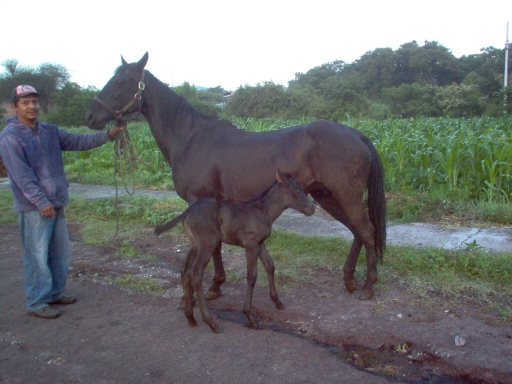
Beauty and Shadow and proud Poppa!

My son and I ran out in our PJs to get the first glimpse. It wasn’t much of a glimpse because the colt was all black, as is Beauty and the sun had already set, but it was enough for us to see that the little one was healthy, alert and well formed. In the morning, we all gathered around and commentated on her size, she seemed smaller than Spirit had been, about her color, all black with a small white marking on her forehead and two little heels of white, and her disposition, she was very friendly and not at all skittish as had been her elder sister. We named her Shadow.

My husband was a bit disappointed she wasn’t a little stallion, but honestly, I think for us it is better to have all females and rent-a-stud when necessary, rather than have a fully hormonal male on premises.

All that next day, my husband, as proud poppa, received visitors, mostly the same men that had gathered to watch the breeding process. They came to look the colt over and make commentary. The previous owner came and nearly cried when he saw Shadow–regretting he had sold his livestock for a visa that was never given. The man who wanted to trade 10 borregas (sheep) for Beauty came to negotiate–but my husband decided he wasn’t interested in selling anymore. Several men who own stallions-to-rent for the maquila (breeding) came to see if my husband was interested in their services (mares will go into season about a week after they give birth, so he had a small window to find a stallion he liked and that was affordable–most maquilas are between $800 and $1500 pesos for 2 visits.) The visitors came from morning until early evening. By then, my husband had gotten over his disappointment and had begun building castles in the air with his future animal kingdom.

shadow front

Just delighted with the new yeguita, Shadow.

My son was also pleased as punch. He stood sentinel by Beauty and Shadow most of the afternoon. He has claimed ownership of Shadow and determined that she shall not be sold. We wonder about her final color. As Beauty is black and the stallion was black, we thought perhaps she would remain dark. However the fur in her ears is a dark chocolate brown, and we think that perhaps when her baby hair falls out, she will be dark brown and not black. Only time will tell.

*****************************************************
Enroll in the Materia Medica Course!

disclosure

16 Comments

Filed under Animal Husbandry

A horse is a horse is a horse–or not

 IM000286.JPG

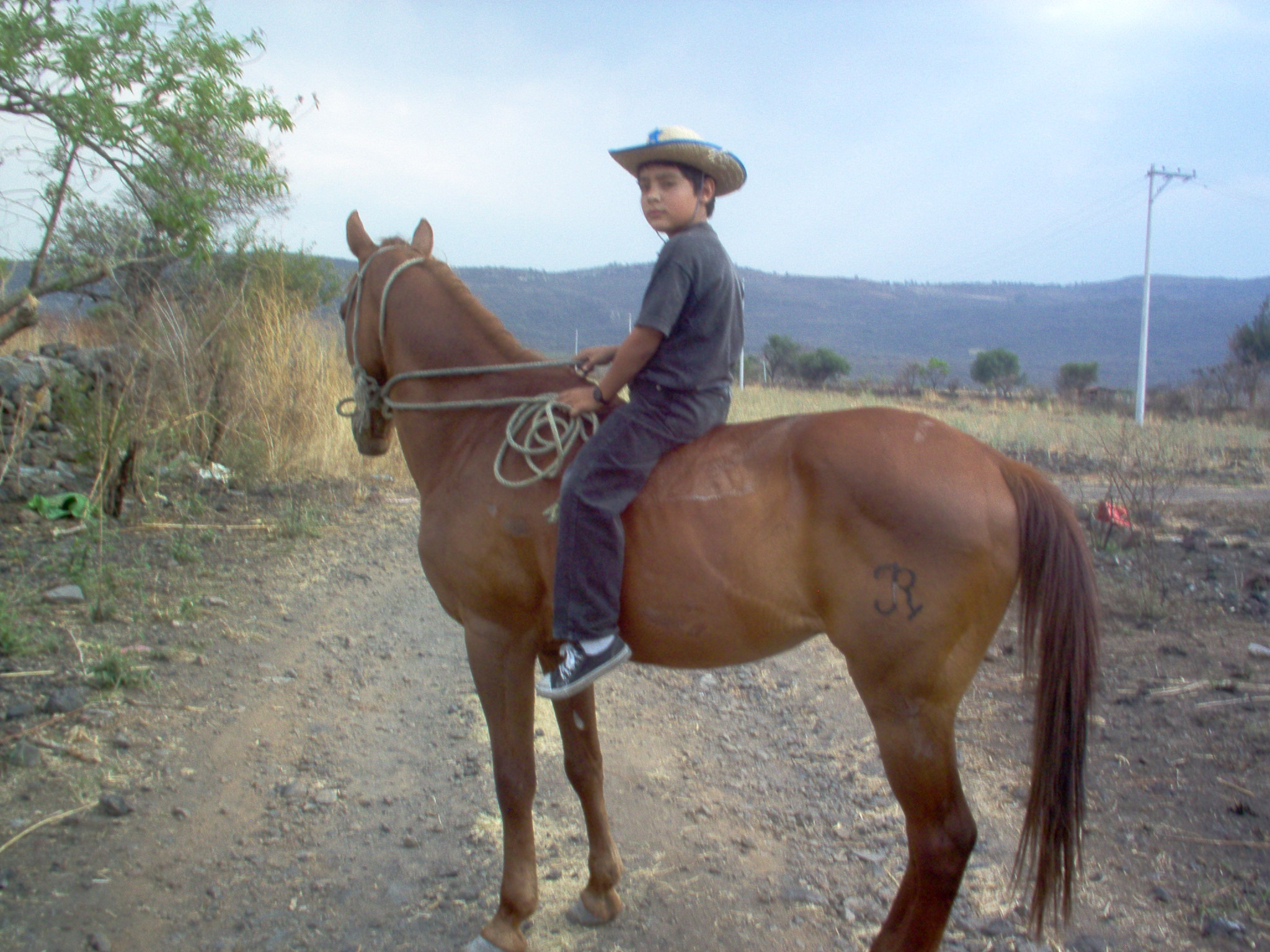
My husband got it into his head awhile ago that he must have a horse. After all, as a youth in Cerano, he was never without his horse. Not long into his search, he found one that the owner was willing to barter for 5 goats and 3000 pesos. Deal done lickety split. Red was a quiet gelding, not much trouble at all at the beginning. He altered his pace to accommodate his rider. For my husband, he did handsprings and danced. For my son, slow and steady up and down the road. And for me, little a pony trot around the block. Everybody was pleased.

However, owning a horse was not without problems. First, there were mounting expenses. A horse needed a bridle, reins, a saddle and new shoes.

IM000284.JPG

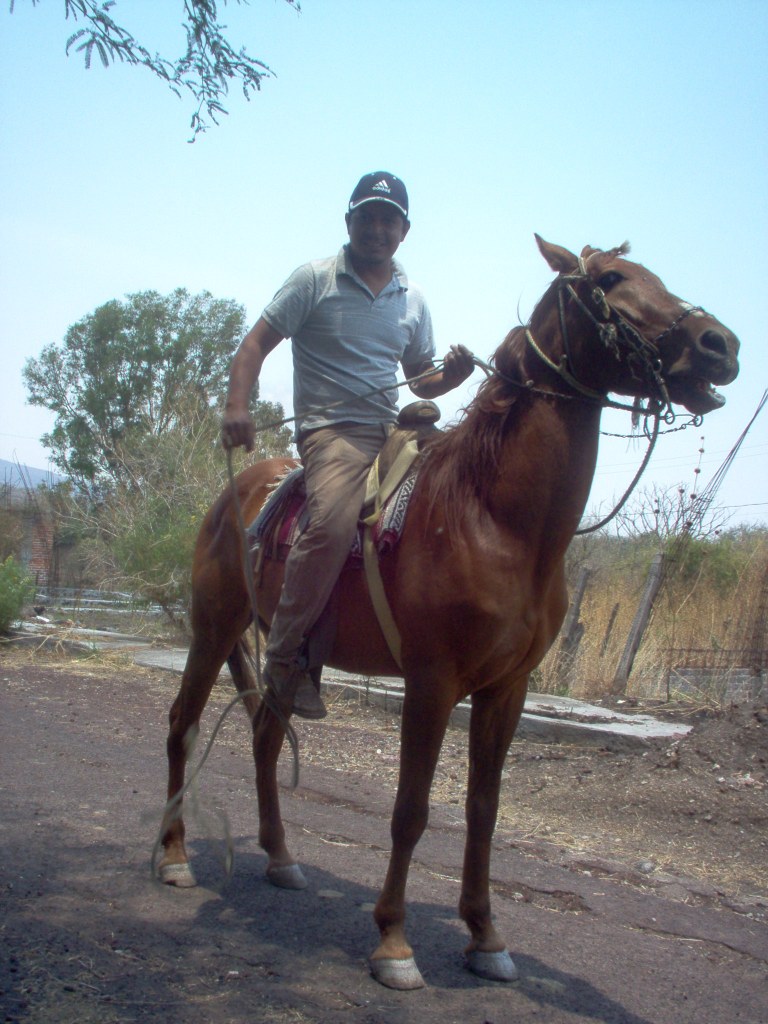
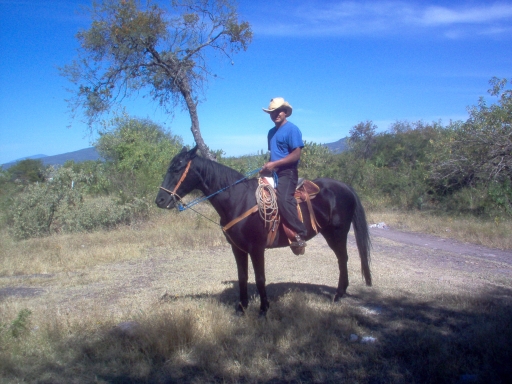
My husband on Red.

Then having acquired a horse, my husband went in search of his lost youth. This caused some problems because he was now a married man with responsibilities, not a charro prancing about for the young ladies to admire. These solitary rides irked my son and I since he left us to do the other chores around the house and we never got a chance to ride.

My husband’s solution to this second problem was to get a second horse. Without ready cash, the problem was how. He heard about herds of wild horses in Los Amoles, and he and my son spent more than a week on daily treks looking for them. They did stumble across a small herd one day, after crossing a lagoon on the motorcycle, water up to their waists, but couldn’t get near enough to catch one, although they felt that the glimpse was well worth the adventure and the dip in the water.

A neighbor heard about my husband’s quest and took him to see an acquaintance who was selling his horse in Salvatierra. My husband was twitterpated with his first sight of Black Beauty. We didn’t have any money, but my husband scrounged and saved and sold his tools and the toolbox to come up with a deposit. That just goes to prove that anything can be bought on layaway. Two weeks later, Beauty was home and in season.

beauty

Our own Black Beauty.

And it couldn’t just be any stallion for Beauty. My husband went hither and yon and found one to his liking that also fit the budget. Stud fees vary on the quality of the stallion and the owner’s whim. But having obtained one, all the men in La Yacata came to watch the maquila (breeding). Then there were the endless discussions on whether the stallion ejaculated and whether Beauty was pregnant afterward. Honestly, not something I spend my afternoons discussing, but hey, whatever floats your boat I suppose.

So then there was the stud service fee, new shoes and, of course, a second saddle and bridle even though we hadn’t finished paying for the set for Red yet. At first, expenses did not include food as it was the rainy season and there was free grass aplenty for fodder. However, it’s a horse of another color during the dry season. Horses eat like, well, horses and now we had two.

But, to our delight, now with two horses, we could go riding as a family. My husband on Beauty, me on Red and my son changing out between us.

Riding about was not without perils. There are the low hanging branches of the thorny mesquite trees to look out for and hidden craters that may have been dug out ages ago for someone’s ajibe (dry well) that may cause a horse to stumble and throw the rider. Then the horse may decide that he or she is a racehorse and that turbo speed is called for to win this imaginary race and the rider (namely me) finds it hard to decelerate while ducking branches and hanging on for dear life.

My husband and son have a natural seat on horseback that I seem to lack. They slouch a bit and sit low in the saddle and actually look like they had been born to it. And I so wanted to look like an elegant English miss, complete with a blue velvet riding habit on the back of the horse. However, the horrible truth was that I looked as elegant as a frog on a log floating downstream. Oh well, I suppose someone had to eat the flies, and it might as well be me.

kids and red

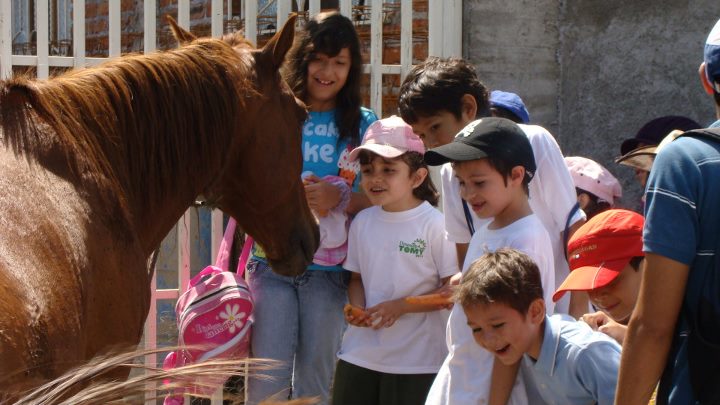
Red and the summer class. He had such a friendly disposition in the beginning.

The word caballero, which is translated as gentleman in English, literally means one who owns a horse. Horses were a status symbol, as only the wealthy could afford their upkeep. Regular folks made do with donkeys or mules. As we hardly qualify as wealthy, Red had to work to earn his keep. My husband worked with my father-in-law and son to till about an acre of land near our house to plant corn, both for our own larder and then later to feed the horses during the winter months when grass is hard to come by.

plowing with red

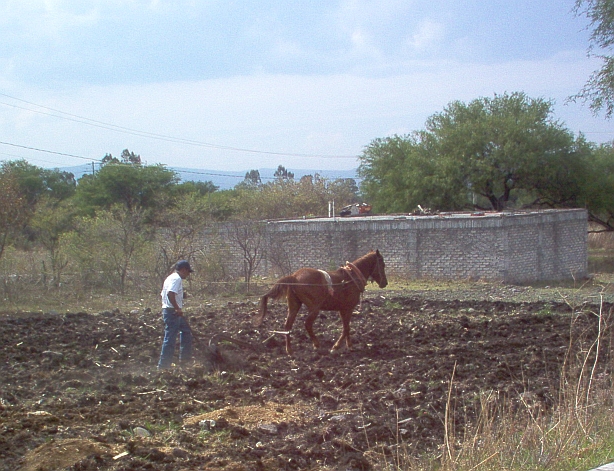
Red the plow horse.

For a time, this worked out well. Then Red became persnickety. He didn’t want to plow. He reared up when I was on his back. He nearly kicked my son. We couldn’t figure out what got into him. My husband thought that he might have been improperly castrated and a neighboring mare in season was causing his bad behavior. So he had a neighbor sedate Red and check. Nope. That wasn’t the cause.

Then, the second theory was that he was too well fed and, therefore, didn’t want to work. It’s true that he filled out while living with us. His coat was not as shaggy but glowed. So what’s the solution for overfeeding? My husband tried tying Red to a tree in the afternoons so he couldn’t graze, but his ornery disposition didn’t improve.

So he was sold to B, my husband’s brother. B would ride hell bent for leather, up and down the ravined roads in La Yacata, late at night. I was sure he would be thrown and break his neck, but he didn’t. That lasted about 3 months, then Red disappeared. We have many theories, but no trace has been found.

***************************************************
Enroll in the Materia Medica Course!

disclosure

5 Comments

Filed under Alternative Farming, Animal Husbandry, Homesteading