
Tag Archives: Christmas in Mexico

Christmas in México—Three Kings’ Day

three-kings

Los Santos Reyes or Los Reyes Magos bring gifts to children in México.

Three Kings’ Day is celebrated in México on January 6, Epiphany, and is based loosely on the visit of an unknown number of unnamed astrologers who visited the young child Jésus sometime after his birth, bringing gifts of gold, frankincense, and myrrh as recorded in the book of Matthew.

These visitors are known as Los Santos Reyes (The sainted kings) or Los Reyes Magos (The magic kings) and have been christened with the names Melchor, Gaspar, and Baltazar.  Young children are told to leave out their shoes filled with grass for the camels of Los Reyes Magos and will be given a gift in return.  Slightly older children may write a letter to Los Santos Reyes making a gift request which is tied to the string of a helium balloon and released to go wherever it is that Los Reyes are when they are not making gift deliveries.

January 6 is the last day of an incredibly long school vacation period and it never seems quite right that children have to wait until the very last day to get something new.  Some families have therefore instituted gift exchanges on Christmas day so that there would be presents to enjoy during the vacation period as well.  However, don’t think that Santa delivers to México, since everyone knows his sleigh won’t work without snow—or at least that is what I have been told.

Children in our area of México, seem to believe in the existence of Los Santos Reyes much longer than children in the U.S. believe in Santa Claus.  On several occasions, I have listened to 11 and 12-year-olds passionately debate the topic, with most still firmly believing.  Of course, given the other religious and cultural miraculous beings that belong to the Mexican people, like la Virgen de Guadalupe, it shouldn’t come as any surprise that their children want to believe, so it is so.
rosca

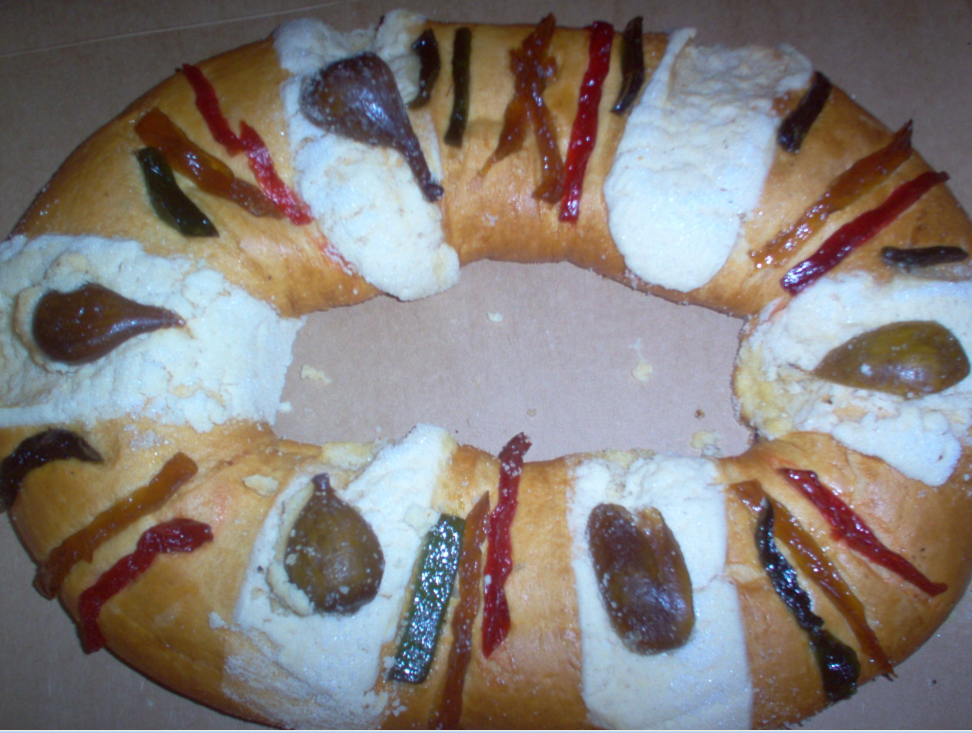
Sharing the Rosca de Reyes on January 6 is a long standing tradition in México.

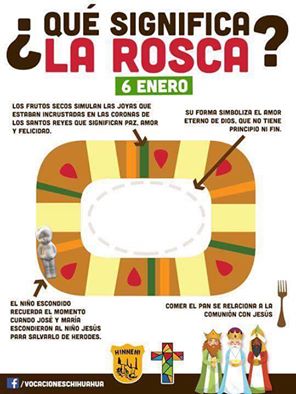
Gifts are often placed at the foot of the child’s bed to be discovered immediately upon waking.  Sometime later in the morning comes the tradition of the cutting of the Rosca de Reyes (a round or oval shaped fruit cake).  Each partaker must cut his or her own piece of cake.  This is to ensure there are no trampas (cheating) since baked inside the cake are one or more plastic babies representing el niño díos (the baby Jésus).  It is considered a sign of good fortune for the coming year if you find one of these plastic babies in your piece, although it comes with a catch, you must provide the tamales and atole (a corn-based drink) for the family gathering on el Día de la Candalaría.
rosca

Last year, not only did I find one in my piece of the rosca at the family gathering, but I was blessed with a second one at work.  I was feeling pretty good about it initially and waited with open arms for some of the reputed good fortune to be laid upon me.  However, I soon had to revise my opinion when a series of unrelated, unfortunate incidents made January into a most trying month.  I figure that the two lucky charms canceled each other out, so no bestowed good fortune for me. I’d have to make my own.  Additionally, I then had two separate events that I had to provide tamales and atole for, a double expense.  What fun!

SOTBS Blog Hop Op1Sq

Have a Christmas or New Year in Mexico themed blog post?

Link it up here! An InLinkz Link-up

**************

Interested in learning more about Mexican holidays?

Check out A Woman’s Survival Guide to Holidays in Mexico!
9 Comments

Filed under Mexican Holidays, Religion

Christmas in México—Poinsettias

poinsetta

Poinsettia gone wild!

Everyone knows that the poinsettia was adopted in the United States as a Christmas decoration when Joel Roberts Poinsett, the first United States Ambassador to Mexico, introduced the plant into the United States in 1825.  So since this weed was so highly esteemed by the neighbors to the north, the Mexican too adopted this plant as a holy Christian symbol. 

However, it was valued prior to Christianity reached the shores of México.  The Poinsettia, or Cuitlaxochitl as it was known in Nahuatl, was used by the pre-Hispanic indigenous people to make clothing dyes.  It was also thought to host the souls of fallen warriors.

Then, during the 17th Century, a group of Franciscan priests settled near Taxco and began to use the poinsettia as decoration in the Fiesta of Santa Pesebre and most likely, in their Christmas celebrations.

A relatively modern story evolved to provide rational for its Christmas use.  There are several versions of this story about, and here is one more.

Once upon a time, a young boy was going to see the image of the Christ child at the altar in the local iglesia (church) on Christmas Eve.  He felt bad that he wasn’t able to bring any gifts to lay at its feet.  As he was walking, he saw a green leafy plant by the side of the road.   Having nothing else to bring, he picked the plant and went inside the church.  When he lay the plant by the image of the baby Jésus, it miraculously changed color.  It’s leaves turned bright red.   He knew his gift from the heart had been well received in heaven. From this day forth, this plant has been called La Flor de la Nochebuena.

Other versions follow the same story line, but the gift is given by a little girl. (The Legend of the Poinsettia)

Some versions of this story have the boy actually giving the plant to the baby Jésus like the Little Drummer Boy rather than visiting a local altar, but that just seems too hokey.  This plant is not native to Bethlehem and how a little Mexican indigenous boy found his way to Israel is beyond explanation, so the stories don’t even try.

However it came about, the NocheBuena is now a firmly entrenched emblem of Christmas in México.
SOTBS Blog Hop Op1Sq

    Have a Christmas in Mexico themed blog post?

Link it up here!   An InLinkz Link-up 

***********************

disclosure

Leave a comment

Filed under Mexican Cultural Stories, Mexican Holidays, Native fauna and flora

Christmas in México–La Aguinaldo

dino christmas

It is customary for employers to give their employees an aguinaldo (Christmas bonus) the last working day of the year before the official start of the extended Christmas vacation.  By law, the aguinaldo must be paid by December 20.  The amount varies for each employee as it is based on the total number of days worked during the year and the current salary of the employee.  Typically, however, it ends up being about one quicena which is one paycheck when the employee is paid on the 15th and the last day of the month.

Therefore, about the middle to end of December finds the average Mexican temporarily flush with cash.  Of course, this is known to all and results in some extra fleecing by the police in the form of mordidas (bribes).

Last year, my husband went out the first day of vacation to load us up with water so that we wouldn’t have to worry about running out on our days off.  (See Water Woes)  Only he didn’t come home that night.  Needless to say, my son and I were beside ourselves with worry.  He arrived with the truck around 7 a.m. the following day.

It seems what happened was that in El Ojo del Medio de Agua where he was filling our water storage tanks, there was an alleged robbery of a stereo.  The police arrived and searched the truck, my husband and the vehicle and person of another man who was also there filling up water containers.  Not being content at finding nothing of value either in the pockets of the accused or the vehicles, they took both men into custody.  They were taken and held in Yuriria.  My husband didn’t have any cash on him, nor did he have a phone to call me to bring any, plus he hadn’t stolen anything, so did not make the customary mordida (bribe) offer.  The police tried to force him to pay una fianza (bail) before releasing him, but again, he didn’t have any money.

He walked from Yuriria back to where the truck had been left, about 5 miles as the crow flies and drove back home, without a full water load though.

This is not the first time something like this has happened to us around the Christmas season.  The second year we were here, my husband and his brother-in-law were stopped by the police, who had removed any tags that might identify them, although they did not wear capuchis (masks). (See Safety and Security or lack thereof) Even after my husband showed them our permit from the Aduana (customs), his driver’s license, and our marriage certificate, the officers threatened to impound the vehicle.  Between the two of them, they had about $2000 pesos on hand, and that was accepted graciously by said law enforcement with a Merry Christmas to you too.

SOTBS Blog Hop Op1Sq

    Have a Christmas in Mexico themed blog post?

Link it up here!   An InLinkz Link-up 

**************************

disclosure

2 Comments

Filed under Mexican Holidays, Safety and Security