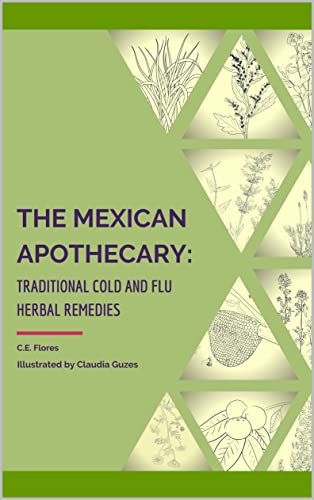
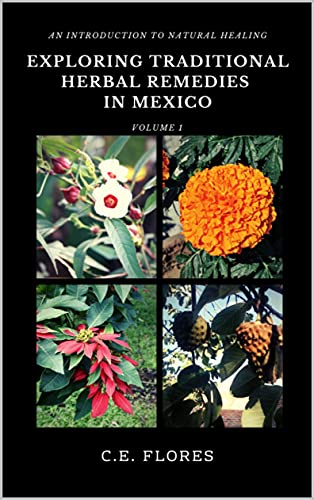
Lest you think I was laying about during my work hiatus in the spring, it’s finally time to announce that The Mexican Apothecary: Traditional Cold and Flu Herbal Remedies got a whole content makeover and is now available in hardback too! Claudia Guzes’ drawings are featured throughout the book, adding so much beauty that you’ll be hard-pressed to resist picking up a copy!
To celebrate the relaunch, you can get the ebook version for 99 cents for the next few days! That’s right! From August 8 – 15, The Mexican Apothecary: Traditional Cold and Flu Herbal Remedies is reduced in price. Using the information in this book, you’ll have time to stock up your winter wellness cabinet before cold and flu season.
So pick up your copy and learn more about science-based natural remedies found in traditional Mexican herbalism.
I recently discovered that Mexico has its own sea salt production in Colima. These salt flats have been in use since pre-Hispanic times. Hueytlatoani Colimotl, the king, paid his tributes to the Aztec emperor with salt. In fact, the salt flats were the cause of the 30-year La Guerra del Salitre (Saltpeter War) between Colimotl and the leader of the Purépechas Cazonci Tangáxoan II, both factions vying for control of this valuable mineral.
After the Spanish conquest, salt increased even more in value because it was used in the extraction of silver. At one point, the salt flats were producing 3,600 tons each year. In the 1890s, cyanide replaced salt in the mining process and production dropped off.
Mexican sea salt is from the La Laguna de Cuyutlán. It is still harvested using the traditional processes. Microplastics are filtered out through the black volcanic sand that surrounds the estuary. The salinated water is dehydrated in the sun and the salt crystals are collected by hand. Because the process is organic, it is only done 16 weeks per year.
According to experts, you can distinguish sal de mar from Colima from other sea salt varieties by its color, bright white, size, smaller than most sea salt, and humidity. When you crush a grain between your fingers, your fingers will be damp.
Sal de mar is high in trace minerals not found in processed table salt. It has medicinal properties that you shouldn’t miss out on. Bathing in sal de mar helps reduce pain associated with rheumatoid arthritis and psoriasis outbreaks.
Estafiate (Artemisia ludoviciana) is another herb with problematic common names that hamper positive identification. In Mexico, Artemisia ludoviciana is sometimes called ajenjo or hierba maestra, which is Artemisa absinthium as well. It is also known as altamisa, another name for artemisia franserioides. And then, cola de zorrillo and epazote are other names for Dysphania ambrosioides.
There is just as much diversity in English in this herb’s name, which include silver wormwood, western mugwort, white sagebrush, and gray sagewort.
Artemisia ludoviciana subsp. mexicana is a plant native to Mexico. Using that knowledge, it’s slightly less complicated to come up with names that aren’t used for other non-native plants. In Nahuatl, it is iztauhyatl, and in Maya zizm. Other names include istafieta and azumate de Puebla. The Otomí call this plant ambfe. In Quintana Roo, it is known by haway, kaway si’ isim ts’tsim or osomiate. The indigenous of San Luís Potosí use the terms tsakam ten huitz, ten ts’ojol. In Veracruz, it is xun. To the Rarámuri it is ros’sabl’i and for the Popoloca, it is kamaistra.
Estafiate has long been considered a sacred plant. It was associated with the water god Tláloc and used to remedy conditions believed to be caused by water, including gout, leprosy, and epilepsy. During celebrations to honor the god, children were brushed with the plant as a protective charm against parasites. In some areas, estafiate is still used as part of limpia (cleansing) rituals. Other traditional uses include fever, asthma, tuberculosis, cough, kidney stones, stomach gas, menstrual cramps, bruises, arthritis, mal de ojo (evil eye), susto (sudden fear), and hemorrhoids.
This bitter herb is more potent fresh. It is often used in conjunction with ruda (Ruta graveolens), manzanilla (Matricaria chamomilla), epazote (Dysphania ambrosioides), and yerba buena (Mentha spicata). Estafiate is toxic in high doses and should not be ingested by pregnant or nursing mothers.
For respiratory issues, including cough and flu, an infusion is made from the stems and leaves and gargled or rubbed on the throat and chest areas. The dried leaves can be smoked to help with asthma. An Inhalation can also be prepared by boiling the leaves and breathing in the steam. Children are given fresh estafiate wrapped in a cloth to suck on for cough.
A tea made with equal parts epazote (Dysphania ambrosioides), and estafiate is prescribed for stomach gas. Allow the herbs to steep for 10 minutes. Flavor with canela (Cinnamomum zeylanicum) and miel (honey) as the tea will taste extremely bitter. For stomach pain caused by parasites, 20 flowers that have been dried in the shade are added to a cup of water.
To treat bilis (excessive rage thought to gather in the liver), chew on a fresh estafiate sprig. Another remedy for bilis calls for an infusion of nopal root (Opuntia ficus-indica) and the leaves of albahaca (Ocimum basilicum), estafiate, yerba buena (Mentha spicata), Orégano de monte (Lippia graveolens), drunk every morning before breakfast for nine days.
An infusion of fresh leaves or a single sprig is given for fever. For arthritis and other muscle pain, crushed leaves are rubbed on the affected joints. A wash for hemorrhoids is made with four teaspoons of leaves of stem boiled in a one-half liter of water and steeped for 15 minutes. Stain and allow it to cool to room temperature.
Estafiate has shown gastroprotective, antispasmodic, antibacterial, antimicrobial, antiparasitic, and anti-inflammatory activities supporting its use as a stomach remedy and cholera treatment. It also possesses properties that suggest it may be beneficial in treating diabetes, cancer, Alzheimer’s, and Muscular dystrophy. It has a significant antinociceptive effect and thus is useful in reducing pain in certain instances. It also has hypoglycemic and antihyperglycemic effects. Artemisia ludoviciana has antimycobacterial activity, indicating that it can be used in addition to antibiotic treatments for tuberculosis. It also demonstrates antifungal activity.







 Surviving Mexico
