Category Archives: Mexican Cultural Stories

Courting in Cerano

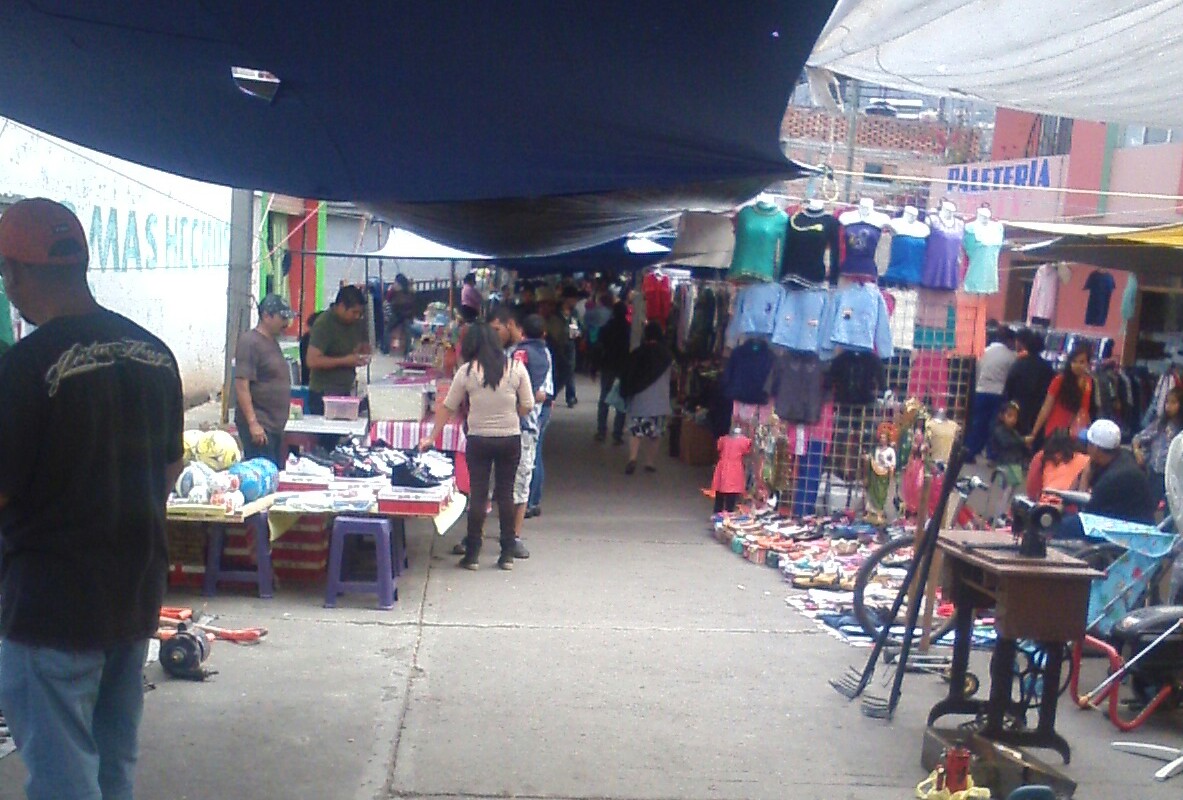
The tianguis on Sunday in Cerano.

The tianguis on Sunday in Cerano.

Last weekend we gathered our chichares (junk) together and headed to Cerano to see what we could sell for cash. (See Failing at your own Business–Tianguis) The morning was busy but uneventful. We sold things right off the bat and then sold some more. Buyers were typically male and campesinos (country folk). We sold enough for us to get some Cerano specialty carnitas de res (fried cow parts) and ice cream. My husband, as always, was in charge of any and all business, therefore my son and I had some free time on our hands. We decided to people watch.

El templo in Cerano.

El templo in Cerano.

Every town has its “circuit” where the young girls and boys circle around and observe, talk to or hook up with members of the opposite sex. In Cerano, Sunday afternoons in the tianguis (flea market) is the place to be. Things really didn’t get interesting until after mass, around 12 pm. Then the young people began to peacock around.

Watching the girls!

Watching the girls!

My son and I were most interested in what makes a muchacho or muchacha (young fellow or lady) attractive and the subsequent “hooking up” stage. We began by observing the groups of boys. They circled in groups anywhere from 2 to 6 in a group. Each group had its own identity. There seemed to be 3 main styles. There were the pseudo-skaters (pseudo in the sense that they did not carry skateboards) in t-shirts and tight colored jeans with even more colorful shoes. Then there were the vaqueros (cowboys) with their checked shirts, jeans, boots and belt buckles. And finally, there were the bad boy gangsta-wanna-bes with their t-shirts, baggy pants, and sparkly gun/marijuana/skull belt buckles, maybe even an earring or two.

We noticed that girls arrived and made the circuit in groups of two, sometimes three. Some girl packs came with their little ones wrapped in rebozos. (See Babywearing in Mexico). Others had toddlers that trailed behind. Some came with their mothers or grandmothers. A few came alone and met up with friends as they circled. All the young ladies were dressed to the hilt.

The main objective is to get the attention of the opposite sex, whether through ostentatious dress or eye contact. Some efforts to get the girls’ attentions were complete and utter failures. Hooting and hollering made the girls speed up or take a sudden left turn into oblivion. Although most already were acquainted, sometimes we witnessed formal presentations by an intermediate after liberal eyeballing from both parties. These introductions allowed the formerly group of 2 to become 3 and the circuit walk continued.
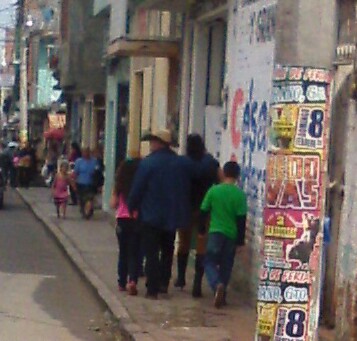
A "couple" walk in Cerano consists of the man walking slightly behind his woman with his hand on her shoulder.

A “couple” walk in Cerano consists of the man walking slightly behind his woman with his hand on her shoulder.

The commitment level of the relationship was easy to read. Single males were still in their wolf packs. The newly hooked up circled in groups of 2 or three (the potential couple and chaperone female friend). Those in the official couplehood stage walked in the customary Cerano way–the female was slightly ahead of the male who had his hand on her shoulder “guiding” her along.

Young couples with babies have a modified couple walk. The woman holds the hands of toddlers, and more often than not, the male carries the infants. This allows the woman to have her hands free for shopping, after all, they were at the tianguis (flea market) and certain things need to be bought. Women with children who had no man, perhaps he was in el norte (the US) or the relationship had ended, carried their own children and were often with another female friend in the same position, or more rarely with their mothers. These women, or young ladies, were either “single” or “in a relationship” which could be determined by how much skin was exposed. The committed had far less tata display than the single ladies.

A gathering of married men in el jardin in Cerano.

A gathering of married men in el jardin in Cerano.

Men married for an extended period of time arrived as lone wolves, meeting up in the jardin (central park) with other lone wolves after making the circuit and seeing what there was to see. Women of the same age also arrived alone but didn’t typically linger after making necessary purchases.

Everything you could possible need is on sale in Cerano on Sundays.

Everything you could possibly need is on sale in Cerano on Sundays.

What an educational day! In the early afternoon, we called it quits, gathered up what remained of our crap for sale and headed home.

*************************************

disclosure

2 Comments

Filed under Cultural Challenges, Mexican Cultural Stories

Christmas in México—Poinsettias

poinsetta

Poinsettia gone wild!

Everyone knows that the poinsettia was adopted in the United States as a Christmas decoration when Joel Roberts Poinsett, the first United States Ambassador to Mexico, introduced the plant into the United States in 1825.  So since this weed was so highly esteemed by the neighbors to the north, the Mexican too adopted this plant as a holy Christian symbol. 

However, it was valued prior to Christianity reached the shores of México.  The Poinsettia, or Cuitlaxochitl as it was known in Nahuatl, was used by the pre-Hispanic indigenous people to make clothing dyes.  It was also thought to host the souls of fallen warriors.

Then, during the 17th Century, a group of Franciscan priests settled near Taxco and began to use the poinsettia as decoration in the Fiesta of Santa Pesebre and most likely, in their Christmas celebrations.

A relatively modern story evolved to provide rational for its Christmas use.  There are several versions of this story about, and here is one more.

Once upon a time, a young boy was going to see the image of the Christ child at the altar in the local iglesia (church) on Christmas Eve.  He felt bad that he wasn’t able to bring any gifts to lay at its feet.  As he was walking, he saw a green leafy plant by the side of the road.   Having nothing else to bring, he picked the plant and went inside the church.  When he lay the plant by the image of the baby Jésus, it miraculously changed color.  It’s leaves turned bright red.   He knew his gift from the heart had been well received in heaven. From this day forth, this plant has been called La Flor de la Nochebuena.

Other versions follow the same story line, but the gift is given by a little girl. (The Legend of the Poinsettia)

Some versions of this story have the boy actually giving the plant to the baby Jésus like the Little Drummer Boy rather than visiting a local altar, but that just seems too hokey.  This plant is not native to Bethlehem and how a little Mexican indigenous boy found his way to Israel is beyond explanation, so the stories don’t even try.

However it came about, the NocheBuena is now a firmly entrenched emblem of Christmas in México.
SOTBS Blog Hop Op1Sq

    Have a Christmas in Mexico themed blog post?

Link it up here!   An InLinkz Link-up 

***********************

disclosure

Leave a comment

Filed under Mexican Cultural Stories, Mexican Holidays, Native fauna and flora

Women in Mexican History–Stories from the Revolution–Marcelina

train adelita

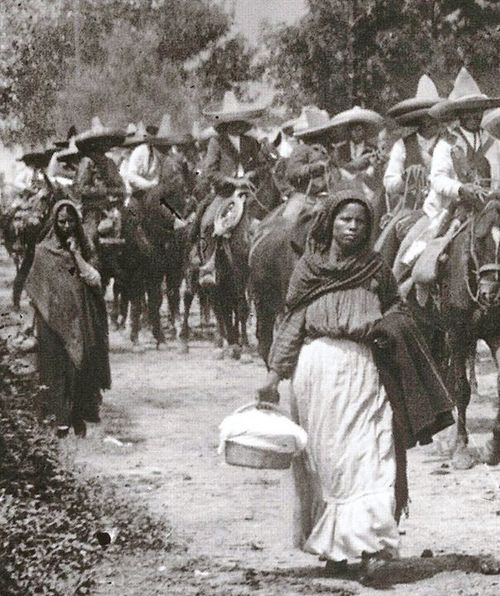
The role women were thought to play in the Mexican Revolution has been typically confined to the caricatures of the Adelitas. Although women did fight alongside their men, the Adelitas were not the only women involved in the revolution.

girl revolution

Claudia Guzes, a Mexican friend of mine, told me some stories about her family during the Mexican Revolution. With her permission, I have translated these stories and am sharing them to give name to some of these anonymous Women of the Mexican Revolution.

Claudia shares:

This is the story of my great-aunt Marcelina Magaña López, my great-grandmother’s sister, Alta Gracia Lucina Graciela Magaña López, originally from Moroleón, Guanajuato.

My great-grandmother Alta Gracia Lucina Graciela Magaña López told my mother some of the stories about her life during the Mexican Revolution. It was a difficult time for women. Soldiers, whether for or against the revolution, were known to kidnap women and girls, who were often not heard from again. Therefore, the people of the town and individual families would make special efforts to hide all the women and girls when soldiers came. Once the revolutionaries arrived in Quiahuyo and my great-grandmother, only a child at the time, asked the soldiers if they had come for las muchachas (girls). She told them that all the girls had already been hidden, which made the soldiers laugh. With good humor, they left without any girls that time.

women in the revolution

My great-grandmother also told me a story about her brother Patricio Magaña López. He was in the habit of heading out to las mezquiteras en el cerro (large areas of mesquite trees) early in the day to work in the fields. One day, he was walking before the sun had risen and literally ran into bodies of soldiers (or rebels depending on the perspective) that had been hung near the entrance of Quiahuyo.

She also told stories about the difficult life of her older sister Marcelina Magaña López. Marcelina bore 8 children, four boys Antonio and Jose Luz (Chito), Eliazar (Eliaser), and unnamed baby boy and four girls Guadalupe, María, Josefina, and Bertha. During the Revolution, her husband, Hermenegildo Pérez, decided to fight with Venustiano Carranza sometime between 1910 and 1913. His particular group patrolled Chihuahua, Zacatecas, la Sierra Madre and up through Texas.

Marcelina was in constant fear for her husband’s life when he was off on patrols while she was at home with the children. This wasn’t an unfounded fear. When rebels were caught by los federales (federal troops) nearly all captives were killed. Once Hermenegildo’s group was captured and somehow he managed to not get shot. He hid among the dead bodies of his companions, pretending to be dead as well, and survived the revolution, although his proximity to canons during the war caused him to lose much of his hearing.

When Hermenegildo did get a chance to visit, he told Marcelina where he would be so that she could come and join him but did not give her any money for the journey. Despite the objections of her mother, Marcelina went, taking all her children with her. The journey was difficult and made more so by the fact that Hermenegildo had to change his location often to hide from los federales (Federal troops). The family traveled by boxcar from one area to another.

Food also was another difficulty on the road. Marcelina and the children often ate tortillas stuffed with nothing more than quelite del campo, an edible plant found along the sides of the road and abandoned fields, or other types of foraged vegetation.   One of Marcelina’s daughters,  Bertha,  died when she was only a few months old as a result eating unripe peaches.

quelite

At times, the family sheltered under bridges. It became such an ordinary event for the children that when they finally were able to return home, her son Chito would cry because he wanted to sleep under the bridge again and not in his own bed.

On one of the family’s trips to San Luis Potosi, Marcelina gave birth to a baby boy who died a short time later.  She left her other children behind and went to pedir limosna (charity) to buy the casket.   On the road, she met with two men who were moved by Marcelina’s grief.  They took Marcelina and her infant son to the panteon (cemetery) in their car and helped her bury him.   The men promised that while they were alive, there would always be flowers on his tomb.

Both Hermenegildo and Marcelina survived the revolution. Hermenegildo became pious, reciting the rosary whenever the opportunity presented itself, and died at the respectable age of 80, although partially blind and completely deaf by then. Marcelina died much younger at the age of 60. It is most likely her life was shortened by the hardships she endured during the revolution and the “reconstruction” afterward.

rainofgold

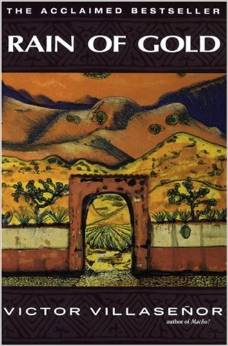
This period of history, although now glorified with parades and fanfare, was devastating to many Mexican families. Thousands of families fled to the United States during the Revolution. The story of two such families, that of the Villaseñores and the Carmargos, parents of Victor E. Villaseñor are told in his biography The Rain of Gold. The accounts of these families are similar to Marcelina’s story, girls hidden under piles of chicken shit, women raped, traveling by train, high infant mortality, and families separated and destroyed. Villaseñor’s grandmother, the mother of 19 children, lost all but 3 of her children during the war. And what did all this suffering accomplish?

silence

The conditions which sparked the Revolution, inequality of the distribution of wealth, censorship, extreme government control, are still present in México. Talk among the campesinos (farmers) is that it is time for a new revolution even as the government tries to repress it. Recently 43 students have “disappeared” (see Anatomy of a Mexican Student Massacre) hauntingly reminiscent of Tlatelolco student massacre of 1968.  There is no doubt that women will be involved in this new period of civil change.  It remains to be seen exactly how.  (See Also Crisis in Mexico: Could Forty-Three Missing Students Spark a Revolution?)

*******************************
Would you like to read more about women in Mexican history?

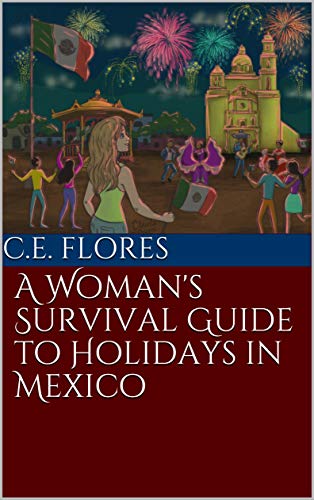
Check out A Woman’s Survival Guide to Holidays in Mexico.

cover holidays

9 Comments

Filed under Guest Blogger Adventures, Mexican Cultural Stories, Mexican Holidays, Politics