As the pandemic really shows no sign of letting up, my self-imposed quarantine drags on and on. I find myself struggling to motivate myself to do just a little bit more each day, instead of the bare minimum, so that I have a feeling of advancement instead of stagnation.
Sometimes, though, I need a reminder that whatever I get done today is enough. These are unusual times, and I really am doing the best that I can. Since I’ve finished my last CBT (cognitive behavior therapy) course at Udemy, I’ve been searching for another way to keep me positive. Ultimate Bundles has filled that void for me with the Ultimate Guide to More Joy and Less Stress.
Now, this isn’t a bundle, but rather a single workbook with 15 video lessons. Each lesson is designed to be completed in less than 15 minutes. These are are simple but effective strategies you can implement immediately. Additionally, many of the presenters have additional bonuses free for you to download. Take a look at the table of contents!
If you order before October 6, you’ll also get a 12-month subscription to the digital edition of The Goodnewspaper, a monthly newspaper that highlights the people, ideas, and movements that are working to make the world a better place. Who can’t use a regular dose positivity these days?
The Ultimate Guide to More Joy and Less Stress is only available from October 5 until October 9, but once you’ve downloaded the workbook, you can go through the lessons at your own pace and as many times as you’d like.
In addition, when you order, you’ll have the option to also pick up the Self Care Mini Bundle 2020 that was available earlier in the year. Having already purchased this bundle, I have to say, you won’t regret it! This little gem has 8 eCourses and Membership Sites, 5 eBooks, 9 printables, and workbooks valued at $564.80!
With the way things have been going this year, the next few months could be just as stressful. I continue to make my mental health a priority, which means continually looking for ways to successfully manage stress. Online classes, like the ones Ultimate Bundles offers and Udemy’s CBT (cognitive behavior therapy) courses, have been so helpful. What have you been doing to keep it together these days?
Although there are countless home remedies used in Mexico, not all of them have been studied for effectiveness. However, I believe that having a basic herbal first aid kit, in addition to an emergency first aid and medicine supply can help you in the event of some medical emergencies.
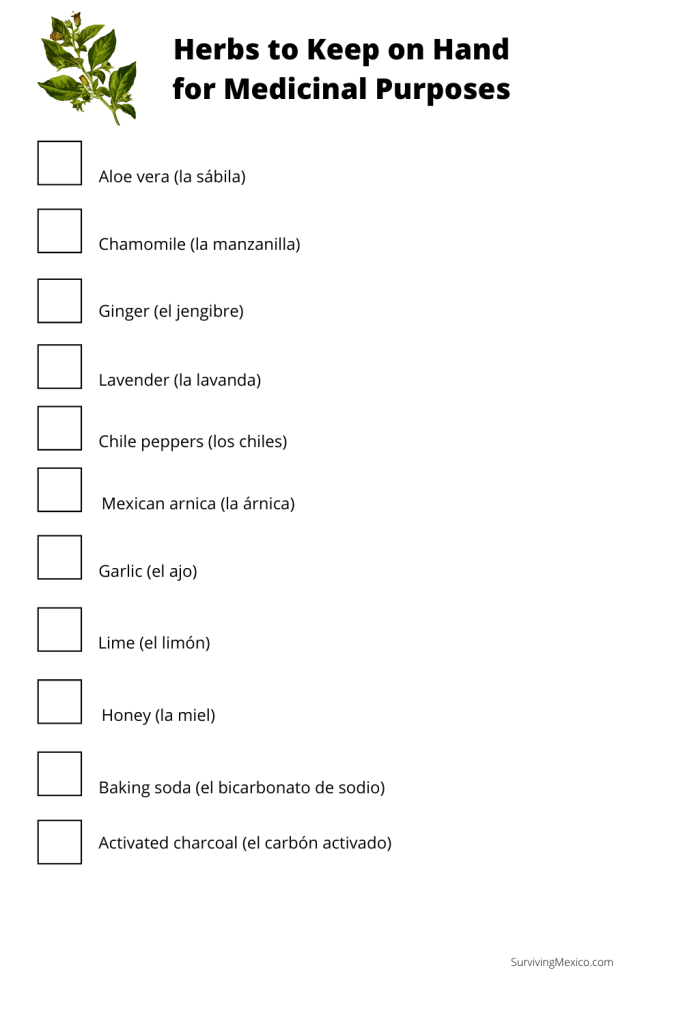
Árnica Mexicana (Heterotheca inuloides) can be used externally for joint inflammations, arthritis, injury, contusions, bruises, tendonitis, sore muscles and skin infections due to bacteria or fungus. You can buy dried Árnica Mexicana from the market and make a tincture or find pomada de Árnica at most pharmacies.
La sábila or aloe vera (Aloe barbadensis miller) can be used externally for burns, insect bites, and wound care. It’s best when used fresh. Growing aloe vera isn’t difficult and having it on hand in emergencies makes it worth the effort. To use, cut the pencas (leaves) in half lengthwise and heat briefly to get the juices flowing. Then apply to the affected area.
La manzanilla, chamomile, (Matricaria chamomilla) can be used as an eyewash, digestive aid or mild sedative. It can be found dried at the market or already in teabags at the store.
Los chiles, peppers, from the Capsicum annuum family have a variety of medicinal and health benefits. Rubbed on the body, they promote circulation to the area. Be careful not to get any in your eyes though. A bite of a particularly spicy chile will cure a headache after your eyes stop watering. Toasted on the comal, dried chiles will clear the nasal cavity and lungs. Powdered chile and olive oil and be mixed to make a liniment for joint, muscle and back pain.
El ajo,garlic, (Allium sativum) is not just for flavoring. When battling a cold, la gripa, or cough, la tos, regular doses of garlic tea will perk you right up. To make boil 3-6 peeled and halved cloves in three cups of water. Add ½ cup of lime juice. Add honey to taste and serve.
El limón, lime, (Citrus aurantifolia Swingle) is a regular addition to most meals in Mexico. The leaves can be used to make a refreshing tea, high in antioxidants. Lime juice squeezed on wounds will reduce the chances of infection and slow bleeding. Fresh is best, so consider planting a lime tree in your backyard.
El jengibre, ginger (zingiber officinale), also helps soothe the digestive system. A pinch of powdered root in your cup of yerba buena (spearmint) or manzanilla (chamomile) will help with nausea. Its anti-inflammatory action relaxes membranes in the airways, reducing the cough reflex. To brew yourself some ginger tea, add 20 to 40 grams of fresh ginger root slices to hot water and sweeten with honey (another natural cough suppressant). Finally, ginger works as a warming agent by improving blood circulation. Ginger root can be found at the market quite easily.
La lavanda, lavender, (Lavandula angustifolia) is a natural antiseptic and has antifungal properties, making it an excellent wound wash. Mixed with olive oil, it works well as a muscle rub, headache cure, or for cramps. Used as aromatherapy, it reduces tension and helps you sleep better. It can also be burnt for insect fumigation. The leaves can be added to other herbs for a digestive tea. You can easily find lavender plants at the viveria (plant nursery) so you’ll always have it on hand.
The following are not herbs per se but are great natural additions to your Mexican herbal first-aid kit.
La miel, honey, has all sorts of beneficial properties. If you happen to live in the Yucatan, the local Melipona honey has even higher antimicrobial, antibiotic and anti-inflammatory properties than regular organic honey. Apply honey to wounds and burns to aid in healing. Honey is a natural cough suppressant. It also aids in digestion, calming heartburn and ulcer flare-ups. If your blood sugar drops, one tablespoon of honey will bring it up. If your jar of honey crystallizes, place the container in a pan of hot water to liquify it again.
El bicarbonato de sodio, baking soda, is useful for stings and bites. Mix water and baking soda to make a paste. For severe heartburn or urinary tract infections, 1/4 tsp can be taken internally to help alleviate the symptoms quickly.
El carbón activado, activated charcoal, can be applied as a poultice on spider bites, stings, and infected wounds by mixing it with enough water to make a paste. It can also be taken internally as a remedy for food poisoning, diarrhea or gas. Taken early enough, it may also help absorb other types of accidentally ingested poisons.
You might also want to invest in an herbal apothecary book. Look for one that specializes in plants found in Mexico rather than one that is designed for all of North America. Do you have any suggestions?
Depending on how rural you are, medical intervention may not be close enough for your immediate needs in the event of an accident or illness. Although most small towns and villages are supposed to have a clinica (clinic) they are often understaffed or closed most of the day or even closed the entire day, only opening once or twice a week.
Hospitals are also understaffed and can be quite a drive from your home. For minor illnesses and injuries, you might be better off treating them at home or going to a clinic attached to a pharmacy.
In our area, we also have a Red Cross (Cruz Roja) facility. They have an ambulance that you can rent to transport patients to the regional hospital in the next town or the more advanced hospital four hours away.
Because of the difficulty in negotiating the public health care system in Mexico, my advice to you is to take first aid and CPR courses as your first line of defense. Along the same line of thought, if you compile your own first aid kit at home, you’ll be able to deal with many emergencies.
Most of the items can be purchased over the counter at the farmacia (pharmacy). It’s just a matter of knowing what to ask for. I’ve included the Mexican term used in my area on these checklists, which may or may not be the same for your area of Mexico.
Serious injuries and illnesses should be treated by a doctor. Since December 2019, you can call 911 for emergency services in the entire country. There’s even an emergency app you can install on your phone. Bear in mind that if you live in rural Mexico, an ambulance can take some time to reach you. It might be faster to drive yourself or get someone to drive you to the nearest hospital.
Be persistent and vocal about receiving care once you arrive at the emergency room. If your Spanish is not adequate bring someone who can help you explain yourself. Remember, the stress of being in an emergency situation reduces your fluency quite a bit.
A medical emergency is stressful in any country, especially in a country where you may not be as familiar with how the health care system works. In the idea of preparedness, find out where the closest medical facilities are BEFORE you need them.
Make sure that you have your official identification and the identification of family members that are ill or hurt. If you are a resident either permanent or temporary, your ID would be your residency card. If you are a citizen, then you’ll need to bring your INE (voter’s registration card). If you live one of the nine states that are still under the Seguro Popular, ISSTE, and IMSS health plans, make sure to bring your family policy. If you are in a state that has transitioned to the new federal healthcare plan Insabi, you’ll need your CURP (Mexican social security number) card. You should also bring a translated list of medications the patient is currently taking and any allergies or health issues.
Make copies of the policy forms, CURPs, and identifications of all your family members and keep them in a folder that you can grab in case you need to rush to the hospital. Be sure that the list of allergies, medications, and health issues is up to date and translated. Gathering paperwork is the last thing you want to worry about during any medical crisis.
Some ex-pats also carry emergency travel insurance such as MedEvac. If you have a policy, be sure to contact the representative as soon as possible to see about emergency evacuation or transferring to a hospital under their jurisdiction.
Although I’m sure it is your fervent hope that you never need to use this information, it’s certainly better to be prepared just in case.
****
Learn more about navigating the Mexican healthcare system.







 Surviving Mexico