Category Archives: Death and all its trappings

The Cost of Dying in Rural Mexico–Funeral Services

Last week I convinced my husband to head to a funeraria (mortuary) to ask some questions about funeral services. It’s not like I’m planning on dying anytime soon, but death comes to us all and I wanted to be a little better prepared in case next time I had to make the arrangements. 
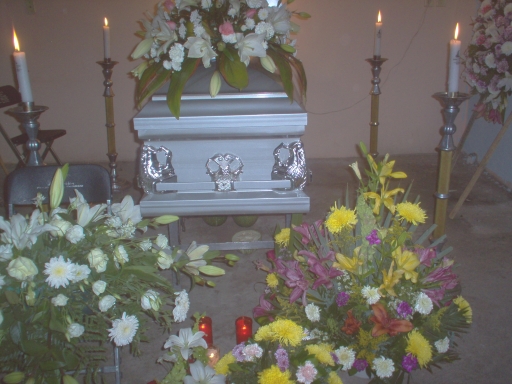
I learned there are lots of integrated pieces involved in being buried in Mexico and that you will be charged for each and every one of them. The particular funeraria that we visited has a sort of burial insurance that can be purchased for 800 pesos per year. 

The package included:

  • El ataúd de madera (basic wooden coffin) or la urna básica (simple urn)
  • 120 sillas para el velorio (chairs for the wake)
  • 2 arreglos de flores (flower arrangements)
  • 70 piezas de pan ( sweetbread pieces)
  • 40 sillas para la novena (chairs for the 9 days of prayer)
  • Los spots de radio (radio announcements informing the general public of the funeral times)
  • Traslado del cuerpo (transfer of the body from home/hospital to where the wake is held to the church for mass to the cemetery for burial or to the crematorio)
  • Ayuda con los tramites (help with the documentation)

Of course, if I don’t die for 40 years, the funeraria gets a grand total of $32,000 pesos. So I decided to ask about the individual costs of the items. The following prices are estimates for 2020. 

An average coffin costs about $14,000. An urn for cremated ashes costs approximately 800 pesos. If you have the seguro (insurance) but want a different urn or coffin than the one included in the plan, you pay the difference in price. If you wish to be cremated, you still have to rent the coffin for the wake. 

Cremation can be done locally in our area, so it ends up being less expensive of a service than it might be in other areas. A funeral service with cremation will cost about $10,000. 

The average funeral service with the velorio and novena in the home costs about $6,000 plus the coffin, not including cemetery and church service fees. If the velorio and novena are to be held in la sala de velatorio, also known as la sala de velación o velorio, then there is an additional rental fee for the space.

In order for a funeral to proceed quickly, and since embalming isn’t commonly done here a quick funeral is better, a coroner needs to sign off that the person is actually dead. If the person died in the hospital, then the last attending medical personnel typically handles the paperwork. If the person dies at home, then the funeraria has someone on call to take care of examining the body. 

The funeraria may or may not “arreglar” the body. When my brother-in-law died, the funeral guys only dressed the body because I didn’t give them a chance to say no and I sure wasn’t going to do it. I did provide the clothes though. On the other hand, my mother-in-law was coiffed and make-upped so much that she didn’t even look like herself. Again, the clothes were provided. Both Mama Vira and my mother-in-law had specially made “santa” dresses. You’ll need to pay about $200 pesos to seamstress for that as well. 

In the event of a violent, suspicious or sudden death, and in case of a miscarriage, the body is often taken for an autopsia. The medical examiner on site conducting the autopsy will fill out the paperwork. The funeral home typically takes care of transporting the body to and from the autopsy site, which in our case is more than an hour away in Yuriria. 

When our nephew’s murdered body was found, his autopsy was done in Celaya, three hours away, since it was part of an open criminal investigation. The paperwork was not ready when the funeraria came for the body, so someone had to return to pick it up the next day. Nothing could advance in the funeral procession procedures without that paper.

When my husband’s cousin miscarried at my mother-in-law’s funeral, the fetus was taken to Yuriria for an autopsy to ascertain that she hadn’t intentionally aborted the baby since abortion is still illegal in most of Mexico. She had to wait two days before they returned the little body in a shoe box for her to take back to Cerano and bury. 

This paperwork is essential in order to have the Acta de Defuncion (death certificate) drawn up in el Registro Civil (Civil Registry). Other paperwork involved that the funeraria will help you with includes getting permission for burial in the cemetery or cremation orders. 

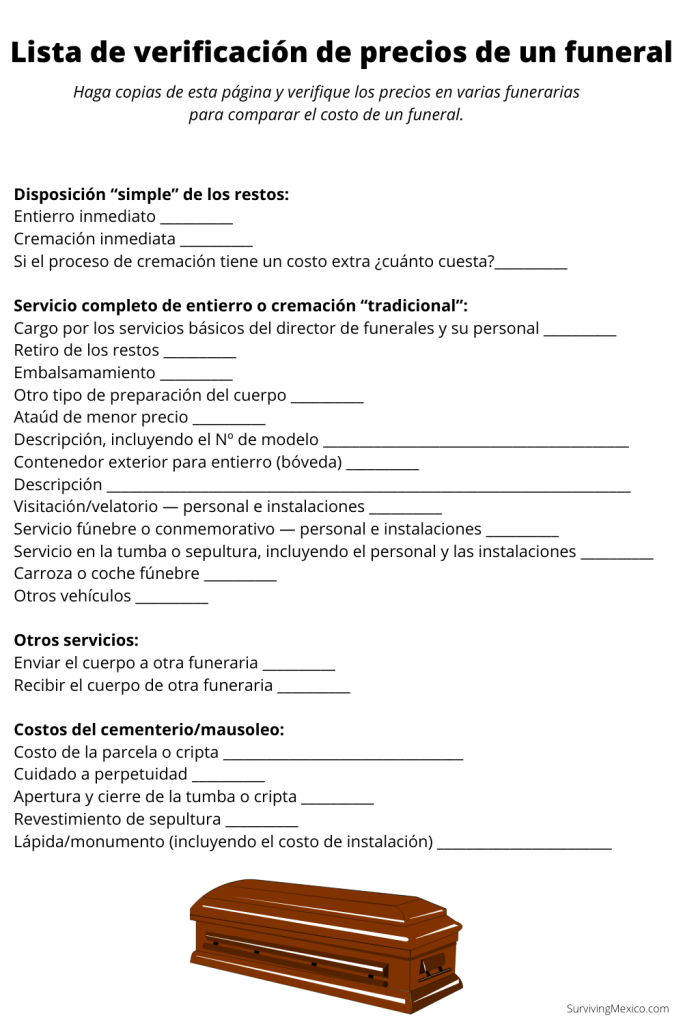
Estimating expenses we now know that a funeral service with casket will run you about $20,000 pesos if you hold the services at home and a cremation service about half that at $10,000. If you shop around, you may be able to find a less expensive setup. You can use this checklist if you like.
1 Comment

Filed under Death and all its trappings

Tiene azucar? — Diabetes in Mexico

Tiene azucar? (Do you have sugar?) is the local way to ask if you have diabetes. It’s not uncommon to see people who have had their feet or legs cut off because of complications with diabetes. The lady who talked to herself on the way to La Yacata had untreated diabetes. She died of a diabetic coma a few years ago at the age of 45. When my son was in elementary, parents were required to attend a workshop on how to diagnose diabetes in our children. We were to look for a purplish ring around their necks that looks like mugre (dirt) but that doesn’t wash off. 

According to the World Health Organization, diabetes is the number one cause of death with nearly 80,000 deaths per year. Mexicans with diabetes die on average younger, at 57 years, compared to the overall age of 69. Early death is not the only side effect. Diabetes can cause strokes, kidney failure, foot ulcers, nerve damage, and blindness.  By 2050, health care practitioners estimate that half of the population of Mexico will have diabetes.

One factor in developing Type 2 diabetes is lifestyle choices. Over the past 40 years, Mexicans have gotten fat. Soda consumption is out of control with an average of more than 176 liters per person per year. It’s hard to find a meal not accompanied by a coke, “la chispa de la vida.” Even breakfast might be served as a bolillo de trigo (wheat bun) and coke. In most areas, a can of soda is cheaper than a bottle of water. High alcohol consumption is another factor in the high sugar diet so popular these days, sugar tax be damned.

IMG_20180430_094325

You are what you eat!

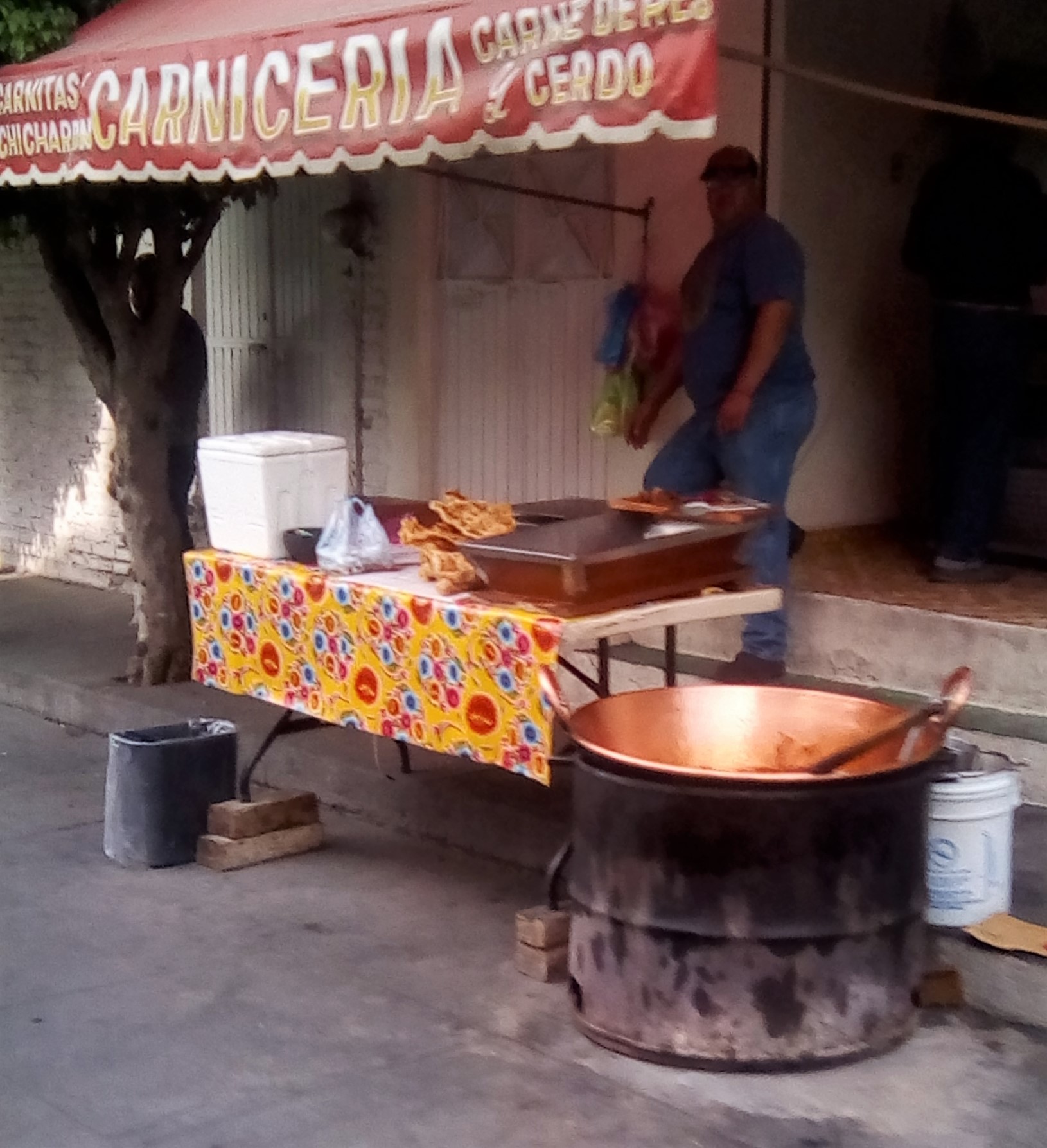
The diet has changed as well. Moving from a predominantly plant-based diet based around corn, the average Mexican now consumes more than double the amount of meat consumed in 1960. Carnitas (fried pork) stands can be found on nearly every corner.

In addition to poor diet, Mexicans have become less active overall. Children don’t run and frolic outdoors, but instead huddle in corners playing hour after hour on their cell phones, tablets, and Xboxes leading to a rise in childhood obesity and early onset of Type 2 diabetes.

Of course, it’s not all in the diet. Mexicans also have a genetic predisposition towards developing Type 2 diabetes which compounds the problem.

And the prevalence of this disease places a burden on the healthcare system currently in place. Estimates average more than $700 USD per year per person out of pocket expenses for diabetes maintenance (insulin injections, test strips, pills) and that doesn’t include the cost of dialysis and kidney transplants that are services also not covered under Seguro Popular. Since minimum wage is still under $5.00 USD per day, this is a huge expense for many families

More education about the prevention and management of diabetes is needed. The general idea I hear is that we all die from something, we might as well die fat and happy. And you can bet, their death will be celebrated in grand style, carnitas (fried pork) and coke all around at the velorio and novena perpetuating the cycle.

1 Comment

Filed under Cultural Challenges, Death and all its trappings, Health, Parenting Challenges and Cultural Norms

Funerals in Mexico–Test of Endurance

Sometimes I think that all I write about these days is Death. We’ve certainly experienced our fair share since moving to Mexico. In September, we experienced yet another tragedy.

l flowers.jpg

My husband’s nephew L made a series of poor decisions and was taken from his home in the middle of August. Several weeks later, his body was found in La Barranca, a small mountaintop community that is a municipality of Moroleon.

His body was taken to Celaya for autopsy and returned to his mother’s house in Moroleon at 3 am the next morning. She had cleared out her tortilleria to receive the body. However, the coroner’s report was not sent with the body. Without the coroner’s report, a death certificate could not be made nor a plot in the cemetery purchased. L’s body had already begun decomposing, so time was of the essence.

Therefore, L’s younger brother A went with the funeral home people back to Celaya to await a coroner’s report. My husband and I hoped to be able to speed the burial process along even without the documentation and went to the panteon (cemetery) to see if we could purchase the plot since it was Friday and the offices are closed over the weekend.

We arrived there to find that the girl who is in charge of the office wasn’t planning on coming in that day. We spoke to the caretaker. Several calls were made and finally, we were told that she would be in after all.

We headed back to my husband’s sister’s house to see what else could be done. The civil registry office closes early on Fridays. Brother A returned with the coroner’s report just in time to get the death certificate but the cemetery office was now closed again. The girl promised she would come in on Saturday at 8 am especially for us to purchase the plot, so the funeral was scheduled for 11 am the next day.

velorio

That night was the velorio (wake). I have to say I was disappointed in the behavior of the attendees. I arrived a little late and nearly everyone present was either high or drunk. I didn’t stay long. I wonder if it was perhaps the age of the mourners, most were just teenagers, and maybe it being their first death, they didn’t know how to act. When I presented my theory to my teenage son, he pointed out that this wasn’t his first funeral and that he certainly wasn’t carrying on like that. So I don’t know what to think about their behavior.

padre nuestro.jpg

The next morning, my son and I went to pick up some flowers before the funeral service at the church. Unbeknownst to me, my gas gauge was broken and we ran out of gas on the highway. We had to walk about 2 kilometers to the nearest gas station. Fortunately, the last 1/2 mile or so was mostly downhill and we coasted right up to the gas pump.

We missed the misa (mass) completely but still went to get those flowers and headed to the cemetery. L’s older brother who is working in the U.S. sent enough money to hire a banda (band) to play during the funeral procession from the house to the church to the cemetery, and then continue playing for an hour or so after the casket was covered. Relatives in el norte (U.S.) also sent enough to buy a ground tomb rather than a crypt. It’s twice as expensive to be buried underground.

I can’t say that the mourners’ behavior was any better at the interment than it was the night previously at the velorio. This isn’t my first funeral here, so I know that this was not the norm. There was such volumes of weeping and wailing and screaming that it really was fit for a telenovela (soap opera). The younger brother A. threw himself into the grave at one point and one guy, I’m not even sure who he was, danced on the tombs as the banda played on.

L’s mother was putting on quite a show, which would have been fine since everyone grieves in his or her own way and all that. However, it was now midday and the sun was blazing hot and no one thought to bring any umbrellas for shade. Well, there was one, but it was a child’s umbrella and it barely covered her head. So her younger sister, who was trying her darndest to be supportive and had stayed up since 3 am the previous day to help her sister through this most difficult time, was left without shade and finally fainted. Here’s where all the first aid training I had paid off.

There is one mesquite tree in the entire cemetery which provides only partial shade. Some of the menfolk moved the prostrate sister to said shade. Having just hiked 2 km myself, I still had 1/2 bottle of water I bought at the gas station. This was poured over her head and revived her some. She was still unable to focus or speak coherently. My son and I marched our fannies to the corner store and bought two bottles of suero (electrolytes). I forced her to drink the smaller of the two bottles immediately. She did and by the last drop, she said that the world had stopped spinning.

I decided that her supportive role in the ongoing drama, albeit commendable, was over for the day. The oldest sister supported my decision. So her father and my son half-carried the ailing sister to the entrance area where there was both shade and benches. I bullied her into drinking the second bottle of electrolytes until she was able to respond to questions without her eyes rolling back into her head. There was some talk of taking her to the hospital, which wouldn’t have been such a bad thing, but nothing came of it. She did go home and rest for a while.

ave maria.jpg

Eventually, someone talked the mother into going home and she was given a prescription for some tranquilizers so was able to mostly make it through the novena (9-day prayer session) without completely alienating the entire family.  I’m not sure that you ever recover from the loss of a child, no matter how it happens.

rosario.jpg

So about L, the autopsy report has not been released as it is part of an open murder investigation. I doubt it will ever be made available. L. had been in trouble before, and in fact, had been kidnapped and tortured and escaped. Despite this, he continued to antagonize the wrong people. He and another young man were taken by those that do the taking around here. No one saw anything. No one knew anything. Without the autopsy report, the family won’t know if he was tortured before he was killed or exactly how he died, which may be for the best, the not knowing part I mean. In having a body to bury, there is some closure. The other young man’s family is still waiting for any information.

The situation where we live has become intense. The cities listed with the highest number of homicides in the first 8 months of 2018 surround us. In August alone, there have been more than 3,000 homicides making a grand total of 22,000 homicides thus far this year. That number doesn’t include Desaparecidos (those that have disappeared). The state in which we live, Guanajuato, has been leading the body count with 1,671 homicide victims between January and August. There is currently a turf war going on between the Jalisco New Generation Cartel (CJNG) and the Santa Rosa de Lima gang.

L was just one more casualty. No one expects the police to find the murderers. After all, the police are up to their eyeballs in this whole business. I’ve seen the impunity that exists before.

What surprised me most was the lack of judgment from the community. It might have been easy to dismiss what happened to L as no more than he deserved. That’s probably true. But what I’ve heard from those who reached out to help, those that attended the funeral service, those that are still trying to do what they can for L’s mother, those that have expressed their condolences, is that each and every one of them realized that it could have been their brother, their cousin, their nephew, or their son. Maybe this realization even inspired the devil-may-care attitude of some of the mourners. After all, they could be next.

So today, el Día de los Muertos we have gone to the cemetery yet again. The grief is still raw and ugly. But we’ve brought flowers for my mother-in-law, killed by a police officer 6 years ago in May. We’ve brought flowers for my brother-in-law, who lost his battle with alcohol last November. And we’ve brought flowers for L, who was once the little boy who called me Tia.


6 Comments

Filed under Death and all its trappings