
Finally, after 15 years living in this house, it was time to paint the front. What, in theory, should have been done in two days took three weeks. But is anyone surprised?
First, we found that the tan paint we chose seemed very yellow when applied. Mixing some dark brown took it to a peachy hue that looked great with both the tejas (tiles) and brown doors. The second bucket ended up slightly darker when the brown paint was added, but not enough for anyone but me to notice.
My husband trimmed out the windows and doors with a stripe of brown. We talked about adding another stripe to the base, but in the end, we decided against it. However, the wall on the far side of the animal gate needed a little something extra. My husband wanted a picture of a horse and two horseshoes. I found some images on the internet that I submitted to my artist friend Claudia and the end result was even better than I had hoped.
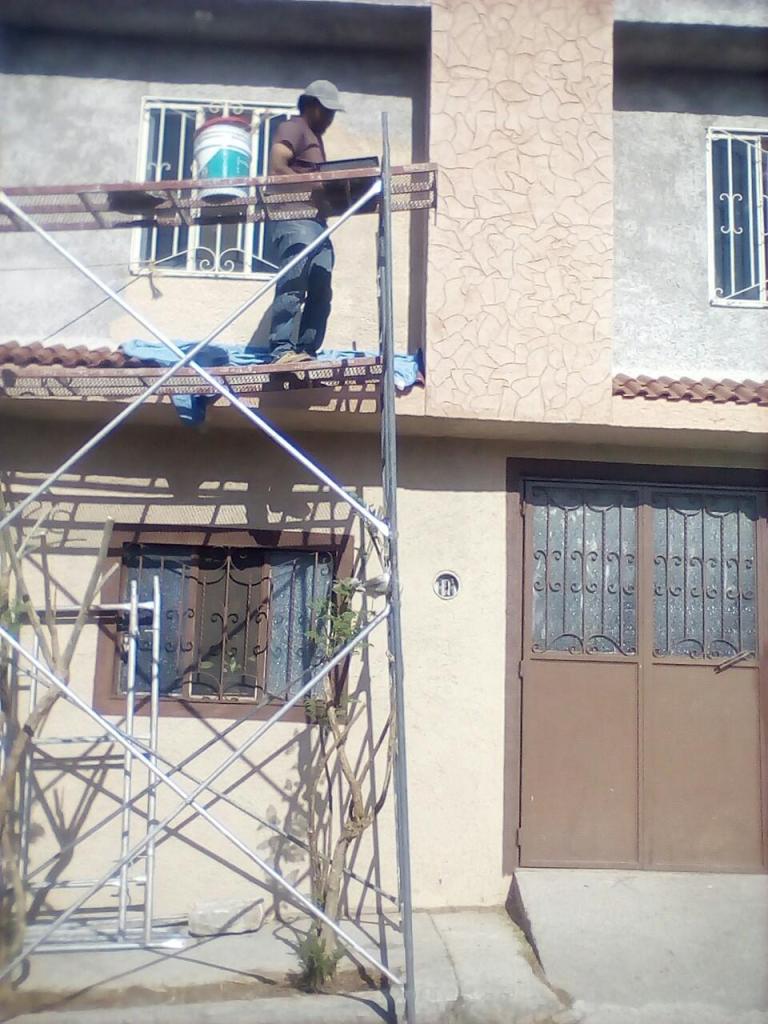
Of course, getting it on the wall was a challenge. We rented an andamio (scaffolding) for 6 days. My husband needed it for the second-floor painting, and Claudia needed it for the upper part of the mural. For three days, it sat there. No one used it. Since the price was a daily charge, I wasn’t too happy about that. The painter and artist were “too busy.”
When Claudia finally came, she didn’t bring her chalk line to mark the sections. She has recently moved, and it didn’t turn up in her boxes she had unpacked. So my son, Claudia, and I attempted to mark the perimeter with burnt sticks, a measuring tape, and string. It didn’t advance much at all. She arrived too late in the day to continue after we boxed the frame in anyway. The front of the house is hot as hades after 1 pm.
The next day, I sent my husband to buy a chalk line before Claudia arrived. By now, we were at day 5 of the 6-day rental. She had a rough start to her morning since she was responsible for feeding someone’s pets while they were on vacation, delivered a contribution to a kermes (charity meal) for medical expenses of a family member, and then had to go back home because she’d left something there. She finally arrived around 10 am. With the chalk line, things progressed faster. She managed to outline the full mural and paint the upper half before she called it a day.
Then we had our own crisis or two going on. The doorknob between the garage and the kitchen broke, leaving us all locked out of the house. Having been locked out a time or two before in my life, I grabbed a screwdriver and lifted the pins from the hinges. That did the trick. Of course, putting the pins back in took longer.
Jolina also decided she needed to give birth right then. Being one of our most frustrating goats, she decided that she would do so under the food trough. My son had a hard time getting the two little ones out. They are fit and healthy, but Jolina isn’t interested in being their mother. She did fine last year with the circus twins. But with these two, she hides under the trough most of the day so the kids can’t get anything to eat. We’ve tried locking her in with her kids in a separate stall, but that doesn’t work either. So my husband and son take turns forcing Jolina to hold still so her kids can eat.

Back to the painting…since Claudia worked past the 1 pm shadow, the next morning she had a terrible headache, so no work was done that day. When she recovered and returned, the painting was done in about 2 hours.
While Claudia was working, the men of La Yacata mosied by. There isn’t a lot of entertainment in these parts, and a pretty girl creating art is one of the seven wonders, apparently. I sent my son out periodically to run interference. He’d glare at the gawkers until they mosied away.
My husband didn’t finish painting the upper story when the scaffolding was here either. He had to drag the extension ladder to finish up. He said that he wanted to ask for another day. I said only if he were paying for the additional day. The guy came to pick up the scaffolding when agreed upon originally. He also didn’t think to ask for the cash before I started teaching for the day. Mid-class, my husband burst into the computer room and asked for the money for the rental fee.

Just as Claudia was finishing up, my husband got a bee in his bonnet about adding a nostril and eye to the horse shadow. Claudia tried to talk him out of it, but he insisted. So now, the horse is sort of a zombie horse–since the “light” is coming through at those parts. I might just go and dab some brown paint one of these days.
Anyway, the front of the house is painted now. So there’s that.