And to top it off, I was interviewed on a podcast, Rediscovering Your Passion and Purpose with Patti.
As an introvert, I always find podcast appearances agonizing, but I thought this one went pretty well. I opted to wear my huge earmuffers (headset) and not risk the issues I had with earbuds falling out onto the floor and rolling behind my desk that I had in my last interview.
Whew! That was a LOT of attention and should last me for quite some time! Back to other matters at hand, like that pesky little insurrection in La Yacata.
One random Sunday in September, my husband comes in and says there’s a community meeting starting. Color me pink, but I couldn’t figure out how that happened since I’m on the mesa directiva (board of directors) of La Yacata, and I hadn’t called junta (meeting).
So I put on my shoes, stop what I’m working on, and head out only to find the meeting has moved from down the road under the mesquite, which is the normal location, to RIGHT IN FRONT OF MY HOUSE.
I asked who arranged the meeting. Someone says it was on the radio, so here they were. And I’m like, well, since you have gathered together, let me give you a quick update on what’s going on.
La Yacata is lovely after the rains.
A month or so previously, Desarollo Urbano (the town planning committee) requested our presence for a meeting in the presidencia (town hall). I don’t know what happened to our invitation, but it arrived just 24 hours prior to the meeting. It would not be in our best interest to miss this meeting, as all government summons are taken with the utmost seriousness. Super Prez found me on WhatsApp, and I ran my butt on my moto over to where the secretary lives to see if he’d be able to make the meeting as well.
I passed Rigo, one of the vocales (understudy of a sort), sitting on a bench drinking at the entrance of La Yacata, and mentioned the meeting to him. He said he couldn’t make it as he had another meeting at the courthouse. Ok, whatever.
At 9 a.m. the next day, Super Prez, the secretary, and myself meet up in the atrium of the presidencia (town hall). We marched our badass selves to the Desarollo Urbano office only to find that the director in charge had forgotten about our meeting and was in the midst of some other very important activity. So we stood cooling our heels for nearly an hour and a half.
While we waited, the dude that had been sitting next to Rigo drinking showed up in his partly buttoned shirt and huge sombrero. He hadn’t been specifically invited to our little party, but it seems that Rigo had sent him as his stand-in. Ok, whatever.
La presidencia de Moroleon (town hall)
Finally, we were able to see the director, and he explained that the presidencia was attempting to regularizar (put in order) any fraccionamientos (neighborhoods) that pertained to the municipio (which is Moroleón). Super Prez gave him a general run down of what urbanization La Yacata had (nothing that worked) and the general apathy of the colonos (residents). He asked that we turn in some paperwork so that he could see where we stood legally and maybe give us some options on how to obtain those vital servicios (utilities).
First was a copy of the acta constitutiva, which is a document that was drawn up when the Associacion de La Yacata was formed. Super Prez, as the son of the original owner, had this. Then he asked for the registered members of la mesa directiva (board of directors). This committee is determined by popular vote at an assembly of residents. Super Prez, the secretary, and I (along with 3 understudies called vocales) were “elected” as it were about 10 years ago. Nobody else has wanted to step up and challenge us until now. And it’s not like we LIKE what we do. We don’t get paid. We’ve had to appear in court when La Yacata was sued (3 times). And it’s generally a hassle. Anyway, this document listing our positions needs to be renewed, so we couldn’t turn that in.
He also asked for the topographic plans, which we had, thanks to Super Prez, but he’d had to bring them back later as he didn’t have the plans with him. With that, the director said he’d be in touch, and we left.
Back to the impromptu meeting…I shared this information in condensed form with those who had gathered at my door. Then, a slight man with glasses began to speak. He said that we needed to renew the activa constitutiva because it had expired. To do this, we could head to Morelia, which is in Michoacán, get it done, pay 8000 pesos, and then pay the 2000 pesos fine to register it in the state of Guanajuato, which is where La Yacata is located.
Then he said we needed 5 people to form a mesa directiva. Remember, it’s not like I love being a member of the board, but to be informed like that that I was to be ousted by this guy, well, it was a little surprising.
Some of the more vocal attendees began with how they wanted to see progress and the current mesa directiva has done nothing and blah blah blah. Profe Juan, who had briefly held the position of association president before renouncing in a huff, pointed out that the problem was with the colonos, not the mesa directiva. True dat. We had done everything we could to protect the properties owned by the colonos and when we provided an estimate on how much it would cost to install the utilities, the assembled said they weren’t interested.
I was pretty incensed at this point, and my Spanish went right out the window, I’m sure. After all we’d done, how could they possibly say we’d done nothing? One lady with an infant started in how she didn’t know what was going on because we hadn’t had a meeting, and I got up in her face about how if she’d registered her lots when she bought them like she was supposed to, I’d have explained all this. Perhaps not my finest moment.
Then the horse guy started in on more of the same, how there’s no progress. And I got huffy and said that if certain people, like himself, would pay the fees for certain obligations we had as a community, perhaps things would be different. As the treasurer, I know exactly who has paid and who scampers off when it’s time to dig deep and hand over cash.
This woman then said it wasn’t important who paid and who didn’t. I begged to differ and said so. It showed what type of person you were, whether you were a responsible member of the association or not.
Later, when I told my friend that I screamed at this lady with a baby, she said I was supposed to kiss the babies, not yell at their moms. Oops! Guess I’m not politically savvy here–again, not that I ever wanted this position. I believe I’ve mentioned that.
Anyway, the slight man with glasses said we needed to have another meeting. They picked the date and time, and I said fine.
After the junta (meeting), I went to talk to this guy for a bit. He was positive the acta constitutiva was up in June of this year since it was constituted in 1993. I said I wasn’t sure of the dates. I told him that we owed the predial (property taxes) for the past 10 years on the community and that we hadn’t finished paying for the demanda (lawsuit). He said that establishing a new acta constitutiva, we aren’t legally responsible for those, but we’d have to change the name of the community. I said currently, the association was registered as La Ayacata. I’m not sure if this was a spelling error or by design, but it was easy enough to become La Yacata dropping the A.
He also said that I needed to have an RFC (Registro Federal de Contribuyentes), which is a tax ID number, more or less to be part of the mesa directiva. I had one and told him that. He seemed surprised, me being a foreigner and all. He said you could only get it by going to Morelia, which again seemed odd to me since it’s another state. My boss at the school I worked for back in the day had done the transaction for me. No trip to Morelia was needed.
At this point, I figured I’d wasted enough time with all this. I asked him to bring a copy of the reglamentos (bylaws) that he was proposing to the next junta (meeting). He felt, as did some of the attendees, that we should start enforcing a multa (fine) for those who didn’t come to the community meetings and that for those who didn’t want to pay the cooperaciones (community fees), the association should seize their lots.
These seemed troubling to me as the majority of the owners were older females who eeked out a meager existence selling tortillas or buñuelos in town. It was a hardship for them to close their stands for the day and come out to La Yacata just to hear blowhards tooting their own horns. It also didn’t seem right to repossess a lot that had been duly paid for, undoubtedly with blood, sweat, and tears, because they didn’t have the funds for the next project. So I wanted to see his proposals in writing.
I immediately called Super Prez to tell him about this attempt at insurrection. As the acting president, it was his decision to convocar (convoke) a community meeting, and he hadn’t been consulted. I tried to explain what was going on, but I was a bit upset and probably not too clear.
I asked when I could stop by to talk to him in person, and we set up a time that worked for both of us. I also sent him an email with all the information gleaned from this hostile gathering.
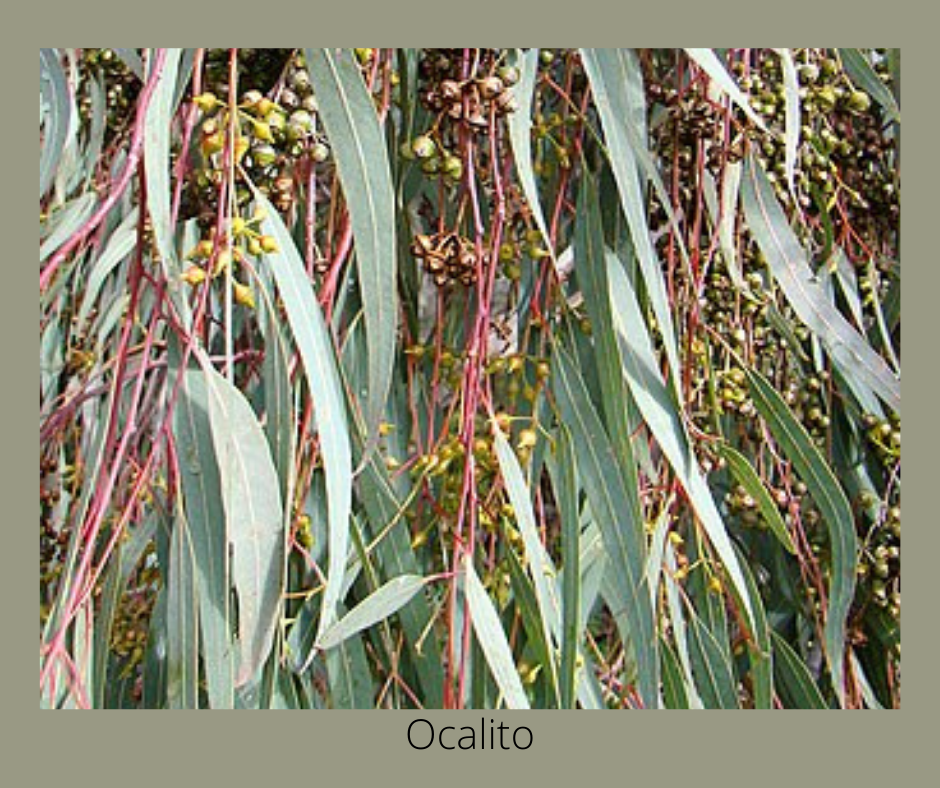
One day, my husband and I were cruising around Cerano looking for, I forget what, and suddenly he stopped the motorcycle, hopped off, and pulled some leaves off a shrubby tree, saying they were ocalito leaves and he needed them for seasoning. Well, all righty then. I really couldn’t identify the leaves, and he didn’t have any more information on them, so time went by.
Then another day, I was perusing the herb section in one of the herb stores in town and saw a bag of leaves like the ones my husband had picked, but they were labeled “eucalipto.” Eucalyptus? But surely, eucalyptus wasn’t a tree that grew in Mexico. Time for some research.
It turns out that eucalyptus trees were brought into Mexico in the late 1800s/early 1900s, predominately the Eucalyptus camaldulensis (rojo) and Eucalyptus tereticornis (azul) varieties. Commercial plantations were established but not well regulated. The trees escaped their growing confines and are now considered invasive species. Other varieties found in Mexico include Dólar de plata (Eucalyptus cinerea) and Eucalipto blanco (Eucalyptus globulus).
While ocalito is the name used in central Mexico, other common names are alcanfor, calipto, árbol de la fiebre, gigante ócalo, calistro, tzon tzko nasi in Oaxaca, ntajine in popoloca, an indigineous language spoken in Puebla.
Both Eucalyptus torelliana and Eucalyptus camaldulensis effectively treat tuberculosis and the persistent cough associated with that illness and other respiratory issues.
Ocalito leaf infusions are given for resfriado (colds), bronquitis, and asthma. A stronger infusion is used for a mouth rinse. Steam inhalations are prescribed for respiratory congestion and cough. A wash from the bark is made for vaginitis, urinary tract infections, and wounds.
As a rub for colds and flu, combine ocalito, ruda (Ruta graveolens), and romero (Salvia rosmarinus) in a liter of arguardiente (alcohol). Allow it to infuse the alcohol. Before using, warm it, then shake. Apply over the entire body in the evening. Drink the following hot infusion and send the sick person to bed.
Ocalito and Ocote Infusion for the Flu
1 stick of canela (Cinnamomum zeylanicum)
1 ocote twig (Pinus montezumae)
Equal parts:
ocalito leaves (Eucalyptus camaldulensis)
malva leaves (Malva sylvestris)
bugambilia morada bracts (Bougainvillea glabra)
Boil in one liter of water for five minutes. Allow to steep for another 5 minutes. Serve with miel (honey) and limón (Citrus aurantifolia).