Yesterday I got home early from my classes and was accosted by the neighbor. As we aren’t exactly friendly, I wondered what this was about. It seems that someone had stolen his borrega (sheep) and he was positive the person or persons had jumped our wall into his area and removed said animal that way.
I doubted his story at first. It seemed a far stretch to think someone would lift a full-grown sheep over the 6-foot wall. He said the tejas (roof tiles) were broken right at the entry point. I commented that we had recently bought bricks to raise two of our walls and that there had been several other robberies recently. They started about the time Chokis was poisoned.
The place where the thieves jumped the wall into the neighbor’s area.
Anyway, I went inside and looked out at the goats. It seemed there were fewer than usual. When my husband got home I asked him about it. Yes, Bunny and one of Venada’s twins were missing, as were a number of tools.
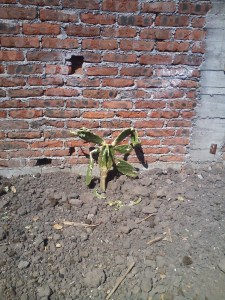
Further evidence of intrusion. This cactus was full and healthy in morning. Now it’s munched on and trampled.
As the house was unattended between 7 am and about 2 pm, that had to be the approximate time frame of the robberies. I can’t imagine that it was a quiet burglary. Lifting 3 hefty animals over the wall surely resulted in loud, hysterical bleating. Yet no one saw a thing.
The corner between the neighbor and our wall that we had plans to raise.
The other corner which meets the cow barn guys’ area.
Our total loss was about 2000 pesos, no small change for us. But what can you do? Call the police. Funny you should say that. Just last week, I thought it odd that a police vehicle was making the rounds in La Yacata. Probably scoping the joint out. AND the day after the robbery, the patrol vehicle sat at the end of the road most of the day. But where was it DURING the robbery?
The neighbor across the street had 2 dogs. They were poisoned yesterday as well. Guess who is probably the next target?
Covering the pigs’ air ventilation holes.
Colando the top.
New wall between us and the pig neighbor.
New wall next to the cow barn guy.
We opted to add to the walls. Now they stand at 9 feet high. We plan on getting some barbed wire to finish off the top. We also covered those air ventilation holes the pig guy had in his wall. Ni modo. (Nothing to be done about it).
While we were working on the walls, we had complaints from other residents that material they had left overnight had been stolen. So it seems the rash of robberies has not finished yet. Well, eventually there won’t be anything left to steal and the theives will move on like hungry locusts. Or at least that’s what we hope.
2016 was a low birth year for us on the Flores mini-ranch overall. We had no horses, puppies, kittens or chicks born. Our goat duplication was also minimal. Instead of everyone having twins, there were only singletons or none at all in the summer. Well, except for Queenie. She’s been a consistent twinner all along.
So in 2017, we weren’t surprised when Whitey was yet another singleton. He wasn’t too happy about being the only kid. There was no one to play with when the mommies went out to graze. He was very vocal in his displeasure. He also didn’t have anyone to huddle with under the trough. He took to waiting until everyone was settled down and then climbing on top of one of the goats, usually his mom, to sleep.
About a month later, the big white nanny goat, a recent acquisition and thus still nameless, decided it was high time to have her baby. She waited until the middle of the night to ensure privacy. I heard the wailing of an unhappy baby goat sometime around 2 am. As my husband was not home, I went out to check it out.
Sure enough, there was a little white kid expressing its dislike of its new condition. But where was the mother? Oh, there on the other side of the corral. It looked as if she wasn’t finished kidding yet as she was still pawing the ground. Whitey wasn’t pleased with this new addition and added his own bleats to that of the new baby.
I waited outside for about 15 minutes, sure that any second she would give birth. As the minutes ticked by, I could see that she was having difficulty. She lay down yet again and stretched her legs into the air. I had never seen a goat in such distress. I decided that emergency measures needed to be taken.
I woke my son from a sound sleep and sent him up the road to my father-in-law. I was concerned that the nanny goat wasn’t going to make it. In the 10 minutes or so that it took for my son to return with my father-in-law (much more skilled in goat husbandry than myself) she popped out another baby goat. However, she was still carrying on.
It turned out that there was yet another baby goat. At this point, she was exhausted and the kid was presenting feet first, which was delaying things a bit. My father-in-law helped out a little, and voila, baby 3. Triplets! There were 2 boys and a girl which we tentatively christened Curly, Moe and Larry.
The next day, mama goat was still exhausted, as were we. The triplets weren’t too fussed if she was out of sight, but move one of their siblings and they became hysterical. Mama goat needed a little extra time to recuperate, but soon enough was back on her feet.
As mama goat had only two teats, feeding time became quite a hassle. One of the triplets decided that he and Whitey would be brothers and hunkered down with his new family. This worked out until Whitey’s mom was sold. The first night she was gone, something happened to the adopted triplet. We found him dead in the morning.
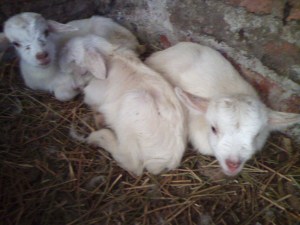
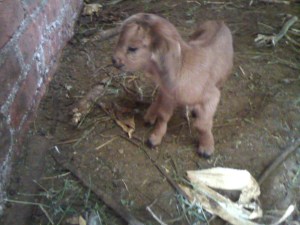
The deaths didn’t stop there. Later that afternoon, Pinta birthed a stillborn kid. We ended up on the plus side by the end of the day, though. Bunnie gave birth to itty bitty Brownie. Just a few hours later, Venada had twins–a boy and a girl, twice the size of Brownie.
Venada’s boy/girl twins are a day younger than little Brownie but look at the size difference.
Brownie gave us quite a scare about 2 weeks later. We had left the goats unattended for about 30 minutes while we went in for lunch. When my husband came out to check on the goats, he gave a holler. Brownie was in the water bucket up to his neck in water and unmoving, although still alive.
Drying Brownie off.
Having a friend visit to play.
Up and around again!
My husband wrapped him in a towel and sat with him in the sun. As he still didn’t show any inclination to move about, he brought one of the triplets that had befriended Brownie to nudge him a bit. About 45 minutes later, Brownie tried to get up. Whew!
It was about 2 hours before he could wobble around any. Now that the danger had passed, we puzzled about how this could have happened.
We think we have an assassin mama goat. The triplet that died, might have been killed. The stillbirth might have been caused by repeated stomach butting. Another triplet has a torn ear. And it just wasn’t possible that Brownie fell into the bucket. He would have fallen head first and that would have been the end of him. We think he was tossed through the air and landed in the bucket. And our probable suspect was Venada.
I’m all for ousting the murderer, but she does give healthy twins even though she goes overboard in her need for world domination. My husband agreed to keep an eye on her and since the bucket incident, there’ve been no new attempts on anyone’s life.
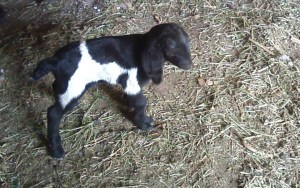
Finally, a month after we thought all the kids for the season had been born, Vaquita presented us with Skunk. He’s long legged, long-eared and oh so cute. She too waited till dark to give birth and had a bit of difficulty. The kid was big and this was her first baby. She’s also pretty skittish compared to our other goats, so didn’t like anyone close enough to give assistance and once delivered, didn’t want anyone near her baby. Of course, the dark coloring make Skunk hard to see and has been causing no end of grief for his nervous nellie mom. My husband separated Vaquita and Skunk in hopes that the assassin goat doesn’t have an opportunity to strike again.
When we did some additional paring down of the goats, Venada and her babies went up on the auction block. We just couldn’t have murdering goats around, even if there was a good probability of twins every season. Instead, my husband purchased Jirafa (Giraffe) and much to our delight, she presented us with twins.
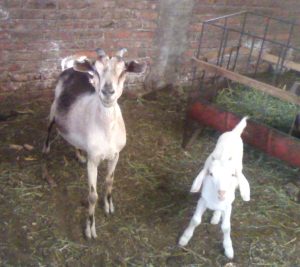
Jirafa and one of the twin daughters. She takes after her dad I guess.
The final assignment was entitled 10/10/100. In the next 10 days, devote 10 hours and $100 of my local currency and do something with what I learned. Then post it here. So here’s my first section of the assignment, to share with you what I have learned in this course.
What did I learn?
Each week focused on a specific aspect of permaculture. Week 1 defined the process. Week 2 concentrated on observing the current landscape. Week 3 highlighted design methods and the principles behind them. Week 4 listed specific strategies for applying permaculture.
What is permaculture?
Permaculture is the ethical creation of sustainable human settlements and food production systems that take into consideration the interrelationship of humans, plants, animals and the natural environment. You don’t see much of this happening these days, especially with the current movement to abolish the EPA. Mexico is even worse at this sort of environmentally conscious thinking, in part because of NAFTA. However, I did learn that there are pockets of resistance even here. Monsanto GMO crops are still officially banned in Mexico. Las Cañadas co-op in Veracruz is an organization dedicated to the education about and practice of sustainability. Mexico City has also been making efforts at urban gardens. Additionally, Mexico City still uses a limited number of chinampas (floating gardens) first developed by the Aztecs when they settled the region. Is it enough to counteract the damage unsustainable practices have caused? It hardly seems so.
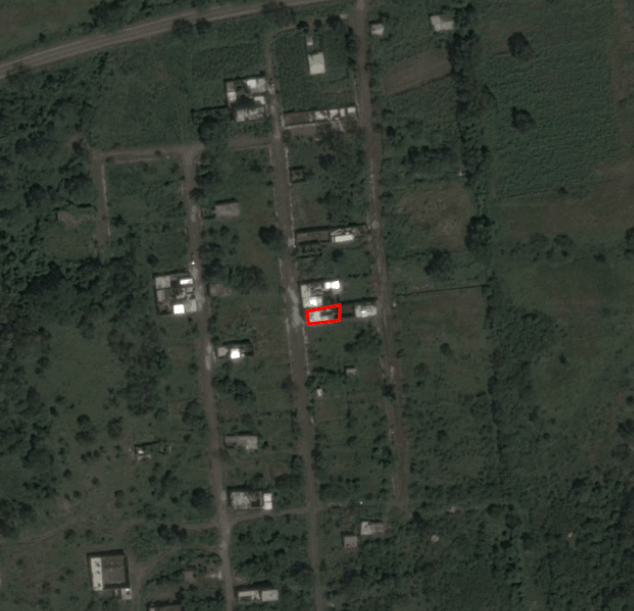
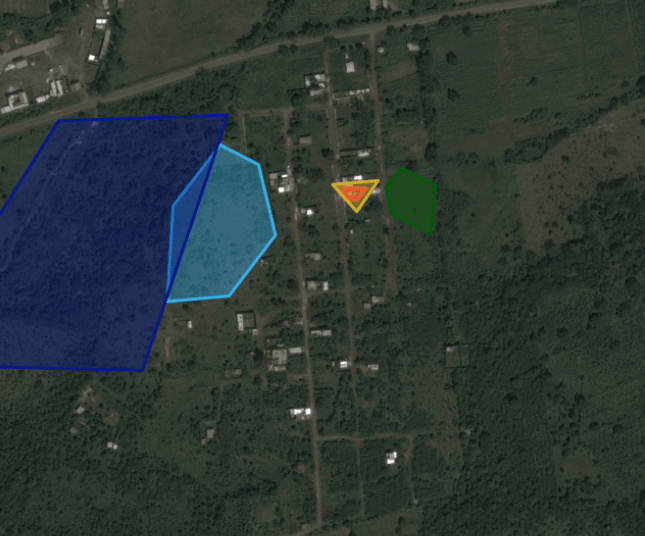
See that red rectangle? Yep, that’s us.
Where am I in the process of permaculture design?
Not far enough. I learned an important terminology distinction. I should not strive to be self-sufficient, but rather self-reliant. No single aspect of the ecosystem is self-sufficient but rather is part of the interdependent web of life. With that, my homesteading life goals have changed a bit.
As you know, La Yacata has a dry climate, except for the torrential tropical rains from June until September. As a result, the natural landscape consists of drought resistant plants, cactus, mesquite, and acebuche. The area had been cleared for cultivation of las tres hermanas (squash, beans, and corn) about 100 years ago. Most of the area has lain fallow for 20 years or more. There is no natural water supply despite claims to the contrary. Sounds pretty bleak doesn’t it?
It gets worse. It seems like the colonos (community members) are determined to exploit what there is to the point of complete environmental. Before the chicken feather guys constructed his pig/chicken compound, the upper part of La Yacata had wild orchids during the rainy season. Before the pig guy backed up the sewer system, the rain flowed freely from the hillside into the arroyo bordered by dense vegetation. (Have I mentioned that these two are in-laws?) We have others who come and cut down the mesquite to make charcoal to sell in town, removing an essential component of the ecosystem. There is no recognition of interdependence here.
Breaking it down even further, our green area is not as green as I would like. Currently, we have a lovely cherimoya tree that provides a good section of shade, as well as a blackberry bush gone wild, 2 guayaba trees, a pomegranate tree that finally is producing fruit now that the goats and chickens are contained on the other side and a lemon tree that is a bit stunted after last year’s blight.
We have a few smaller trees started, nispero, aguacate, papaya, durazno, capulin, and mango but it’s too soon to tell if they will flourish or die. Our new puppy likes to munch the lower branches and every now and then that rogue white hen escapes and eats the leaves.
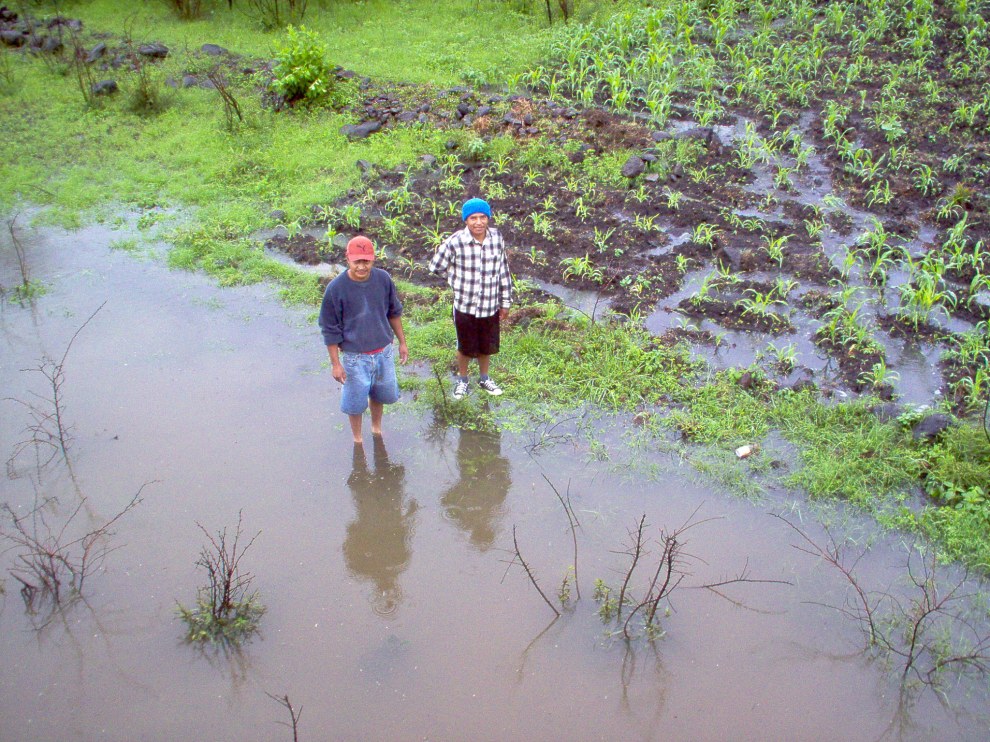
The rain water floods the area beside our house in the rainy season. We’ve had to add a run-off path.
Miss Piggy’s former compound is undergoing a transformation from wasted space to raised garden, although it didn’t work out so well last year. We catch and store our rainwater in the aljibe and tinacos. The rain runoff builds up on the right side of our wall and so we have a drainage path through the back yard.
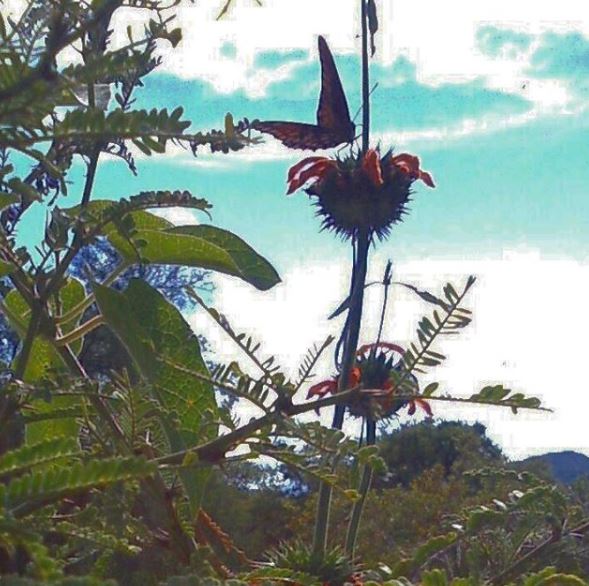
Klip dagga grows wild in La Yacata and attracts butterflies and hummingbirds.
I have big plans for our backyard this year, although it seems all my efforts are sabotaged. In addition to the animal issues, there are human issues. One year I transplanted a handful of klip dagga plants from under the mesquite down the road to our yard. They were doing well, sprouting up all over the place, and my son got annoyed and chopped them all down one afternoon. Sigh. I’m determined to make another attempt this year.
Red is our home zone. Yellow is our home orchard. Green is our farming zone. Light blue is the semi-managed zone. We managed with grazing the goats there. Dark blue is the wild where we forage.
How can I apply the techniques to my own situation?
Our goal for solar is right in line with these principles. We catch and store rainwater. We obtain a yield from both cultivated areas and wild foraged areas. We try to keep down our waste generation and apply self-regulation. We can improve on using the edges and marginal and the integrate rather than segregate principles.
How important is permaculture?
A number of the podcasters talked about the imminent crash of the ecosystem. Imminent as in the next 20 years. How did we get to this precipice? Daniel Quinn’s novel Ishmael chronicles our historic demise from the birth of agriculture to modern-day unsustainable farming practices. And yet there have been places where the utter desolation has been transformed into viable habitat in as little as 5 years.
After seeing these incredible examples of regeneration, it’s easy to agree with Bill Mollison, author of Permaculture Designer’s Manual, when he says “Though the problems of the world are increasingly complex, the solutions remain embarrassingly simple.” The solution is simply that more people need to identify themselves as “leavers,” those that live in harmony with nature, rather than “takers,” those that seek to dominate nature, if we are to survive this ecosystem crash as a species.
As for that 10 hours / $100 assignment I mentioned at the beginning–looks like I’m heading to the local tianguis (flea market) this weekend to pick up some more of those home grown, native plants the women in rebozos (shawls) sell. At $10-15 pesos per coffee can packed vegetation, I’m sure I’ll have the back yard on its way to permaculture in no time. It’s good for me, it’s good for the environment, and it’s good for the little old ladies.
Interested in learning more about permaculture? Check out these podcasts!