Natural Healing–Tamarindo

Have you ever wondered what those pod things were at the Asian or Mexican market?  Wonder no more.  Today, let me share what I learned about tamarindo.

The Tamarind (Tamarindus indica) tree is not a plant native to Mexico, but was brought by the Spanish and Portuguese in the 16th century and has since become an integral part of Mexican cuisine and traditional medicine.  It’s a slow-growing, long-lived tree that can be 80-100 feet tall with a trunk circumference up to 25 feet.  The evergreen feathery foliage is made up of pinnate leaves that fold up at night.  It has small 5-petalled yellow flowers with orange or red streaks.  The flower buds are pink.  It takes 80 to 90 years for a tamarind tree to begin producing fruit. The fruits are green pods or beans that ripen to a cinnamon brown color.  The outer covering becomes brittle and the pulp within dries to a sticky paste. The fruit begins to dehydrate in 203 days and reaches full ripeness in 245 days.  The fruit can be left on the tree for as long as 6 months after full ripening. (Morton, J. 1987. Tamarind. p. 115–121. In: Fruits of warm climates. Julia F. Morton, Miami, FL.)

Tamarindo fruit is high in tartaric acid, sugar, B vitamins, calcium, thiamin, iron, magnesium, niacin, vitamin C, copper, and pyridoxine.  Other antioxidants found in the tamarindo include limonene, geranoil (shown to inhibit cancerous pancreatic growth), safrole, cinnamic acid, methyl salicylate, pyrazine, alkylthiazoles.  Its high content of malic acid, tartaric acid, and potassium bitartrate make it an excellent treatment for constipation, which you may want to remember should you be tempted to eat large quantities.  

Tamarindo has also been used traditionally as a treatment for stomach discomfort, diarrhea, parasitic infections, dysentery, helminth infections, malaria cell cytotoxicity, used as a gargle for sore throats, mixed with salt and made into a liniment for rheumatism and arthritic inflammation.  It’s been used for Datura poisoning, alcoholic intoxication,  liver toxicity, and sunstroke.  It has also been recommended as a daily drink for those suffering from thyroid disorders and as a way of fluoride detoxification.  The dried or boiled leaves and flowers can be made into poultices for swollen joints, sprains, boils, hemorrhoids, gonorrhea and conjunctivitis. The roots and bark are boiled in an infusion for chest complaints and as an ingredient in treating leprosy. In one study, the seeds have shown improve glucose homeostasis in rats with streptozotocin-induced diabetes mellitus, which may lead to further studies as a treatment for diabetes in humans.  In another study, the bark has been shown to possess blood glucose lowering effect along with antioxidant effect and protective effect on renal complications associated with hyperglycemia.  In yet another study of hens fed tamarindo as part of their daily diet, it has been linked to lower cholesterol in the hens’ serum and egg yolks leading to the speculation that similar results could be obtained in humans. (Top 15 Health Benefits of Tamarind and 30 Health Benefits Of Tamarind and 7 Amazing Benefits Of Tamarind)  I could go on and on as to the health benefits, but I think you get the picture.

Are there any safety concerns about tamarindo?  Yes, there are.  As I outlined above, the ingestion of tamarindo has definite effects on the body.  If you have certain conditions, tamarindo may make your condition worse.

As it lowers blood pressure, it may increase bleeding when taken with aspirin, ibuprofen, blood thinners, and anti-platelet drugs.  As its ingestion reduces serum glucose levels, diabetics who are already taking drugs for lowering their blood sugar level should be careful to not eat too much.  As with any food, you may have an allergic reaction.   Excessive quantities of tamarind may damage the enamel of your teeth.  Frequent ingestion of huge amounts of tamarind can promote the formation of gallbladder stones.  If you have gastroesophageal reflux disease (GORD) or ‘acid reflux’, you should stay away from it since it will probably increase the acid in your stomach. If you are taking any sort of vasoconstrictor you need to know that tamarindo is known to add to the vasoconstricting effects by accelerating the process of narrowing of the blood vessels. If you are using any ophthalmic antibiotic on your eyes topically, avoid tamarind intake as it will interact with the cream. (Top 10 Side Effects Of Tamarind) So moderation is the key.
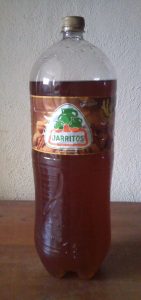
Just one of the many tamarindo products found in Mexico!

So how do you eat it? Maybe the correct question is how don’t you eat it?  The fruit can be eaten raw right off the tree. Wherever you go here in Mexico, you can find tamarindo candy dipped in chile, tamarindo balls, tamarindo candy that comes out of its containers like a  playdoh barber shop toy, tamarindo fruit roll-ups,  tamarindo juice, tamarindo soda, tamarindo Tang, tamarindo salsa, tamarindo on a plastic spoon,  tamarindo margaritas, tamarindo lollipops,  tamarindo marinade, tamarindo gummies,  tamarindo nectar,  tamarindo popsicles, tamarindo hard candy, tamarindo soup, and many more delightful and savory uses.  (Recetas de Tamarindo).  Would you believe that it’s also found in good ol’ Worcestershire sauce?  

Although I can get agua de tamarindo from the same tricycle market vendors that sell jamaica and horchata, I thought I’d try and make my own. Here’s how that went.
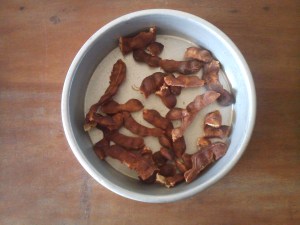
I picked up some dried pods at the market.  Then I cracked and peeled them.  Because of the stickiness factor, it was a bit more difficult than peeling a boiled egg.  I soaked them in water for about an hour.  When the pulp was soft, I removed the seeds and mashed the pulp with my fingers.  That part didn’t take very long.  After that, I added more water and strained the concoction to remove any large lumps and fibers. Add sugar to taste and ice and it’s ready, the perfect refreshing summertime drink!

I kept the seeds and have planted them.  I’d surely like my own tamarindo producing tree (in 80 or 90 years)!

Tamarindo has other uses as well.  Tamarind lumber is used to make furniture and carvings.  The fruit pulp is used to polish brass statues and lamps, and remove the tarnish from copper, brass, and bronze items.

The word itself also has some distinctly Mexican uses as well.  Tamarindo is sometimes used to insult los transitos (traffic police) probably first begun as a commentary about their brown uniforms.  My husband has also said that among hombres (men) tamarindo can be used to imply someone is stupid or an a**hole.  So perhaps it’s not a word you can throw around lightly in some parts however delicious the fruit!

*********************************
5 Comments

Filed under Health, Mexican Food and Drink, Native fauna and flora, Natural Healing

Transition year

mototeacher

If you recall, a few months ago, I outlined my busy work schedule (Juggling all the eggs in one basket) and wondered if really these things were worth the effort I was putting into them.  I decided shortly thereafter that they were not.  Thus began the transition year.

The first to go was my Saturday classes. (See Saturday classes)  Some days I had been pulling in a whopping $600 pesos, but more often, I had a single class.  $50 for a 6 hour day was not profitable.  So when my student finished the book we were working with, I told his mother that I was going to take a break from teaching on Saturdays.  She and her 8-year-old son were disappointed, but I consoled them that I may start up again in the Spring.  The uncle, who had been my student but gave his hour to the nephew, sent me an email demanding to know why I wasn’t going to teach English anymore.  I explained that I was still teaching English, just not on Saturday mornings.  I had too many other obligations and I needed more time to do things like laundry and shopping.  He wasn’t happy.  Oh well.  Can’t please everyone.

I still taught online Saturday afternoons, but I wanted to transition to my new place in Sunflower Valley (See A Room of Her Own).  It took over a month, but I finally was able to make the little house my base of operations rather than the school.  Having a kitchen made the afternoons easier.  There’s a little store across the street, so whipping up a light meal for a hungry teenager boy was more manageable.

Then I started dropping my afternoon private classes one by one.  The first to go was in mid-November.  We finished our book and that was that.  She begged and pleaded that I not abandon her.  I told her that I’d start teaching in the spring but that if she really wanted classes, she’d have to come to my little place in Sunflower Valley.  She said she would. We would see.  That freed up 2 hours a week.

Then in December, right before Las Posadas, I dropped the other 3.  All of them said that yes, it would be a good idea that I took a break, but that they didn’t want to lose their classes.  Maybe I could drop everyone else, and just teach them?  When I said that I really was planning an extended break, like maybe until Semana Santa, their eyes went wide and said, well, they’d be waiting here for me to return and give them classes again. That freed up 2 afternoons per week.

I didn’t start teaching afternoon classes after Semana Santa. Instead, I began going through my things at the school, readying it for my final transition.  I reviewed the supplementary books I had made for each grade level for errors and changes.  I also checked that there were assessments and exams and grade sheets for each unit of all 6 levels.  I would be leaving the entire system in place for whoever takes my place.

Finally, in July, I told the owners that for health reasons I would not be returning the following school year.  It’s not that I hated my job at the school.  After all, I had designed the entire ESL program myself.  I was getting some results, not as much as I would have liked, but some.  I had my own classroom, which is a rare perk in the schools around here.  Yet, at $65 USD per week, it was not in my best interest to continue. The health problem wasn’t invented.  I’m really working myself to death at this rate.  

I interviewed and recommended 2 teachers, one for first, second and third grade, and the other for fourth, fifth and sixth grade.  Yep, two teachers were needed to replace me.  I agreed to do a training session with them in August before everyone returns to classes.

The owner asked if I would consider staying and teaching at least 2 groups or at least the phonics classes since the main focus is pronunciation there.  Nothing doing.  I would, however, make a book for the sixth-grade group for the new teacher to use.  And if I got around to it, make a recording for the phonics books.

My first schedule with my newest online job came out the week after we finished classes.  Twenty-six hours paid in US dollars.  So provided I have a full schedule each week (and with online work nothing is a given) I’ll nearly triple my income for half the work and less than half the time.  

Hasta la vista baby!

*************************

disclosure

6 Comments

Filed under Education, Employment, Teaching

And the winner is….

My first sponsored contest ended on Monday.  There were two winners, fittingly enough one from the US and one from Mexico, who won on the basis of being the two highest scorers on the Surviving Mexico social media “test.”  I’m still waiting to hear back from dangerks to send out your prize. Please check your inbox. 

Here are the answers to the “test.”

Captura de pantalla (57)

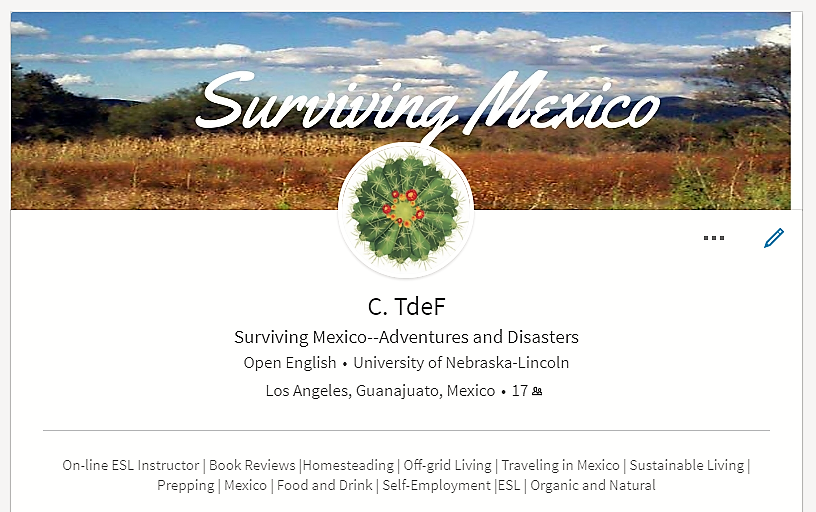
Question #1–Where does Linkedin say that I am located?

Answer: Los Angeles, Guanajuato, Mexico

I know I don’t live there.  You know I don’t live there.  But for some reason, Linkedin insists that is where I live.  I’ve tried changing it, but to no avail.

Captura de pantalla (49)

Question #2–How many boards do I have on Pinterest?

Answer: 39

Captura de pantalla (50)

My most popular boards are Mexican Revolution, Women in Mexico and Mexican Food and Drink.

Captura de pantalla (51).png

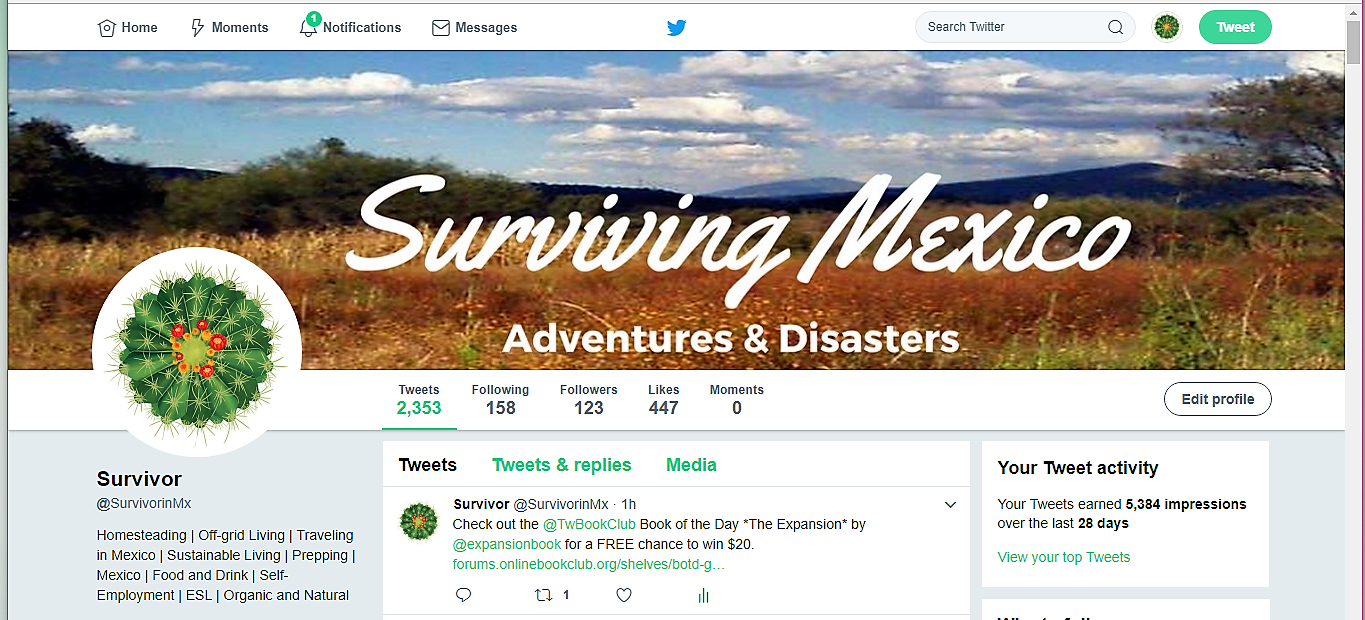
Question #3–How many people am I following on Twitter?

Answer: 156 (although it seems I followed 2 people without knowing about it)

Twitter is not my favorite social media network.  The instant updates distract me, so I end of turning off my notifications and just checking in once a day when I do my Book of the Day tweet.

Captura de pantalla (53)

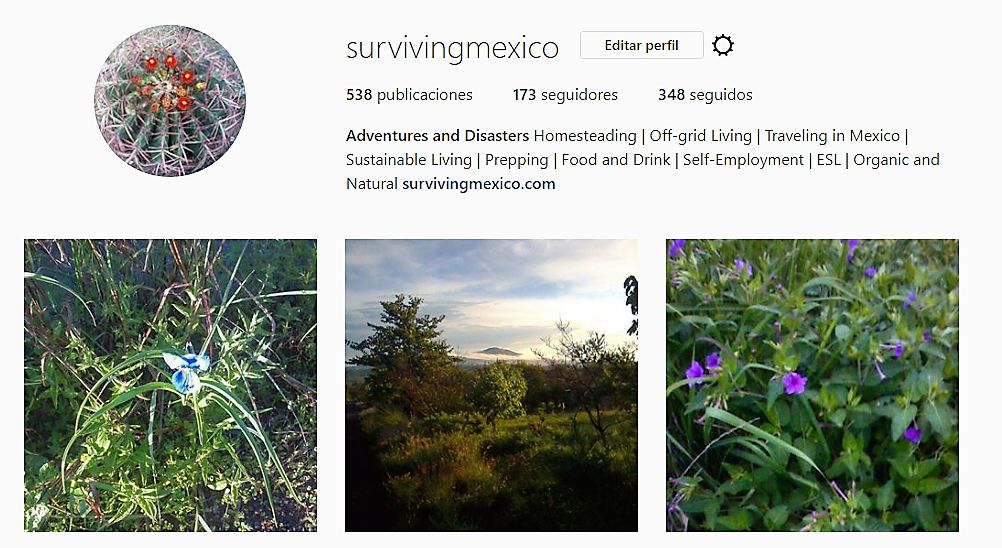
Question #4–How many posts do I have on Instagram?

Answer: 535

I forgot I was running this contest and started posting again at the end of the month so the actual number is 538 posts.  Isn’t Mexico lovely?

Captura de pantalla (54)

Question #5–What is the category of my Facebook page?

Answer: Local & Travel Website

The category was selected by the process of elimination.  I am not featuring famous people, nor am I running a business, so tourist page it is.

Captura de pantalla (55)

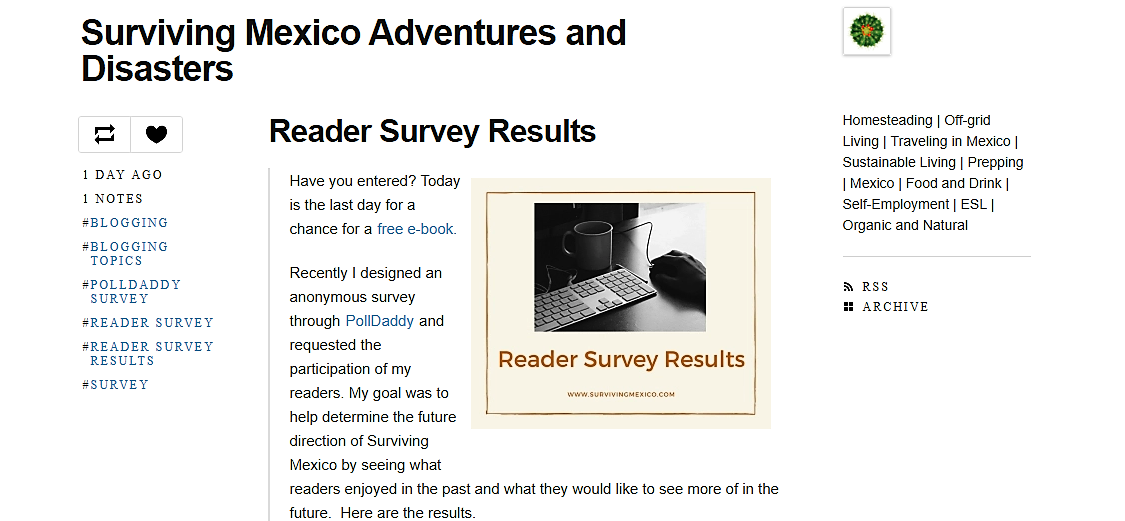
Question #6–How many classifications do I have in the About section on Tumblr?

Answer: 10

My presence on Tumblr has been a struggle for me. Maybe if I post more boob shots?   

Captura de pantalla (56)

Question #7–How many drop down menus do I have at the top of my WordPress site?

Answer: 5

As of right now, I have 4.  Amazon suddenly stopped offering its astore option and so I just deleted it from my header.  


And there we have it, folks.  Miss Fabi chose Dizzy in Durango as her free ebook.  Congratulations Miss Fabi!  Thank you for participating and stay tuned for another contest in 2018! 

******************


1 Comment

Filed under Blogging, Book Reviews