Hopefully, in the days to come, the world will be less interested in hoarding toilet paper and more focused on creating a healthier lifestyle that can withstand the viruses that plague us. One often overlooked source of important vitamins and minerals is the mushroom.
Mushrooms have the same quantity of B-12 as meat. They contain linoleic acid, one of the two essential fatty acids that humans must get through their diet. They are a source of ergothioneine which has a powerful antioxidant. Mushrooms support your body’s healthy immune and inflammatory responses by improving the formation of the adaptive immunity system which eliminates or prevents the growth of pathogens. They also enhance the functionality of immune cells.
You can find more information about mushrooms and immunity here.
Would you like to learn more about mushrooms? Well, since you’re most likely in quarantine, why not consider an online class that explores the health benefits of mushrooms while you practice your social distancing skills?
The Herbal Academy has just opened The Mushroom Course for pre-registration. By registering now, you can save $50 on the regular course price and receive some great bonus offers as well. An optional upgrade will get you the Mushroom Foraging Kit so that you can set out and explore the wonderful world of mushrooms in your own area.
The Mushroom Course will help you discover 20 common wild mushrooms that you can begin to include in your diet to boost your immune system. You’ll have the chance to explore the ecological relationship mushrooms have with the world and how that means a healthier place to live for everyone.
This is an introductory to intermediate level course, so don’t worry if you haven’t studied much about these fascinating fungi before. It’s designed to allow you to become more familiar with their identification and biology and incorporate mushrooms into your healthy diet.
Why not use this time you have been given to learn more about immunity and your diet?
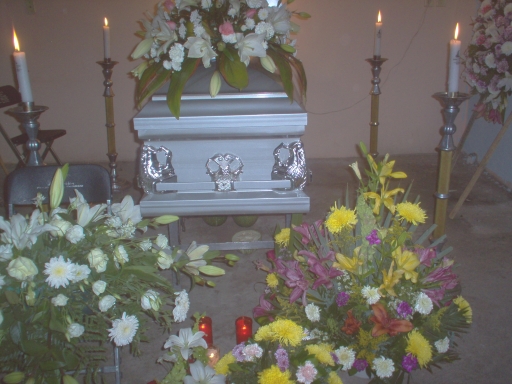
Last week I convinced my husband to head to a funeraria (mortuary) to ask some questions about funeral services. It’s not like I’m planning on dying anytime soon, but death comes to us all and I wanted to be a little better prepared in case next time I had to make the arrangements.
I learned there are lots of integrated pieces involved in being buried in Mexico and that you will be charged for each and every one of them. The particular funeraria that we visited has a sort of burial insurance that can be purchased for 800 pesos per year.
The package included:
El ataúd de madera (basic wooden coffin) or la urna básica (simple urn)
120 sillas para el velorio (chairs for the wake)
2 arreglos de flores (flower arrangements)
70 piezas de pan ( sweetbread pieces)
40 sillas para la novena (chairs for the 9 days of prayer)
Los spots de radio (radio announcements informing the general public of the funeral times)
Traslado del cuerpo (transfer of the body from home/hospital to where the wake is held to the church for mass to the cemetery for burial or to the crematorio)
Ayuda con los tramites (help with the documentation)
Of course, if I don’t die for 40 years, the funeraria gets a grand total of $32,000 pesos. So I decided to ask about the individual costs of the items. The following prices are estimates for 2020.
An average coffin costs about $14,000. An urn for cremated ashes costs approximately 800 pesos. If you have the seguro (insurance) but want a different urn or coffin than the one included in the plan, you pay the difference in price. If you wish to be cremated, you still have to rent the coffin for the wake.
Cremation can be done locally in our area, so it ends up being less expensive of a service than it might be in other areas. A funeral service with cremation will cost about $10,000.
The average funeral service with the velorio and novena in the home costs about $6,000 plus the coffin, not including cemetery and church service fees. If the velorio and novena are to be held in la sala de velatorio, also known as la sala de velación o velorio, then there is an additional rental fee for the space.
In order for a funeral to proceed quickly, and since embalming isn’t commonly done here a quick funeral is better, a coroner needs to sign off that the person is actually dead. If the person died in the hospital, then the last attending medical personnel typically handles the paperwork. If the person dies at home, then the funeraria has someone on call to take care of examining the body.
The funeraria may or may not “arreglar” the body. When my brother-in-law died, the funeral guys only dressed the body because I didn’t give them a chance to say no and I sure wasn’t going to do it. I did provide the clothes though. On the other hand, my mother-in-law was coiffed and make-upped so much that she didn’t even look like herself. Again, the clothes were provided. Both Mama Vira and my mother-in-law had specially made “santa” dresses. You’ll need to pay about $200 pesos to seamstress for that as well.
In the event of a violent, suspicious or sudden death, and in case of a miscarriage, the body is often taken for an autopsia. The medical examiner on site conducting the autopsy will fill out the paperwork. The funeral home typically takes care of transporting the body to and from the autopsy site, which in our case is more than an hour away in Yuriria.
When our nephew’s murdered body was found, his autopsy was done in Celaya, three hours away, since it was part of an open criminal investigation. The paperwork was not ready when the funeraria came for the body, so someone had to return to pick it up the next day. Nothing could advance in the funeral procession procedures without that paper.
When my husband’s cousin miscarried at my mother-in-law’s funeral, the fetus was taken to Yuriria for an autopsy to ascertain that she hadn’t intentionally aborted the baby since abortion is still illegal in most of Mexico. She had to wait two days before they returned the little body in a shoe box for her to take back to Cerano and bury.
This paperwork is essential in order to have the Acta de Defuncion (death certificate) drawn up in el Registro Civil (Civil Registry). Other paperwork involved that the funeraria will help you with includes getting permission for burial in the cemetery or cremation orders.
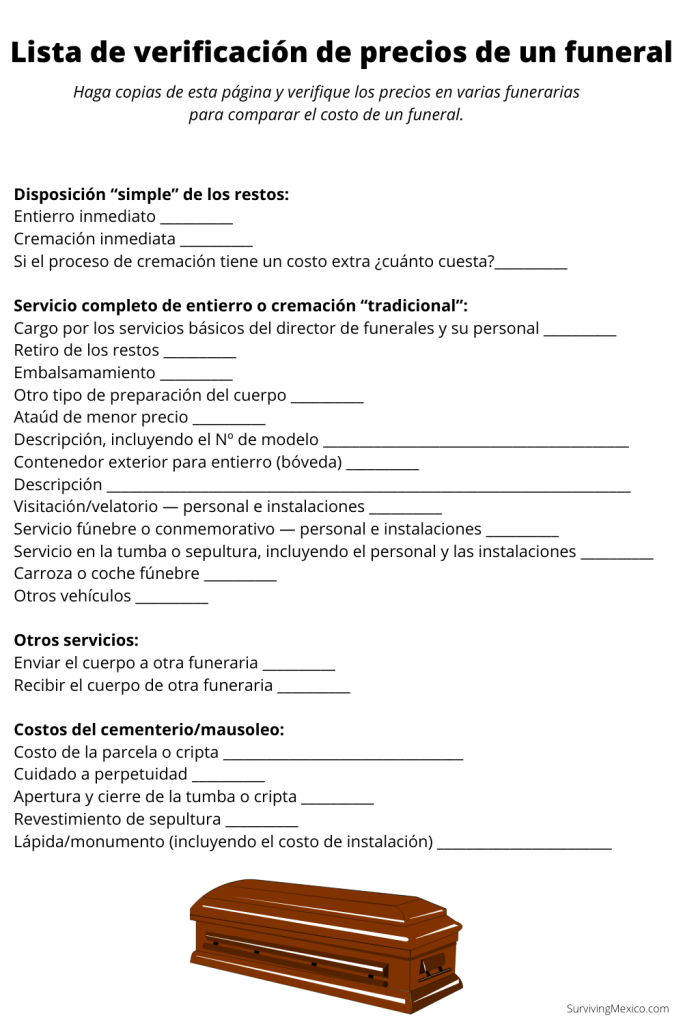
Estimating expenses we now know that a funeral service with casket will run you about $20,000 pesos if you hold the services at home and a cremation service about half that at $10,000. If you shop around, you may be able to find a less expensive setup. You can use this checklist if you like.
If you remember, one of my goals for 2020 was to finish the front of the house. There are several small projects that need to be done for that to happen, one of which was the adornment of the chimney face.
My husband had a bee in his bonnet that he wanted to use what he called “pasta” to make a design. So we spent nearly three fruitless weeks looking for a place that sold pasta. Every place that we were referred to had gone out of business it seemed. Finally, we found a ferretería that sold this pasta–which is actually called PegaDuro Piedra en Polvo.
Examples of molds. We wanted the top one.
In order to make the design, you need a mold of some sort. The PegaDuro spreads on with a play-dough like consistency, then the mold is pressed into it while it’s still wet to make the pattern. We looked through the catalog and picked a color and molding design.
Of course, when the supplies were delivered, the ferretería had sent some sort of texturing device instead of a mold. Back to the store we went. It turns out, the piece we had paid for was the texturing thingy, not the mold. The mold would cost $1,500 pesos and they didn’t even have the design we wanted. My husband was having none of that.
He decided that he’d make his own mold and he wanted to use my bath. I objected. Then he said he’d use the car mat. I was still making faces at the idea. Finally, he said we could get a tile piece and use that as a mold.
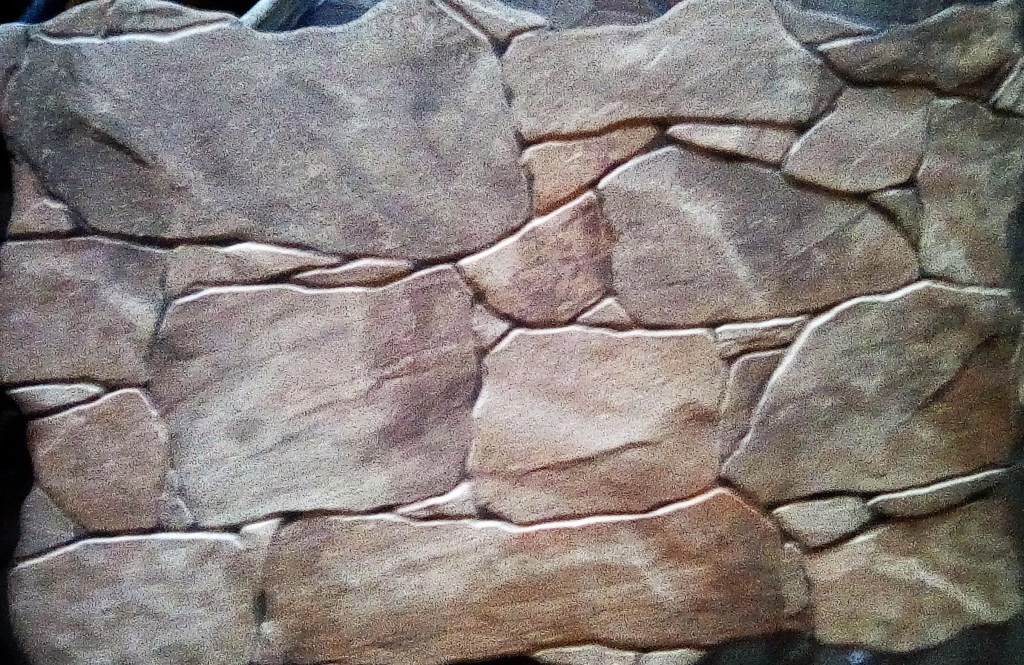
This is the design I wanted.
We went to the tile shop and bought one tile for $83 pesos. I wanted to tile the section to begin with, but my husband said it would cost over $2,000 pesos just for the tile plus we’d have to get the grouting and adhesive and stuff. My second suggestion was that he use rocks from around La Yacata. There are plenty of those, it would be free, and I already know he can do a fabulous job based on our two fireplaces. Nope, pasta it would be.
Well, the tile didn’t work as a mold. As I mentioned, the consistency is like play-dough, so it just stuck to the tile. While my husband was hemming and hawing, my son decided to try and draw a pattern with a stick. I have to say, it didn’t turn out too bad. It’s not exactly what I had in mind, but I suppose it will do. I also noticed that the very top of the chimney seems a bit lopsided, but I think I won’t mention that at all.
Currently, the three of us are in a heated debate about what color to paint the house, so the next step might take awhile.








 Surviving Mexico