
Tag Archives: working in Mexico

Getting Legal–Working Papers

paperwork lady

Just so you know, I have been working most of the 7 years I have lived here, but apparently not legally. It was easier for me to obtain my permanent residency through a dependent status, as there is no minimum income requirement. But this year, feeling frisky, I decided to tackle the work permit business.

When I went to pick up my residency card (See Getting Legal-Trip 5) I asked at the desk what I needed to do to work legally now. The clerk printed out a little paper and said that I would need to fill out electronically the form “notificacion de cambio de lugar de trabajo” (job location change notification), then write a letter indicating the change bajo de protesto de decir la verdad (swearing to tell the truth) and return to the office with my residency card and a copy. I had to ask a second time if that was all, just to be sure. That seemed so easy–it had to be a mistake. The clerk emphasized that it needed to be done within 90 days of the change. Okie Dokie.

However, when I applied for a job teaching English at a private elementary school, that was a horse of a different color. I sent my diploma, notarized, apostillado (apostille), and traducido por un perito traductor (translated into Spanish by an authorized agent) that indicated that I had a Bachelor’s in Science in Education with specialties in English and English as a Second Language. Who better qualified to teach the children of México but me, I thought.

But my own high opinion and a Bachelor’s degree weren’t enough for SEP (Secretaria de Educacion Primaria). I received, with my rejection letter, a list of 10 requirements and a request for payment in the amount of $758 pesos, plus 11 pesos for each document sent, to re-evaluate my documents.

I was requested to send:

1–Formato de Solicitud original (a form requesting my reevaluation)

2–Acta de nacimiento original y copia, traducida y apostillada (birth certificate with an apostille and translated into Spanish and copy)

3–Pago de derechos clave 85-20 (payment to the state of Guanajuato)

4–Pago Correspondente (the $758 and 11 pesos per document)

5–copia de CURP (copy of my identification number issued by federal government)

6–Documento original y copia oficial que acredite las calificaciones finales de los grados a revalidar apostillado y traducido (the original and a legal copy of my high school transcripts translated and with an apostille)

7–Titulo o diploma original y copia del grado a revalidar apostillado y traducido (High School diploma and copy, translated and with an apostille)

8–Documento original y copia migratorio que acredite al legal estancia en el país (my permanent residency card and copy)

9–Certificado original y copia o Diploma de Bachillerato cuando los estudios a revalidar sean de nivel Licenciatura apostillado y traducido por un perito autorizado (my diploma from the University with an apostille and translated into Spanish by an authorized person)

10–Plan y programa que ampare los estudios realizados en el extranjero original y 2 copias traducidas (my college transcripts and 2 copies translated into Spanish)

What the….? Not even immigration asked for so much documentation. I was upset and asked around to see if it was just because I was not born a Mexican–and yep, it was.

Obtaining even this information was as difficult as prying state secrets from a loyalist. I honestly was perplexed at what SEP was requesting, as in my opinion, a diploma from a University was sufficient proof of my qualifications. So I asked around, specifically currently employed English teachers or people working at Universities that might know a foreign-born English teacher. Some didn’t respond. Some said they would get back to me. Some said that I needed to fix my own problems myself. These same people who didn’t hesitate to call me up when they needed to cram for the IELTS, Trinity or TOEFL exams, or had a question about U.S. Social Security benefits, or who sent me desperate people with difficult U.S. questions who then never paid me for my time or effort. These people I thought were my friends! Silly me.

So then I asked the Spanish teachers for information and discovered the astonishing fact that most teachers here in México have never attended a University to become teachers. The law requiring a University education is quite recent, hence teachers who did not attend a University are allowed to continue teaching because of their years in the field are seen to be the equivalent of actual studies. Newer teachers who have not completed their studies, often use a diploma prestado (borrowed) from someone who has completed his or her studies.

But not me, noooo. I would have to complete these requirements and take them to Guanajuato personally in order to be given a teaching position.

**************************

disclosure

3 Comments

Filed under Employment, Getting Legal, Teaching

Cultural Stories and myths–Relative value

market
Once upon a time, a vendedor (merchant) en el mercado (marketplace) was complaining  about poor sales. The head merchant happened to hear his lamentations and approached. He gave the vendedor (merchant) a jewel and told him to go and sell it, however, he must not sell it for under $2000 pesos.
jewel

So the vendedor (merchant) went up and down the mercado (marketplace) looking for a buyer but without success. Some wanted the jewel but offered less than the $2000 minimum, so the vendedor (merchant) was forced to decline, as much as he wanted to sell. At the end of the day, he returned discouraged to the head merchant.

The head merchant told him that he should go to a joyeria (jewelry store) tomorrow on the other end of town and offer the jewel to him. Though skeptical, the vendedor (merchant) agreed.

jeweler

The next day, he presented the jewel at the joyeria (jewelry store). The jeweler examined the jewel at length and in silence. Finally, he told the merchant that even if he sold everything in his store, he would not have enough to buy this rare jewel from him, but that if he came back later in the day, he would see if he could raise enough money to make the purchase.

The vendedor (merchant) was overjoyed and gladly agreed to come back later. The final price was many times the original asking price.

A teacher I worked with told me this story one year when I was working at a school that didn’t value my efforts. She said that I was that rare jewel and that only someone with expertise would recognize my real worth and then when that happened, I shouldn’t settle for less like I was at that time. (See Learning and Teaching Year 5)

As much as I enjoyed this fable, it is a hard truth to live by here in México, for both myself and my husband. I have finally found employment where I am valued and although my salary is low at the moment, I wouldn’t work anywhere else.
job wanted

My husband has not been so fortunate. His abilities to build pretty much anything with brick or stone are without equal in the area. He charges $250 per day (which is about $22.00 U.S. dollars for an 8-10 hour day) and he is unable to find work. He thought he might get the job for the new building that is being built right next door to us, but the owner said his price was too high. He offered to work for $220 pesos a day or to do the job for a set sum. The owner offered $5000 pesos for the entire structure. My husband declined and the owner found someone that would work cheaper.This isn’t the first job he has lost to a cheaper bid. Some have come to regret giving the job to someone else. For example, the house up on the hill, owned by a pair of elderly sisters, was begun but not finished by my husband. The owners remarked to a neighbor that the second albañil (bricklayer) didn’t compare at all to the quality of work of my husband, although he came at a reduced rate. Well, that’s nice to know and all, but that doesn’t make the search for relative value any less discouraging.

**********************

1 Comment

Filed under Employment, Mexican Cultural Stories

Failing at your own business–Tianguis Flea Market

tiangus cerano

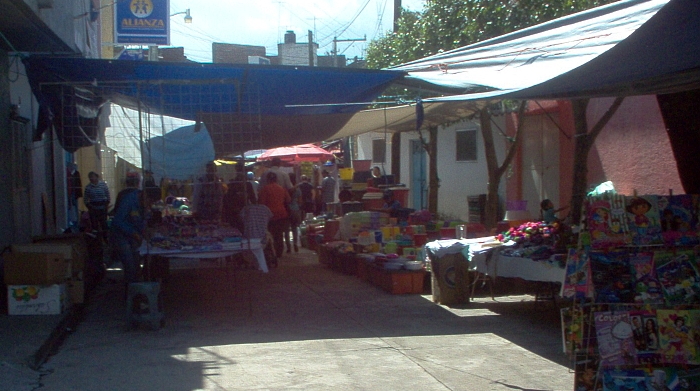
The tianguis in Cerano.

My son has a birthday coming up and we thought to rework his room to reflect his almost-a-man age. So he and I went through his things and took out the younger stuff–like the Bob the Builder suitcase, the Spidey posters, the itty bitty reclining chair and the like, to make room for other more manly decor. But, as funds are tight, we needed to sell the rejected items to buy other items. This meant a trip to Cerano for the Sunday tianguis (flea market).

So we loaded up the truck and headed out early Sunday morning. My husband secured us a puesto (spot). It was a pretty good spot, right next to the ice cream store at the corner of the callejon (alley) that goes to the church. We were up on the bridge that crosses the arroyo (open sewer drain), so by 2 pm the smell was a bit strong, but by then we had done all the business we had hoped to and more, so we left.

The first to greet us after we had our puesto assigned was Cowboy. He hangs about the tianguis asking for handouts and helping merchants unload for a few pesos. Although I hadn’t been to Cerano in over a year, he remembered my name and rushed over to help us unload. My husband gave him 10 pesos for his efforts.

Business was slow but steady in the morning. I let my husband do all the negotiating and just kept an eye on the merchandise. It isn’t like a yard sale, where the prices are ticketed and you pay the price on the ticket. An interested person asks the cost of the item. My husband responds with a price. The potential buyer thinks it over. My husband asks what price would be acceptable. The potential buyer names a price substantially lower than the proposed price. My husband responds with a negative and then points out the special features of the object of interest. Then he names a price 10 pesos lower than the original price. The potential buyer may name another price. My husband may say ‘ni para mi ni para ti’ and offer a different price. This continues until they agree on a price or my husband says the price they want to pay is too low and the deal ends. Occasionally someone walking by will hear the price my husband names and snatch the object at that price, stealing it away from the negotiating buyer. It’s all the same to us.

carnitas de res

Carnitas de res, a speciality from Cerano.

After misa, (mass) things started to get busy. While my husband did his salesman thing, my son and I went to the carniceria (butcher shop) that sells carnitas de res (fried cow pieces). Carnitas are typically made from pig and are not on my list of favorite things to eat, but these carnitas de res make going to Cerano something to look forward to. My husband bought tortillas from the 13-year old son of his cousin who died last year from inhaling light bulb filaments (I’m still not sure I understand that) and we chowed down.

Oh, did I mention that my husband is from Cerano? Cerano is a small town about 30 minutes from Moroleón and as different as being on Venus. The population is said to be about 4,000 and most of them I swear are relatives of his. Well, look that the logistics. My mother-in-law came from a family of 9 children, children of Mama Vira and Papa Rique. Her father Papa Rique also had a lady on the side who had 9 children. My mother-in-law had 11 children, although none live in Cerano at the moment. Her sister Lucia had 9 children, all of which live in Cerano. Her daughters all have 3 children each, some of which live in Cerano. My mother-in-law’s other sister, Tía Lena, the dwarf who owns the bar, has 4 daughters who have a variety of children. Another sister, Tía Jesus (yes, Jesus) has 3 girls. Basically, a good portion of the town reflects my husband’s features, some so closely that at a distance I have mistaken identity. One day, one of his cousins was at the house of the relatives that we were visiting, but without a shirt. I went to scold my husband for taking his shirt off, when I realized, just in time that this person was quite a bit younger than my husband, and wait, wasn’t him at all.

My husband, having lived there until he was 13, can identify and tell the stories of nearly all the residents. One man came along and wanted to buy a palo (shovel) because it would be useful if he were attacked. I thought this was a bit strange until my husband explained that this man was the uncle of Cowboy. OK. All in the family right?

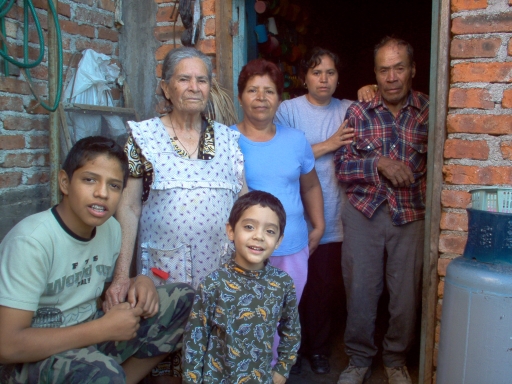
cerano gang

From left to right– A, Mama Vira, my mother-in-law, Tia Jesus, Papa Rique and my son in the front

Mama Vira, Papa Rique and Tia Jesus stopped at our puesto to visit with us. We shook hands all around–our customary greeting. They looked over our things. My husband gave Mama Vira $20 for tortillas and I gave Tia Jesus a flowered comforter that we had out to sell. They shook hands all around again and left, happy with the day’s acquisitions.

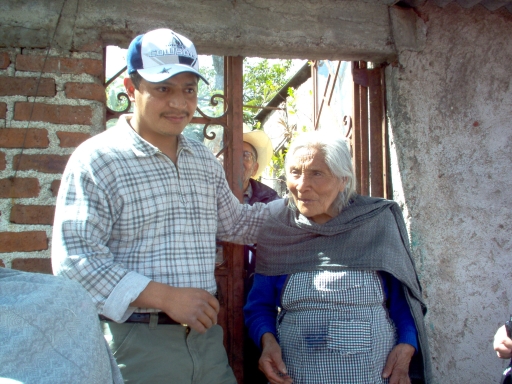
cerano gang 2

My husband and Mama Sofia with Tío Felipe lurking in the background

Mama Sofia, the mother of my husband’s father, also passed by. She greeted me amiably enough on her way to buy meat for lunch, but wouldn’t look our way on the way back. Seems she hasn’t forgiven my husband for nearly choking the lights out of her husband, Tio Felipe (not the father of my father-in-law Porfirio who died after being kicked by a burro some 50 years ago) after Felipe had given her a beating. Felipe has tried various times over the years to murder Mama Sofia. I think she recovers out of spite.

Well, sales went well overall. We had $600 take home after paying for the puesto, cleaning fees, ice cream, carnitas, the family handouts and gas for the truck, which is more than I earn in 2 days teaching. It doesn’t pay to go every week, but once every few months is a nice afternoon’s work. Now on to remodeling.

*********************

disclosure

9 Comments

Filed under Employment