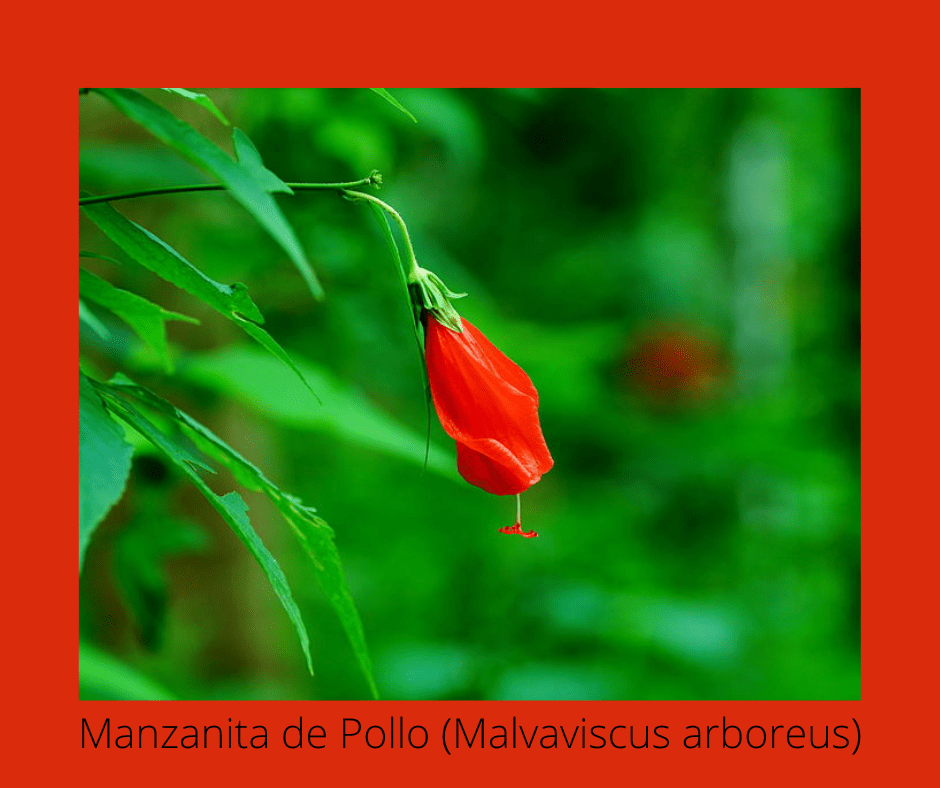
Manzanita de pollo (Malvaviscus arboreus) is a type of mallow related to the hibiscus, with red blossoms that never open completely. These native Mexican beauties are a favorite of hummingbirds. The flowers, fruits, and leaves can be used in the preparation of jellies, herbal dyes, and salads.
Other common names include tulipán (the generic name for most varieties of hibiscus flowers), chocho, Obelisco de sierra, altea, chay or chey in Oaxaca state, x-bizil in Maya, thoot huitz in Teneck, sibil in Tabasco state, tlalsomplilt in Tepehua, ixwaqult in Veracruz, tz´oban pox in Tzotzil and atlatzompilili or tzopelchichilxóchitl in Náhuatl. In English, common names include Turk’s Cap, Sleeping Hibsicus, and Wax Mallow. Botanical synonyms include Malvaviscus mollis and Malvaviscus acapulcensis.
The flowers ooze a sticky sap which is rubbed on wounds and canker sores. Several sources also include applying macerated blossoms to measles blisters. The flowers, stems, and leaves are also made into a gargle for tonsillitis and drunk as tea for gastrointestinal issues.
In Chiapas, whooping cough, known as tos ferina, a flower and leaf decoction is administered, sometimes with the addition of ground armadillo shell. In Veracruz, the same ailment is treated with bee pollen and honey boiled with manzanita de pollo flowers with the addition of bugambilia morado (Bougainvillea glabra) bracts, dried and ground hormigas chichimecas (ants), and powdered bitter orange seeds (Citrus × aurantium). For a particularly nasty cough or tuberculosis, a tea made from the flowers and leaves is given which can be sweetened with honey and flavored with sauco (Sambucus mexicana), cinco negritos (Lantana camara) or young durazno (Prunus persica), ciprés (Cupressus), or chicoria (Cichorium intybus) leaves.
For urinary tract infections, a root is cut in half, ground, and then boiled over low heat in a covered container until it is reduced by half. It is left uncovered overnight to catch the morning dew. The following day, the resulting beverage is drunk three times: once in the morning, once at midday, and once at night while fasting.
A flower and leaf decoction is prescribed for dysentery, fever, kidney diseases, and flujo blanco (yeast infections). The decoction is also used to bathe newborns in some areas. For hair loss, the stems are finely crushed and mixed with water which is rubbed on the scalp like conditioner and left on for up to two hours before rinsing three or four times a week.
Studies have shown that Malvaviscus arboreus has antioxidant, cytotoxic, hepatoprotective, gastroprotective, and antimicrobial properties. It also demonstrates significant vasorelaxant activity, supporting its use in hypertension treatment. The flowers are antifungal and antibacterial. The leaves have anticonvulsant properties, making them an effective natural treatment for epilepsy.
***
Want to learn more? Check out the Exploring Traditional Herbal Remedies in Mexico series.