
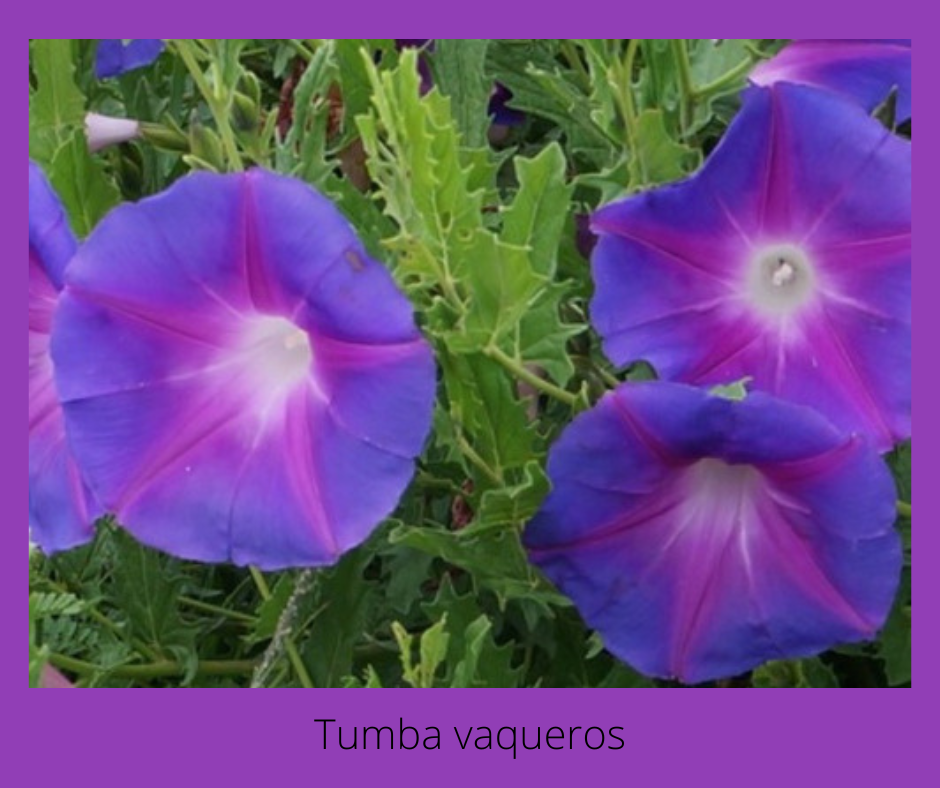
Ipomoea stans, another morning glory although more bushy than viney, is most often called tumba vaqueros (knocks down cowboys) in the area where I live. However, there are a plethora of other names including espanta lobos (frightens wolves), limpia tunas (cleans prickly pears), quebra platos (breaks plates), correhuela (run it smells), and campanita (little bell). In Náhuatl, this plant is known as cacamótic, cacastlapa (cacaxtlapa), flor de casclapa (caxtlapa) or castlapa canibata. Still other areas use the terms galuza, manto, maromero, tanibata, den-tzee’ or tlaxcapan (with spelling variant tlascapan).
The rhizome is boiled in remedies for kidney ailments and bilis (excessive rage). It’s also used to treat el mal de San Vito (Huntington’s disease), chorea (involuntary movement disorders), and epilepsy. For movement disorders, the recommended dosage is 15 grams of rhizome boiled in one-half liter of water and drunk three times a day. Studies have shown Ipomoea stans does have anticonvulsant properties as well as neuroprotective activity.
As an anti-anxiety treatment, it is made into an infusion along with flor de azahar (Citrus sinensis), flor de manita (Chiranthodendron pentadactylon), salvia (Salvia mexicana), palo de Brasil (Haematoxylum brasiletto), and flor de tila (Ternstroemia lineata). Another nerve tonic used in the states of Guanajuato, Hidalgo, and Puebla is to make a tincture with the rhizome, allowing it to steep for eight days. When it is ready, the tincture is applied to the back of the neck. An infusion for nervous disorders is made with two grams of the rhizome boiled in a one-half liter of water. Half is drunk in the morning and the other half in the evening. Research has demonstrated that tumba vaqueros possess anxiolytic and sedative effects.
The chopped rhizome is eaten to calm coughing. An infusion made from boiling chopped root and allowing it to steep for ten minutes before straining is drunk three or four times daily during menstruation as an anticontraceptive. A tincture made from the plant is rubbed on the abdomen to reduce cramping.
In one form or another, tumba vaqueros is also used for headaches, nephritis, bone pain, dysentery, and dizziness in different areas of Mexico. As with jalapa (Ipomoea purga), the root also has purgative properties. It’s considered a “hot” remedy.
To treat dystenery, ten flowers are boiled in one liter of water and sweetened with honey. It’s drunk before breakfast and then three or four times additionally during the day.
In addition to the aforementioned properties, tumba vaqueros is cytotoxic, antiproliferative, and antibiotic.
***
Interested in natural remedies? Uncover herbal remedies from traditional Mexican sources for healing and wellness in the Exploring Traditional Herbal Remedies in Mexico series.


 Surviving Mexico