Tag Archives: Christmas in Mexico

Christmas in México—La Piñata

A traditional Christmas piñata is a seven pointed star.

A traditional Christmas piñata is a seven pointed star.

The piñata is an integral part of the Christmas season in México.  The traditional piñata is in the form of a 7-pointed star made from a clay pot, although it is more common now to find paper maché piñatas. (Fiesta Star Pinata)Depending on your source, the star represents the Star of Bethlehem or the devil with each point representing one of the 7 deadly sins.  The piñata is broken with a stick, usually a broom or mop handle, that represents the strength from God through faith that allows the participant to romper (break) the hold of the 7 deadly sins and destroy the devil.  The fruit and candy that fall from the demolished piñata represent the love and blessing of God.  Just goes to show you that anything can be religified.

A piñata is broken each night of the 9-day posadas (See Celebrating Christmas–Las Posadas).   After the singing of Pedir Posadas, prayers and refreshment, the chant of “¡No quiero oro, ni quiero plata, yo lo que quiero es quebrar la piñata!” is taken up.  (I don’t want gold, I don’t want silver.  All that I want is to break the piñata!)

So how do you break the piñata?
pinata

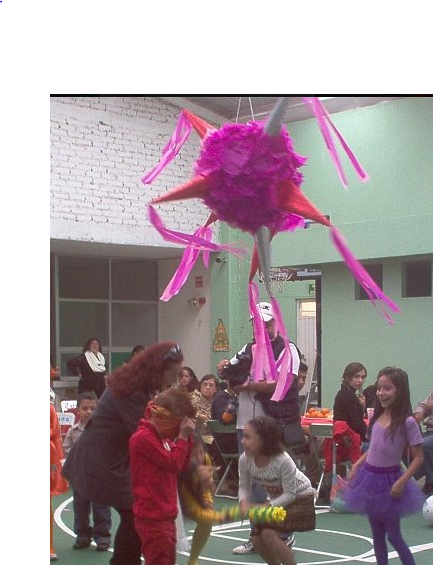
Children line up from youngest to oldest.  The piñata is hoisted on a pulley which is manned by someone whose intent is to not allow it to be broken until all children have had a go at it.  The first child is given the stick and may or may not be blindfolded.   Usually, the younger children are not, but the older ones are both blindfolded and spun around several times. (Fiesta Star Pinata)

Singing watchers form a rough circle and each child has until the end of the song to swing like mad and try to hit it to the tune of “¡Dale, dale, dale, no pierdas el ritmo, porque si lo pierdes, pierdes el camino; ya le diste uno ya le diste dos, ya le diste tres y tu tiempo se acabó!”

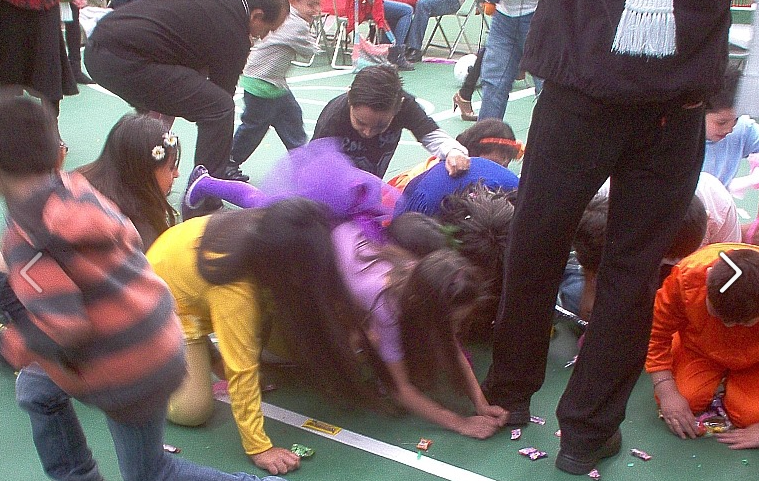
At the word acabó (finished) the swinger is supposed to hand the stick to the next child in line and not make a flurried series of last minute swings, but it seldom happens as smoothly as one would like.  No matter how many piñata breakings children have attended and no matter how many times the parents caution restraint, there is always a mad rush at the first shower of candy and inevitably someone ends up bonked on the head and crying.  Since there is never enough candy to go around, each child is given an aguinaldo (treat bag) to ease any hurt feelings or cracked skulls.
scramble

At the last piñata bashing we attended, not only were there head bonks, but there was an all-out fist fight and bloody nose between two teenagers over candy.   We took our aguinaldos (treat bags) and high-tailed it out of there.
SOTBS Blog Hop Op1Sq

    Have a Christmas in Mexico themed blog post?

Link it up here!   An InLinkz Link-up 

****************

disclosure

2 Comments

Filed under Mexican Holidays

Christmas in México–Las Posadas

posada

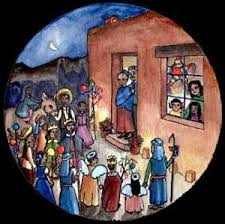
Las Posadas is a 9-day series of community or family gatherings that begin December 16 and end December 24 reenacting the pilgrimage of José y María (Joseph and Mary) from Nazareth to Bethlehem.  According to some sources, this tradition began in 1587 when the priest Diego Soria instituted a series of masses to replace the celebrations that occurred during this same time period to the god of war, Huitzilopochtli.  During this Aztec festival, a slave was selected to represent Quetzalcóatl and sacrificed at the conclusion of the 9 days of festivities, and the temples held ceremonies reenacting the arrival of Quetzalcóatl.

As it is currently observed, family groups or communities take turns hosting the event.  The host family plays the role of the innkeeper, and the visitors are assigned the role of peregrinos (pilgrims) in search of lodging.  The peregrinos (pilgrims) pedir posada (ask for accommodation) in song-form from the host family, standing outside a closed door with lit candles.  The song is funny, irreverent and a bit complicated to sing.  Most participants use cheat sheets provided by the host.  The complete song in Spanish and English can be found HERE.

Once the host “recognizes” Mary and Joseph, the peregrinos (pilgrims) are allowed to enter.  Refreshment is provided by the host, usually in the form of pozole (hominy stew) or another traditional dish and ponche (fruit punch) or canela (hot cinnamon tea).  This is followed by reza (prayers, usually the rosary is recited) and la piñata.  Host families also provide aguinaldos (a bag of treats and fruit) for the departing participants to take with them.

Or so this custom is celebrated in Moroleón.  Once upon a time, before I knew better, I agreed to accompany my mother-in-law to Las Posadas.  Little did I realize that we would be in for a night of posada-crashing.  We drove around until we saw a group of people huddled outside a home and follow them in.  As the whole point of the event is to express hospitality, the host could not ask us to leave although I noticed several dirty looks sent our way.  I, for one, felt extremely uncomfortable eating a stranger’s food and accepting the aguinaldo (treat bag), so much so that I tried to return it, but that wasn’t allowed either.  It’s the season for giving after all and I just further offended that host.  My mother-in-law had no such qualms and ate to her heart’s content, even asking for a second aguinaldo.  After that night, I refused to attend any more posadas that Christmas season, even though there were 8 days left.

SOTBS Blog Hop Op1Sq

    Have a Christmas in Mexico themed blog post?

Link it up here!   An InLinkz Link-up 

*********

disclosure

15 Comments

Filed under Mexican Holidays, Religion