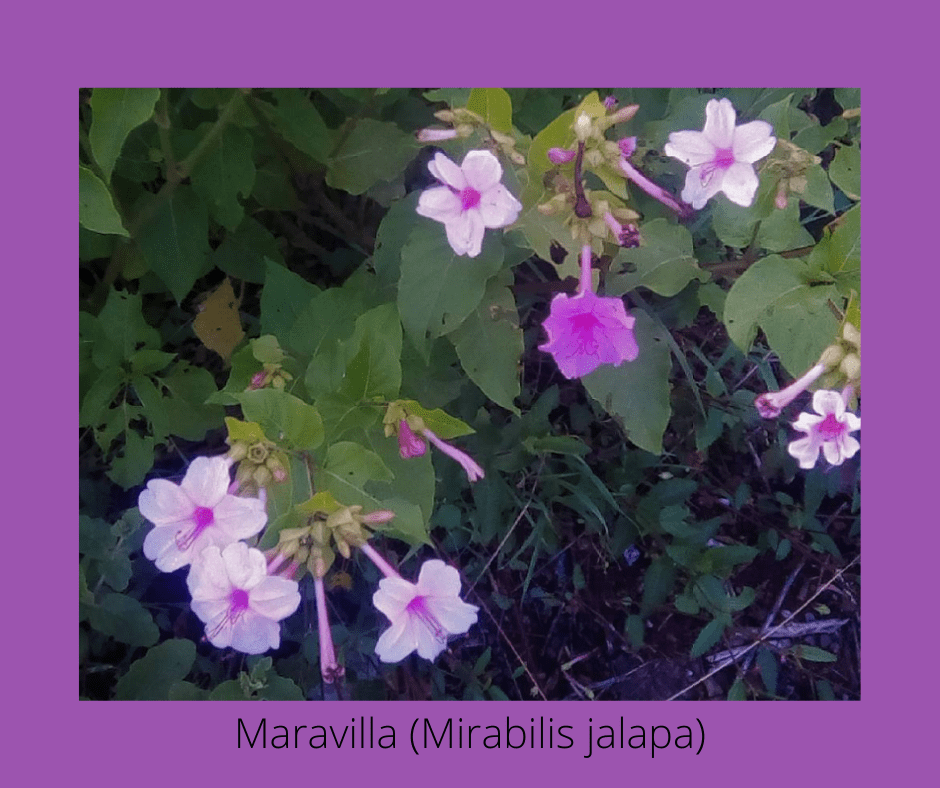
The lovely native Mexican plant Mirabilis jalapa has quite a number of names. In the area where I live, it’s known as Aretitos (little earrings), but it also has been given the names Maravilla, Hoja de Xalapa, Linda Tarde, Clavelina, Maravilla amarilla, Don Diego de Noche, and Maravilla de Perú in Spanish. In English, this plant is most commonly known as Four o’clocks, and in Maya ts’uts’uy xiiw. In Náhuatl is it Tlaquilin. Other indigenous names include tzojoyo by the Zoque in Chiapas, Isha-var by the Tepehuano people in Nayarit, Atssuupoljy by the Mixe in Oaxaca, and Chuyem by the Tenek in San Luis Potosi.
The plant has unique characteristics reflected in some of its common names. The blossoms, which resemble dangly earrings, open in the afternoons and close again in the early morning, providing pollen for nocturnal pollinators. Another curious phenomenon is that flowers of different colors can bloom on the same plant. These might be simultaneously blooming or found at different times during the peak flower season and can include white, yellow, pink, magenta, red, and even two-toned, speckled, or variegated blossoms. The pink, magenta, and red flowers are sometimes used to make a red food dye, while some traditional remedies call specifically for the yellow blossoms.
Traditionally, the plant is most often applied as an anti-inflammatory. The root is boiled with salt as a wash, or the crushed leaves are placed on the affected area as a poultice. For acne, boiled and crushed branches are placed directly on the affected area. For boils and tumors, a root decoction is added to the treatment and administered as tea.
Other maladies that have remedies that contain maravilla include bilis (excessive rage based in the liver), stomachache, sore throat, intestinal parasites, wounds, scrapes, varicose veins, fever, dysentery, epilepsy, and el mal de San Vito (Huntington’s disease). The flowers inhibit gut smooth muscle contractions, providing evidence of the plant’s effectiveness as a treatment for dysentery or stomachache.
Full branches with leaves, flowers, and stems with tobacco (Nicotiana tabacum) leaves are combined in alcohol to make a tincture as a topical treatment for rheumatism. Mirabilis jalapa leaves demonstrate antinociceptive activity and anti-inflammatory properties, supporting their use as an analgesic and beneficial in wound healing. For varicose veins and arthritis, the ground root is combined with potato flour and applied externally with lard. The pulverized root has been shown to be effective in treating allergic skin disorders.
Maravilla is also considered a contraceptive in some areas, although the root is considered an aphrodisiac in other areas and prescribed for male impotence. Studies have shown that Mirabilis jalapa root extract alleviates some types of erectile dysfunction and reduces the occurrence of premature ejaculation.
The root is sometimes eaten raw in salads. The fruit, which is dark and wrinkly in appearance, is toxic and should not be eaten or used in any remedy.
Additionally, studies have shown that Mirabilis jalapa root improves insulin sensitivity and reduces elevated blood sugar levels, making it a potential treatment for certain types of diabetes.
Furthermore, the root stimulates aortic muscle contractions and shows the potential to reduce lipid levels, such as cholesterol and triglycerides, suggesting it might be effective in the treatment of heart disease.
****
Are you curious about other traditional herbal remedies found in Mexico? Check out the Exploring Traditional Herbal Remedies in Mexico series!