Category Archives: Parenting Challenges and Cultural Norms

Parenting challenges–when someone dies


Welcome to the March 2013 Carnival of Natural Parenting: Tough Conversations

This post was written for inclusion in the monthly Carnival of Natural Parenting hosted by Hobo Mama and Code Name: Mama. This month our participants have spoken up about how they discuss complex topics with their children. Please read to the end to find a list of links to the other carnival participants.

***


cross

The majority of México is Catholic and nearly every house has a cross displayed.

We moved from a predominately Protestant but mostly religiously tolerant country to a nearly universally Catholic country when we moved from the United States to México. So the question became how to raise a religious but open-minded child in such a dogmatic and closed culture?

Don’t get me wrong, I’m not saying there is anything inherently wrong with Mexican Catholicism. After all, there are millions of devout devotees. But I wasn’t raised as a Mexican Catholic, and I did not wish to limit my son’s religious experience just because it’s the religion of the masses.

Although my husband was raised as a Mexican Catholic, our religious differences were not a point of contention between us, until we arrived in México with our 4-year-old child who had not been baptized as an infant. My mother-in-law started in immediately with how it was necessary for our son to be baptized in order to remove the devil’s horns from his head. (I admit to thinking WHATEVER to that idea.) My husband began to agree and make noises about how we should get him baptized. I told him that if he wanted to get our son baptized, although personally not seeing the necessity of that myself, he could go ahead and make the arrangements himself. As he never went to make the arrangements (being male) and my mother-in-law was unwilling to take on the expense (being cheap) this passed and our son remained unbaptized.

Then came the First Communion debate. Having not baptized our son, I did not see the necessity of having him prepared for his First Communion, but since his cousin, the same age was going through the ritual, it came up again. Again, I told my husband if he wanted to do this, he would need to make the arrangements, and again my mother-in-law was not interested enough in the plight of my son’s soul to make the financial sacrifices involved (clothes and a party mostly). Being a non-Catholic, I was automatically barred from involvement, unless of course I went and became Catholic. I wasn’t interested in doing that.

We attended mass on a few occasions, mostly for the experience of it over the last 6 years, but we never really had to confront the issue until last May when my mother-in-law was involved in an accident. Then, all of a sudden, religion became a big deal in our lives. My mother-in-law’s personal saint was El Niño de Atocha, and the family lit candles to that saint in supplication for her life. The saint was moved from her house to ours since my father-in-law was either in jail or at the hospital and couldn’t be there to keep a candle lit, so it became my responsibility. My father-in-law made a vow to walk descalzo (without shoes) to the Virgin of Guadalupe‘s shrine in Soledad if my mother-in-law recovered. My brother-in-law B became downright hostile towards me, the only non-Catholic in the bunch, although I tried to do what I could to help. When my mother-in-law died, she received the last rights and made her confession as any good Catholic would. My father-in-law asked me, not his religious son B if he needed to complete his pilgrimage since she died. I said no, I didn’t think so.

The altar of El señor de Escapulitas Catholic Church in Moroleón

The altar of El señor de Escapulitas Catholic Church in Moroleón

We had the funeral in the El Señor de Escapulitas with all the pomp and circumstance of a Catholic funeral. Then we began the novena(the 9-day prayer session for the soul of the departed to be released from purgatory). And then my son asked me about death.

So we talked about it, he and I. I asked him what he thought might happen when someone dies. He said he wasn’t sure. Being only 10, his death experiences involved mostly pets and livestock. So I explained that most people in México believed the soul lives on for a time in a place called purgatory, which wasn’t heaven or hell and that there would be rituals that were intended to help his grandmother’s soul move from purgatory towards one or the other. We talked about what heaven might be or what hell might be. Then I presented other ideas to him. I talked about the concept of reincarnation, the belief that the essence of a person is transferred to another living being, human or otherwise, in its quest for nirvana. He found that concept fascinating. I talked about that perhaps nothing at all happens at death, that perhaps we just cease to be and our body returns to the earth as part of a natural cycle of life. He was quiet for awhile after our discussion, thinking over things and finding his own way in the darkness that accompanies death.

That night, my son sat down with us for the first of the 9 prayer sessions of the novena. His cousins, who were baptized and confirmed, played outside as we prayed. He said to me after the prayers, “Mom, I don’t think that abuelita is in purgatory, but I prayed to remember her.” He endured the entire 9 days and subsequent mass, the only one of her many grandchildren who did so.

I’m not sure he’s made up his mind about death yet. I’m not sure I have either. We find comfort for our grief as we can. I’ve shared several of my favorite poems and scriptures about death and life with him. He’s listened and commented and gone on with his young life. I know perhaps it would be easier on him if I had made definite statements about what happens when someone dies instead of letting him grope about for his own answers. But finding your own way is the most precious part of living, and I would not deprive him that, even if he is still too young to understand.


***

disclosure

***

Carnival of Natural Parenting -- Hobo Mama and Code Name: MamaVisit Hobo Mama and Code Name: Mama to find out how you can participate in the next Carnival of Natural Parenting!

Please take time to read the submissions by the other carnival participants:

(This list will be updated by afternoon March 12 with all the carnival links.)

  • A Difficult Conversation — Kellie at Our Mindful Life is keeping her mouth shut about a difficult topic.
  • Discussing Sexuality and Objectification With Your Child — At Authentic Parenting, Laura is puzzled at how to discuss sexuality and objectification with her 4-year-old.
  • Tough Conversations — Kadiera at Our Little Acorn knows there are difficult topics to work through with her children in the future, but right now, every conversation is a challenge with a nonverbal child.
  • From blow jobs to boob jobs and lots of sex inbetweenMrs Green talks candidly about boob jobs and blow jobs…
  • When Together Doesn’t Work — Ashley at Domestic Chaos discusses the various conversations her family has had in the early stages of separation.
  • Talking To Children About Death — Luschka at Diary of a First Child is currently dealing with the terminal illness of her mother. In this post she shares how she’s explained it to her toddler, and some of the things she’s learned along the way.
  • Teaching 9-1-1 To Kids — Kerry at City Kids Homeschooling talks about the importance of using practical, age-appropriate emergency scenarios as a springboard for 9-1-1 conversations.
  • Preschool Peer PressureLactating Girl struggles to explain to her preschooler why friends sometimes aren’t so friendly.
  • Frank Talk — Rosemary at Rosmarinus Officinalis unpacks a few conversations about sexuality that she’s had with her 2-year-old daughter, and her motivation for having so many frank discussions.
  • When simple becomes tough — A natural mum manages oppositional defiance in a toddler at Ursula Ciller’s Blog.
  • How Babies are Born: a conversation with my daughter — Justine at The Lone Home Ranger tries to expand her daughter’s horizons while treading lightly through the waters of pre-K social order.
  • Difficult Questions & Lies: 4 Reasons to Tell The Truth — Ariadne of Positive Parenting Connection shares the potential impact that telling lies instead of taking the time to answer difficult questions can have on the parent-child relationship.
  • Parenting Challenges–when someone dies — Survivor at Surviving Mexico writes about talking to her child about death and the cultural challenges involved in living in a predominantly Catholic nation.
  • Daddy Died — Breaking the news to your children that their father passed away is tough. Erica at ChildOrganics shares her story.
  • Opennesssustainablemum prepares herself for the day when she has to tell her children that a close relative has died.
  • Embracing Individuality — At Living Peacefully with Children, Mandy addressed a difficult question in public with directness and honesty.
  • Making the scary or different okay — Although she tries to listen more than she talks about tough topics, Jessica Claire of Crunchy-Chewy Mama also values discussing them with her children to soften the blow they might cause when they hit closer to home.
  • Talking to My Child About Going Gluten Free — When Dionna at Code Name: Mama concluded that her family would benefit from eliminating gluten from their diet, she came up with a plan to persuade her gluten-loving son to find peace with the change. This is how they turned the transition to a gluten-free lifestyle into an adventure rather than a hardship.
  • Discussing Difficult Topics with Kids: What’s Worked for Me — Deb Chitwood at Living Montessori Now shares parenting practices that enabled discussions of difficult topics with her (now-adult) children to be positive experiences.
  • Tough Conversations — Get some pointers from Jorje of Momma Jorje on important factors to keep in mind when broaching tough topics with kids.
  • Protect your kids from sneaky people — Lauren at Hobo Mama has cautioned her son against trusting people who’d want to hurt him — and hopes the lessons have sunk in.
  • Mommy, What Does the Bible Say? — Amy at Me, Mothering, and Making it All Work works through how to answer a question from her 4-year-old that doesn’t have a simple answer.
  • When All You Want for Them is Love: Adoption, Abandonment, and Honoring the Truth — Melissa at White Noise talks about balancing truth and love when telling her son his adoption story.


14 Comments

Filed under Carnival posts, Death and all its trappings, Parenting Challenges and Cultural Norms

Homeschool variation

scarlet king snake

Red touches yellow kills a fellow. Red touches black, a friend of Jack.

As an educator, I have always been concerned about my son’s education. I felt, since the moment he was born, that my principle task as a mother was to help him learn to be a well-adjusted, happy and successful man, no matter where he might live.

When we arrived in México, my son was 4 years old, and according to his Spanish-speaking grandparents, he didn’t speak any Spanish. However, he did understand everything he heard. In order to jump start his language acquisition, we decided to send him to a bilingual kindergarten. I found a position with a private school, and he attended with me. We both liked this arrangement since Mommy was his teacher for 1/2 the day. His Spanish improved immensely.

At 5, we needed to make some decisions about schooling. We planned to make México our permanent home, not just a 2 or 3-year stint. It was evident that there would be things I just wouldn’t be able to adequately teach my son about Mexican culture and language. Thus began our homeschool variation.

My son attends public elementary school from 2 pm in the afternoon until 6:30 pm. His normal subjects include Spanish, Math, Science, Mexican Moral Values, Physical Education and Mexican History, with brief sessions of music, art, and computer classes. So my mission was to supplement these courses with those that I thought he might need. We began a home study course in the mornings and on weekends.

I left Spanish alone. A native teacher is always better than a foreigner. At 10, he speaks Mexican Spanish fluently, without a trace of an American accent. He also is the top reader in his class, having been elected several years in a row to represent his school at various reading competitions.

Math, other than learning the terms in English, again was something I didn’t need to focus too much on since numbers are easily understood in digit form in either language. Anyway, I wasn’t much help with the metric system, having learned the English measurement system when I was a girl. His dad does most of the teaching for this subject. Having worked in both the United States and México, he is able to use both measurement systems well. He and our son used hands-on math in the construction of our home.

I added World History to his morning agenda, using interesting books or fun activities like word searches or hidden picture books. I also had him play Civilization on the computer, which really was his favorite lesson by far. If you’ve never played the game, the idea is for you to grow a civilization from the hunter/gatherer stage to a scientifically advanced one. Your scientific and military advancements depend on the civilization you choose. I think, for this reason, he never complained when we had to gather vinas (a bean type plant) or cut grass for the animals. He imagined he was gathering, just like in the game. Now that his reading ability has caught up to the textbooks I brought with us, he enjoys comparing what he learned from the game to the information in the books.

In line with our world culture study, we recently added Bible lessons as well. We can really relate to some of the early biblical accounts as we too have sheep and goats and have to haul water and make good trades. I found Semana Santa (Holy Week) a good time to present the life and times of Jesus since there are live reenactments of the trial and death in this very Catholic nation. He also is my assistant in designing Spanish Bible games for a local Christian church.

Science has been the easiest by far. We live off the beaten path and every day provides opportunities to study native flora and fauna. I remember the day we saw a dung beetle rolling its dung with his hind legs. Having only ever seen that creature on TV, we were very excited to be sure. We watched it for awhile, then raced home to do more research in the bug encyclopedia.

On another nature walk, we came across a snake that my son was able to identify as a non-venomous scarlet king snake, not its poisonous cousin the coral snake, from his readings. Then there are the butterflies of México, every size and hue imaginable. After the rains, butterflies can be found in groups of hundreds. You can literally walk through clouds of butterflies. No museum trip can match the wonder of that.

With the native vegetation, I am as an avid a student as my son. I have been unable to locate any composite books on plants of México, so am always full of questions for my husband and my in-laws. What is the medicinal value of this or that plant? Is it edible? What animals eat it? Which are poisonous? Can it be made into a tea? How do you eat it, raw or cooked?

We also began our mini-ranching about the time our son started school, so he has had hands-on experience with a number of different animals, much more learning intensive than a day trip to the petting zoo. He has helped with births and hatchings, with daily care and milking, with the selling and butchering. He has learned, along with us, about the interconnectedness of the environment. For example, the horses eat grain then poop. The chickens eat the flies and the undigested grains and lay eggs. We eat the eggs, which gives us the energy to plant the grain that the horse eats. He has also seen the agonizing results of improper or inadequate care and learned how we have a responsibility to our animals to provide adequate food and shelter and what benefits we receive in return.

Of course, his daily homeschool curriculum includes liberal doses of English. He helps me design exciting language games, reads, does his (in his opinion ‘not so fun‘) daily grammar or spelling activity, and uses the language every day with his father or me or my other ESL students. He speaks English without a Mexican accent, although he often spells as if the word were phonetically Spanish. We’re working on that.

With non-academic courses such as physical education, music, art, and computer literacy classes, most Mexican public schools do not have a lot of funding for intensive year-long classes, but they do provide sessions as teachers become available.

My son had an art class working with barro (clay) which is a traditional medium for many everyday items still made and used here in México today. He is also learning Zentangle design from a student of mine in exchange for English classes.

He has had a few flute classes, but he never mastered that well. So now, he takes Mommy piano lessons on Saturday and is progressing nicely.

Our daily lives, with its many activities, provide ample physical activity for a growing boy. For instance, my son’s job is to fill the barrica (barrel) using the hand pump so that we have water to wash with. We tease him about how the girls in his class must notice how muscular he has become because of this daily task. We also love to take family bike rides to the next town and back.

And he has had access to a computer from an early age in our home. We have recently been able to get internet service, and the whole world has opened up for him with the click of a button.

I wish I could provide more for my son. The area that we live in is so backward regarding technology and at times, culturally. But I hope that I am providing enough that wherever he may go, he will have enough knowledge to survive and succeed.

After all, as Joseph Campbell says, “Wherever you go, there you are.” and that should be enough for anyone.

**************************

disclosure

6 Comments

Filed under Education, Parenting Challenges and Cultural Norms

Independence vs. Safety

whats in the backpack

My little guy has grown into a big guy. At 10 going on 11, there are new challenges in parenting. Our most recent being, how to let him have more independence while still keeping him safe.

As you may have noticed, safety is a serious issue where we live. Those in charge of law enforcement, often can not be trusted. Then with the proximately of the Michoacan-Guanajuato border, there are the Michoacan bad guys that make raids in our area then skip back to their own territories. It’s hard to say who the bad guys are sometimes.

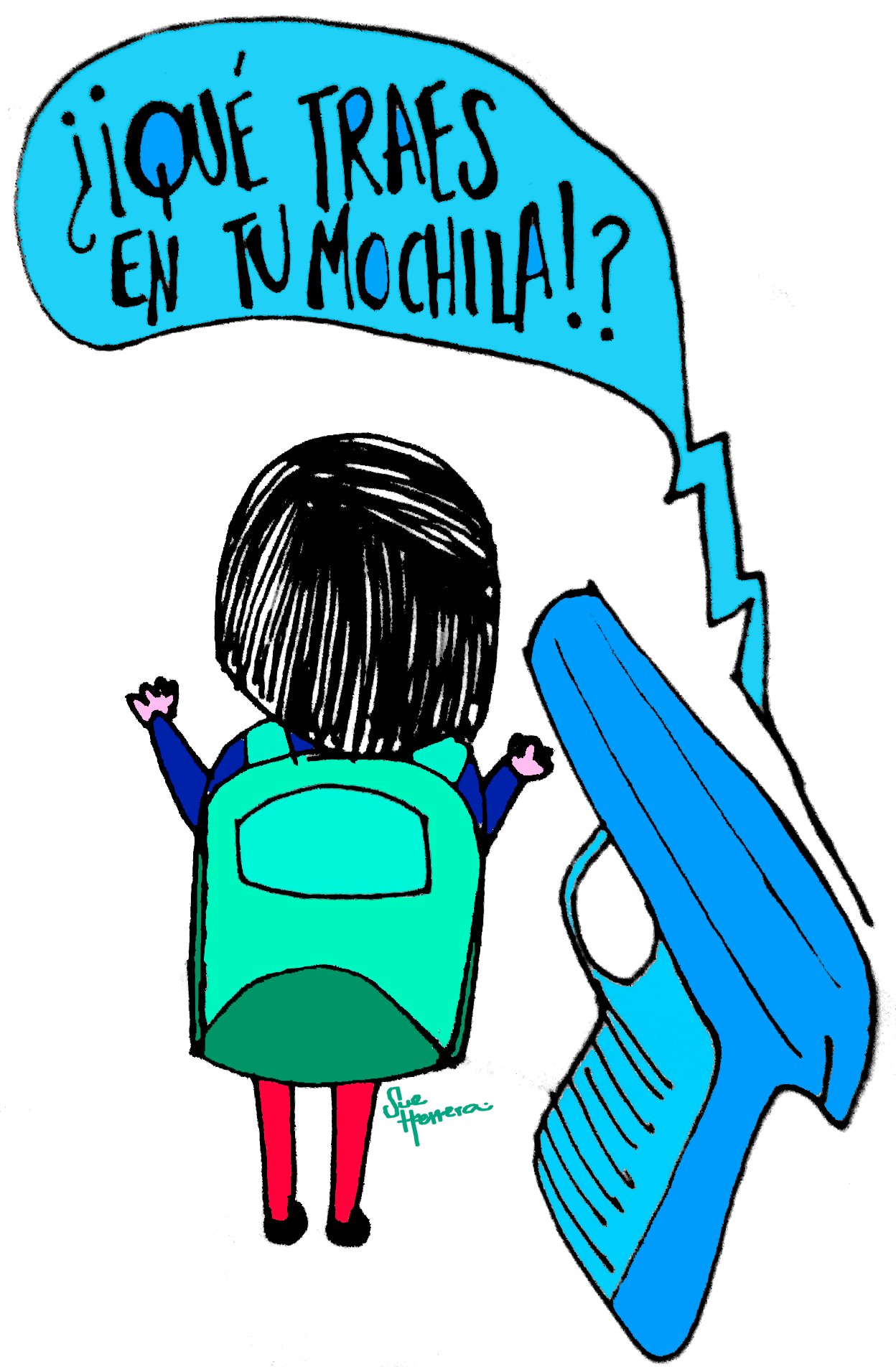
Up until this point, we drove our son to his class at 2 pm and picked him up at 6:30 pm on the moto. However, wishing to be more independent, he has decided that he would walk to school and back home. As he arrives after dark, I wait anxiously at the window until I see him trot around the corner. I worry about bullies or careless drivers. However, there are more worrisome things than these here. My son has been subjected to random backpack searches by Los Federales, (Federal police) on the way home from school. It makes me nervous, to say the least, not that he might be carrying weapons or drugs, but that a frustrated Federal might take out his aggression on my little boy.

Gangs are also problematic, although I expect not as bad as say, Los Angeles, California, USA. Here we have Sur 13, Los Zetas (Z) and La Familia (the mafia). Most of Moroleón is controlled by Sur 13. For the most part, they are in the employ of Los Zetas or La Familia, in a sort of a dog-guard capacity. They don’t start trouble but stand guard on the corners one of these groups wishes to have monitored. Periodically, they are sent as decoys for the Federales (Federal police) to come and hassle and pick up for petty drug-possession, while a bigger transaction occurs on the other side of town. Typically, they are compensated for their time in el bote (jail) and out on their corner watch the next day.

Being initiated into Sur 13 is as bad as you might see on TV. My husband’s nephew L was inducted about 2 years ago, and it nearly cost him his life. The 13-second beating by gang members that he was subjected to damaged a good portion of his liver. A week or so later, after eating some particularly greasy chicharrones (fried pig skin), his liver stopped functioning. He was taken to the Regional Hospital, where he was basically given up for dead. Only one doctor thought he could be saved because of his youth, just 17. The doctor had him transferred immediately to León, a state-of-the-art hospital facility. L survived, however, he has permanent liver damage.

Right now, my son is too young to be considered for gang membership. However, there are sort of junior gangs that hang about other corners, watching and learning from a distance. Obviously, in our family, this hanging about business is discouraged with liberal doses of study and work. Perhaps he might remember what happened to his cousin and if the time comes when he has such a decision to make, hopefully, he chooses a wiser course.

The next level up in the gang hierarchy are Los Zetas. They are found mostly across the border in Michoacan but have their representation here. They are known for telephone extortion scams. They have contacts within the community, typically at banks and money-wiring places like Western Union. They use the information from these sources to make phone calls to those who recently received money from the US. They may say that one of the victim’s family members has been kidnapped, usually a daughter. Then they might have a female voice screaming or asking for her mommy in the background to prove that she has been kidnapped. If X amount of money is not deposited to X account by X time, then the family will not see her again. The fear occasioned has led to the defrauding of countless families.

Another ploy is that the person who answers the phone is the intended target. The caller may say that the victim is being watched, that their location and the location of their loved ones are known, and then begin asking leading questions in the hopes the victim may give away his or her present location. Again, the fear and intimidation are incredible leveraging tools, and the victim is not only defrauded, but their sense of security shattered.

Phone safety has repeatedly been stressed at our home. My son is NOT to answer any unknown caller. His newly acquired phone is NOT to be shown even to his friends but hidden away in the secret compartment of his backpack. He is NOT to spend all his saldo (pre-paid phone money) in case he needs to call one of us in an emergency. I hope it’s enough.

La Familia is the mafia and has branches wherever you might go in México. They are not the law, they are their own law. They have wealth and power and prestige. Reportedly, La Familia was the authority that had the traffic camera deactivated at the corner where my mother-in-law was killed. Her death was not mafia related. However, this inactive traffic camera contributed to the subsequent cover-up by the police.

My husband’s youngest brother C is a gang member wanna-be. But if he really wanted to be, I expect he could go through the initiation just like the regular members, so maybe he is happy with his wanna-be status. He gets himself Sur 13 tattoos and talks big. This has caused him trouble. Once, while intoxicated, he threatened a member of Los Zetas with the wrath of La Familia. The Zeta backed down and left. Two days later, he was back. He ran C down with his truck, destroyed his moto, and put him in the hospital. Word on the street was he had investigated C’s boast, found that he was unknown to La Familia and decided he needed to be taught a lesson. C has since recovered but doesn’t leave the house these days.

My husband’s sister’s young boyfriend has also been involved in gang activity. He isn’t so smart either and seems he had broken in and stolen items (most likely drugs) from a house owned by La Familia. He fled Moroleón and tried to cross the border to the US to avoid retribution, and my husband’s sister went with him. They stayed away nearly a year. I’m not sure what deal was made, but eventually, G was permitted to come back, tail tucked between his legs, and L came trotting along behind him.

Apparently, he didn’t learn so well the first time, because recently he has been warned again, this time with the removal of several of those ‘sticky’ fingers. He again tried fleeing but was unsuccessful in escaping to the US.

Where I grew up, we didn’t have any sort of gangs, so really I haven’t a clue how to help my son make good choices with regard to gang membership and dealings. I have to trust that these examples his extended family has provided, and some perhaps his own classmates might yet provide, will keep him safe from harm. But things are just so uncertain, and I worry.

********************************

disclosure

2 Comments

Filed under Parenting Challenges and Cultural Norms, Safety and Security