
Category Archives: Mexican Holidays

Christmas in México—Three Kings’ Day

three-kings

Los Santos Reyes or Los Reyes Magos bring gifts to children in México.

Three Kings’ Day is celebrated in México on January 6, Epiphany, and is based loosely on the visit of an unknown number of unnamed astrologers who visited the young child Jésus sometime after his birth, bringing gifts of gold, frankincense, and myrrh as recorded in the book of Matthew.

These visitors are known as Los Santos Reyes (The sainted kings) or Los Reyes Magos (The magic kings) and have been christened with the names Melchor, Gaspar, and Baltazar.  Young children are told to leave out their shoes filled with grass for the camels of Los Reyes Magos and will be given a gift in return.  Slightly older children may write a letter to Los Santos Reyes making a gift request which is tied to the string of a helium balloon and released to go wherever it is that Los Reyes are when they are not making gift deliveries.

January 6 is the last day of an incredibly long school vacation period and it never seems quite right that children have to wait until the very last day to get something new.  Some families have therefore instituted gift exchanges on Christmas day so that there would be presents to enjoy during the vacation period as well.  However, don’t think that Santa delivers to México, since everyone knows his sleigh won’t work without snow—or at least that is what I have been told.

Children in our area of México, seem to believe in the existence of Los Santos Reyes much longer than children in the U.S. believe in Santa Claus.  On several occasions, I have listened to 11 and 12-year-olds passionately debate the topic, with most still firmly believing.  Of course, given the other religious and cultural miraculous beings that belong to the Mexican people, like la Virgen de Guadalupe, it shouldn’t come as any surprise that their children want to believe, so it is so.
rosca

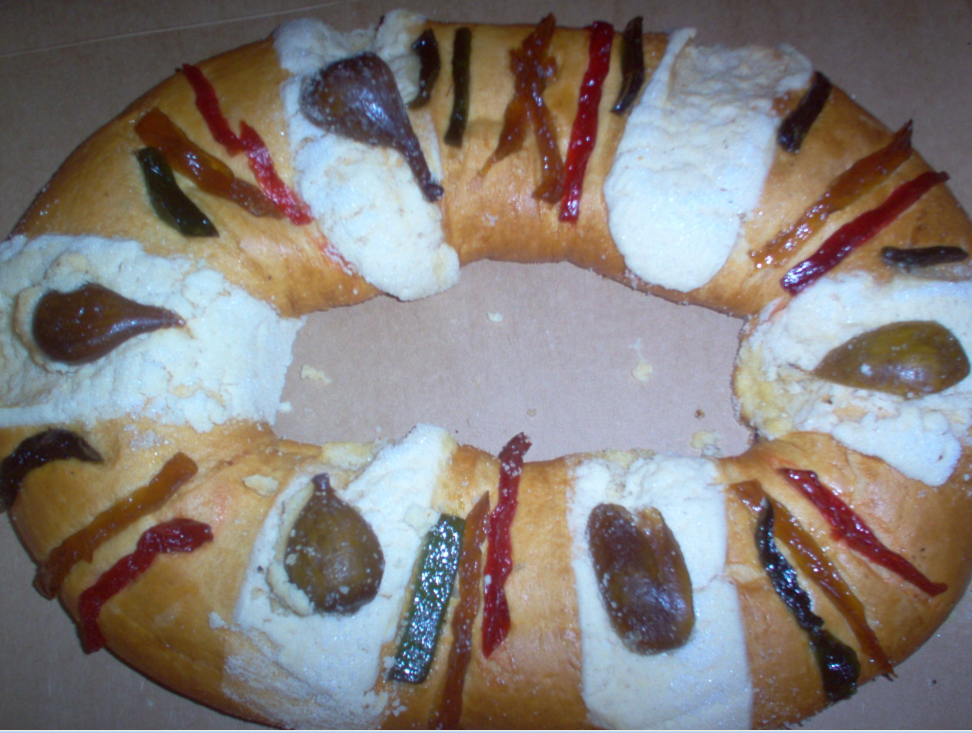
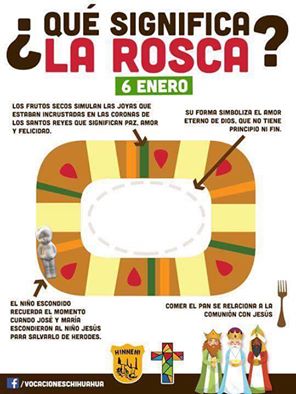
Sharing the Rosca de Reyes on January 6 is a long standing tradition in México.

Gifts are often placed at the foot of the child’s bed to be discovered immediately upon waking.  Sometime later in the morning comes the tradition of the cutting of the Rosca de Reyes (a round or oval shaped fruit cake).  Each partaker must cut his or her own piece of cake.  This is to ensure there are no trampas (cheating) since baked inside the cake are one or more plastic babies representing el niño díos (the baby Jésus).  It is considered a sign of good fortune for the coming year if you find one of these plastic babies in your piece, although it comes with a catch, you must provide the tamales and atole (a corn-based drink) for the family gathering on el Día de la Candalaría.
rosca

Last year, not only did I find one in my piece of the rosca at the family gathering, but I was blessed with a second one at work.  I was feeling pretty good about it initially and waited with open arms for some of the reputed good fortune to be laid upon me.  However, I soon had to revise my opinion when a series of unrelated, unfortunate incidents made January into a most trying month.  I figure that the two lucky charms canceled each other out, so no bestowed good fortune for me. I’d have to make my own.  Additionally, I then had two separate events that I had to provide tamales and atole for, a double expense.  What fun!

SOTBS Blog Hop Op1Sq

Have a Christmas or New Year in Mexico themed blog post?

Link it up here! An InLinkz Link-up

**************

Interested in learning more about Mexican holidays?

Check out A Woman’s Survival Guide to Holidays in Mexico!
9 Comments

Filed under Mexican Holidays, Religion

Christmas in México–New Year’s Eve

sidra

New Year’s Eve is celebrated much like Christmas Eve, with family, fireworks and feasting, laughter and drinking, and in our case, buckets and bonfires. However, there are a few local traditions that you shouldn’t miss out on.

It is considered good luck to wear red or yellow underwear to bring in the New Year. The red underwear brings luck in love, and the yellow underwear brings luck in finances. The underwear should be new and purchased as a gift for the wearer for the full effect. Last year, I wore my yellow chonies (underwear), but I should have also worn a yellow bra as well since the financial benefits were only observable in the second half of the year, but something is better than nothing I suppose. My son couldn’t decide which would be better, the money or the love, so he wore yellow boxers over his red underwear. The result was that he continued to be well loved and my increase in finances provided for his increase in allowance. I bullied my husband into his yellow chonies (underwear), and it paid off. January 1 brought the birth of 4 healthy chivitos (goat kids), and a fifth born on January 2 rounded off the effect nicely. This doubled our little herd in one day, so an immediate payoff so to speak.  As 4 of the 5 were male, that’s money in the bag in 6 months or so. As

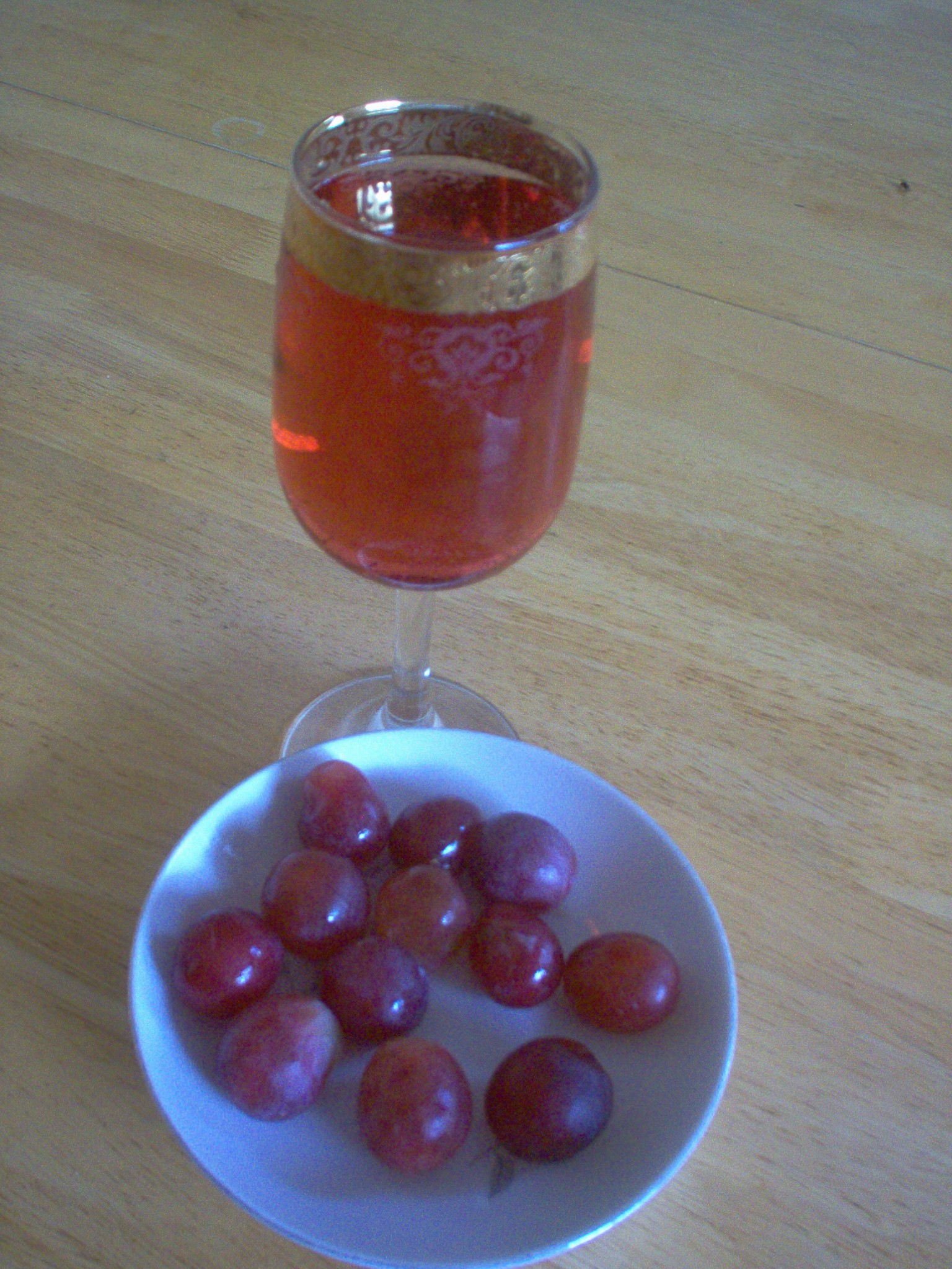
Another New Year’s Eve tradition is the consumption of 12 grapes at the stroke of midnight. Each grape represents a month and must be eaten before the church bells stop ringing. As each grape is eaten, you can make a pedida (request or wish) for the coming year. Like birthday wishes, it is considered bad luck to reveal your desires until they come true. My mother-in-law swore that she received her materials from DIF to build her house from her New Year’s Eve wish. So last year, we incorporated this little custom into our family New Year’s Eve celebrations. It isn’t as easy as you might think. I was hard pressed to tragar (swallow) all 12 grapes in the allotted time limit. Maybe it was because our grapes were mammoth sized. It literally took 2 or 3 bites for me to eat each grape. And then they had seeds too. I just swallowed hunks of grapes, seeds and all, in an effort to finish. Fortunately, the grapes are served with a glass of champagne or sidra (cider wine), so I was able to drown my disappointment with a little bubbly.

Cleaning is also a regular part of the New Year’s Eve (or afternoon) activities. The house should be swept from back to front in preparation for the New Year. If you are in need of an extra bit of cleansing, there is the possibility of La Limpieza de las Siete Iglesias (the 7 church cleaning). This requires a trip to 7 churches and a bit of holy water from each church. Then the holy water should be mixed with cloro (Clorox) and the super-powered cleaning can begin. As I worked until late afternoon on New Year’s Eve, I didn’t have time to make the required pilgrimage, so our house just got the regular cleaning. Maybe next year.

New Year’s day finds the streets in Moroleón deserted as revelers nurse sidra induced hangovers.

Here’s a nifty infographic that mentions the yellow underwear custom from Gift Ideas for All.

*******************

disclosure

1 Comment

Filed under Mexican Holidays

Christmas in México–Christmas Eve

pinata December 24th is the final night of Las Posadas.  (See Celebrating Christmas—Las Posadas)  Therefore, the singing, prayers, and piñata are all part of the evening’s activities.  Unlike the other 8 days, there is a Misa de Gallo (midnight mass) afterward.  Traditionally, this is also when the image of the baby Jésus is placed in the manger of the nativity scene. But basically, this night is dedicated to the Christmas Eve feast.  Some homes serve traditional foods such as pozole or tamales, but other families have become more Americanized and serve ham or turkey.

However, my husband’s family is del rancho (from the country) and therefore, we did things just a bit differently. When my mother-in-law was alive, it was customary for all the in-México family to gather together in order to enjoy the largesse of the out-of-México family.  This generosity was usually in the form of some money wired and the subsequent purchase of some meat and tequila.  We would meet up after mass at the house up the hill in La Yacata, for the BYOB (Bring Your Own Bucket) affair. The buckets were arranged around a bonfire big enough to scorch the bejeezus out of both the meat and party-goers, but it was unheard of to have this gathering indoors.  My mother-in-law would serve the meat, and I as was one her least favorite, I had to be content with a mere sliver of bistek (beef) and a few greasy tortillas. Meanwhile, the menfolk, and some of the womenfolk gallivanted around with their tequila and poked at the bonfire every so often.

When my son was smaller, I used his bedtime to retire after my measly meal.  I didn’t see any reason to stay up and outside ‘til the wee hours of the morning in the cold.  My absence, other than a snide remark or two about my delicacy as I left, was hardly noted. Since the death of my mother-in-law, any warped togetherness my husband’s family ever had disappeared and we no longer congregate around the bonfire perched on paint buckets.  The past two years we have made feeble attempts to institute another sort of family gathering for Christmas Eve, but it’s too soon to say if a new family tradition has been adopted.

SOTBS Blog Hop Op1Sq

    Have a Christmas in Mexico themed blog post?

Link it up here!   An InLinkz Link-up 

****************

disclosure

8 Comments

Filed under Mexican Holidays