Category Archives: Death and all its trappings

La Novena and el Luctuoso

la novena
Then began the novena, 9 days of prayers for the release of my mother-in-law’s soul from purgatory.  This was held where her body had been viewed, with the leftover candles from the funeral.  A candle must be lit at all times and no one may sweep, since this would be rushing her soul out of the house. (See Mass and Burial)
Each child took a day to sponsor the novena, providing refreshments for those that came to pray.  I thought my night of hosting went well.  I had to be signaled that the prayer was over and hurried to the kitchen to serve the flan, jello, and juice that I had bought earlier in the day, my son and husband helping to serve.  I hadn’t had time to prepare anything traditional or home-made, but that’s why supermarkets were invented right?
A woman named Socorro did the prayer reading for each evening.  It seemed to be her calling, presiding over novenas when asked.  She isn’t paid per se, the refreshments each night being given in compensation for her time.  (See Parenting Challenge–When someone dies)
Each night, Socorro and her echo, another religious woman, intoned prayers from a little booklet.  It’s important that everyone  sit in the same seat each night, but I didn’t understand the reason for this, just that’s the way its done.  The prayer session lasted about an hour since every few minutes there was a round of choral recitals of Padre Nuestro, (Our Father), and Ave Maria pleading that if my mother-in-law’s soul be found at the gates of purgatory, that she be pardoned as well as any other souls found with her.  Apparently, her eternal damnation or salvation would be based on the strength of our prayers during the novena while her soul was wandering around in purgatory.
A glass of water and a white towel were set out the first night.  This was in case the soul was in need of refreshment.  If the soul visited and drank the water, the towel would be imprinted where it had knelt.
As this was my first novena, I’m not sure how smoothly it goes, but it seemed to me that we had more than our share of issues during the 9 days.
The first night, the little children, who were exempt from the prayer meeting, locked themselves in one of the bedrooms and we had to break the door down to rescue them as they became more and more hysterical on the other side.  Not a very auspicious beginning to the novena.
Then another night all the sons came drunk to the novena and interrupted the prayers abruptly and repeatedly in order to use the bathroom.  Again, not as it should be.
Then the night D was in charge of the refreshments, not only did she not have enough for everyone and I had to supplement with some flan left over from my hosting, but her husband refused to help her serve, demonstrating what an ass he was to all.
Then L was had a screaming fit because my father-in-law had asked where the money from the presidencia was (nearly 3000 pesos) that she had spent on rent for her apartment and local although it wasn’t her money to spend but meant to defray funeral costs.
Another night, I was called away from the novena by the mother of one of my students who happened to be a judge.  She had been given a copy of the lawsuit that Chuchi sent and wanted to speak with me immediately.  As she isn’t the type of woman you say no to, I hurried to her house.  She explained some of the legal terminology and wanted to know for sure if we had answered the charges as there was only a 10-day period to do so.  If the charges were not answered, Chuchi wins by default.  I called R and he assured me that they had.  I wasn’t satisfied so went to the office of Super Prez and asked him.  He gave me a copy of the respuesta (answer to the charges) and I hurried back just in time for the opening prayer.
Then J was to make the traditional corundas for the last night, but B said he wanted enchiladas, and to please him, his sister P made them although it was extra work and angered her own husband and was contrary to tradition.  The three sides of the corunda represent the trinity and the eating of it as a sort of holy communion in honor of the deceased.
The final novena was a 2-hour session.  Not only were the final day prayers said but the dirt that was in the form of the cross on the floor since the viewing must be lifted.  It couldn’t be swept up and had to be scooped by hand in a prescribed manner.  First the right side of the cross, then the left side of the cross, then the foot of the cross where the three Marys wept, and then the head of the cross.  Flower petals, candle wax, and dirt were all scooped into a yellow shoe box.  More prayers were said and the rosary was placed on top.
ceramic statue novena
Each attendee was given a small ceramic crucifix, like a party favor, with the following poem on the back:
Fin de novenario
“Muero pero mi alma no muere los amare y los bendeciré en el cielo como lo hice en la tierra”   Agradece Padre e hijos
Loosely translated it read:
End of the Prayer sessions
I die but my soul does not.
I love you and bless you in heaven as I did on earth.
With appreciation: Father and children
panteon
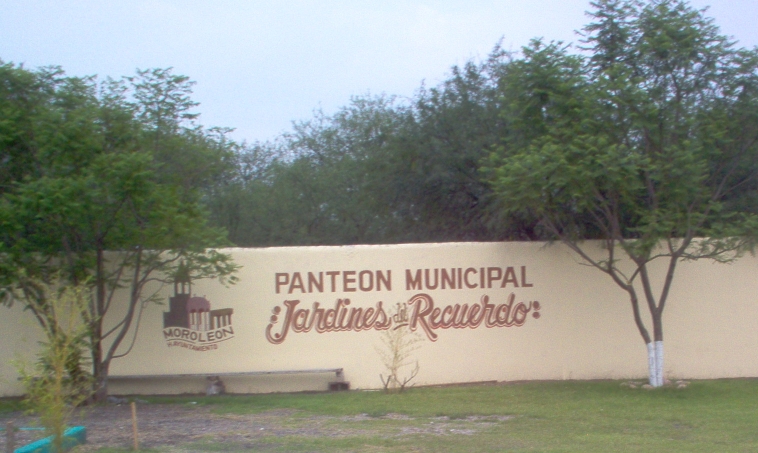
The following morning we gathered again at the panteón (cemetery). The sacred dirt in its shoebox, candles, photo, cross, the statue of the Virgin of Guadalupe, some sacred saint prayer cards, rosaries, the glass of water and the white cloth were all stuffed unceremoniously in the windowed front of the crypt.
The altar of El señor de Escapulitas Catholic Church in Moroleón

The altar of El señor de Escapulitas Catholic Church in Moroleón

But that wasn’t the end of it.  The next week there was a mass en el Templo del Señor de Escapulitas.  The priest was paid to say the names and ask for special blessings for those recently departed, but my mother-in-law’s name was accidentally left off the list.  So it was rescheduled for Saturday.
Then there was another mass in another church in the wealthy section of town.  I misunderstood where this mass was scheduled and my son and I went to the wrong church and then arrived late for the services.
Then there were masses scheduled every month.  My son and I went to the first few, but as the sons would be there either drunk or hung over, which in my opinion was shameful, I refused to go to anymore.
B made a vow that he would not shave until his mother had been gone one year.  I’m not sure if this vow was meant to be a bargain made to ensure that his mother’s soul left purgatory for heaven or not, but the result is that for most of the year looked like a ungroomed Mexican dwarf with a beard halfway down his chest. The night of the first-anniversary mass, he arrived completely bald and clean shaven.
So this week there was a mass to mark the one-year anniversary of her death. It’s called el primeto luctuoso (which as far as I can translate means the first anniversary of a person being called to the light).  An ad was placed in the paper for the first luctuoso.  This year, the masses will only be every 3 months.  An ad will be placed in the paper for the second luctuoso.  Next year they will only be performed every 6 months.  An ad will be placed in the paper for the third luctuoso.  After that, there will only be one mass per year until eternity.  Each year with its own newspaper ad.
Again, I discovered that the quality of the misa (mass) is dependent on the money you pay.  My mother-in-law again was given the basic package service.  I can not imagine how much money the church earns through this system since the masses continue for all perpetuity.  Death is quite a profitable business after all.
first anniversary
As souvenirs, the few attendees were given escapularios (small sewn leather charms to be worn around the neck) and a poem.  This one reads:
Te damos gracias, Señor, por habernos dado la dicha de tener una madre ejemplar y disfrutar de su amor.  Tu la llamaste Señor y ella no hizo sino tomar tu mano; al escuchar tu voz.  Agradecemos su asistencia, Esposo e Hijos.
Loosely translated it reads:  We thank you, Lord, for given us the honor of having an exemplary mother and of enjoying her love.  You called her, Lord, and she did not refuse to take your hand when she heard your voice.  We thank you for your attendance, Husband, and Children.
crypt 2

******************************************************

disclosure

14 Comments

Filed under Death and all its trappings

Mass and Burial Mexican style

coffin
Typically, a person dies, his or her body is taken to a family member’s home or the funeral home for the viewing.  Mass is the next morning with burial following.  As my mother-in-law’s body was not released until late afternoon, and the entire family, my father-in-law and his children, were required to report to the Public Ministry Office the following day at 11 and were there until late afternoon again, they felt that they hadn’t had time to properly mourn, so she was returned to the house for a second night mourning after mass.   (See Viewing and Wake)
The altar of El señor de Escapulitas Catholic Church in Moroleón

The altar of El señor de Escapulitas Catholic Church in Moroleón

Mass was scheduled at 9 a.m. in the morning so that the family could be at the 11 a.m. hearing.  The funeral car came to pick up the body and we walked from the house to the church, El Señor del Escapulitas for mass.  The sons and my father-in-law stood with the casket in front of the altar during mass.  The daughters stayed with their families in the first few pews.  My son and I knelt when everyone else knelt, stood when everyone else stood and said amen when everyone else did.  I can’t say that the mass was in any way personalized from what I understood.  Nothing about her life was mentioned, just the solemnized intonations of ritual prayer.  My mother-in-law’s co-workers from the Presidencia came along with a good group of teachers from the school I was working at.

I, unfortunately, experienced another death later in the year when my friend, el maestro (teacher) died.  The mass said over his body was an entirely different affair.  The Padre (priest) spoke about the fullness of his life and quoted beautiful and hopeful passages from the bible.  There were music and singing.  And when his coffin left the church, the masses that had gathered in the Centro gave el maestro (teacher) a standing ovation.  My mother-in-law’s funeral paled in comparison.

So I asked about the differences in the misas (masses) and found out that the church offers levels of services, at different prices.  The basic package was what my mother-in-law was given, very little personalization.  The deluxe package costs more, of course, but has the spectacular effects of el maestro’s (teacher’s) services.

We walked back to the house behind the funeral car after mass. The plan was that my mother-in-law’s body was to spend one night in town and the second night in La Yacata, however, the town children protested due to the fact that there wasn’t running water or electricity in La Yacata.  So her body stayed in town.  Although it seemed to me that my mother-in-law wouldn’t have minded the lack of services anymore, the convenience of the mourners kept us in town. This cause general confusion and attendance was scanty at best the second night, most having believed the body to be already interred or to be in La Yacata.
To top it all off, R arrived the morning of the second day to have me sign papers for the lawsuit from Chuchi.  So there I am, outside in the blazing sun, reading the 3 page paper (because it just wouldn’t do to sign and not know what you are signing) that stated that 1) Chuchi was not president at the time he made the contract and therefore not legally representing La Yacata 2) the pozo perforation is outside the boundaries of what is legally registered as La Yacata  and 3) no water rights were ever purchased that would make a pozo a legal possibility. (See Demanda 1 and Demanda 2).
My husband and I went out and bought 12 rotisserie chickens to feed the family and group of mourners that stayed throughout the day.  We also bought more flowers so that everyone would be able to leave a flower when we took the body for burial.
Tradition requires that the body not be left alone or the soul the deceased might be offended but the second evening, through the pure exhaustion of the family members this was allowed to happen unintentionally.  There also must not be any cleaning up.  The multitude of mourners left their Styrofoam cups and napkins littered about, but we were not to sweep.  All the trash had to be picked up by hand until after the novena, since sweeping would be an insult to the soul, a way of saying that it was unwelcome here.
Having very little rest, the family and mourners drank some coffee for energy before the long walk to the panteón (cemetery) the following morning.  As it is outside of town limits, but within a stone’s throw of La Yacata, often the funeral home arranges for public transport from mass to the cemetery, but as we had gone from the church back to the house the previous day, we were about half the distance already.
Another small band of mourners joined us for the walk from the house to the cemetery that morning.  I didn’t think to bring an umbrella for shade and so ended up with a headache and slight sunburn.  Our walk brought us past the courthouse.  Not one guard was outside, perhaps warned to stay inside, as the sight of a uniform might enrage the mourners.  But from the windows, they could watch us as we passed and take a good long look at what “one of their own” had done.  (See On Life and Liberty)
At the cemetery, the casket was placed in an open pavilion and opened for one last viewing while the crypt was prepared.  At this point, physically and emotionally drained, her daughter P fainted. She was moved to the shade and rubbing alcohol was applied to her face until she came around.
The children were distraught and took turns caressing and kissing her body.  I told my son that we would look, say our goodbyes and he could leave a flower with her body but that he should not touch her skin.  I didn’t want his last memory of his grandmother to be of her cold dead flesh, but of the warm embrace she gave him in the hospital when she said “My niño” (her special endearment for him) before slipping into a coma.   (See Parenting Challenge–When someone dies)
 IM000608
When the crypt was prepared, the sons carried the casket over the uneven ground, past the plots, to the corner where rows of crypts had been built.  The casket was slid into the middle row #19, about at eye level.  The cemetery workers bricked up and patched the hole while we looked on, again in the now midday sun.  I am surprised we didn’t have more casualties from heat stroke.  The wreaths were stacked against the wall and the flower arrangements placed nearby.  And that was that.  Nothing doing but to go home.
******************************
disclosure

16 Comments

Filed under Death and all its trappings

El Velorio –Viewing and Wake

Today marks a year since my mother-in-law was killed by the police. (See On Life and Liberty) The horror, shock and grief have abated for her family some and as death is a part of life, it is necessary to understand some of  the customs surrounding it.
After my mother-in-law’s body was released from the hospital, she was taken to Yuriria for an autopsy since there were legal charges pending.  Her daughter L went in search of clothing to take to the funeral home, where they would clean and dress the body for viewing once the autopsy was finished.  I thought she would need to head out to La Yacata to pick up some clothing from my mother-in-law’s wardrobe, but I needn’t have worried.  L went to a special tailor to have a green and pink satin dress made and a crown of plastic flowers for her head.  Her body was dressed as the Virgin, possibly Santa Gertrudis, in what I thought was burlesque and even for this area was not common, although when I asked locals, they said they had heard of that being done.
Funeral homes come and set up a tent like this one to shade the mourners.

Funeral homes come and set up a tent like this one to shade the mourners.

The funeral home came to pitch a tent for the mourners outside the house before they brought the coffin.  There are funeral homes and salones de velación (places for the public display of the body) in Moroleón, however the poor still open their home for the viewing and wake, as inconvenient as it may be.
cofin 2
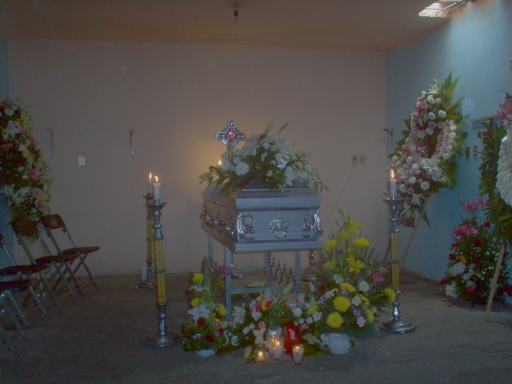
Her coffin arrived in the late afternoon and set up in the area adjoining the kitchen.  Large pillar candles were placed one at each corner and remained lit during the entire viewing. As the viewing was extended an extra day, we had to buy another set of candles.  Mourners brought more candles and flowers.
Squash was cut open and placed underneath the casket along with a dirt cross and rosary.  The squash was there to suck out the “cancer” from the deceased.  The nearest I was able to understand is that the squash removes the bad humors from the body in preparation for the spiritual awakening and that as the squash shrivels, the body is cleansed.
Every once in awhile, the women passed inside to rezar (pray with rosary beads) and I was included in this as a daughter-in-law of the deceased.   Being not only foreign but non-Catholic, I was not expected to lead the prayers and I just stood respectfully in silence.  However, the inclusion was a first and demonstrated an acceptance from the ladies of the family that was not extended to M’s American wife, who stayed outside with the men.
The casket was open but my mother-in-law was kept under glass, or rather plexiglass.  Her 88-year-old parents, Mama Vira and Papa Rique, came from Cerano, as did my father-in-law’s mother, Mama Sofia and her husband Tío Felipe.  Everyone was concerned that the viewing and wake might be too much for them at their advanced ages, but instead, it was her niece, daughter of her sister Lucia, that had difficulties.  Later that night, she was rushed to the hospital after having miscarried.  Doctors said that the fetus was malformed and the body took care of it on its own, however, the everyone nodded and said it was only natural that my mother-in-law’s spirit did not want to go alone and so took one of the family to accompany her.  Pregnant women are discouraged from attending for this reason.
In the evening, mourners arrived to accompany the family in their grief.  Some brought flowers, some tequila, some sugar and coffee or bread, as it is custom for the family to host the mourners, providing a beverage and light repast.
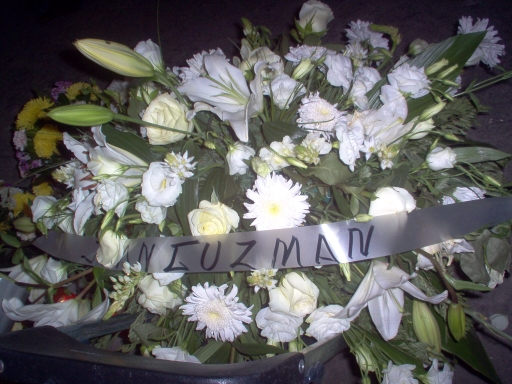
Mourners the first night included representatives of the various political parties, PAN, PRI/Verde, PRD, with their candidates very visibly and ostentatiously positioned.
Flowers sent from the PRD candidate, later elected President of Moroleon

Flowers sent from the PRD candidate, later elected President of Moroleon

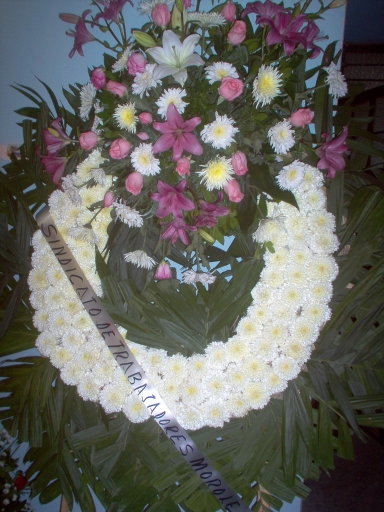
(See Politicking) My mother-in-law was PAN and although she wasn’t able to participate in this year’s elections, she was well known for past services and honored with a corona (wreath) from the party members.
flores de pan
Super Prez also came to the viewing with secretary R and his brother and the community’s lawyer R2.  Super Prez sent another corona (wreath) from the colonos de La Yacata.
flores de la yacata
My mother-in-law’s co-workers at the Presidency sent a third corona (wreath).
flores de sus companeros de trabajo
Not to be outdone, her son B bought a corona (wreath) twice as big as any of the others and at the crypt positioned it to eclipse the other wreaths, although as the heaviest it unbalanced and broke the stakes of the other wreaths.  I guess that proves that he loved her best.
flores de su familia
Mourners stayed until the early morning hours.  Family members took turns serving coffee and sweetbread to the women and tequila to the men.  Every two hours or so, there was another session of prayer.  In the early morning hours, there was singing.
****************************
disclosure

10 Comments

Filed under Death and all its trappings, Religion