Category Archives: Death and all its trappings

Surviving a toXic cloud in La Yacata

Accidents happen. It’s part of life. Human error, mechanical malfunction, shoddy safety practices, deliberate terrorism, even natural disaster all could cause a life-threatening toxic cloud in your area.

Mexico has quite a history of such toxic cloud disasters. The thing is, it’s often hard to measure the real magnitude of the disaster with all the government cover-up that goes on. Here are a few examples.

In April of 2016, The Pemex facility in Coatzacoalcos had an explosion which reportedly killed 13 people and injured another 100. The explosion caused a massive fire (it is an oil refinery after all) which created a toxic cloud containing chloroethane among other toxic gasses.

Schools were suspended in six municipalities surrounding the toxic cloud site. Residents were told to stay inside their houses, although Mexican authorities insisted that the cloud posed no risk to the population. Pemex supported this statement and further assured the media that the explosion would not impact the plant’s oil exportation production. Whew! I’m sure everyone was worried about that!

This is not the first major accident for the Mexican company. In January of 2013, Pemex’s headquarters in Mexico City was hit by a massive gas explosion that killed 37 people.

In October of 2012, 30 people were killed and 42 wounded at another Pemex oil refinery in Reynosa, Tamaulipas. The smoke from the toxic cloud that resulted was visible up to 10 miles away.

In Poza Rica, Veracruz in November of 1950, the Pemex oil refinery “accidentally” released hydrogen sulfide into the air. Over 20 people were killed while they slept and 320 were treated for exposure. The toxic cloud killed 50% of the animals that were exposed to its gasses.

Another incident on Poza Rica occurred in May of 2002. A series of explosions occurred at the refinery, killing one, burning two and injuring 7 in the toxic cloud that resulted.

In May of 1991, there was an explosion and subsequent fire at the national pesticide plant ANAVERSA in Cordoba, Veracruz which created a toxic cloud made up of Xylene. The vapors killed 5 people and caused dozens to be treated for inhalation of the chemical compound that affects the central nervous system.

In Nanchital, Veracruz in April of 2005, workers attempting to repair a pipeline, mistakenly cut an ammonia pipe releasing a toxic cloud into the neighborhood. Six workers were killed, 297 others were treated for exposure and more than 1,500 were evacuated.

Pemex has numerous received accolades for its safety standards year after year, however, the death toll is in the thousands. Those listed above are only a small segment of industrial air contamination caused by the national oil company.

In 2005 alone, 516.9 thousand tons of SOx emissions were released into the atmosphere by Pemex facilities.  SOx emissions are the major precursor of acid rain.

At times a toxic cloud results from deliberate actions. An explosion on a drilling platform off the coast of Louisiana in 2010 caused a massive oil spill which was then set on fire in an attempt to keep the spill from spreading. The fire in the Gulf of Mexico created an enormous toxic cloud, which of course, the U.S. government felt would be the lesser of two evils and cause less damage than allowing the oil spill to reach land.

Then there was that naled aerial spraying in North Carolina in August of 2016. Not only were millions of bees and other beneficial insects killed, but naled is a compound toxic to humans as well, causing damaged to the nervous system, birth defects, paralysis, and death.

Smog is yet another form of toxicity found in the air.  Smog is highly toxic to humans and has been proven to cause sickness and death among those that breath it in.  Mexico City is the most smog-plagued city in Latin America

Although the Mexican government is quick to point out that Mexico City’s air quality is better than much of China and India.

So what do you do in the event of a toxic cloud in your area? Well, a biohazard suit would come in handy. However, in the event that your suit is at the cleaner’s, any cloth used to cover your mouth and nose that minimizes the amount of toxic fumes you inhale would help as you move away from the source as quickly as possible. A biohazard mask would be good to have in this case.

Another tip that might work in some areas is to go into an airtight building. I have to say though that most buildings in Mexico are far from airtight so this might not be as helpful as it would be in more modern areas.

Remove any clothing that might have been exposed to the toxic cloud and dispose of it. Then shower to remove any residue left on your skin. Unfortunately, some chemicals react negatively to water so this might cause even more problems.

Several prepper sites recommended listening for official announcements by someone in authority for instructions on evacuation. I’m going to say that again that government cover-up might preclude this as being a valid life-saving option.

La Yacata would be an excellent place to be to survive a toxic cloud catastrophe as it is far from any Pemex refineries, there are no pipes going through the area, ammonia or otherwise, and since our 95-year-old pesticide spraying neighbor no longer plants any crops, the air in and around us is totally breathable, unless you are downwind of the pig farmer that is. (See Hate thy neighbor). The area is still sparsely populated so government agencies are not spraying toxic chemicals to eliminate Zika carrying mosquitos either. They don’t really care if we get Zika or not, which is just as well I think.  Don’t you?

***************************************

4 Comments

Filed under Carnival posts, Death and all its trappings, Health, Safety and Security

Surviving a Windstorm in La Yacata

A windstorm can have winds more than 55 km (34 mi) per hour in short bursts or longer periods of sustained winds and can cause death, destruction, and general mayhem.

In 2015, Mexico was hit by Hurricane Patricia. This storm had sustained winds of 215 mph (345 km/h), breaking the record for the highest ever one-minute maximum sustained winds. When the hurricane made landfall near Cuixmala, Jalisco, the windstorm still registered up to 150 mph (240 km/h) making it the strongest landfall hurricane along the Pacific coast of Mexico.

The village of Chamela was completely flattened in the storm. In the town of Emiliano Zapata, winds tore roofs from homes and businesses, stripped the hillside of vegetation, toppled concrete power poles and crumpled transmission towers. Hundreds of homes were destroyed and 7 deaths occurred as a direct result of the intense winds. The total damage has been estimated to be more than 5.4 billion pesos ($323.3 million U.S. dollars). More than 59,000 acres of crops were damaged or destroyed in Jalisco alone. In Colima, the banana crop loss was estimated at 500 million pesos ($30.2 million U.S. dollars). Because of the extreme intensity of the storm, the name Patricia was retired from the hurricane list by the World Meteorological Organization.

In Mexico, one of the primary causes of injury or death as a result of a windstorm is falling billboards.

Here’s just a partial list:

In Metepc on March 10, 2016

In Fray Servando Teresa de Mier on June 26, 2016

In Mexico City on July 22, 2016

In Puebla on August 29, 2016

In Culiacán, Sinaloa on March 8, 2016

In Mexico City on April 18, 2016

In Mexico City on August 30, 2016

In Periférico Norte on March 12, 2015

On the Mexico-Queretaro Highway on March 10, 2010

In Tlalnepantla on Apr 24, 2013

So I would say that surviving a windstorm in Mexico would require that you stay as far away from a billboard as possible. Fortunately, there are no billboards in La Yacata.

Make sure to secure your tinaco!

Make sure to secure your tinaco too!

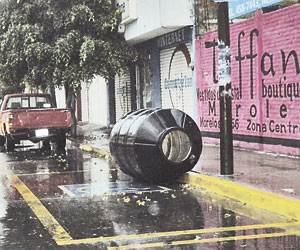
Other things that you might want to do as prevention including removing dead trees and overhanging branches, loose roofing materials, tie down outside furniture and garbage cans. In Mexico, it might be securing your tinaco (water storage container) as well or risk it flying off as happened in our neighboring town of Uriangato.

Park your vehicles inside if possible. If not, move them a safe distance away from objects (like billboards) that might fall on them. Stay inside, away from windows, doors, and billboards. Make sure pets and livestock are in a sheltered area, far from billboards.

Following these simple precautions will help you best survive a windstorm in La Yacata.

*******************************************************

1 Comment

Filed under Battling Nature, Carnival posts, Death and all its trappings, Safety and Security

Papa Rique

Descansen en paz Mama Vira y Papa Rique

Descansen en paz Mama Vira y Papa Rique

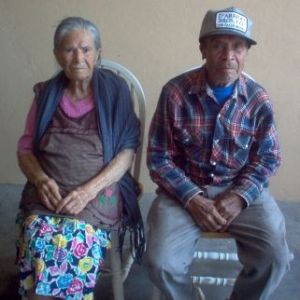
Thursday morning, December 15, 2016, the patriarch of the Gonzalez-Trejo family, Papa Rique died. He had been feeling poorly for the last week or so. He wasn’t able to get out of bed and had fits of trembling. Not getting out of bed really aggravated Papa Rique. He was used to wandering around town for hours every day.

In fact, the last time we saw him was on November 2 during one of his wanders. We were heading to the panteon (cemetery) to visit with Mama Vira on the Day of the Dead and there he was, heading out of the cemetery. We tried to convince him to go on back in with us, but he was having none of it. He was irritated at the women folk and was going home. So we said our goodbyes and watched as he headed up the road, turtle slow, nearly getting clipped twice in less than 15 minutes by passing trucks.

So, being bedridden was absolutely unacceptable to him. He said he was feeling bad enough to head to the hospital. That’s saying something! The nearest hospital is in Uriangato, more than an hour’s drive away. So he sent word for his grandson to take him in his truck. This being a first for a hospital request, the grandson came on the run, leaving his bread deliveries left undone.

Here’s where the story gets a bit confusing. Although he went to the hospital, he died at home a few hours later. I don’t quite understand why he wasn’t admitted to the hospital. Maybe the doctors decided at his age, 90, there wasn’t much they could do for him and sent him home. From what I gathered, he had another trembling fit at home with two of his daughters present. The daughters held onto him until the trembling passed and sat him in a chair. Then both of them left the room. A little later, a granddaughter came into the room and found him dead. Someone was sent for the local doctor who declared Papa Rique had died from a heart attack.


In Cerano, the dearly departed are stacked, lego style in cement boxes. In the plot where Papa Rique was to be buried, the bottom tier was inhabited by a granddaughter who died from complications associated with drug use in 2012. The second tier housed Mama Vira who died in 2014. So now the third tier needed to be built. My husband volunteered to help with the crypt building.

Papa Rique had the rebar and some sand just lying around his house and we had brought some more sand that had been leftover from B’s house construction. However, the cement, mortar, and cal needed to be bought. So we did. My husband spent $500 pesos from the sale of a goat and I ended up spending about the same amount, but the materials were bought and the building of the boveda (crypt) commenced.

cam05103

The neighbor, a cousin and two other guys were there as well. There was quite a bit of discussion at the beginning, but after a bit, each maestro (head bricklayer) had a section to complete.

cam05104

You can see the quality of the workmanship differed. My husband’s work is on the right. The other guy’s work is on the left.

As the day had started to heat up, my son and I went to the store to pick up some drinks. I wasn’t sure if I was allowed in since the store resembled a cantina (bar) more than anything, so I sent my son in. He came back with some cokes for the guys and a bottle of water for me. BUT when we got back to the gravesite, half the crew was gone. Supposedly, they had gone for more material. Several phone calls and an hour later they returned, with you guessed it, caguama (liter-sized beer bottles).

I needed to get back to teach classes, so we left about 2 pm. My husband told the neighbor that if he needed more help, to call. Sure enough, he called. The crew had been lost to a drunken haze and it had started to rain and he wasn’t going to get the top on. So my husband went back to Cerano to work another 2 hours. They finished the actual building, but not the enjari (cement spread over the bricks as a sealant).

The mass was planned for 4 pm the next day, however, there were no slots available at that time what with Las Posadas and all. So, the service and burial were moved up to 10 am. Of course, the tomb wasn’t finished yet. So we headed to Cerano in the morning and arrived just as the funeral station wagon pulled up to collect Papa Rique.

Building material and the flower arrangements were loaded into the back of our truck. My son and I joined the procession of walkers. I had forgotten an umbrella for shade yet again. I’m really not prepared for Mexican funerals. My husband followed behind with the supplies.

It wasn’t far to the church. The service lasted about 30 minutes. Various family members took turns standing with the casket. Papa Rique was praised for his Catholicness and for raising his family in the church. Otherwise, it seemed to be a pretty standard funeral mass.

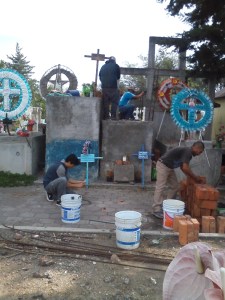
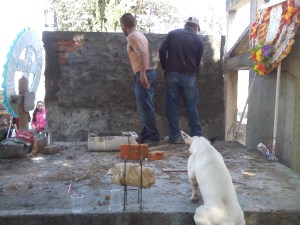
Then the procession headed to the cemetery. There we found my husband and his cousin, who although not 3 was certainly at least 2 sheets to the wind, working like madmen trying to get the walls of the crypt covered. As the cement was already mixed, they had to keep working, even with the open casket present.

As you can see, the cousin took his shirt off since he was slopping cement EVERYWHERE! That's the cousin's dog climbing the crypts.

As you can see, the cousin took his shirt off since he was slopping cement EVERYWHERE! That’s the cousin’s dog climbing the crypts.

Soon, the family had enough viewing and lifted the casket into the third tier. My husband sealed the opening. The brother of the cousin took over the work saying that the job would take 20 minutes no more, but with cousin #1 working, he’d be at it all day. Before too long, it was finished.

One of Papa Rique’s daughters asked if my husband would place a Christ image on the front of the tomb, which he did. The flowers were arranged to everyone’s satisfaction. And then there was nothing to do. So we went back to our daily lives, one person less.

cam05107

**********************

disclosure

3 Comments

Filed under Death and all its trappings